
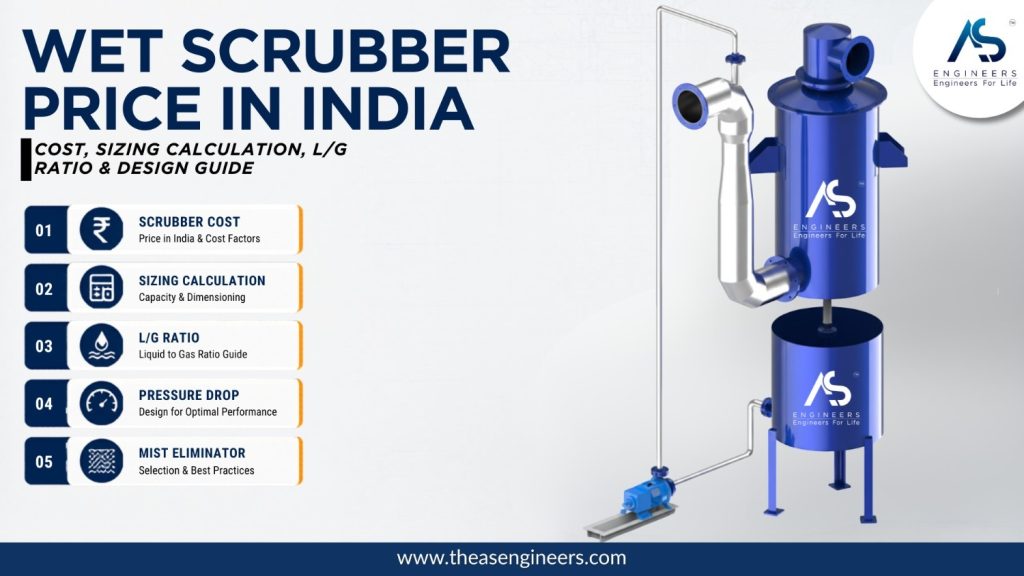
Wet Scrubber Price in India: Industrial Scrubber Cost, Sizing Calculation, L/G Ratio, Pressure Drop and Mist Eliminator Selection

Wet scrubber price in India is not fixed by CFM alone. For an industrial scrubber, the cost depends on gas flow, pollutant type, inlet concentration, required outlet limit, material of construction, packed bed size, liquid-to-gas ratio, pressure drop, ID fan, pump, dosing system, mist eliminator, ducting, stack and installation scope.
A low-cost scrubber quotation can become expensive later if it ignores pressure drop, mist carryover, corrosion, fouling, pH control or actual site duct resistance.
At AS Engineers, we treat scrubber selection as a complete pollution-control airflow problem, not only a vessel price problem. A wet scrubber, ID fan, pump, packing, mist eliminator and duct layout must work together.
For a basic working-principle background, first read our guide on scrubber working principle. For application selection, see our article on wet scrubbers for industrial air pollution control.
What decides wet scrubber price in India?
Industrial scrubber price changes mainly because every plant has a different gas stream. A scrubber for an ETP odour vent is not priced like a scrubber for acid fumes, chlorine, SO₂, ammonia, HCl vapour, boiler flue gas or particulate-laden exhaust.
| Price factor | Why it changes scrubber cost |
|---|---|
| Gas flow rate | Higher m³/hr requires larger tower diameter, larger packing volume, larger fan and stronger structure. |
| Pollutant type | HCl, NH₃, H₂S, SO₂, Cl₂, acid mist and mixed fumes need different scrubbing liquid chemistry. |
| Inlet concentration | Higher loading may need higher L/G ratio, more packing height, more chemical dosing and more bleed-off handling. |
| Required outlet limit | Stricter outlet emission requirement increases design margin, contact area and monitoring need. |
| Temperature and humidity | High-temperature gas may need quenching, special MOC or larger evaporation allowance. |
| Dust load | Dust can choke packing, block nozzles and foul mist eliminators, so cyclone or bag filter pre-separation may be needed. |
| Material of construction | PP, FRP, MSRL, SS304 and SS316 have very different cost and corrosion suitability. |
| Packing type and height | Random packing, structured packing and bed depth affect mass transfer, pressure drop and cost. |
| Pressure drop | Higher pressure drop increases ID fan size, motor HP and power cost. |
| Mist eliminator | Vane, mesh pad or special demister selection affects droplet carryover and maintenance. |
| Automation | pH control, dosing pump, level control, conductivity, pressure transmitter and PLC panel add cost but improve control. |
| Scope of supply | Vessel-only price is very different from complete system price with fan, pump, ducting, stack, instruments and erection. |
Why public scrubber prices are often misleading
Many buyers search “industrial scrubber price” and compare only the first visible number. That is risky.
A quotation may include only the scrubber body. Another quotation may include the packed bed, spray system, recirculation tank, pump, chemical dosing, mist eliminator, ID fan, motor, control panel, ducting, chimney and site installation. Both may be called “wet scrubber”, but they are not the same scope.
When comparing wet scrubber price in India, ask these questions before selecting the lowest quote:
| Question | Why it matters |
|---|---|
| Is the quoted price for vessel only or complete system? | Vessel-only price excludes many cost-heavy parts. |
| Is ID fan included? | Scrubber pressure drop directly affects fan and motor selection. |
| Is recirculation pump included? | Pump flow and head decide actual liquid distribution. |
| Is chemical dosing included? | Acid gas or odour control usually needs controlled pH/reagent dosing. |
| Is mist eliminator included? | Without proper demisting, droplet carryover can damage downstream stack and create visible plume. |
| Is MOC specified clearly? | PP, FRP, MSRL, SS304 and SS316 are not interchangeable. |
| Is ducting and stack included? | Duct resistance affects fan selection and total project cost. |
| Are instruments included? | Pressure drop, pH, level and flow monitoring improve operational reliability. |
| Is installation included? | Erection, supports, access platform and alignment change the final project budget. |
A practical purchase decision should compare complete duty scope, not only the scrubber vessel price.
Wet scrubber sizing calculation: the basic workflow
Wet scrubber sizing calculation starts with the gas stream, not the vessel diameter.
For a preliminary estimate, the sizing sequence is:
- Confirm gas flow rate at actual operating condition.
- Convert Nm³/hr to actual m³/hr if required.
- Identify pollutant type and inlet concentration.
- Define required outlet concentration or removal efficiency.
- Select scrubber type: packed bed, spray tower, tray tower, venturi or multi-stage.
- Select scrubbing liquid and reagent chemistry.
- Estimate tower diameter from gas flow and allowable velocity.
- Estimate packing height from mass transfer duty.
- Estimate liquid circulation rate from L/G ratio and absorption need.
- Calculate pressure drop across packing, internals, mist eliminator, ducting and stack.
- Select ID fan and motor for total static pressure.
- Select mist eliminator for droplet carryover, fouling risk and cleanability.
- Verify MOC against gas, liquid, temperature and corrosion condition.
The U.S. EPA notes that wet scrubber performance depends on parameters such as particle loading, gas flow rate, gas temperature, humidity, gas velocity, pressure drop, L/G ratio, droplet size and residence time. It also states that waste gas flow rate is the most important sizing parameter for a wet scrubber.
For Indian plants, the final design should also be checked against CPCB, SPCB and consent-condition requirements for the specific industry and location.
Packed bed scrubber design calculation: key equations
These equations are useful for preliminary understanding. They should not be treated as final design calculations without engineering review.
Actual gas flow
If gas flow is given in Nm³/hr, convert it to actual flow before tower sizing.
Formula:
Q actual = Q normal × (T actual in K / 273.15) × (101.325 / P actual in kPa)
Where:
| Symbol | Meaning |
|---|---|
| Q actual | Actual gas flow at scrubber inlet condition |
| Q normal | Normal gas flow at standard condition |
| T actual | Gas temperature in Kelvin |
| P actual | Gas pressure in kPa |
This step matters because hot gas occupies more volume. If you size the scrubber only on Nm³/hr without correcting the actual inlet condition, the scrubber may be undersized.
Tower cross-sectional area
Formula:
A = Q / (3600 × V)
Where:
| Symbol | Meaning |
|---|---|
| A | Tower cross-sectional area in m² |
| Q | Actual gas flow in m³/hr |
| V | Selected superficial gas velocity in m/s |
| 3600 | Conversion from hour to second |
Tower diameter
For a circular vertical packed bed scrubber:
Formula:
D = √(4A / π)
Where:
| Symbol | Meaning |
|---|---|
| D | Internal tower diameter in m |
| A | Cross-sectional area in m² |
| π | 3.1416 |
Liquid circulation rate from L/G ratio
Formula:
Liquid flow in m³/hr = Gas flow in m³/hr × L/G in L/m³ ÷ 1000
Where:
| Symbol | Meaning |
|---|---|
| L/G | Liquid-to-gas ratio |
| Liquid flow | Recirculation flow required through spray system |
| Gas flow | Actual gas flow through scrubber |
The actual L/G ratio depends on pollutant solubility, chemical reaction, inlet concentration, target removal efficiency, gas temperature, packing type and fouling risk.
Example: preliminary wet scrubber sizing calculation
This is only a simplified budgeting example.
Assumed duty:
Gas flow = 10,000 m³/hr
Preliminary tower velocity = 1.5 m/s
Preliminary L/G ratio = 5 L/m³
Packed bed height = 2 m
Step 1: Tower area
A = 10,000 / (3600 × 1.5)
A = 1.85 m²
Step 2: Tower diameter
D = √(4 × 1.85 / 3.1416)
D = 1.54 m
A practical preliminary tower internal diameter may be rounded upward, subject to packing, flooding, maintenance and fabrication checks.
Step 3: Liquid circulation flow
Liquid flow = 10,000 × 5 ÷ 1000
Liquid flow = 50 m³/hr
Step 4: Pressure drop estimate
Pressure drop must include:
| Component | Pressure drop source |
|---|---|
| Inlet duct and hood | Friction and entry loss |
| Scrubber inlet transition | Velocity and direction change |
| Packing bed | Gas-liquid resistance through packed section |
| Liquid distributor | Spray/nozzle restriction and flow interference |
| Mist eliminator | Droplet removal resistance |
| Outlet duct and stack | Duct friction and discharge loss |
| Damper or bends | Additional local losses |
| Fouling allowance | Future choking, scaling or dust deposition |
Never select the ID fan only from scrubber vessel pressure drop. The fan must handle total system resistance.
For a deeper fan-side view, read our guide on custom centrifugal blowers for pollution control systems.
Scrubber liquid-to-gas ratio: what L/G ratio really means
The liquid-to-gas ratio tells how much scrubbing liquid is circulated for a given gas flow. It affects absorption, particulate capture, pump size, recirculation tank volume, chemical consumption, wastewater bleed and operating cost.
A higher L/G ratio is not automatically better. It may improve contact, but it can also increase pump power, liquid carryover, mist load, blowdown volume and ETP load.
| Low L/G risk | High L/G risk |
|---|---|
| Poor pollutant absorption | Larger pump and higher power |
| Dry or partially wetted packing | More droplet carryover |
| Lower removal efficiency | Higher mist eliminator load |
| Hot spots or poor contact | More blowdown and chemical use |
| Scaling due to concentration build-up | Larger recirculation tank requirement |
When I review a scrubber requirement, I do not finalize L/G ratio from a thumb rule alone. I first check pollutant identity, gas temperature, inlet concentration, target outlet limit, pH control need, packing wetting requirement and expected solids build-up.
Scrubber pressure drop calculation
Scrubber pressure drop calculation is important because it decides ID fan static pressure, motor HP, operating power and system stability.
Basic formula:
Total ΔP = ΔP hood + ΔP duct + ΔP scrubber inlet + ΔP packing + ΔP mist eliminator + ΔP outlet duct + ΔP stack + ΔP damper + fouling allowance
| Pressure drop item | What to check |
|---|---|
| Hood or suction point | Capture velocity and entry loss |
| Ducting | Length, bends, elbows, branch ducts, leakage and velocity |
| Scrubber body | Inlet transition, tower velocity and internal turbulence |
| Packing | Packing type, bed height, liquid flow and fouling tendency |
| Mist eliminator | Droplet loading, washing arrangement and clogging risk |
| Stack | Height, diameter, discharge velocity and outlet loss |
| Damper | Control position and pressure loss |
| Fouling allowance | Dust, salt, scaling, crystallisation and solids carryover |
A low-pressure-drop design may save fan power, but if it gives poor gas-liquid contact, it may fail the emission duty. A high-pressure-drop design may improve capture in some applications, but it increases energy cost and fan size. The correct answer depends on the pollutant and removal target.
Packed bed scrubber pressure drop: why flooding check matters
In a packed bed scrubber, gas flows upward while scrubbing liquid flows downward. If gas velocity becomes too high, the upward gas force restricts liquid flow through the packing. Liquid starts accumulating inside the bed, pressure drop rises sharply and the tower approaches flooding.
This creates operational problems:
| Flooding or near-flooding symptom | Plant-side effect |
|---|---|
| Sudden high pressure drop | ID fan overload or reduced airflow |
| Poor liquid distribution | Lower removal efficiency |
| Liquid carryover | Wet stack, corrosion or visible plume |
| Packing movement | Internal damage or uneven bed |
| Nozzle choking | Dry zones inside packing |
| Recirculation instability | pH and concentration variation |
For final design, the selected velocity should be checked against packing data, flooding curve, liquid loading and fouling risk.
Mist eliminator selection for wet scrubbers
The mist eliminator removes entrained liquid droplets before cleaned gas leaves the scrubber. If the mist eliminator is undersized or wrong for the duty, the stack may discharge droplets, chemical mist or wet plume.
| Mist eliminator type | Best fit | Caution |
|---|---|---|
| Chevron / vane type | General industrial scrubbers, higher liquid load, easier cleaning | May not capture very fine mist as efficiently as specialized media |
| Mesh pad demister | Cleaner gas streams, finer droplet capture | Can choke faster in dusty, salty or scaling service |
| Fiber bed mist eliminator | Fine acid mist or submicron mist applications | Needs careful design review and maintenance planning |
| Washable removable demister | Dusty, scaling or crystallising service | Needs access door, wash nozzle and maintenance clearance |
Selection depends on droplet size, gas velocity, liquid loading, chemistry, dust load, scaling tendency, maintenance access and acceptable carryover.
A good scrubber design should provide enough access for inspection and cleaning. In dusty or salt-forming applications, mist eliminator wash arrangement should be planned at the design stage, not added later after carryover problems start.
Wet scrubber MOC selection
Material of construction can change industrial scrubber price significantly. But MOC should never be selected only by budget.
| MOC | Typical use case | Selection caution |
|---|---|---|
| PP | Acid/alkali fumes at moderate temperature | Temperature and structural limits must be checked |
| FRP | Larger scrubbers, corrosive fumes, outdoor service | Resin selection must match chemical and temperature |
| MSRL | Corrosive duty with lined mild steel structure | Lining quality and damage protection are critical |
| SS304 | Moderate corrosion, food/pharma-adjacent utility duty | Not suitable for every chloride or acid condition |
| SS316 / SS316L | Higher corrosion resistance requirement | Higher price, still needs chemistry verification |
| Special alloys | Severe corrosive or high-temperature service | Use only after detailed process review |
Wrong MOC can lead to corrosion, leakage, shutdown and replacement cost. The cheapest scrubber body is not cheaper if it fails early.
Wet scrubber vs bag filter vs cyclone: price and selection logic
A wet scrubber is not always the first answer. If the pollutant is mostly dry dust, a bag filter or cyclone may be better. If the pollutant is soluble gas, acid vapour or odour, a wet scrubber is usually more relevant.
| Equipment | Best for | Not ideal for |
|---|---|---|
| Cyclone separator | Coarse dust pre-separation, high dust load, rugged duty | Fine particulate and gas-phase pollutants |
| Bag filter | Dry particulate control and dust collection | Soluble gases, acid vapours and wet sticky fumes |
| Wet scrubber | Soluble gases, acid mist, odour, some particulate with liquid contact | Dry product recovery where wet slurry is not acceptable |
| Venturi scrubber | Fine particulate with high-energy contact | High operating power and wet slurry handling |
| Packed bed scrubber | Gas absorption and odour/acid fume control | Heavy dust without pre-cleaning |
If your gas stream contains both dust and soluble gas, a cyclone or bag filter may be placed upstream to protect the scrubber packing. For cyclone-side design logic, see our guide on cyclone separator design. For dry dust collection, see our article on bag filter types.
Industrial scrubber price: scope checklist before asking for quotation
Share complete data with the manufacturer. It saves time and prevents under-quotation.
| RFQ input | What to provide |
|---|---|
| Application | ETP odour, acid fume, reactor vent, boiler flue gas, pickling tank, chemical process exhaust, dryer exhaust |
| Gas flow | Nm³/hr and actual m³/hr if available |
| Gas temperature | Normal and maximum temperature |
| Humidity | Dry, saturated or high-moisture gas |
| Pollutant | HCl, NH₃, H₂S, SO₂, Cl₂, acid mist, VOC mixture, dust, fumes |
| Inlet concentration | ppm, mg/Nm³ or lab/source data |
| Required outlet | Consent limit, stack limit or target removal efficiency |
| Dust load | Particle type, particle size, loading and stickiness |
| Scrubbing liquid | Water, caustic, acid, hypochlorite, lime slurry or other reagent |
| pH control | Manual or automatic dosing requirement |
| MOC preference | PP, FRP, MSRL, SS304, SS316 or special material |
| Space available | Height, width, access and foundation details |
| Electrical supply | Motor voltage, phase, frequency and control preference |
| Fan scope | Existing fan or new ID fan required |
| Ducting scope | Existing ducting or new ducting required |
| Stack | Existing stack or new chimney required |
| Automation | pH, level, flow, pressure drop, conductivity, PLC or local panel |
| Site location | Indoor/outdoor, corrosive area, hazardous zone if applicable |
| Documentation | GA drawing, QAP, test certificate, manual, compliance documentation |
Common wet scrubber buying mistakes
| Mistake | Result |
|---|---|
| Buying only by CFM | Wrong tower size because temperature, pressure and pollutant loading are ignored |
| Comparing vessel-only price with complete system price | False price comparison |
| Ignoring pressure drop | ID fan underperformance or high power use |
| Wrong MOC selection | Corrosion, leakage and shutdown |
| No dust pre-separation | Packing choking and high maintenance |
| No mist eliminator access | Carryover and difficult cleaning |
| No pH control plan | Poor absorption and chemical wastage |
| No blowdown plan | Salt build-up, scaling and ETP overload |
| No instrument ports | Difficult troubleshooting after installation |
| No maintenance clearance | Packing and demister cleaning becomes difficult |
How AS Engineers approaches scrubber enquiries
AS Engineers works in pollution control equipment such as scrubbers, cyclones and bag filters, along with centrifugal blowers and industrial fans. That combination matters because a scrubber does not work alone. The ID fan must match the scrubber pressure drop, duct resistance, gas temperature, dust load and operating duty.
When we review a scrubber enquiry, we normally look at:
- gas flow and actual operating condition
- pollutant and concentration
- removal target or consent requirement
- scrubbing liquid chemistry
- L/G ratio and liquid circulation
- packed bed diameter and height
- mist eliminator selection
- pressure drop and ID fan duty
- MOC and corrosion risk
- ducting, stack and site layout
- operation, cleaning and maintenance access
For airflow-side equipment, you can also review our page on industrial blowers manufacturer in India.
FAQs
What is the wet scrubber price in India?
Wet scrubber price in India depends on gas flow, pollutant type, required outlet limit, MOC, packed bed size, pressure drop, fan, pump, mist eliminator, chemical dosing, instruments, ducting and installation scope. A reliable price needs a duty-based quotation, not only CFM.
How do you calculate wet scrubber size?
Wet scrubber sizing starts with actual gas flow, gas temperature, pollutant concentration and required removal efficiency. A preliminary tower diameter can be estimated using A = Q / (3600 × V), then D = √(4A / π). Final sizing needs packing, L/G ratio, pressure drop and flooding checks.
What is L/G ratio in a wet scrubber?
L/G ratio is the liquid-to-gas ratio. It shows how much scrubbing liquid is circulated for a given gas flow. It affects absorption, pump size, chemical consumption, mist loading, blowdown and operating cost.
How is scrubber pressure drop calculated?
Scrubber pressure drop is calculated by adding the losses from hood, ducting, scrubber inlet, packing bed, mist eliminator, outlet duct, stack, dampers and fouling allowance. The ID fan must be selected for total system pressure drop, not only scrubber vessel loss.
How do I select a mist eliminator for a wet scrubber?
Mist eliminator selection depends on droplet size, gas velocity, liquid loading, dust load, scaling tendency, chemical corrosion, cleaning access and acceptable carryover. Chevron types are common for industrial scrubbers, while mesh pads or special mist eliminators may be used for cleaner or finer mist duties.
Conclusion
Wet scrubber price in India should be evaluated as a complete engineered system, not as a simple equipment price. The correct industrial scrubber price depends on sizing, pollutant chemistry, L/G ratio, pressure drop, MOC, mist eliminator, ID fan, pump, dosing, ducting, stack and installation scope.
If you are planning a packed bed scrubber, odour control scrubber, acid fume scrubber, chemical scrubber or industrial air pollution control system, share your gas flow, pollutant, inlet concentration, outlet requirement, temperature, dust load, site layout and preferred MOC with AS Engineers. This allows the team to review the real duty and suggest a practical scrubber configuration.
