
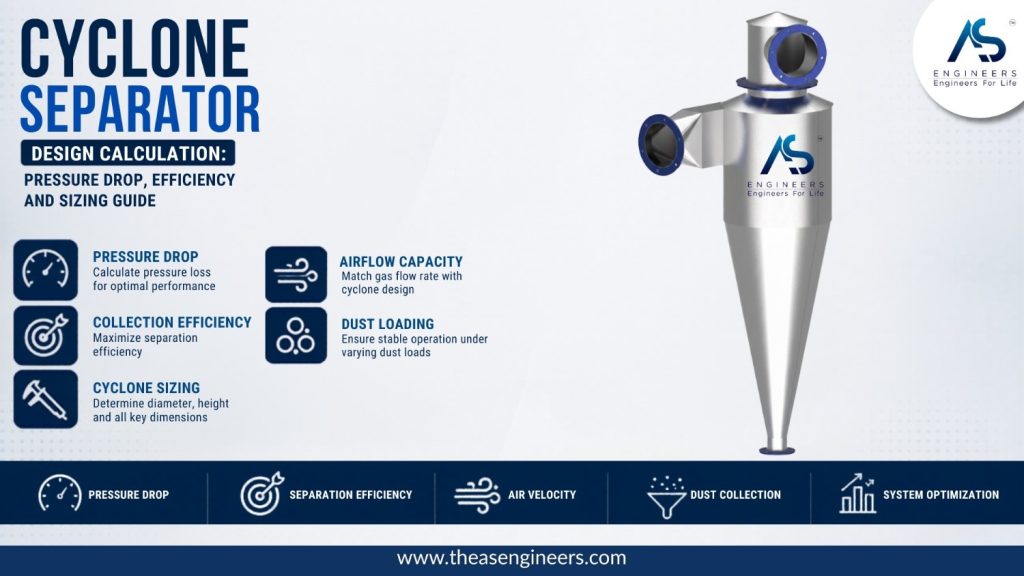
Cyclone Separator Design Calculation: Pressure Drop, Efficiency and Sizing Guide

Cyclone separator design calculation is used to estimate cyclone size, inlet velocity, pressure drop, cut size, and dust collection efficiency before final manufacturing. A cyclone is not selected only by diameter. It must be matched with gas flow rate, particle size, dust loading, gas temperature, gas density, allowable pressure drop, discharge arrangement, and the downstream pollution-control system.
For a general selection overview, first read our guide on cyclone separator design. This article focuses specifically on cyclone separator calculation methods.
Quick answer: what calculations are needed for cyclone separator design?
For most industrial cyclone separator sizing, the engineer checks five calculation areas:
| Calculation area | What it decides | Why it matters |
|---|---|---|
| Gas flow conversion | Actual operating flow rate | Wrong flow basis gives wrong cyclone size |
| Inlet area and cyclone diameter | Main body size | Affects velocity, pressure drop, and separation |
| Pressure drop | Fan/blower load | High pressure drop increases power demand |
| Cut size, d50 | Approximate particle size captured at 50% efficiency | Helps judge separation behavior |
| Fractional and overall efficiency | Expected dust removal by particle size | Avoids relying on one broad efficiency number |
A cyclone calculation is a screening and design-development tool. Final cyclone selection should still be reviewed against real dust behavior, wear, temperature, moisture, discharge reliability, and site layout.
Important design boundary
Cyclone separator formulas are empirical. They are useful for estimating performance, but they do not replace application review, test data, CFD where needed, or supplier engineering. The U.S. EPA notes that cyclones use centrifugal and inertial forces and are commonly used for particles above about 10 micrometers, often as pre-cleaners before downstream equipment. High-efficiency cyclones can collect smaller particles, but with higher pressure drop and energy cost.
In practical plant work, I do not treat a cyclone as an isolated item. I check the ducting, ID fan or blower, dust discharge, hopper, rotary airlock, downstream bag filter or scrubber, and maintenance access together.
Inputs required before cyclone separator calculation
Before starting the calculation, collect these inputs from the plant or process team.
| Input | Unit | Why it is required |
|---|---|---|
| Gas flow rate at operating condition | m³/hr or m³/s | Used for cyclone sizing |
| Gas temperature | °C | Affects gas density and viscosity |
| Operating pressure | bar / Pa | Affects density correction |
| Gas density | kg/m³ | Used in pressure drop and separation calculations |
| Gas viscosity | Pa·s | Used in cut size estimation |
| Dust loading | g/m³ or kg/hr | Affects wear, hopper, and discharge design |
| Particle density | kg/m³ | Heavier particles separate more easily |
| Particle size distribution | µm by mass fraction | Needed for real efficiency calculation |
| Moisture or stickiness | qualitative / % | Sticky dust may choke cyclone or hopper |
| Allowable pressure drop | Pa or mmWC | Needed for fan/blower selection |
| Downstream equipment | bag filter, scrubber, stack | Decides whether cyclone is primary or pre-separator |
| Discharge method | rotary airlock, screw conveyor, bin | Prevents dust re-entrainment and buildup |
AS Engineers works with cyclone separators as part of broader pollution control equipment systems where cyclone, bag filter, scrubber, ducting, and fan selection must be matched to actual duty.
Step-by-step cyclone separator design calculation
Convert operating airflow
Use actual airflow at the cyclone inlet, not only standard flow, unless the design basis is clearly defined.
Formula
Q = actual volumetric flow rate at operating condition
Where:
Q= actual gas flow rate, m³/sQ_std= standard gas flow rate, if givenT= absolute temperature, KP= absolute pressure, Pa
For a simplified ideal-gas correction:
Q_actual = Q_std × (T_actual / T_std) × (P_std / P_actual)
This matters because hot gas occupies more volume. If a cyclone is sized using standard flow while the actual inlet gas is much hotter, the cyclone can become undersized.
Select design inlet velocity
Cyclone inlet velocity controls vortex strength, pressure drop, erosion risk, and separation performance.
A practical first-pass range for many dry dust applications is around 12 to 20 m/s, but this must be checked against dust type, erosiveness, moisture, pressure-drop allowance, and fan capacity. Smaller, high-efficiency cyclones usually improve separation but increase pressure drop. NPTEL notes that smaller cyclones are more efficient than larger cyclones, but they also have higher pressure drop and capacity limitations.
For abrasive dust, avoid blindly pushing velocity too high. Higher velocity may improve separation on paper but can increase erosion at the inlet, barrel, cone, and dust outlet.
Calculate inlet area
Formula
Ai = Q / Vi
Where:
Ai= cyclone inlet area, m²Q= actual gas flow, m³/sVi= selected inlet velocity, m/s
Example:
If Q = 2.5 m³/s and selected Vi = 16 m/s:
Ai = 2.5 / 16 = 0.156 m²
Estimate cyclone diameter from inlet proportions
For a high-efficiency cyclone starting geometry, engineers often use inlet height and width as proportions of cyclone body diameter.
Example starting assumption:
- Inlet height,
a = 0.5D - Inlet width,
b = 0.2D
So:
Ai = a × b = 0.5D × 0.2D = 0.1D²
Therefore:
D = √(Ai / 0.1)
Using the example above:
D = √(0.156 / 0.1) = √1.56 = 1.25 m
So the estimated cyclone body diameter is around 1.25 m for this selected geometry and velocity.
This is only a first-pass diameter. Final dimensions should be reviewed against pressure drop, collection target, material behavior, wear, hopper size, and site layout.
Cyclone separator pressure drop calculation
Pressure drop is one of the most important cyclone design checks because it directly affects ID fan or blower selection. NPTEL explains that cyclone pressure drop is due to entry and exit losses, friction, and kinetic energy losses, with significant losses caused by swirl and energy dissipation inside the body.
A commonly used early-stage method estimates pressure drop from inlet velocity head.
Formula
ΔP = NH × (ρg × Vi² / 2)
Where:
ΔP= cyclone pressure drop, PaNH= number of inlet velocity heads, dimensionlessρg= gas density, kg/m³Vi= inlet velocity, m/s
To convert Pa to mmWC:
mmWC = Pa / 9.80665
Example pressure drop calculation
Assume:
- Gas density,
ρg = 1.2 kg/m³ - Inlet velocity,
Vi = 16 m/s - Velocity head factor,
NH = 6.4
Calculation:
ΔP = 6.4 × (1.2 × 16² / 2)
ΔP = 6.4 × (1.2 × 256 / 2)
ΔP = 6.4 × 153.6
ΔP = 983 Pa
Convert to mmWC:
983 / 9.80665 = 100 mmWC approx.
So the estimated cyclone pressure drop is about 983 Pa, or 100 mmWC, before adding full ducting, entry, exit, dust loading, system losses, and safety margin.
For system design, this pressure drop must be checked with the full fan curve. If the cyclone is installed before a bag filter or scrubber, the combined system resistance must be considered.
What affects cyclone pressure drop?
| Design or process factor | Effect on pressure drop |
|---|---|
| Higher inlet velocity | Increases pressure drop sharply |
| Smaller cyclone diameter | Often increases efficiency but also pressure drop |
| Narrow inlet | Can increase velocity and erosion |
| Long or rough ducting | Adds system loss beyond cyclone body |
| High dust loading | Can increase real operating pressure drop |
| Wet or sticky dust | Can cause buildup and unstable pressure drop |
| Poor outlet design | Can increase turbulence and loss |
| Downstream bag filter or scrubber | Adds separate resistance that fan must handle |
A cyclone with low pressure drop is not automatically better. If pressure drop is too low because velocity is weak, separation may also be weak. The design target is not the lowest pressure drop, but the right balance between separation, energy use, wear life, and stable plant operation.
Cyclone separator efficiency calculation
Cyclone separator efficiency is not one fixed number for all dust particles. A cyclone may capture coarse particles well but allow fine particles to pass. That is why fractional efficiency is more useful than only saying “90% efficient” without particle data.
NPTEL explains that cyclone efficiency calculation uses particle size ranges, mass fractions, and fractional efficiency, and the sum of weighted fractions gives the overall efficiency.
Calculate number of effective turns
A simple Lapple-style estimate uses effective turns of gas inside the cyclone.
Formula
Ne = (Lb + Lc / 2) / a
Where:
Ne= number of effective turnsLb= length of cyclone bodyLc= length of cyclone conea= inlet height
More effective turns generally improve separation because particles get more time under centrifugal action. But making a cyclone taller without checking pressure drop, re-entrainment, and discharge design can create a false design assumption.
Estimate cut size, d50
The cut size, often written as d50, is the particle size collected at approximately 50% efficiency.
A simplified screening formula is:
d50 = √[9 × μ × b / (π × Ne × Vi × (ρp - ρg))]
Where:
d50= approximate cut size, mμ= gas viscosity, Pa·sb= inlet width, mNe= effective turnsVi= inlet velocity, m/sρp= particle density, kg/m³ρg= gas density, kg/m³
The formula shows useful design logic:
| If this increases | Typical effect on d50 |
|---|---|
| Gas viscosity | d50 increases, fine capture becomes harder |
| Inlet width | d50 increases |
| Effective turns | d50 decreases |
| Inlet velocity | d50 decreases, but pressure drop rises |
| Particle density | d50 decreases, heavier dust is easier to collect |
Calculate fractional efficiency by particle size
Once d50 is estimated, fractional efficiency for each particle size can be estimated.
Formula
ηi = 1 / [1 + (d50 / dpi)²]
Where:
ηi= collection efficiency for particle size range id50= cut sizedpi= representative particle size for the size range
This means:
- particles smaller than d50 have lower collection efficiency
- particles equal to d50 are around 50% collection
- particles larger than d50 have higher collection efficiency
Calculate overall efficiency
Formula
ηoverall = Σ (wi × ηi)
Where:
wi= mass fraction of particles in that size rangeηi= fractional efficiency for that size range
Example efficiency calculation
Assume calculated d50 = 10 µm.
| Particle size | Mass fraction | Fractional efficiency | Weighted efficiency |
|---|---|---|---|
| 5 µm | 10% | 20.0% | 2.0% |
| 10 µm | 20% | 50.0% | 10.0% |
| 20 µm | 30% | 80.0% | 24.0% |
| 40 µm | 25% | 94.1% | 23.5% |
| 80 µm | 15% | 98.5% | 14.8% |
| Total | 100% | 74.3% overall |
In this example, the cyclone looks strong for particles above 20 µm but weak for 5 µm particles. If the plant needs fine dust control, the cyclone may need to work as a pre-separator before a bag filter instead of being treated as the only dust-control device.
Cyclone separator design calculation checklist
Use this sequence for practical sizing.
| Step | Calculation or check | Output |
|---|---|---|
| 1 | Convert flow to actual operating m³/s | Correct design flow |
| 2 | Select inlet velocity | Initial velocity basis |
| 3 | Calculate inlet area | Ai = Q / Vi |
| 4 | Choose cyclone geometry family | High-efficiency or high-throughput basis |
| 5 | Estimate cyclone body diameter | First-pass D |
| 6 | Calculate main dimensions | Inlet, barrel, cone, outlet, dust outlet |
| 7 | Estimate pressure drop | Fan/blower pressure requirement |
| 8 | Estimate d50 | Approximate cut size |
| 9 | Calculate fractional efficiency | Size-wise separation |
| 10 | Calculate overall efficiency | Weighted dust removal |
| 11 | Check erosion and MOC | Wear protection |
| 12 | Check hopper and discharge | No choking or re-entrainment |
| 13 | Check downstream equipment | Bag filter, scrubber, stack, ducting |
| 14 | Review fan curve | Stable operating point |
| 15 | Final engineering review | Manufacturing-ready design basis |
AS Engineers also reviews connected airflow equipment such as industrial centrifugal blowers because cyclone pressure drop directly affects fan and blower duty.
Common mistakes in cyclone separator calculation
Using standard flow instead of actual hot gas flow
This is common in boiler, furnace, dryer, and process exhaust applications. Hot gas volume is higher, and undersizing the cyclone can increase velocity, pressure drop, erosion, and unstable operation.
Treating efficiency as one fixed number
Cyclone efficiency changes with particle size. A single efficiency number without particle size distribution can mislead purchase and project teams.
Ignoring pressure drop during fan selection
Cyclone pressure drop must be added to ducting, bends, dampers, bag filter, scrubber, stack, and other system losses. Do not select the fan only from cyclone pressure drop.
Overlooking hopper and rotary airlock design
A cyclone can separate dust but still fail if the dust outlet bridges, leaks air, allows re-entrainment, or does not match the discharge rate.
Using high velocity for every application
Higher velocity can improve separation, but it can also increase pressure drop, noise, erosion, and maintenance cost. For abrasive dust, this is a serious design risk.
Ignoring material behavior
Fibrous dust, sticky powder, hygroscopic material, corrosive fumes, and abrasive particles do not behave like dry free-flowing dust. Material behavior must be part of the design calculation review.
Cyclone separator fit and no-fit guide
| Application condition | Cyclone fit? | Practical note |
|---|---|---|
| Coarse dry dust | Good fit | Common cyclone application |
| Pre-separation before bag filter | Good fit | Reduces dust loading on filter bags |
| Abrasive heavy particulate | Possible fit | Needs wear-resistant design |
| High-temperature dry gas | Possible fit | Needs MOC and expansion review |
| Very fine dust only | Weak as standalone | Consider bag filter or multistage system |
| Sticky or wet particulate | Risky | Buildup and choking risk |
| Toxic or compliance-critical emission | Needs engineering review | Do not rely on generic calculation |
| Gaseous pollutants or fumes | Cyclone alone not suitable | Scrubber or other treatment may be needed |
For a visual explanation of parts and gas movement, link this article to cyclone separator diagram and cyclone separator working principle.
RFQ checklist for cyclone separator design
Before asking for a cyclone separator quotation, share these details:
- Actual gas flow rate at cyclone inlet
- Gas temperature and operating pressure
- Gas composition, if corrosive, humid, solvent-laden, or high-temperature
- Dust loading in kg/hr or g/m³
- Particle size distribution by mass percentage
- Particle density and bulk density
- Dust abrasiveness, stickiness, moisture, and hygroscopic behavior
- Required outlet dust level or process objective
- Whether cyclone is primary separator or pre-separator
- Existing or planned bag filter, scrubber, ID fan, blower, stack, or ducting
- Allowable pressure drop
- Site layout constraints and available height
- Hopper and discharge preference, such as bin, rotary airlock, screw conveyor, or bagging
- Material of construction requirement
- Access platform, inspection door, maintenance, and cleaning requirement
For plant-specific cyclone selection, share the above duty details with AS Engineers. A calculation without duty data is only a rough estimate.
Conclusion
Cyclone separator design calculation is useful only when airflow, particle size, gas density, pressure drop, and efficiency are checked together. The most important point is balance. A smaller or faster cyclone may improve separation, but it can also raise pressure drop, fan power, erosion, and maintenance risk.
For industrial plants, the safer approach is to calculate cyclone diameter, inlet velocity, pressure drop, d50, fractional efficiency, and overall efficiency, then review the full system around the cyclone. That includes ducting, ID fan or blower, hopper, discharge system, downstream bag filter or scrubber, and site maintenance access.
If your plant is planning a cyclone separator for dust collection, dryer exhaust, pollution control, process air, or pre-separation duty, share the airflow, temperature, dust loading, particle size distribution, pressure-drop limit, and discharge arrangement. AS Engineers can review the cyclone requirement with the connected fan, blower, bag filter, scrubber, and pollution-control system in mind.
FAQs
What is the basic formula for cyclone separator pressure drop?
A common first-pass formula is ΔP = NH × (ρg × Vi² / 2), where NH is the number of inlet velocity heads, ρg is gas density, and Vi is inlet velocity. Final pressure drop must also consider ducting, inlet/outlet losses, dust loading, and downstream equipment.
How is cyclone separator efficiency calculated?
Cyclone efficiency is calculated by estimating cut size, calculating fractional efficiency for each particle size range, and multiplying each fractional efficiency by its mass fraction. Overall efficiency is Σ (wi × ηi).
What is d50 in cyclone separator design?
d50 is the approximate particle size collected at 50% efficiency. If d50 is 10 µm, particles around 10 µm are captured at about 50% efficiency, larger particles are captured better, and smaller particles are captured less effectively.
Does higher inlet velocity always improve cyclone performance?
No. Higher inlet velocity can improve centrifugal separation, but it also increases pressure drop, power demand, noise, erosion, and re-entrainment risk. The correct velocity depends on dust properties and system pressure-drop limits.
Can a cyclone separator replace a bag filter?
Not always. A cyclone is often suitable for coarse particulate or pre-separation. If the plant needs fine dust capture, a bag filter may still be required after the cyclone.
