

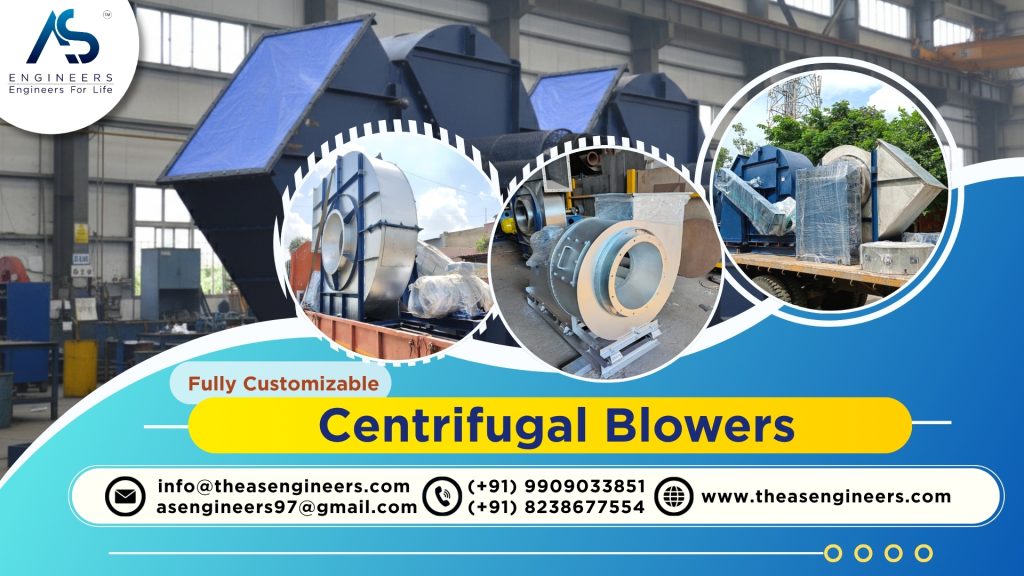
Industrial Exhauster Air Handling Blower
Large industrial facilities – cement plants, automotive paint lines, chemical processing units, power plants, and heavy fabrication shops – move enormous volumes of air continuously. In many of these positions, the air is not clean. It carries heat, moisture, fume, mist, fine particulate, or some combination of all of these. A standard ventilation fan degrades quickly in these conditions. A backward curved or backward inclined blower loses balance through blade accumulation. Even a standard radial exhauster, designed for lighter duty, wears faster than the application demands.
The Industrial Exhauster Air Handling Blower is the heavy-construction answer to this specific problem. Built with an air handling impeller – heavy-gauge blades welded to both the back plate and the front plate – it delivers the airflow volumes needed for large industrial exhaust duty with a construction robust enough to run reliably in conditions that would shorten the service life of lighter-built blowers.
AS Engineers manufactures industrial exhauster air handling blowers to IS 4894 (BIS) for large-volume fume extraction, AHU systems, industrial ventilation, pollution control exhaust, and process air handling across cement, automotive, chemical, power, and environmental applications. Every unit is engineered from your duty specification.
Submit your airflow and application data

Air Flow
1750 to 230000 CMH

Static Pressure
1” TO 16” (Pressure in Inch)

Temperature
Up to 200℃

Efficiency
Up to 85%

Performance Curve
Non-overloading power curve

Type of Construction
SWSI & DWDI
What the Air Handling Impeller Construction Actually Means
The term “air handling blower” refers to a specific impeller construction, not just a duty category. Understanding the difference clarifies why this blower type is specified for demanding industrial exhaust positions.
A standard radial blade impeller used in lighter exhaust applications is constructed with blades attached to a back plate only — the inlet side of the impeller is open or uses a lighter front ring. This construction is adequate for fresh air and light-dust conditions where mechanical loads on the blades are modest.
The radial air handling impeller is constructed differently. Heavy-gauge blades are welded to both the back plate and the front plate — the full shroud is present on both sides, and the weld connection is made at both blade edges. This gives the impeller substantially greater structural rigidity. The blades cannot flex or deflect under aerodynamic load, and the double-plate connection distributes stress across both weld joints rather than concentrating it at one. The heavier gauge steel used throughout the construction further reduces the rate of blade thinning in environments where airborne particulate causes continuous slow erosion.
The practical outcome: in humid, mist-laden, or moderately abrasive exhaust streams where a lighter impeller would develop cracks at the blade-to-plate weld or experience blade deflection within one to two years of service, the air handling impeller construction extends service life significantly. The catalog descriptors — Abrasion Resistant, Construction Ready, Extended Durability — are all consequences of this construction choice, not marketing statements applied over a standard product.
Which Exhauster Blower Does Your Application Require?
AS Engineers manufactures three blower types that use radial blade geometry. They are not interchangeable. The correct type is determined by duty severity — particulate loading, pressure requirement, and construction demand.
| Criterion | Exhauster Air Handling Blower | Exhauster Radial Blower | High Pressure Radial Blade Blower |
|---|---|---|---|
| Primary duty | Large-volume industrial exhaust, fume extraction, AHU | Fresh air, light dust, general industrial exhaust | Pneumatic conveying, high-pressure duty, heavy abrasive dust |
| Impeller construction | Heavy-gauge, both plates welded | Standard radial | Heavy-duty closed or open, heavy abrasion grade |
| Particulate tolerance | Moderate — fumes, mist, fine dust | Light — clean to very light dust | High — heavy abrasive, sticky, fibrous material |
| Pressure range | Moderate | Lower | High |
| Primary differentiator | Heavy construction for extended durability | Fresh air / light duty at lower cost | High pressure and abrasion resistance |
| IS 4894 tested | Yes | Yes | Yes |
If your application involves abrasive particulate heavy enough to require hard-facing or AR steel impeller material, the High Pressure Radial Blade Blower is the correct starting point. If the exhaust is genuinely clean or carries only trace dust, the Exhauster Radial Blower is adequate and more cost-effective. The Air Handling Exhauster is the correct choice for the large-volume middle ground — industrial exhaust with challenging but not extreme conditions.
When to Specify the Industrial Exhauster Air Handling Blower
| Application condition | Air Handling Exhauster: Suitable? |
|---|---|
| Large-volume industrial exhaust (above 50,000 m³/hr) | Yes — primary use case |
| AHU exhaust in large industrial buildings or plants | Yes |
| Fume and mist extraction from process areas | Yes |
| Humid or moisture-laden exhaust streams | Yes — construction handles moisture exposure |
| Moderate fine dust — grinding, cutting, processing dust | Yes — at moderate concentrations |
| Heavy abrasive dust — fly ash, silica, cement in concentration | No — use High Pressure Radial Blade |
| Fresh air ventilation, clean supply air | No — Backward Curved or Exhauster Radial more cost-effective |
| High static pressure above 1,500 mmWC | Evaluate — High Pressure Radial Blade may be required |
| Corrosive fume exhaust — acid, solvent, chloride | Yes — with appropriate SS or FRP MOC |
| Paint booth and spray booth exhaust | Yes |
| Cement plant auxiliary exhaust fans | Yes — where conditions are within moderate range |
| Large power plant auxiliary ventilation | Yes |
Materials of Construction
AS Engineers manufactures the Industrial Exhauster Air Handling Blower in a wider MOC range than most competitors offer for this blower type. Selection is driven by the gas composition, temperature, particulate abrasion potential, and corrosion risk of the specific application.
- Mild Steel (MS) — Standard for non-corrosive, ambient-temperature general industrial exhaust. Heavy-gauge plate used for the air handling impeller construction
- High Strength Low Alloy Steel (HSLA) — Higher yield strength than standard MS at similar weight. Used where structural rigidity requirements are elevated or where weight reduction in large impellers is a consideration
- DOMEX-700 / WELDOX / QUEND-690 — High-strength, wear-resistant structural steels used for impeller back plates and blades in abrasion-prone applications. These grades offer substantially higher hardness and tensile strength than standard MS, extending wear life in moderately abrasive exhaust streams without stepping up to full AR steel construction
- SS 202 — Cost-effective stainless option for corrosion-resistant applications where full 304 or 316 specification is not required
- SS 304 / SS 304L — Moderate corrosion resistance for chemical fume, food processing exhaust, and general mild corrosive environments
- SS 316 / SS 316L — Acidic fumes, chloride-bearing exhaust, pharmaceutical plant exhaust requiring GMP documentation (MTC and PMI available)
- SS 410 — Hardened stainless for applications requiring both corrosion resistance and moderate abrasion resistance
- SS-2205 Duplex Steel — Severe corrosion with chloride stress risk, aggressive chemical environments
- FRP (Fibre-Reinforced Plastic) — Highly corrosive exhaust where metal corrosion would be severe regardless of SS grade — acid pickle fumes, strong oxidiser exhaust
- Titanium — Extreme corrosion applications where FRP temperature limits are exceeded and SS grades are inadequate
For paint booth and solvent exhaust applications involving flammable vapours, spark-resistant construction requirements should be discussed at the enquiry stage. Motor enclosure (EXPL) and grounding specifications are also confirmed at that stage.
Industries and Applications
Automotive. Paint booth exhaust is among the most demanding blower applications in the automotive industry. The exhaust carries solvent vapour, paint mist, and fine overspray particles in a humid airstream. The air handling exhauster’s heavy impeller construction and abrasion-resistant build are directly suited to this duty. Spark-resistant MOC and explosion-proof motor enclosures are specified where solvent concentration requires it.
Cement Plants. Large auxiliary exhaust fans for clinker cooler ventilation, raw material handling exhaust, packing plant ventilation, and bag filter exhaust on secondary collection positions. The air handling exhauster handles the large-volume, moderately dusty conditions in these positions. For primary kiln fans and positions with severe abrasive loading, the High Pressure Radial Blade Blower is specified.
Chemical Processing. Large-volume fume extraction from reactor areas, solvent handling zones, acid storage ventilation, and process building exhaust. MOC selection is driven by the specific chemicals present in the exhaust. SS 316L handles most acid fume applications; FRP is used where metal would not provide adequate corrosion life regardless of grade.
Power Plants. Large-volume auxiliary ventilation for turbine halls, cable galleries, boiler house exhaust, and transformer cooling ventilation. These positions require reliable, long-life blowers that run continuously with minimal maintenance intervention — which is exactly the service life profile the air handling construction delivers.
Pharmaceutical Manufacturing. Process area exhaust handling solvent vapour, fine API dust, or containment ventilation exhaust. SS 316L construction with MTC and PMI documentation is standard for GMP-regulated positions. The closed impeller construction prevents product accumulation in the impeller airway.
Environmental and Pollution Control. Induced draft on scrubber systems and oxidiser exhaust, where the treated gas leaving the pollution control equipment is still warm, humid, and may carry residual fine mist. The air handling impeller handles these conditions with better durability than lighter exhauster designs.
Large Industrial Buildings and Facilities. Air handling units serving large factories, warehouses, and heavy manufacturing facilities where supply and exhaust volumes are in the range of 50,000 m³/hr and above, and where the exhaust air quality involves industrial contamination not suitable for a lighter fan.
Bag Filter Clean-Side Exhaust. The clean-side induced draft fan drawing filtered air through a bag filter housing. For large bag filter installations handling difficult dusts, the air handling exhauster provides the construction durability that lighter backward curved or inclined designs cannot match over extended service.
Drive Arrangements and Construction
- Belt-driven (Arrangement 1, 9) — Preferred for large-volume applications where RPM flexibility during commissioning is valued. Belt drive also provides isolation from motor vibration transmitted to the blower shaft
- Direct-coupled (Arrangement 4, 8) — Fixed-speed installations with defined duty points. Lower maintenance than belt drive; suitable for VFD-controlled applications
- Arrangement 7 — Impeller between bearings on extended shaft. Used for the largest and heaviest air handling impellers where shaft stiffness and bearing load distribution are critical to maintaining balance over a long service life
For DWDI (Double Width Double Inlet) configurations available at high airflow requirements, confirm at enquiry stage. Standard construction is SWSI.
Standard accessories: metallic expansion bellows, anti-vibration mounts, inlet damper, discharge damper, shaft seal, and guards. Drain provision on housing is standard for humid or mist-laden exhaust applications.
Testing and Quality Assurance
Every Industrial Exhauster Air Handling Blower manufactured at AS Engineers goes through the following before despatch:
- CNC plasma cutting for all MOC components — dimensional accuracy from fabrication start
- Dimensional inspection against approved GA drawing
- Weld inspection on impeller blade-to-plate joints
- Impeller dynamic balancing to ISO 1940-1, Grade G6.3 (standard) or G2.5 (precision)
- Performance test to IS 4894 — airflow, static pressure, and shaft power at duty point recorded using manometer, pitot tube, digital tachometer, vibration meter, and sound meter
- Anemometer-based capacity test available where duct assembly testing is not practical
- Soap-bubble leak test for mechanical seal-equipped airtight blowers
- Material test certificate (MTC) for SS, alloy steel, and AR steel grades
- PMI (positive material identification) for SS and alloy components where specified
- Pre-despatch inspection by client or third-party inspector on request
One-year warranty from invoice date, exclusive of bought-out components.
For blowers in service requiring performance restoration or construction upgrades — including units not manufactured by us — our blower repair and overhaul service covers impeller replacement, rebalancing, and IS 4894 performance retesting.
Frequently Asked Questions
What is the difference between an Industrial Exhauster Air Handling Blower and an Exhauster Radial Blower?
Both types use radial blade impeller geometry, but the construction standards and intended duty severity are different. The Exhauster Radial Blower is designed for fresh air and light-dust industrial exhaust at lower pressure requirements — a lighter-build, more cost-effective machine for cleaner conditions. The Industrial Exhauster Air Handling Blower uses heavy-gauge blades welded to both the back plate and the front plate of the impeller, producing a more rigid and abrasion-resistant assembly suited for large-volume industrial exhaust involving fumes, moisture, mist, or fine particulate. If the exhaust is genuinely clean, the Exhauster Radial is the right choice. If the duty involves any of those contamination conditions at scale, the Air Handling Exhauster is specified.
What airflow volumes does the Industrial Exhauster Air Handling Blower handle?
AS Engineers has supplied blowers across the overall range of 100 m³/hr to 2,00,000 m³/hr, with design capability up to 10,00,000 m³/hr for very large industrial applications. The specific airflow range for the air handling exhauster depends on impeller diameter, fan speed, and duty point — confirm your required airflow at the enquiry stage and we will determine the correct impeller size and speed combination.
Can this blower handle corrosive fume exhaust?
Yes, with the correct material of construction. SS 316L handles most acid fume and chloride-bearing exhaust applications. For exhaust from strong acid processes where SS 316L corrosion rates are still unacceptably high, FRP construction is available. For mildly corrosive environments, SS 304 is often adequate. The correct MOC is confirmed after reviewing the gas composition — the choice is based on specific corrosive species present, their concentration, and operating temperature, not on a general corrosivity rating.
Is spark-resistant construction available for paint booth and solvent exhaust applications?
Yes. For applications involving flammable solvent vapour or combustible dust in the exhaust stream, spark-resistant construction is specified — typically non-ferrous rub rings at the impeller-to-inlet interface, grounded housing construction, and EXPL (explosion-proof) motor enclosures. The specific spark-resistant construction standard required depends on the gas group classification of the solvent or dust present. Confirm the application’s hazardous area classification at the enquiry stage.
What documentation is provided with the blower?
Standard documentation includes: IS 4894 performance test report (airflow, static pressure, power at duty point), dynamic balancing certificate (ISO 1940-1 grade stated), dimensional inspection record, material test certificates (MTC) for SS and alloy grades, and PMI reports where specified. For GMP pharmaceutical applications in SS 316L, weld inspection records and surface finish documentation are available. Third-party inspection coordination is available on request.
Get a Quote for Your Industrial Exhauster Air Handling Blower
Share your airflow volume, exhaust conditions, and any gas composition details, and we will recommend the correct construction and provide a technical proposal within one working day.
Submit your duty requirements and application details or call +91 99090 33851 / +91 82386 77554.
For the full centrifugal blowers range, see the product hub. For dedicated high-pressure blower resources, visit highpressureblower.in.