
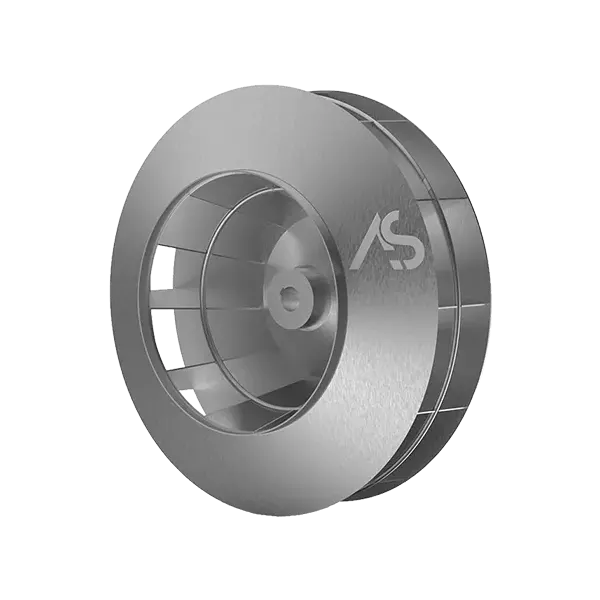
Backward Inclined Fan
The backward inclined blower sits between the backward curved blower and the radial blade blower in both efficiency and robustness. Its flat, single-thickness blades are set at an angle away from the direction of rotation — a simpler geometry than backward curved, with a specific operational advantage: the flat plate surface does not trap particulate the way a curved blade can. This makes the backward inclined impeller the practical choice when the airstream is not clean enough for a backward curved design but does not carry the heavy or abrasive particulate loading that demands a radial blade.
AS Engineers manufactures backward inclined blowers to IS 4894 (BIS) for industrial ventilation, process exhaust, dust collection, and pollution control applications. Every unit is engineered to your duty point — airflow, static pressure, temperature, and gas condition — before impeller geometry is finalised.

Air Flow
1300 to 385000 CMH

Static Pressure
0.25” TO 6” (Pressure in Inch)

Temperature
Up to 250℃

Efficiency
Up to 85%

Performance Curve
Non-overloading power curve

Type of Construction
SWSI & DWDI
Technical Specifications
| Parameter | Value |
|---|---|
| Airflow capacity | 1,300 CMH to 3,85,000 CMH |
| Operating temperature | Up to 250°C |
| Peak static efficiency | Up to 85% |
| Power curve | Non-overloading |
| Construction type | SWSI (Single Width Single Inlet) and DWDI (Double Width Double Inlet) |
| Testing standard | IS 4894 (Bureau of Indian Standards) |
| Certification | ISO 9001:2015 |
| Drive arrangement | Belt-driven and direct-coupled (Arr. 1, 3, 4, 7, 8, 9) |
| Balancing standard | ISO 1940-1, Grade G6.3 / G2.5 |
Why the Flat-Plate Blade Geometry Matters
Backward inclined and backward curved blowers are often specified interchangeably, but the blade geometry produces different operational behaviour — and that difference determines which type is correct for a given application.
A backward curved blade has a continuously curved profile. It achieves higher peak static efficiency than the backward inclined design in clean air because the curved surface guides airflow through the impeller more smoothly, recovering more pressure with less turbulence. The cost of that smooth surface is accumulation: any particulate in the airstream that contacts the curved blade face can stick and build up unevenly, which shifts the impeller balance over time.
A backward inclined blade is flat — a single-thickness plate set at an angle. The absence of a curved surface means particulate that contacts the blade face is more likely to slide off or be thrown clear by centrifugal force rather than accumulate. Efficiency is slightly lower than backward curved at the same duty point, but the design holds that efficiency more consistently over an operating lifecycle in lightly to moderately contaminated airstreams.
This is the practical reason experienced engineers specify backward inclined blowers for industrial exhaust, dust collection secondary fans, and process ventilation where the air carries moisture, light dust, or fine particulate — conditions where a backward curved design would need more frequent maintenance to sustain performance.
Backward Inclined vs. Backward Curved vs. Radial Blade — How to Choose
| Criterion | Backward Curved | Backward Inclined | Radial Blade |
|---|---|---|---|
| Blade profile | Continuously curved | Flat plate, angled back | Straight radial |
| Peak efficiency | Highest (~80–85%) | High (~75–85%) | Moderate (~60–75%) |
| Particulate tolerance | Low — clean air only | Moderate — light to medium dust | High — heavy abrasive dust |
| Blade fouling risk | Higher | Lower | Lowest (self-cleaning) |
| Static pressure capability | Moderate | Moderate to high | High |
| Operating temperature | Up to 200°C (standard) | Up to 250°C | Higher — application-specific |
| Best application fit | HVAC, clean process air, pharma | Industrial exhaust, dust collection, process ventilation | Pneumatic conveying, bag filter exhaust, heavy dust |
| Typical IS 4894 test standard | Yes | Yes | Yes |
For dust concentrations above approximately 20 mg/m³, or for abrasive particulate such as silica, fly ash, or cement dust in direct contact with the impeller, neither backward inclined nor backward curved designs are appropriate. A High Pressure Radial Blade Blower is the correct specification in those cases.
For temperatures above 250°C, a High Temperature Plug Blower is required.
When to Specify a Backward Inclined Blower
| Application condition | Backward Inclined: Suitable? |
|---|---|
| Clean air, no particulates | Yes — though backward curved may be more efficient |
| Light dust load (below 5 mg/m³) | Yes — preferred over backward curved |
| Moderate dust load (5–20 mg/m³) | Yes — this is the primary use case |
| Heavy dust, abrasive particulates | No — use Radial Blade Blower |
| Sticky or fibrous material | No — blade buildup risk remains |
| Temperature up to 250°C | Yes |
| Temperature above 250°C | No — use High Temperature Plug Blower |
| Humid or moisture-laden air | Yes — tolerates better than backward curved |
| Induced draft on scrubber or oxidiser | Yes — upstream gas is cleaned before reaching impeller |
| Forced draft on boiler (clean combustion air) | Yes — Backward Curved Blower may offer higher efficiency if air is clean |
Materials of Construction
Material selection depends on the gas composition, temperature, and regulatory or documentation requirements of the project.
- Mild Steel (MS) — Standard for general industrial ventilation and process exhaust where the gas is not corrosive and temperature is within ambient to moderate range
- SS 304 / SS 304L — Light chemical environments, food-adjacent exhaust, moderate corrosion exposure
- SS 316 / SS 316L — Acidic gas streams, chloride environments, pharmaceutical plant exhaust requiring GMP documentation (MTC and PMI available)
- SS 321 — Elevated temperature service with oxidising gas exposure
- Duplex SS 2205 — Aggressive corrosion conditions, chloride stress corrosion environments
- Hard Facing on blade edges — Moderate abrasion applications where impeller wear protection is needed without switching to full radial blade geometry
Material is selected based on gas analysis, not default. Where corrosion potential or regulatory requirements are uncertain, our engineers will recommend the appropriate MOC after reviewing your process conditions.
Industries and Applications
Industrial Ventilation and Process Exhaust. Backward inclined blowers are widely used as general industrial exhaust fans in chemical plants, fertiliser units, and heavy manufacturing where process air carries fine particulate or moisture. The flat blade profile maintains balance over longer service intervals compared to backward curved in the same duty.
Dust Collection Systems. In multi-stage dust collection setups, the backward inclined blower typically serves as the induced draft fan drawing cleaned air through a primary cyclone separator or after the dirty-side collection stage. For the primary exhaust fan drawing directly from a high-particulate source, a radial blade design is specified. The backward inclined is the correct choice in the middle of the system — where the air has been partially cleaned but is not yet clean enough for a backward curved impeller.
Bag Filter Systems. The induced draft fan pulling exhaust through a bag filter housing sees cleaned air on the clean side of the filter. Backward inclined blowers are commonly specified here, offering better efficiency than radial blade designs and greater dust tolerance than backward curved at the same duty point.
Air Pollution Control — Scrubbers and Oxidisers. Scrubbers and thermal oxidisers process contaminated gas upstream. The fan handling the treated gas on the outlet side sees a partially cleaned but still warm and potentially damp airstream — conditions where backward inclined construction holds up better than backward curved over time.
Cement Plant Auxiliary Fans. Raw mill ventilation, separator fans, and cooler exhaust fans in cement plants operate in dusty, high-temperature conditions. Backward inclined blowers handle cement plant auxiliary duties where the dust burden is moderate and temperatures fall within the 250°C operating envelope.
Chemical and Fertiliser Plants. Process ventilation in chemical and fertiliser manufacturing involves air that may carry fine particulate, moisture, or mild corrosive content. Backward inclined blowers in SS 304 or SS 316L construction are specified based on gas analysis.
Combustion Air Supply. Where combustion air is clean but the application requires a robust, simpler impeller design than backward curved — such as in some kiln and furnace auxiliary positions — backward inclined blowers are specified.
Drive Arrangements and Construction
Backward inclined blowers are available in the following configurations:
- Belt-driven (Arrangement 1, 9) — Allows speed adjustment via pulley change; preferred where RPM may need tuning during commissioning or process changes
- Direct-coupled (Arrangement 4, 8) — Compact footprint, reduced transmission losses, preferred for fixed-speed installations
- Arrangement 3 — Impeller overhung, bearings on drive side; for space-constrained installations
- Arrangement 7 — Impeller between bearings; for larger, heavier impeller assemblies
SWSI configuration handles single-duct inlet systems. DWDI draws from both sides and delivers higher airflow capacity from the same impeller diameter, or provides balanced loading for symmetrical duct systems.
Standard accessories: metallic expansion bellows, inlet cone, variable inlet vane (VIV) damper, anti-vibration mounts, shaft seal, and discharge damper. Cooling disc and stuffing box available for elevated temperature service.
Testing and Quality Assurance
Every backward inclined blower manufactured at AS Engineers is tested and documented before despatch:
- Dimensional inspection against approved GA drawing
- Impeller dynamic balancing to ISO 1940-1, Grade G6.3 (standard) or G2.5 (precision-grade)
- Performance test to IS 4894 — airflow, static pressure, and shaft power recorded at the duty point
- Noise level measurement where specified in order
- PMI (positive material identification) for SS and alloy steel components where specified
- Pre-despatch inspection by client or third-party inspector on request
Test reports and balancing certificates are provided with every blower as standard. For blowers already in service — including those not manufactured by us — our blower maintenance and repair service can measure current performance against original IS 4894 test data and recommend corrective action.
Frequently Asked Questions
What is the difference between a backward inclined and backward curved blower?
Both impeller types angle the blades away from the direction of rotation and produce a non-overloading power curve. The difference is blade geometry: backward curved blades have a continuously curved profile that achieves higher peak static efficiency in clean air, while backward inclined blades are flat plates set at an angle. The flat surface is less prone to particulate accumulation — making backward inclined blowers more suitable when the airstream carries light to moderate dust, moisture, or fine particulate that would cause uneven buildup on a curved blade over time.
Can a backward inclined blower handle dust-laden air?
Yes, for moderate particulate loading — typically up to around 20 mg/m³ with non-abrasive dust. The flat blade geometry sheds particulate more readily than a curved blade, which is why backward inclined designs are commonly specified as induced draft fans on dust collection systems and bag filter exhausts, where the air has already passed through primary collection. For heavy particulate loading, abrasive dust (silica, fly ash, cement), or direct contact with high-concentration dust streams, a radial blade blower is required.
Why is the backward inclined blower rated to 250°C when the backward curved is rated to 200°C?
The temperature rating difference is primarily a function of mechanical design choices in standard construction — shaft seal selection, bearing housing design, and material specification. The backward inclined blower’s simpler blade geometry also allows more conservative mechanical allowances in high-temperature configurations. For temperatures above 250°C, purpose-built high-temperature construction is required — see our High Temperature Plug Blower.
What drive arrangement is recommended for a backward inclined blower?
This depends on the application. Belt-driven arrangements (Arr. 1, 9) are preferred where RPM flexibility is needed — the pulley ratio can be adjusted during commissioning if the system resistance differs from design. Direct-coupled arrangements (Arr. 4, 8) are used where the duty point is well-defined and a compact, lower-maintenance installation is preferred. For higher-power applications with larger impeller diameters, Arrangement 7 (impeller between bearings) provides better shaft stiffness and bearing life.
What information do you need to size and quote a backward inclined blower?
Required inputs: airflow in m³/hr or CMH, static pressure in mmWC or Pa, gas temperature at blower inlet, installation altitude, nature and concentration of particulate in the airstream, preferred drive type, and any MOC or documentation requirements. If complete process data is unavailable, our engineers can work with partial data and assist in confirming the remaining parameters.
Get a Quote for Your Backward Inclined Blower
Share your process requirement — airflow, static pressure, temperature, and application — and we will respond with a technical recommendation and budgetary indication within one working day.
Submit your process data or call +91 99090 33851 / +91 82386 77554.
You can also explore our full range of centrifugal blowers or visit highpressureblower.in for high-pressure blower applications.