

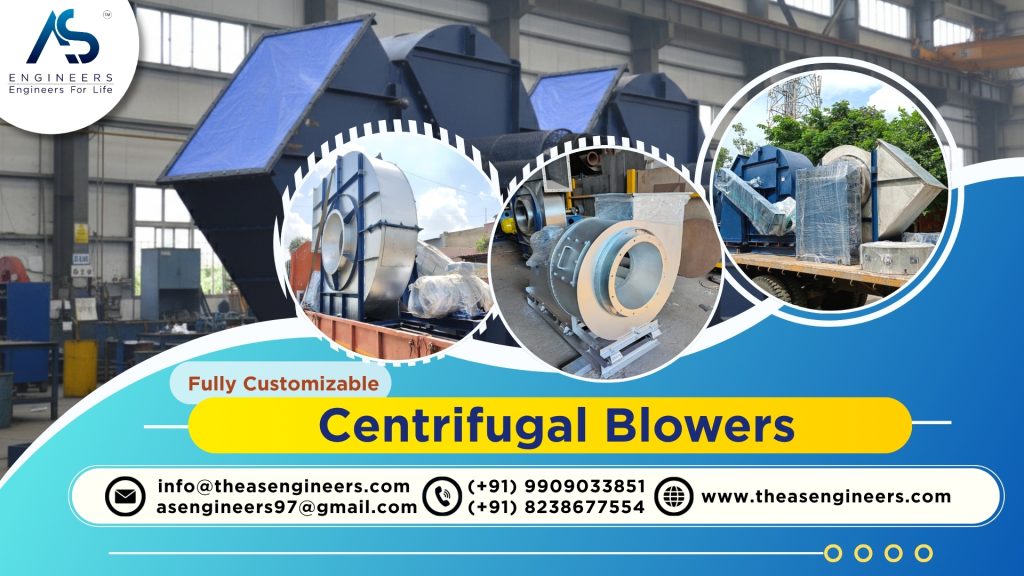
Industrial Exhauster Radial Blower
Not every industrial exhaust application needs the heaviest blower in the range. A general ventilation system moving fresh ambient air through a workshop, a boiler house FD fan supplying clean combustion air, a cooling fan for electrical equipment enclosures, or a building exhaust system handling clean process air — these applications require an industrial-grade blower with reliable radial construction, not the abrasion-resistant heavy build reserved for fume extraction and dust collection primary fans.
The Industrial Exhauster Radial Blower is the cost-effective radial option in the AS Engineers range. Its catalog positioning says it directly: Fresh Air, Light Dust, Heavy Duty. The radial blade geometry delivers the durability and self-cleaning tendency of the radial family at a lower construction cost than the heavier Industrial Exhauster Air Handling Blower — because the application does not require it.
Understanding where this blower is the right call, and where it is not, is the purpose of this page.
Submit your duty requirements for a recommendation

Air Flow
400 to 150000 CMH

Static Pressure
100 to 2000 MMWC

Temperature
Up to 200℃

Efficiency
Up to 85%

Performance Curve
Non-overloading power curve

Type of Construction
SWSI & DWDI
Why Choose a Radial Exhauster Over a Backward Curved Blower for Clean Air?
This is a reasonable question. The Backward Curved Blower is more efficient for clean air applications — it draws less power at the same duty point. So why would a plant engineer specify a radial exhauster for an application involving fresh or clean air?
There are three scenarios where radial construction is the better specification even when the air is relatively clean.
Uncertainty about air quality over time. A fresh air blower installed in a cement plant auxiliary position, a fertiliser plant service building, or a heavy manufacturing facility may start on clean air and gradually encounter process dust that migrates from adjacent areas. The radial blade handles incidental contamination without the blade-buildup and balance risk that a backward curved impeller would face in the same situation over years of service.
High tip-speed, high-RPM applications. In direct-drive, high-RPM configurations, the radial blade’s structural simplicity and symmetry — straight blades of uniform section — is mechanically more stable under centrifugal stress than a curved blade profile. For small, high-speed blowers in direct-drive arrangement, radial is often the safer mechanical choice regardless of efficiency.
Cost-driven specifications where efficiency is not the primary constraint. For auxiliary and utility fans not on the plant’s energy efficiency critical path — building ventilation, equipment cooling, general exhaust — the lower purchase cost of a standard radial exhauster may be the primary selection criterion, with the efficiency difference at smaller motor sizes being commercially insignificant compared to the capital cost delta.
Where energy efficiency over a long operating life is the controlling factor and the air is genuinely clean, the Backward Curved Blower or Backward Inclined Blower will deliver better lifecycle economics. The honest recommendation is to confirm which criterion controls the specification before choosing.
Where the Duty Boundary Sits — Exhauster Radial vs. Heavier Types
The Exhauster Radial is designed for fresh air and light dust. “Light dust” means incidental contamination — not a primary dust-laden exhaust stream. When conditions push beyond this envelope, a heavier type is required.
| Condition | Exhauster Radial | Air Handling Exhauster | High Pressure Radial Blade |
|---|---|---|---|
| Clean fresh air supply or exhaust | Yes — primary use | Over-specified | Over-specified |
| Light incidental dust, very low concentration | Yes | Possible | Over-specified |
| Humid or mist-laden air | Marginal — assess | Yes | Possible |
| Fume extraction, chemical vapour | No — use SS MOC + heavier type | Yes | Yes |
| Moderate dust (5–20 mg/m³) | No | Yes | Possible |
| Heavy abrasive dust | No | No | Yes |
| Pneumatic conveying | No | No | Yes |
| High pressure above 800 mmWC | Evaluate | Evaluate | Yes |
| Large-volume industrial AHU exhaust | Possible at lower volumes | Yes | Possible |
| General workshop and building ventilation | Yes | Over-specified | Over-specified |
Specifying the Exhauster Radial where the Air Handling Exhauster is required shortens service life and increases maintenance frequency. Specifying the Air Handling Exhauster where the Exhauster Radial is adequate adds unnecessary capital cost. The table above gives the starting boundary — confirm during technical review.
When to Specify the Industrial Exhauster Radial Blower
| Application | Suitable? |
|---|---|
| Fresh air supply fans — workshops, factories, warehouses | Yes |
| Building and facility exhaust — clean general ventilation | Yes |
| Boiler house FD fans — clean combustion air supply | Yes |
| Cooling air for electrical panels, transformers, machinery | Yes |
| Utility and auxiliary ventilation — not on energy-critical path | Yes |
| Light-duty process ventilation — incidental dust only | Yes |
| Clean-side exhaust after bag filter at lower volumes | Yes |
| High-RPM, direct-drive applications on clean air | Yes — radial geometry preferred |
| Humid or fume-laden exhaust | No — Air Handling Exhauster required |
| Dust-laden or abrasive exhaust streams | No — higher-type required |
| Applications where energy efficiency is the primary constraint | No — Backward Curved preferred |
| Pneumatic conveying or material transport | No — High Pressure Radial Blade required |
The Complete AS Engineers Centrifugal Blower Range – One Reference Table
Buyers shortlisting across the full range of six blower types can use this matrix to confirm their selection. Each type is optimised for a specific position in the duty spectrum.
| Blower Type | Primary Position | Key Strength | Not Suitable For |
|---|---|---|---|
| Backward Curved | Clean air, energy-sensitive | Highest efficiency, non-overloading | Any dust or particulate |
| Backward Inclined | Light-moderate dust, process ventilation | Efficiency + dust tolerance balance | Heavy/abrasive dust |
| High Pressure Radial Blade | Pneumatic conveying, heavy dust, high pressure | Self-cleaning, abrasion-resistant, high pressure | Clean-air energy-sensitive duty |
| High Temperature Plug Blower | Kilns, furnaces, heat recovery | Rated to 650°C | Ambient temperature applications |
| Industrial Exhauster Air Handling | Large-volume fume and AHU exhaust | Heavy impeller construction, extended durability | Heavy abrasive dust primary fans |
| Industrial Exhauster Radial | Fresh air, light dust, utility exhaust | Cost-effective radial, industrial-grade build | Contaminated, humid, or abrasive exhaust |
If this table does not confirm a clear match for your application, share your duty data with our engineers and we will identify the correct type.
Industries and Applications
Power Generation. Boiler forced draft fans supplying clean combustion air, cooling air for cable galleries and switchgear rooms, turbine hall ventilation, and general plant utility exhaust. These positions typically involve genuinely clean air and benefit from the Exhauster Radial’s industrial-grade construction at a cost point appropriate for auxiliary equipment.
Steel and Metals. Plant service building ventilation, cooling air for electrical rooms and motor control centres, transformer cooling, and general-purpose exhaust in areas adjacent to but not directly connected with the process. For positions directly handling process gas, dust, or fume in steel plants, heavier types are required.
Manufacturing Facilities and Workshops. Large factory fresh air supply and general exhaust, warehouse ventilation, machine tool cooling, welding area ventilation where fume concentration is low and the primary need is high-volume air movement. For welding fume extraction at source, a higher-duty type with appropriate MOC is specified.
Railways and Infrastructure. Tunnel ventilation, station platform exhaust, workshop ventilation, and equipment room cooling. Radial construction is preferred in railway applications for its mechanical simplicity and predictable service intervals.
Food and Beverage. Fresh air supply for packaging areas, cold room antechamber ventilation, and general factory exhaust where the air is clean and no product contact occurs. For exhaust handling process air with product carryover, SS construction and a heavier impeller type are specified.
General Industrial Buildings. Any large industrial facility requiring reliable, long-service fresh air supply or clean exhaust fans — from chemical plant service buildings to pharmaceutical facility general ventilation — where the primary requirement is industrial-grade durability without the construction overhead of a heavy-duty exhauster.
Utility and Auxiliary Fans. The Exhauster Radial serves well as a general-purpose industrial fan for positions that need to run reliably for years without intensive maintenance attention — motor room ventilation, compressed air room cooling, instrument room air supply, substation exhaust.
Materials of Construction
The same MOC range available across the full centrifugal blower series applies to the Exhauster Radial. For fresh air and light-duty exhaust applications, MS construction is standard. Where corrosion from ambient humidity, coastal atmospheres, or mild process exposure is a consideration, SS grades are specified.
- Mild Steel (MS) — Standard for non-corrosive fresh air and general ventilation duty
- SS 202 — Economy stainless for mild corrosion resistance where full 304 specification is cost-constrained
- SS 304 / SS 304L — Moderate corrosion resistance for coastal installations, food-adjacent environments, and mildly corrosive ambient conditions
- SS 316 / SS 316L — Chemical plant utility fans, pharmaceutical facility general ventilation where GMP documentation requirements extend to all installed equipment
- SS 410 — Where mild abrasion and corrosion resistance are both needed
- HSLA / DOMEX-700 / WELDOX — High-strength structural steel for large-diameter impellers where weight and rigidity are design constraints
- FRP — Highly corrosive ambient environments — coastal chemical installations, acid storage areas — where even SS 316L degradation over time is unacceptable
Drive Arrangements
- Belt-driven (Arrangement 1, 9) — Standard for most industrial exhaust and fresh air fan applications. Allows RPM fine-tuning via pulley change during commissioning. Preferred where airflow may need adjustment as the building or system is commissioned
- Direct-coupled (Arrangement 4, 8) — Fixed-speed, low-maintenance installations. Common for high-RPM fresh air supply fans and equipment cooling applications where the duty point is known and stable
- Arrangement 3 — Overhung impeller on extended shaft for space-constrained layouts
- Arrangement 7 — For larger impeller diameters requiring impeller-between-bearings shaft stability
VFD compatibility available for all arrangements — specify at enquiry stage.
Testing and Quality Assurance
Every Industrial Exhauster Radial Blower manufactured at AS Engineers is tested and documented before despatch:
- CNC plasma cutting for dimensional accuracy from fabrication start
- Dimensional inspection against approved GA drawing
- Impeller dynamic balancing to ISO 1940-1, Grade G6.3 (standard) or G2.5 (precision)
- Performance test to IS 4894 — airflow, static pressure, and shaft power at duty point recorded
- Test apparatus: manometer, pitot tube, digital tachometer, vibration meter, sound meter, digital clamp meter
- Material test certificate (MTC) for SS and alloy grades where specified
- PMI (positive material identification) where specified
- Pre-despatch inspection by client or third-party inspector on request
One-year warranty from invoice date, exclusive of bought-out components.
For blowers in service requiring performance checks, rebalancing, or general maintenance — including units not manufactured by us — our blower maintenance and repair service is available with IS 4894 performance testing as part of the service output.
Frequently Asked Questions
What is the Industrial Exhauster Radial Blower used for?
The Industrial Exhauster Radial Blower is designed for fresh air supply and exhaust applications handling clean or lightly contaminated air in industrial facilities. Typical positions include forced draft fans for boiler combustion air, fresh air supply for workshops and factories, building exhaust systems, cooling air for electrical and mechanical equipment, and general utility ventilation in chemical, power, steel, and manufacturing plants. It is the cost-effective industrial-grade radial option in the AS Engineers range — suited for applications that need the durability of radial construction without the heavier build required for fume extraction or abrasive dust exhaust.
What is the difference between the Industrial Exhauster Radial Blower and the Industrial Exhauster Air Handling Blower?
Both are radial blade designs, but they are built for different duty severity levels. The Exhauster Radial is built for fresh air and very light dust — clean industrial air where the primary requirement is reliable industrial-grade construction at a reasonable cost. The Industrial Exhauster Air Handling Blower uses a heavier impeller construction — heavy-gauge blades welded to both back plate and front plate — designed for large-volume industrial exhaust involving fumes, moisture, mist, or moderate dust concentration. If the air contains any of those contaminants in meaningful quantity, the Air Handling Exhauster is the correct specification. If the air is genuinely clean or carries only trace contamination, the Exhauster Radial provides better value.
Is a radial exhauster more efficient than a backward curved blower?
No. For clean air applications, a Backward Curved Blower is significantly more efficient — it draws less shaft power at the same duty point. The Exhauster Radial is specified over backward curved when the application involves uncertainty about long-term air quality, when high RPM and direct-drive makes radial geometry mechanically preferable, when the application is a non-critical auxiliary fan where capital cost matters more than operating cost, or when there is any possibility of the airstream carrying incidental dust over time. For large motors on long-running energy-critical fans handling genuinely clean air, backward curved is almost always the better lifecycle choice.
Can the Exhauster Radial handle humid or moisture-laden air?
Marginally — it is better suited to dry or near-dry fresh air. For sustained humid exhaust, mist-laden airstreams, or applications where condensation in the blower housing is likely, the Industrial Exhauster Air Handling Blower is the appropriate type. The heavier impeller construction and drain provision in the housing make it more suitable for wet conditions. The Exhauster Radial in MS construction is also susceptible to internal corrosion in continuously humid service — specify SS if moisture is present.
What is the minimum information needed to get a quote?
Required: airflow in m³/hr or CFM, static pressure in mmWC or Pa, gas temperature at the blower inlet, installation altitude, and confirmation that the airstream is clean or carries only very light dust. If the air quality is uncertain, describe the process area and what activity is occurring near the fan inlet — this helps confirm whether the Exhauster Radial is adequate or whether a heavier type is appropriate.
Get a Quote for Your Industrial Exhauster Radial Blower
Share your airflow, static pressure, and application context, and we will confirm whether the Exhauster Radial is the right specification or recommend an alternative type if the duty pushes beyond its range. We respond within one working day.
Submit your duty requirements or call +91 99090 33851 / +91 82386 77554.
For the full range of centrifugal blowers — all six types with application guidance — see the product hub. For high-pressure blower resources, visit highpressureblower.in.