
Dilute Phase Pneumatic Conveying System Manufacturer
Dilute Phase Pneumatic Conveying System Manufacturer
When a plant needs to move dry powder or granular material from one point to another without spillage, contamination, or manual handling, dilute phase pneumatic conveying is the most practical and widely applied method in Indian industry. The material is suspended in a fast-moving air stream and carried through an enclosed pipeline to its destination.
AS Engineers designs and manufactures dilute phase pneumatic conveying systems from our ISO 9001:2015 certified facility in GIDC Vatva, Ahmedabad. We have supplied air and material handling equipment to plants across chemical, fertilizer, food processing, pharmaceutical, and cement sectors for 27 years.
Get a Custom Quote Today
Looking for a reliable, high-efficiency dilute phase pneumatic conveying system tailored to your specific needs? Let AS Engineers help you streamline your operations with a custom solution designed for performance and longevity. Reach out now—our experts are ready to assist you.
One capability that most conveying equipment suppliers cannot offer: we manufacture centrifugal blowers in-house. The air source and the conveying system are engineered together, not matched after the fact from two separate suppliers.
Send your material and throughput requirement
What Is Dilute Phase Pneumatic Conveying
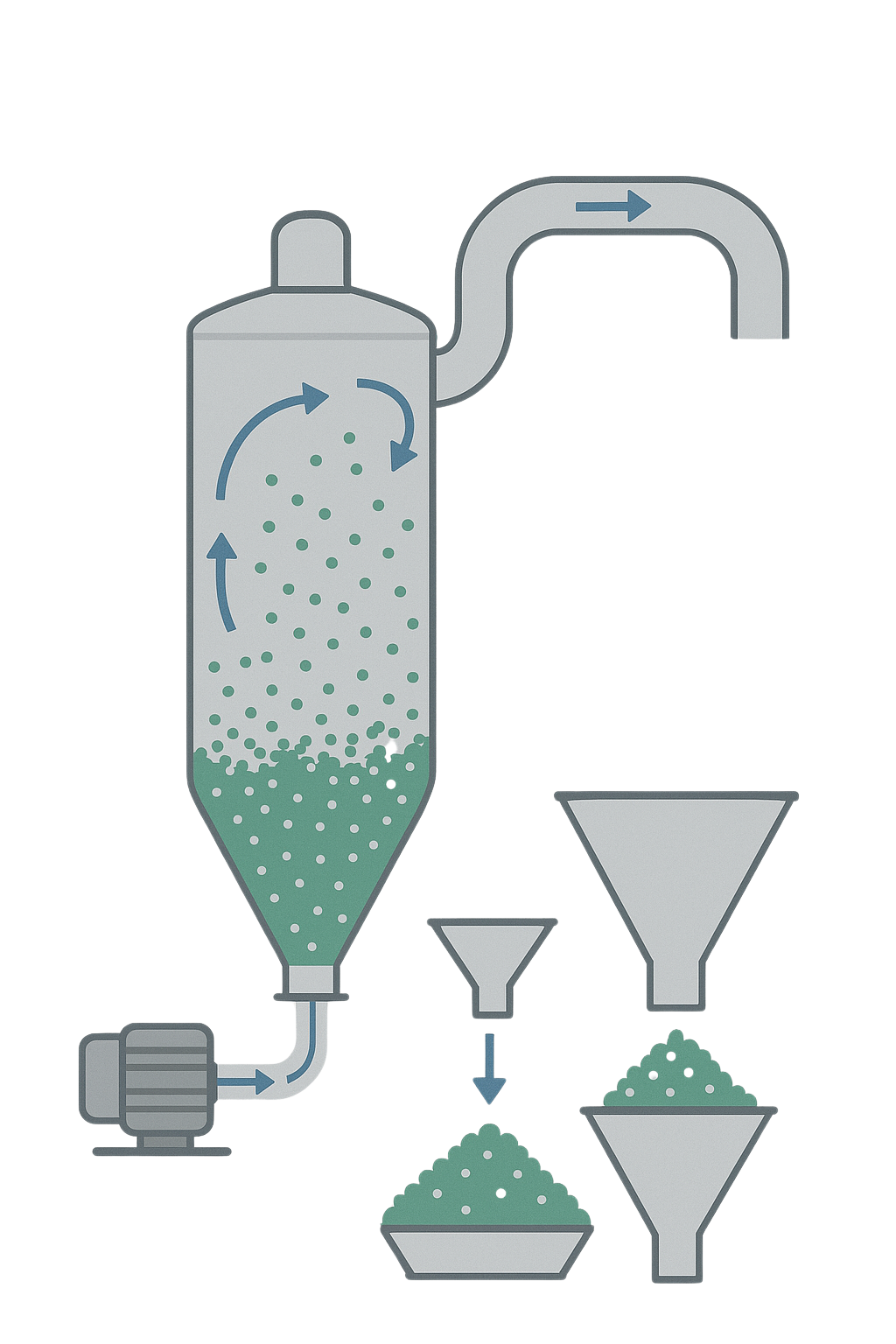
Dilute phase conveying moves material suspended in an air stream at high velocity and relatively low system pressure. The blower generates continuous airflow. Material is fed into the pipeline through a rotary airlock valve or screw feeder. Particles are carried in suspension through the pipeline and separated from the air at the receiving end, typically by a cyclone followed by a bag filter.
The defining characteristic is suspension transport: particles do not settle during conveying. This requires maintaining air velocity above the saltation velocity of the material throughout the system. Below that threshold, particles drop out of suspension and blockages follow.
Typical operating parameters:
| Parameter | Typical Range |
|---|---|
| Conveying air velocity | 18 to 35 m/s |
| System pressure | Up to 1.0 bar (g) for pressure systems |
| Vacuum systems | Up to -0.5 bar (g) |
| Pipeline MOC | MS, SS 304, SS 316 |
| Air mover type | Centrifugal blower or positive displacement blower |
Is Dilute Phase the Right System for Your Material
This is the question most product pages do not answer directly. Here is a practical reference:
| Material | Dilute Phase Suitable? | Notes |
|---|---|---|
| Fly ash | Yes | Standard application in power and cement plants |
| Wheat flour | Yes | Common in flour mills and food processing |
| Sugar (granulated) | Yes | Low abrasion, free-flowing |
| Plastic pellets / resin granules | Yes | Widely used in petrochemical and compounding |
| Soda ash, salt cake | Yes | Chemical plants, standard application |
| API powders (pharma) | Yes, with conditions | Requires SS 316 pipeline, contained feeder |
| Cement powder | Yes | High throughput applications |
| Lime powder | Yes | Water treatment and chemical dosing |
| Coffee beans, whole spices | No | Fragile; velocity causes breakage; use dense phase |
| Wet or sticky powder | No | Cohesive material coats pipe walls and blocks |
| Highly abrasive media (silica, alumina) | Evaluate | Dilute phase causes excessive elbow wear; dense phase or hardened lined pipe required |
| Fluidisable fine powder with low bulk density | Evaluate | Risk of surging; needs careful feeder design |
If your material falls in the “Evaluate” or “No” category, we will tell you at the enquiry stage rather than size a system that will fail in operation.
System Components and What AS Engineers Supplies
Air mover
The blower is the component most conveying contractors ask you to source separately. We manufacture centrifugal blowers and high pressure radial blade blowers in-house and select and supply the correct type as part of the system. This matters because the blower must be sized to the actual system pressure drop and airflow demand, not to a catalog standard curve.
Conveying pipeline
MS or SS construction depending on material corrosivity, temperature, and hygiene requirements. Pipeline diameter is calculated from the required conveying velocity and volumetric airflow. Elbows are specified with adequate bend radius to reduce wear and avoid abrupt direction changes that cause turbulence and particle impingement.
Feed system
Rotary airlock valves for standard applications. Screw feeders for materials that need controlled metering. The feeder must maintain a pressure seal between the atmospheric feed hopper and the pressurised conveying line – a detail that causes most blockage problems when undersized or worn.
Downstream separation
Cyclone separators remove the bulk of the conveyed material from the air. The exhaust air still carries fine particles and must pass through bag filters before release to atmosphere, bringing outlet dust concentration within CPCB ambient air quality standards. We manufacture both the cyclone and the bag filter, so the filtration specification is set alongside the conveying system design.
Receiving bin
Material is discharged into a receiving bin or existing hopper. For applications with multiple discharge points, diverter valves allow single-pipeline, multi-destination routing.
Dilute Phase vs Alternative Conveying Methods
Plant engineers typically compare pneumatic conveying against mechanical alternatives before issuing an RFQ. Here is the practical comparison for Indian industrial conditions:
| Criterion | Dilute Phase Pneumatic | Screw Conveyor | Belt Conveyor |
|---|---|---|---|
| Enclosed transport (no dust) | Yes | Partial | No |
| Vertical conveying | Yes | Limited | No (needs bucket elevator) |
| Multi-direction routing | Yes | No | No |
| Moving parts count | Low (blower only) | High (flights, shaft, gearbox) | High (belt, rollers, drive) |
| CPCB dust compliance | Easier with bag filter | Depends on cover design | Requires additional dust control |
| Suitable for cohesive materials | Limited | Good | Good |
| Energy consumption | Higher per tonne-metre | Lower | Lower |
| Capital cost | Moderate-high | Low-moderate | Moderate |
For free-flowing powders and granules that need enclosed, clean, multi-directional transport, dilute phase is the practical answer. For heavy, cohesive, or high-density bulk solids over short distances, screw conveyors are often the more cost-effective choice. We will recommend the right system at the enquiry stage.
What We Need to Design Your System
Before we can size any component, we need this data from you. Sending this information with your first enquiry eliminates one or two rounds of back-and-forth.
- Material name and description
- Bulk density (kg/m³) and particle size (µm or mesh)
- Moisture content and temperature at feed point
- Any abrasion, corrosion, or hygroscopic characteristics
- Required throughput in kg/hr (average and peak)
- Conveying distance: horizontal run and vertical lift in metres
- Number of pickup points and delivery points
- Existing plant layout drawing or sketch (even a rough sketch helps)
- Available power supply (kW, voltage, phase)
- Any regulatory or hygiene requirements (GMP, ATEX, CPCB permit conditions)
A plant visit is available for projects above a defined scope. Our engineering team covers Gujarat and can travel to project sites in Maharashtra, Rajasthan, Madhya Pradesh, and Punjab for site surveys.
Submit your requirement or call us at +91 99090 33851.
Industries and Applications
| Industry | Typical Application |
|---|---|
| Cement and Power | Fly ash, raw meal, cement powder transfer between silos and process points |
| Food Processing | Flour, sugar, starch, spices — fully enclosed, FSSAI-compliant handling |
| Pharmaceuticals | API and excipient transfer with SS 316 pipeline and GMP documentation |
| Fertilizer | DAP, urea, micronutrient powder between grinding and bagging |
| Chemical | Soda ash, salt cake, polymer powder in GIDC cluster plants |
| Plastics and Compounding | Pellet and granule transfer between extrusion and moulding lines |
| Water Treatment | Lime and activated carbon dosing from storage to dosing points |
Frequently Asked Questions
What is the minimum and maximum throughput for dilute phase pneumatic conveying?
Dilute phase systems are practical from small-scale laboratory or pilot quantities up to several hundred tonnes per hour for large industrial installations. The pipeline diameter, blower capacity, and feeder size scale with throughput. Share your kg/hr requirement and we will size the system accordingly.
My material is mildly cohesive – will dilute phase work?
It depends on the degree of cohesion and the particle size. Mildly cohesive fine powders can sometimes be conveyed in dilute phase with a properly sealed rotary valve and careful velocity management. Strongly cohesive or sticky materials will coat the pipeline walls and block. We ask for a small material sample for assessment before finalising the system type recommendation.
Can I add more delivery points to the system after installation?
Yes, with diverter valves and additional pipeline branches. Designing for future expansion at the outset is cheaper than retrofitting later. If you anticipate additional pickup or delivery points within the next two to three years, mention this at the enquiry stage and we will design the pipeline header and blower capacity with headroom.
Does the blower come with the system, or do I need to source it separately?
We supply the blower as part of the system. We manufacture centrifugal blowers and high pressure radial blade blowers in-house and size the air mover to the specific conveying duty. You receive a single-vendor, engineered system – not a pipeline that depends on a separate vendor’s blower matching the system requirement.
What documentation is provided with the system?
Standard documentation includes general arrangement drawing, process and instrumentation diagram, bill of materials, material test certificates for pressure-bearing components, inspection and test reports, and an operation and maintenance manual. For pharmaceutical and food applications, additional GMP documentation and third-party PMI testing can be arranged.
Request a Quote for Your Dilute Phase Conveying Requirement
If you are moving dry powder or granules and need an enclosed, clean, low-maintenance system, we can design and supply the full system from air mover to receiver. ISO 9001:2015 certified manufacturing, India-based engineering team, 27 years of industrial equipment experience.
Send your requirement to our engineering team or call +91 99090 33851.