

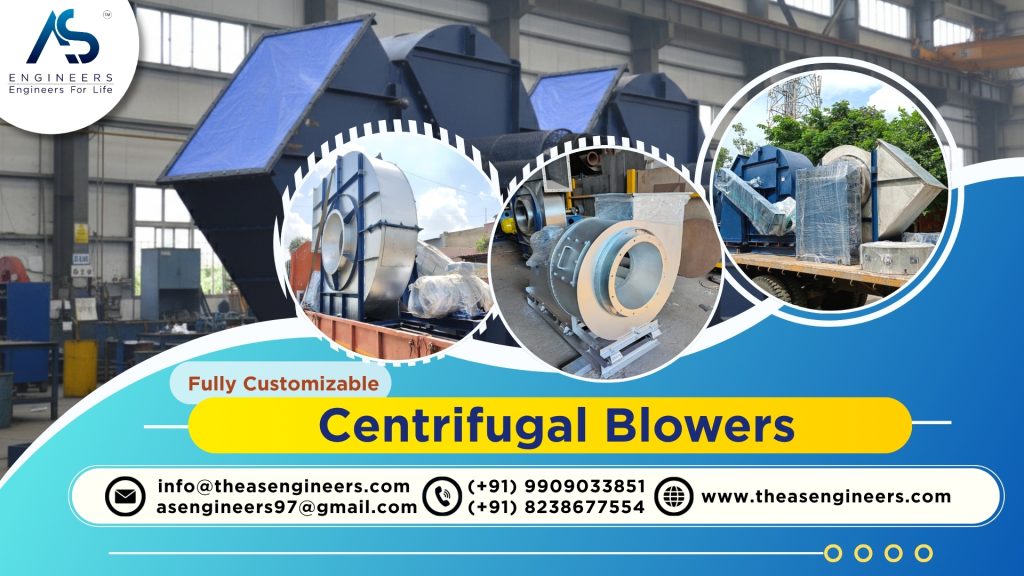
High Temperature Plug Blower/Fan
Every centrifugal blower has a temperature limit. Below that limit, standard construction holds. Above it, the blower fails — not in a dramatic sense, but progressively: bearing grease breaks down, shaft seals leak hot gas, thermal expansion jams impellers on shafts, and what looked like a working blower on the datasheet becomes an unplanned outage every few months.
The high temperature plug blower exists specifically to extend that limit. AS Engineers manufactures high temperature centrifugal blowers rated to operating temperatures up to 650°C, engineered for kilns, reheating furnaces, industrial drying ovens, heat recovery systems, and high-temperature process air applications across the steel, cement, ceramics, glass, and power sectors.
Temperature is the primary specification for this blower type. Share your operating temperature and we will confirm the correct construction package within one working day.

Air Flow
100 to 15000 CMH

Static Pressure
10 TO 200 MMWC

Temperature
Up to 150 °C

Efficiency
Up to 85%

Performance Curve
Non-overloading power curve

Type of Construction
SWSI & DWDI
What Makes It a Plug Blower – and Why That Matters at High Temperatures
The term “plug” refers to the housing and impeller arrangement, not to the blade type. In a plug fan configuration, the impeller sits inside a cylindrical or plenum housing without a conventional scroll casing. The drive arrangement – motor, bearings, and belt or coupling – is located on the cold side of a separating wall or insulated pedestal, entirely outside the hot airstream.
This separation is what makes the plug arrangement the correct architecture for high-temperature service. In a conventional housed centrifugal blower, the shaft passes through the housing wall at the point where the hot gas is contained. At moderate temperatures, a standard stuffing box or mechanical seal manages this transition adequately. As temperature rises above approximately 200°C, heat conduction along the shaft becomes the primary threat to bearing life. The shaft transfers heat from the hot gas zone toward the bearing, and unless that heat path is interrupted, bearing temperatures rise until the grease fails.
The plug blower addresses this with layered thermal protection: the shaft cooler dissipates heat before it reaches the bearing, the stuffing box or mechanical seal prevents hot gas from tracking along the shaft toward the drive side, and the insulated pedestal separates the bearing housing thermally from the hot housing. Together, these features keep bearing operating temperatures within the range where standard or high-temperature grease specifications remain valid — even when the airstream temperature is 400°C, 500°C, or above.
Without these features, a standard blower installed in a high-temperature position will appear to work initially, and will fail on a timeline that tracks directly with the severity of the temperature exposure.
Construction Features for High-Temperature Service
High temperature blower engineering is not a single specification — it is a layered set of design decisions that change progressively as operating temperature increases. The following features are standard or required at the temperature bands shown.
Shaft cooler. A cast or fabricated metal disc or fin assembly mounted on the shaft between the hot housing and the bearing. As the shaft rotates, the cooler dissipates heat by convection, preventing heat conducted along the shaft from reaching the bearing. Required for operating temperatures above approximately 150°C in most configurations.
Stuffing box. A packed seal assembly around the shaft at the point where it exits the housing wall. The packing material compresses against the shaft, preventing hot gas from tracking along the shaft toward the drive side. Specified at temperatures where mechanical shaft seals would experience seal face distortion or elastomer degradation.
Mechanical shaft seal. An alternative to the stuffing box for lower-temperature high-temp applications. Provides a cleaner, lower-friction seal than packing, but has a lower temperature ceiling. The correct seal type is specified based on the operating temperature and gas composition.
Fixed and floating bearing arrangement. Thermal expansion causes the shaft to lengthen as temperature increases. A shaft constrained at both ends by fixed bearings will develop axial load as it tries to expand — leading to bearing overload and premature failure. The fixed and floating arrangement constrains the shaft axially at one end (fixed bearing) and allows free axial movement at the other (floating bearing), accommodating thermal growth without transmitting it as a load into the bearing races.
Insulated or elevated pedestal. The bearing housing is separated from the hot blower housing by an insulated pedestal or a designed air gap, reducing heat conduction from the hot housing to the bearing block.
High-temperature bearing grease. Standard NLGI 2 lithium grease has a service temperature ceiling of approximately 120–140°C. High-temperature applications require specialist greases — calcium sulphonate complex, polyurea, or PTFE-based — specified to match the bearing operating temperature after all cooling features are applied.
Cooling disc. A disc-type cooler on the shaft, standard in AS Engineers’ high-temperature blower construction (listed in catalog accessories). Works in combination with the shaft cooler for extreme temperature service.
Expansion bellows. Metallic expansion bellows (flexible connectors) at the duct connections to the blower, accommodating differential thermal expansion between the blower housing and the connected ductwork during heat-up and cool-down cycles.
Temperature Tier Construction Guide
Use this table as a starting reference. The confirmed construction package for your specific application is determined during technical review.
| Operating Temperature | Minimum Required Features | Typical MOC |
|---|---|---|
| Up to 150°C | Standard construction, high-temp grease | MS |
| 150°C to 250°C | Shaft cooler, standard shaft seal, high-temp grease | MS / SS 304 |
| 250°C to 350°C | Shaft cooler, stuffing box, fixed + floating bearings, insulated pedestal | MS / SS 304 / SS 321 |
| 350°C to 500°C | Shaft cooler, cooling disc, stuffing box, fixed + floating bearings, insulated pedestal, high-temp specialist grease | SS 321 / SS 310 |
| 500°C to 650°C | Full high-temp package: all above features, high-temp alloy impeller, engineering review required for each application | SS 310 / high-temp alloy |
For temperatures above 500°C, each application is reviewed individually. Impeller tip speed, gas density at temperature, static pressure, and housing material selection are all recalculated for the specific duty.
Why Temperature Ratings Require Engineering Scrutiny
A supplier stating “up to 650°C” on a product page does not confirm that every component of the blower is rated to 650°C. The temperature limit of a blower assembly is set by its weakest component — typically the shaft seal material, bearing grease specification, or impeller alloy. A mild steel impeller may be structurally adequate at 400°C but will oxidise and weaken progressively at 600°C. A standard stuffing box packing material may hold at 250°C but pass gas above 300°C.
When evaluating a high-temperature blower supplier, the correct questions are: what specific construction features are included at the stated temperature, what material is the impeller at that temperature, what seal type is used and what is its temperature limit, and has the complete assembly been tested at or near the operating temperature?
AS Engineers confirms all these parameters during technical review, before GA drawing release. The construction package is specified to the actual process temperature, not to the headline specification of the product type.
Materials of Construction by Application
Material selection for high-temperature blowers is driven by the combination of operating temperature, gas composition, and any corrosive or oxidising components in the airstream.
- Mild Steel (MS) — Suitable for dry, non-corrosive gas at temperatures up to approximately 300–350°C. Above this range, surface oxidation accelerates and structural properties begin to degrade at the impeller tip where centrifugal stress is highest
- SS 304 / SS 304L — Oxidation resistance to approximately 870°C (continuous service) in non-sulphur-bearing gas. Suitable for clean hot-gas applications in the 300–600°C range
- SS 321 — Titanium-stabilised grade; preferred where sensitisation is a risk at elevated temperatures. Used in the 350–600°C range for applications involving thermal cycling
- SS 310 — High chromium-nickel content for maximum oxidation resistance. Specified for the highest temperature service, particularly above 500°C in oxidising gas environments
- SS 316 / SS 316L — Where the hot gas contains chlorides, sulphur, or other corrosive components alongside elevated temperature. Corrosion resistance takes priority alongside heat resistance
- High-temperature alloys — For extreme temperature service above 600°C with corrosive gas, specialist alloys are evaluated on a per-application basis
All MOC selection is confirmed against operating temperature, gas analysis, and thermal cycling frequency before fabrication begins.
Industries and Applications
Steel and Metals. Reheating furnace recirculation fans, soaking pit ventilation, annealing furnace air supply, and heat treatment oven circulation are among the most demanding high-temperature blower applications. Gas temperatures in these positions can exceed 500°C and may involve oxidising or reducing atmospheres depending on the furnace type. Full high-temperature construction packages are standard for steel plant applications.
Cement. Kiln shell cooling fans, cooler exhaust systems, and preheater tower ventilation operate in hot, often dust-laden conditions. The combination of high temperature and particulate in cement kiln auxiliary positions typically requires a radial or backward inclined impeller in high-temperature construction, rather than a backward curved design. Confirm impeller type alongside temperature requirements at enquiry stage.
Ceramics and Glass. Tunnel kiln recirculation fans, periodic kiln ventilation, and glass furnace combustion air supply operate at sustained high temperatures in relatively clean gas. These are applications where thermal efficiency — the third of the three catalog descriptors for this blower type — is a material consideration, since the blower operates continuously for long production campaigns.
Industrial Drying. Spray dryer recirculation, rotary dryer hot gas supply, and continuous drying oven air systems require blowers that handle elevated temperatures reliably over extended operating periods. The plug arrangement, with the motor outside the hot airstream, is the correct architecture for sustained-temperature drying applications.
Heat Recovery Systems. Waste heat recovery from furnace exhaust, heat recovery steam generators (HRSGs), and hot gas recirculation in energy recovery systems all involve elevated gas temperatures that standard centrifugal blowers cannot handle without purpose-built thermal construction.
Power Plants. Hot gas recirculation in boiler systems, flue gas handling at elevated temperatures, and air preheater bypass fans are positions where high-temperature construction is required.
Foundries. Cupola and induction furnace ventilation, casting cooling air supply, and hot fume extraction all involve temperature ranges that require high-temperature blower specification.
Drive Arrangements
High temperature plug blowers are available in the following drive configurations. The arrangement also determines how the thermal separation between the hot housing and the drive components is achieved.
- Belt-driven (Arrangement 1, 9) — Motor is mounted remotely, away from the hot housing. Belt drive provides the mechanical separation needed at high temperatures, and allows speed adjustment via pulley ratio change. Arrangement 9 (plug fan configuration) is the most common for high-temperature service — the impeller is overhung, with the motor on the cold side of the separating wall
- Direct-coupled (Arrangement 4, 8) — Motor is coupled directly to the blower shaft. Suitable for moderate high-temperature service where the motor enclosure (TEFC) can tolerate the ambient heat around the blower. Requires careful layout to ensure motor ambient temperature remains within the motor manufacturer’s specification
- Separated pedestal design — For temperatures above approximately 300°C, the bearing housing is mounted on an extended insulated pedestal that provides both a thermal barrier and the necessary distance between the hot housing and the bearing block
For each application, the arrangement selection is confirmed based on operating temperature, available layout space, and maintenance access requirements.
Testing and Quality Assurance
Every high temperature plug blower manufactured at AS Engineers is tested and documented before despatch:
- Dimensional inspection against approved GA drawing
- Impeller dynamic balancing to ISO 1940-1, Grade G6.3 (standard) or G2.5 (precision)
- Shaft cooler and stuffing box assembly verification
- Bearing arrangement confirmation — fixed vs. floating designation checked against shaft drawing
- Performance test to IS 4894 — airflow, static pressure, and shaft power at the duty point recorded
- Material test certificate (MTC) verification for impeller and housing in SS or alloy grades
- PMI (positive material identification) for all SS and alloy components where specified
- Noise level measurement where specified
- Pre-despatch inspection by client or third-party inspector on request
Test reports, balancing certificates, MTC, and PMI documentation are supplied as standard.
For high-temperature blowers in service requiring performance restoration or thermal protection upgrades — including units not manufactured by us — our blower maintenance and overhaul service can assess current construction adequacy against the operating temperature and recommend or implement necessary upgrades.
Frequently Asked Questions
What is a plug blower and why is it used for high-temperature applications?
A plug blower is a centrifugal blower in which the impeller is mounted without a conventional scroll housing, discharging into a plenum or duct. The drive components — motor, bearings, and belt or coupling — are positioned on the cold side of a separating wall or insulated pedestal, entirely outside the hot airstream. This arrangement is preferred for high-temperature service because it physically separates the heat-sensitive drive components from the hot gas, reducing heat conduction to the bearings. Combined with a shaft cooler, stuffing box, and fixed-floating bearing arrangement, the plug configuration allows reliable operation at temperatures that would damage a standard centrifugal blower within weeks.
What is the maximum temperature an AS Engineers high temperature blower can handle?
AS Engineers manufactures high temperature centrifugal blowers rated to operating temperatures up to 650°C. The specific construction package required at each temperature tier changes as temperature increases — materials, shaft sealing, bearing arrangement, and accessories are all specified to the actual process temperature, not to a generic maximum. Applications above 500°C require engineering review on a case-by-case basis before GA drawing release.
What is the fixed and floating bearing arrangement, and why is it required at high temperatures?
As a blower shaft heats up from ambient to operating temperature, it expands axially — the shaft becomes longer. If both bearings constrain the shaft axially (both fixed), this thermal expansion cannot occur freely and generates axial thrust force that loads the bearing races. Over time this causes premature bearing failure. The fixed and floating arrangement solves this: one bearing (the fixed side) constrains the shaft axially, while the other (the floating side) allows the shaft to slide axially within the bearing inner race as it expands. This accommodates thermal growth without transmitting it as load into either bearing.
How does the shaft cooler protect the bearings?
Heat is conducted along the rotating shaft from the hot gas zone toward the bearing, which sits on the cold side of the housing wall. Without intervention, this conducted heat raises the bearing operating temperature until the grease reaches its service temperature limit and begins to degrade. The shaft cooler — a disc or fin assembly mounted on the shaft between the hot zone and the bearing — dissipates this conducted heat by convection as the shaft rotates. The result is a significantly lower bearing temperature than would occur without cooling, keeping bearing and grease temperatures within their rated operating range even when the gas side of the shaft is exposed to several hundred degrees.
What information is needed to specify a high temperature plug blower?
The primary input is operating temperature at the blower inlet — this drives the entire construction specification. Additionally required: airflow in m³/hr or CFM, static pressure in mmWC or Pa, gas composition (clean air, flue gas, oxidising/reducing atmosphere, any corrosive components), dust or particulate content if present, installation altitude, preferred drive arrangement, and any documentation requirements (MTC, PMI, third-party inspection). Temperature is the non-negotiable starting point. Without it, no construction package can be confirmed.
Get a Quote for Your High Temperature Blower
Operating temperature is the first specification we need. Share your temperature and application details and we will confirm the correct construction package and provide a technical recommendation and budgetary price within one working day.
Submit your process data and temperature requirement or call +91 99090 33851 / +91 82386 77554.
For the full range of centrifugal blowers including standard-temperature types, see the product hub. For high-pressure blower applications, visit highpressureblower.in.