

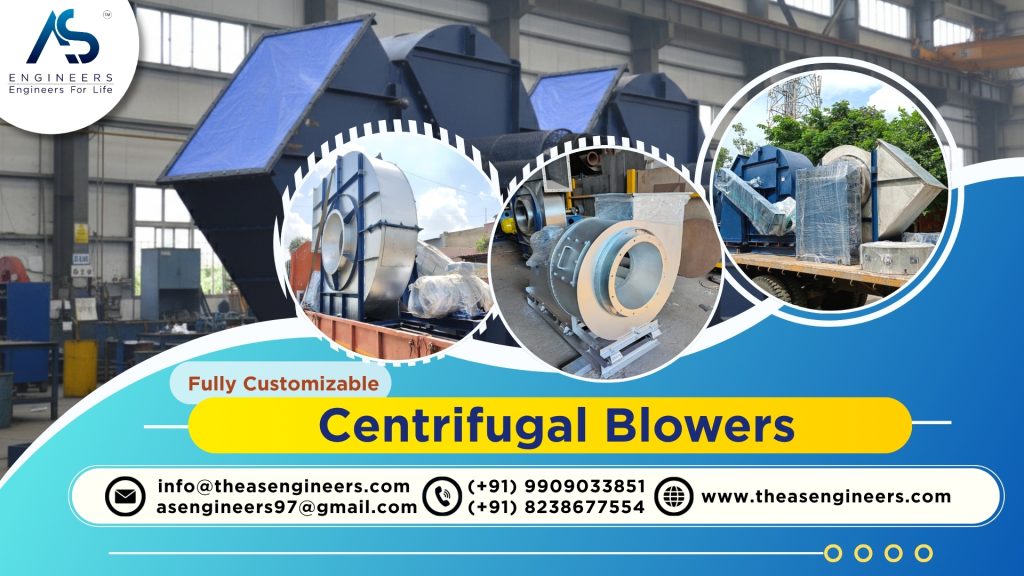
High Pressure Radial Blade Blower
When a plant engineer specifies a radial blade blower, the decision is usually not about efficiency — it is about what the blower has to survive. Pneumatic conveying lines carry abrasive powders at high velocity. Dust collection primary fans pull air directly from grinding, milling, or crushing operations before any pre-separation. Material handling systems move granules, fibres, or sticky product through the impeller. In all these applications, the aerodynamically superior impeller — backward curved or backward inclined — would fail quickly through uneven blade buildup, erosion, or imbalance.
The radial blade impeller is designed for these conditions. Straight blades, set perpendicular or near-perpendicular to the direction of rotation, produce the centrifugal force geometry that makes the design self-cleaning and abrasion-resistant. The efficiency trade-off is real and deliberate. A radial blade blower is the right machine when keeping the blower running reliably matters more than minimising power consumption.
AS Engineers manufactures high pressure radial blade blowers — designated PH type in our internal series — to IS 4894 (BIS) for pneumatic conveying, dust collection, combustion air supply, and high-pressure industrial process applications. Every unit is engineered from your duty data.

Air Flow
400 to 150000 CMH

Static Pressure
100 to 2000 MMWC

Temperature
Up to 200℃

Efficiency
Up to 85%

Performance Curve
Non-overloading power curve

Type of Construction
SWSI & DWDI
Why the Radial Blade Is Self-Cleaning — The Engineering Reason
Every impeller type handles particulate differently. The mechanism matters for specification decisions.
In a backward curved or backward inclined impeller, air travels along the concave face of the blade as it moves through the impeller. Particulate in the airstream follows this path and contacts the blade surface at an angle. Fine dust, sticky material, or fibrous content can adhere to the blade face and accumulate unevenly. Over time, this causes impeller imbalance, increased vibration, and performance degradation. The blade profile that gives BC and BI designs their efficiency advantage is also what makes them sensitive to particulate in the airstream.
A straight radial blade is oriented perpendicular to the impeller rotation. Particulate that contacts the blade surface hits it face-on and is immediately subject to full centrifugal force directed radially outward — away from the blade, toward the housing. There is no concave surface for particulate to settle into. The blade does not hold material. This is the physical mechanism behind the self-cleaning characteristic, and it is why radial blade impellers maintain their balance and performance profile over long service intervals in heavy-duty applications where BC or BI designs would require frequent cleaning and rebalancing.
The trade-off: radial blade designs achieve lower peak static efficiency than backward curved impellers at the same duty point. For a plant running 8,000 hours per year on a large motor, this difference in power consumption is real and should be evaluated. The correct approach is to confirm whether the operational conditions — particulate loading, abrasion potential, and material characteristics — genuinely require a radial blade, or whether a backward inclined design could handle the duty with better energy efficiency. AS Engineers will advise on this during technical review.
Open vs. Closed Impeller — Which Construction to Specify
Radial blade impellers are manufactured in both closed and open configurations. The choice is driven by the material being conveyed.
Closed impeller (with front plate) — Air is guided between the front plate (shroud) and the back plate through the full impeller width. This design produces higher static pressure at a given speed and is used for clean to moderately dust-laden airstreams, combustion air, and high-pressure process applications where the gas does not carry material that would jam between the shroud and blade tips.
Open impeller (material handling / paddle type) — No front plate. The blades are mounted directly on the back plate with no shroud on the inlet side. Fibrous material, stringy product, or large-particle material that would jam in a closed impeller passes through without blockage. Open impellers are used in dilute phase pneumatic conveying, paper and textile fibre handling, and material handling applications where the impeller must pass bulk material without plugging.
Paddle impeller — A specialised open-type radial design with broader, heavier blades. Used in high-concentration, high-abrasion applications where blade wear life is the primary concern.
The correct construction is confirmed during technical review of the application. Material characteristics — particle size, shape, concentration, moisture content, and abrasion index — all inform the choice.
Application Decision: When to Use Radial Blade Over Backward Curved or Inclined
| Application condition | Radial Blade | Backward Inclined | Backward Curved |
|---|---|---|---|
| Pneumatic conveying (dilute phase) | Yes — primary choice | No | No |
| Dust collection — primary fan (before separator) | Yes | No | No |
| Dust collection — secondary fan (after bag filter) | Possible | Preferred | Possible if clean |
| Heavy abrasive particulate (silica, fly ash, cement) | Yes | No | No |
| Sticky or fibrous material in airstream | Yes — open impeller | No | No |
| High static pressure (above 800 mmWC) | Yes — PH type | Possible | Less suitable |
| Clean air, energy efficiency critical | No — use BC | Possible | Yes — preferred |
| Moderate dust, up to ~20 mg/m³ | Possible | Preferred | No |
| Combustion air supply, high pressure | Yes | Yes | Possible |
| Material handling with bulk product passage | Yes — open impeller | No | No |
If your application falls in the middle of this table — moderate dust, moderate pressure — the Backward Inclined Blower or Backward Curved Blower may deliver better energy efficiency with adequate service life. Our engineers will recommend the correct type after reviewing your process data.
Answering the Efficiency Objection
Backward curved blowers are more efficient. For a clean-air application running a 100 kW motor, the difference between a backward curved and a radial blade design at the same duty point could represent 15 to 20 kW of additional power draw on the radial unit — a real operating cost that compounds over a plant’s lifecycle.
The case for specifying radial blade despite that penalty is service life and maintenance cost. A backward curved impeller in a pneumatic conveying line will accumulate uneven blade deposits within weeks of startup in many applications. The resulting vibration accelerates bearing wear, increases seal failures, and requires the blower to be pulled for cleaning and rebalancing — downtime that interrupts production.
A radial blade blower in the same application runs cleanly, maintains its balance, and may go months or years between service interventions. When that maintenance saving and production continuity is factored against the higher power consumption, the radial blade is often the lower total lifecycle cost option for heavy-duty applications — not just the more robust one.
Specify radial blade when the application demands it. Specify backward curved when it does not. If the duty is ambiguous, we will advise which way the numbers fall for your specific case.
Industries and Applications
Pneumatic Conveying. The dilute phase pneumatic conveying blower operates in one of the most demanding conditions for any rotating machine — high-velocity air carrying abrasive product particles at continuous concentration. Radial blade blowers, sized for the conveying velocity and pickup pressure of the system, are the standard choice. Open impeller construction is specified where product size or fibrous content requires it.
Cement Plants. Raw mill exhaust fans, separator fans, and coal mill fans in cement plants handle hot, dusty, abrasive air that would destroy a backward curved impeller within a short service period. Radial blade blowers — often with hard-faced leading edges — are specified for these positions. Closed impeller construction handles the high-pressure requirements of raw mill and separator duty; open paddle types handle positions with higher particulate concentration.
Chemical and Fertiliser Processing. Product dryer exhaust, granulator ventilation, and dust collection primary fans in chemical and fertiliser plants carry fine abrasive or reactive particulate. Radial blade blowers in MS or SS construction (based on gas corrosivity) handle these applications reliably.
Bag Filter Systems. The primary induced draft fan drawing from the dirty side of a bag filter — before the filtered air crosses to the clean side — sees high dust concentration and requires a radial blade design. After the bag filter, a backward inclined blower or backward curved blower is appropriate on the clean-air side.
Cyclone Separators. Where cyclones are used as primary separation before a bag filter, the radial blade blower serves as the primary draft fan drawing through the cyclone — handling the partially cleaned but still particle-laden airstream.
Power Plants. Fly ash handling, coal dust collection primary fans, and some combustion air positions where pressure requirement or particulate concentration exceeds what backward inclined designs can reliably handle over long service intervals.
Pulp and Paper. Fibre-handling fans in pulp processing carry wet, fibrous material that would jam a closed impeller. Open paddle-type radial blade impellers are specified for these applications.
General Industrial Dust Collection. Any primary exhaust fan drawing directly from a source of heavy abrasive dust — grinding, cutting, crushing, screening — is a radial blade application.
Materials of Construction
Material selection is driven by the combination of gas corrosivity, operating temperature, abrasion severity, and project documentation requirements.
- Mild Steel (MS) — standard plate and structural — For non-corrosive, ambient-to-moderate temperature applications. Heavy-gauge construction available for high-wear positions
- Hard Facing on blade leading edges — Applied to MS blades in high abrasion applications (silica, quartz, fly ash, cement clinker) to extend blade wear life without switching to a full alloy construction
- Wear-resistant liner plates — Housing liner plates in AR steel or ceramic can be fitted in positions with extreme abrasive wear
- SS 304 / SS 304L — Moderate corrosion resistance, light chemical exposure, food-adjacent applications
- SS 316 / SS 316L — Acidic gas streams, chloride environments, pharmaceutical plant exhaust. MTC and PMI documentation available for GMP projects
- SS 321 — Elevated temperature with oxidising gas
- Duplex SS 2205 — Aggressive corrosion, high chloride environments
- Carbon Steel / SA516 Gr.70 — Pressure-rated applications where IBR documentation is specified
All MOC selection is confirmed against gas analysis, operating temperature, and particulate composition before fabrication.
Drive Arrangements
- Belt-driven (Arrangement 1, 9) — Standard for most PH type blower applications. Belt drive allows speed adjustment via pulley ratio changes during commissioning and as process conditions evolve. Preferred for ID fan installations with variable process loads
- Direct-coupled (Arrangement 4) — Fixed-speed, compact installations. Lower transmission losses, less maintenance than belt drive, suitable where duty point is well-defined and VFD control is used for speed variation
- Coupling drive (Arrangement 8) — For higher-power applications requiring flexible shaft connection between motor and blower
- Arrangement 7 — Impeller between bearings; for large, heavy radial blade impellers where shaft deflection must be minimised
Variable frequency drive (VFD) compatibility is available for all arrangements. Specify at enquiry stage.
Testing and Quality Assurance
Every high pressure radial blade blower manufactured at AS Engineers is tested and documented before despatch:
- Dimensional inspection against approved GA drawing
- Blade thickness verification against specification
- Impeller dynamic balancing to ISO 1940-1, Grade G6.3 (standard) or G2.5 (precision)
- Hard facing thickness and hardness check where specified
- Performance test to IS 4894 — airflow, static pressure, and shaft power at duty point recorded
- Noise level measurement where specified
- PMI (positive material identification) for SS, alloy, and SA516 components where required
- Hydrotest on housing where pressure-rated construction is specified
- Third-party or client witness inspection on request
Test reports, balancing certificates, MTC, and PMI documentation provided as standard.
For blowers in service requiring performance restoration — including units not manufactured by us — our blower repair and overhaul service covers impeller replacement, blade hard-facing renewal, rebalancing, and performance testing to IS 4894 as found versus post-repair.
Frequently Asked Questions
What makes a radial blade blower self-cleaning?
The straight radial blade is oriented perpendicular (or near-perpendicular) to the direction of impeller rotation. Particulate that contacts a radial blade strikes it face-on and is immediately acted on by centrifugal force directed radially outward — away from the blade surface and toward the housing outlet. There is no concave blade surface for material to settle into or accumulate on. This contrasts with backward curved and backward inclined designs, where the blade curvature creates a surface that particulate can progressively build up on, causing impeller imbalance over time.
What is the difference between the High Pressure Radial Blade Blower and the Industrial Exhauster Radial Blower?
Both use radial blade impeller geometry, but they are designed for different duty positions. The High Pressure Radial Blade Blower (PH type) is engineered for high-pressure applications — pneumatic conveying, dust collection primary fans, combustion air supply — where static pressure requirements and particulate loading are both high. The Industrial Exhauster Radial Blower is designed for fresh air, light dust exhaust, and lower-pressure industrial exhaust positions. If your application involves heavy particulate or pressure above 500 mmWC, the PH type is the correct starting point.
When should I specify an open impeller instead of a closed impeller?
Specify an open (no front plate) impeller when the airstream carries fibrous, stringy, or large-particle material that would jam between the blade tips and the front shroud of a closed impeller. Typical open impeller applications: dilute phase pneumatic conveying of granular or fibrous product, paper fibre handling, textile waste extraction, and material handling systems where bulk product passes through the blower. For dust-laden but particle-free airstreams, a closed impeller is preferred as it generates higher static pressure at the same speed.
How does radial blade blower efficiency compare to backward curved or backward inclined?
Radial blade blowers operate at lower peak static efficiency than backward curved or backward inclined designs at the same duty point — typically in the range of 55 to 70%, compared to 75 to 85% for backward curved designs. This means more shaft power is required to move the same volume of air against the same pressure. The trade-off is justified when the application demands the durability, self-cleaning geometry, and abrasion resistance of a radial blade design. For clean or lightly dust-laden applications where a backward inclined blower would provide adequate service life, specifying radial blade simply to be conservative results in unnecessary operating cost over the plant lifecycle.
What information is needed to size and quote a high pressure radial blade blower?
Required inputs: airflow in m³/hr or CFM, static pressure in mmWC or Pa, gas temperature at blower inlet, altitude of installation, nature and concentration of particulate (type, size, specific gravity, moisture content, abrasion index if known), whether an open or closed impeller is preferred, drive type preference, and any MOC or documentation requirements. Partial data is acceptable — our engineers will work through the remaining parameters with you.
Get a Quote for Your Radial Blade Blower
Share your duty point and application details — airflow, pressure, temperature, and material handled — and we will respond with a technical recommendation and budgetary price within one working day.
Share your process data or call +91 99090 33851 / +91 82386 77554.
For dedicated high-pressure blower resources and application guidance, visit highpressureblower.in. For the full centrifugal blowers range including lower-pressure and clean-air types, see the product hub.