

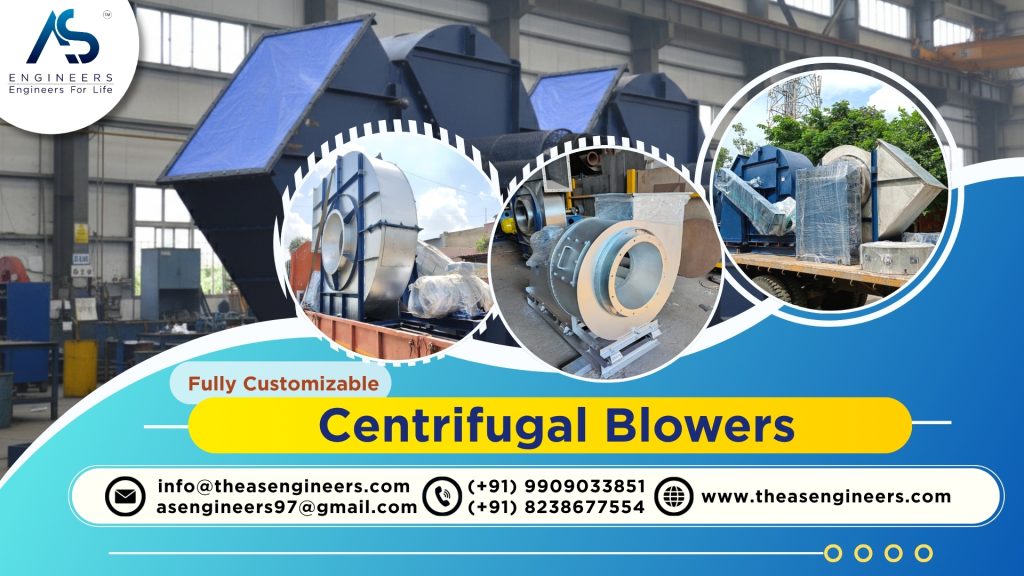
Make-To-Order Centrifugal Blower
Standard catalog selection works when the application fits within the performance curves a manufacturer has already optimised. Most applications do. But when the duty point falls outside those curves, when the gas composition rules out standard materials, when the installation geometry demands a non-standard drive arrangement, or when the project’s documentation requirements go beyond what a catalog product supports — standard selection fails, and engineering from first principles is the only route.
AS Engineers has manufactured make-to-order centrifugal blowers since 1997. Every blower we produce is designed to a specific duty point — there is no standard model being stretched to fit. Make-to-order is not a premium tier for us. It is how we build everything. The distinction on this page is that it covers applications where the requirement cannot be met by interpolating within an established range.
Submit your technical specification for review
Do You Need a Make-To-Order Blower? Five Triggers
Most buyers arrive on this page because a standard supplier has declined their enquiry, asked for a long lead time on a “special,” or sent a quotation based on the closest catalog model rather than the actual duty. The following conditions typically indicate a genuine make-to-order requirement.
1. Duty point falls outside standard range. Your required airflow, static pressure, or combination of both does not fit within the performance curves of standard catalog models. This commonly occurs in large-scale cement, steel, and power applications where single-fan duties exceed 2,00,000 m³/hr, and in high-pressure applications above 1,200 mmWC that require non-standard impeller geometry.
2. Gas composition rules out standard materials. The gas being handled is corrosive, reactive, or at a temperature that requires alloy steel, duplex stainless, FRP, or titanium construction — grades that standard catalog manufacturers do not hold in stock and cannot process without specialist fabrication capability.
3. Installation geometry is non-standard. The site layout requires a discharge orientation, motor position, drive arrangement, or dimensional envelope that standard models cannot accommodate. Retro-fit replacements for existing blowers from other manufacturers frequently fall in this category — the bolt pattern, shaft height, and connection dimensions are fixed by the existing installation.
4. Operating conditions are outside standard temperature or altitude limits. High-altitude sites where air density corrections change the duty significantly, or high-temperature applications above 300°C where standard construction is inadequate, require engineering calculations specific to the site conditions.
5. Documentation requirements exceed standard product scope. EPC projects, IBR-applicable applications, ATEX-classified environments, and pharmaceutical GMP installations require documentation — Quality Assurance Plan, PMI reports, third-party witness testing, H-T and P-T performance curves — that only a custom-engineered blower can support with traceability from material to test.
If your requirement includes any of the above, standard catalog selection is not the right approach. If you are unsure, share your duty data and we will confirm whether the requirement falls within or outside standard design territory.
The Engineering Design Process – What Happens After You Send Your Data
The difference between catalog selection and engineering from first principles is in the calculation sequence. Here is what AS Engineers does with your process data.
Step 1 — Duty data collection and verification. Required inputs: discharge capacity (m³/hr or CFM), static pressure (mmWC or Pa), operating temperature (°C), operating medium (gas composition, density, dust content, humidity), operating speed and drive arrangement preference, and installation altitude if above approximately 500 metres above mean sea level. Where process data is incomplete, we perform custom analysis to derive the missing parameters from available information.
Step 2 — Specific speed calculation. The dimensionless specific speed (Nss) is calculated from the confirmed duty point — airflow, pressure, and speed. This value determines which impeller type is aerodynamically optimal for the duty: radial blade for high pressure, backward curved for high volume and efficiency, backward inclined for the balance of both. Where two impeller types produce similar specific speed values, the higher efficiency option is selected unless other application constraints override.
Step 3 — Fan curve analysis and impeller sizing. The appropriate performance curve series is selected based on specific speed. Impeller diameter, blade geometry, housing width, and tip speed are calculated to place the duty point at or near the peak efficiency point of the selected curve. Tip speed is verified against the material’s allowable stress limit at operating temperature. Noise level is estimated and checked against any specified limit.
Step 4 — BHP calculation at 20°C and at operating temperature. Shaft power is calculated at both standard reference temperature (20°C) and at actual operating temperature. Gas density at operating temperature is factored into both the performance and the motor selection. Motor frame and power rating are confirmed against the operating temperature BHP with an appropriate service factor.
Step 5 — Mechanical design. Material of construction is selected based on gas analysis, temperature, and documentation requirements. Drive arrangement (belt, direct, coupling), bearing selection, shaft diameter, and seal type are confirmed. Accessories — expansion bellows, cooling disc, stuffing box, shaft seal, damper, guards — are selected based on the application.
Step 6 — Quotation and GA drawing. A detailed techno-commercial quotation is prepared showing all selected parameters, materials, documentation scope, lead time, and price. On order placement, a General Arrangement (GA) drawing is prepared and submitted for customer approval before production begins. Production does not start until the approved GA is on file.
Step 7 — Fabrication with in-house CNC plasma cutting. All structural components are cut on our in-house CNC plasma cutting machine for dimensional precision. Impeller and housing are fabricated to the approved GA drawing.
Step 8 — Balancing and performance testing. Impeller is dynamically balanced to ISO 1940-1, Grade G6.3 or G2.5 as specified. Performance is tested to IS 4894 — airflow, static pressure, and shaft power measured at the duty point using manometer, pitot tube, digital tachometer, vibration meter, and sound meter. For sealed blowers with mechanical shaft seals, soap-bubble leak testing is performed. For applications requiring airtight closed-loop operation with 0% air leakage, we operate a dedicated closed-loop test facility.
Verified Capability Range
These are verified figures from blowers AS Engineers has actually supplied and tested — not theoretical maximums.
| Parameter | Supplied Range | Design Capability |
|---|---|---|
| Airflow capacity | 100 m³/hr to 2,00,000 m³/hr | Up to 10,00,000 m³/hr |
| Static pressure | 25 mmWC to 1,900 mmWC | Up to 2,000 mmWC |
| Impeller diameter | 300 mm to 2,000 mm | Larger on review |
| Fan speed | 300 RPM to 4,000 RPM | |
| Motor power | 0.25 HP to 475 HP | 500 HP+ available |
| Operating temperature | Ambient to 650°C | |
| Balancing grade | ISO 1940-1 Grade G6.3 / G2.5 | |
| Testing standard | IS 4894 |
For requirements at the upper end of these ranges or beyond them, contact us with your full duty specification. We will confirm feasibility and lead time before committing to a quotation.
Materials of Construction
The full MOC range available for make-to-order blowers reflects the breadth of applications AS Engineers has supplied across 27+ years. Material is selected based on gas analysis, temperature, corrosion potential, abrasion severity, and regulatory requirements — never on availability or convenience.
| Material | Typical Application |
|---|---|
| Mild Steel (MS) | Non-corrosive gas, ambient to moderate temperature |
| SS 202 | Economy stainless, mild corrosion exposure |
| SS 304 / SS 304L | Moderate corrosion, food-adjacent environments |
| SS 316 / SS 316L | Acid fumes, chloride environments, pharma GMP (MTC + PMI) |
| SS 410 | Abrasion + corrosion resistance combined |
| EN-8 | Shafts and structural components requiring high tensile strength |
| SS-2205 Duplex Steel | Aggressive corrosion, chloride stress cracking risk |
| HSLA | High-strength low-alloy for large impellers where weight is a constraint |
| DOMEX-700 / WELDOX | High-strength wear-resistant structural steel |
| QUEND-690 | Abrasion-resistant steel for heavy-wear impeller positions |
| FRP | Highly corrosive gas streams where SS grades are inadequate |
| Titanium | Extreme corrosion where FRP temperature limits are exceeded |
Hard facing on impeller blade leading edges is available for abrasive applications where extending blade wear life is preferable to full AR steel construction.
Documentation Scope
Make-to-order blowers for EPC, infrastructure, pharma, and regulated projects require documentation that goes beyond a standard dispatch note. The following documents are available from AS Engineers as part of the make-to-order supply scope.
- General Arrangement (GA) drawing — issued for customer approval before production
- Quality Assurance Plan (QAP) — prepared as required by project specifications
- Dynamic balancing certificate — ISO 1940-1 grade achieved, with before and after readings
- Material Test Certificate (MTC) — mill TC for impeller, shaft, and housing materials
- Shaft Ultrasonic Test (UT) report — for large-diameter shafts where specified
- PMI (Positive Material Identification) report — for all SS and alloy components
- IS 4894 performance test report — airflow, static pressure, power at duty point
- H-T (Head-Temperature) curve — performance at different temperatures
- P-T (Pressure-Temperature) curve — pressure rating at operating conditions
- Mechanical run test report — extended run at duty point with vibration and temperature readings
- Soap-bubble leak test report — for sealed blowers with mechanical shaft seals
- Noise level measurement report — where dB limit is specified in the purchase order
- Third-party / client witness inspection — coordination available on request
All documentation requirements must be specified at the enquiry stage to ensure they are built into the QAP and manufacturing sequence. Retrospective documentation for items not planned from the start cannot always be provided.
Who Typically Orders Make-To-Order Blowers
EPC Contractors and Project Consultants. Engineering, procurement, and construction companies working on greenfield or brownfield industrial projects frequently encounter blower specifications that fall outside standard catalog ranges — particularly in cement, steel, chemical, and power plant projects where process fan duties are defined by the process engineer, not by a manufacturer’s available range.
Pharma and Chemical Plants with Regulatory Requirements. GMP-regulated pharmaceutical plants and REACH-compliant chemical facilities require blowers with full material traceability, PMI documentation, and construction in verified SS 316L. These requirements cannot be met by a standard catalog product and require a make-to-order approach from material procurement through performance testing.
Retro-fit and Replacement Enquiries. When an existing blower from any manufacturer fails or reaches end of life, the replacement must match the installed dimensions and connections — shaft height, flange dimensions, bolt pattern, rotation direction, and discharge orientation. AS Engineers creates production drawings of any existing fan or blower on site and manufactures the replacement to match, including performance improvements where the original design is inefficient.
High-Temperature Process Applications. Kiln, furnace, heat recovery, and drying applications above 300°C require High Temperature Plug Blowers with construction packages specific to the operating temperature. These are inherently make-to-order because no manufacturer carries high-temperature blowers at every temperature rating and size combination in stock.
Unusual Gas Compositions. Applications handling aggressive or hazardous gas — acid vapours, solvent-rich streams, pyrophoric material exhaust, or gas requiring spark-resistant construction — require engineering review before any material or construction commitment is made. These enquiries are always handled as make-to-order.
Large-Volume Single-Fan Duties. At very high airflow duties — above 2,00,000 m³/hr in a single machine — standard catalog performance curves do not extend to the required duty. Large impeller diameter, low speed, double-width construction, and custom shaft design are all required and must be calculated specifically for the duty.
Make-To-Order vs. Standard Blower — How to Know Which You Need
| Requirement | Standard Catalog | Make-To-Order |
|---|---|---|
| Duty point within published performance curves | Yes | — |
| Non-standard airflow + pressure combination | — | Yes |
| Standard MS or SS 304/316 construction | Yes | — |
| Exotic alloy, FRP, or titanium required | — | Yes |
| Standard discharge orientation and drive arrangement | Yes | — |
| Non-standard layout, retro-fit dimensional match | — | Yes |
| Basic MTC and balancing certificate sufficient | Yes | — |
| QAP, PMI, UT, H-T/P-T curves, witness test required | — | Yes |
| Temperature within 0°C to 250°C (standard range) | Yes | — |
| Temperature above 250°C or below ambient (dense gas) | — | Yes |
| Altitude at or near sea level | Yes | — |
| High altitude with density correction required | — | Yes |
| Standard lead time acceptable | Yes | — |
| Dimensional match to existing installed equipment | — | Yes |
If your requirement falls in the Make-To-Order column on two or more rows, a custom engineering approach is almost certainly necessary.
Frequently Asked Questions
What is the minimum information needed to start a make-to-order blower enquiry?
The core inputs are: airflow required (m³/hr or CFM), static pressure (mmWC or Pa), operating temperature at the blower inlet, nature of the gas being handled (composition, dust content, moisture level, any corrosive components), preferred drive arrangement, and any documentation requirements. If some data is unavailable — for example, where the process is still being defined — share what is confirmed and our engineers will work with you to derive or estimate the remaining parameters. We can also perform a site survey or process review for large projects where duty data needs to be established.
How long does the make-to-order design and manufacturing process take?
Lead time depends on complexity, motor power, and material of construction. A make-to-order blower in MS construction in the range of 10–75 HP typically requires 5 to 7 weeks from GA drawing approval to despatch. SS or alloy steel construction, larger motor frames, or extensive documentation scope (QAP, PMI, third-party inspection) extend lead time to 8 to 12 weeks. High-temperature construction above 350°C is reviewed case by case. Lead time is confirmed at the time of order placement after GA drawing is agreed.
Can you reverse-engineer and replace a blower made by another manufacturer?
Yes. Our team can create production drawings of any existing blower or fan, matching shaft height, discharge orientation, flange bolt pattern, inlet dimensions, and drive arrangement. We can simultaneously improve the impeller design if the original was inefficient or if the process conditions have changed since the original blower was installed. Provide photographs, dimensional data, and the nameplate data (airflow, pressure, motor HP, RPM) from the existing machine and we will confirm feasibility.
What is the IS 4894 performance test, and what does it confirm?
IS 4894 is the Bureau of Indian Standards specification for testing centrifugal fans and blowers. It defines the test duct assembly, instrumentation, measurement method, and data reporting required to confirm that a blower delivers its rated airflow and static pressure at its rated shaft power. AS Engineers tests every blower — including make-to-order units — to IS 4894 before despatch, using a duct assembly, manometer, pitot tube, digital tachometer, vibration meter, sound meter, and digital clamp meter. The test report states measured airflow, static pressure, and power at the duty point, with a comparison against the specified values. For make-to-order blowers with H-T or P-T curve requirements, testing is performed at multiple operating points and the results are plotted to generate the required curves.
Do you provide an Annual Maintenance Contract (AMC) for make-to-order blowers after supply?
Yes. AS Engineers offers AMC contracts for all blowers we supply, including make-to-order units. The AMC scope is designed specifically for the blower — accounting for its operating conditions, bearing specification, seal type, and access requirements — rather than applying a generic maintenance schedule. AMC typically includes periodic site visits, performance measurement, vibration analysis, bearing and seal inspection, and priority access to spare parts. AMC terms are discussed at the time of order placement or post-commissioning.
Submit Your Make-To-Order Blower Requirement
Share your duty specification — airflow, static pressure, temperature, gas composition, and any documentation requirements — and we will review it within one working day and come back with a technical assessment and indicative timeline.
For requirements that fall outside even our standard make-to-order range, we will tell you honestly rather than commit to a specification we cannot meet.
Submit your technical specification or call +91 99090 33851 / +91 82386 77554.
You can also review our full centrifugal blower range to confirm whether a standard type meets your requirement before proceeding to make-to-order. For blower repair and overhaul service for existing blowers, including those from other manufacturers, see our service page.