
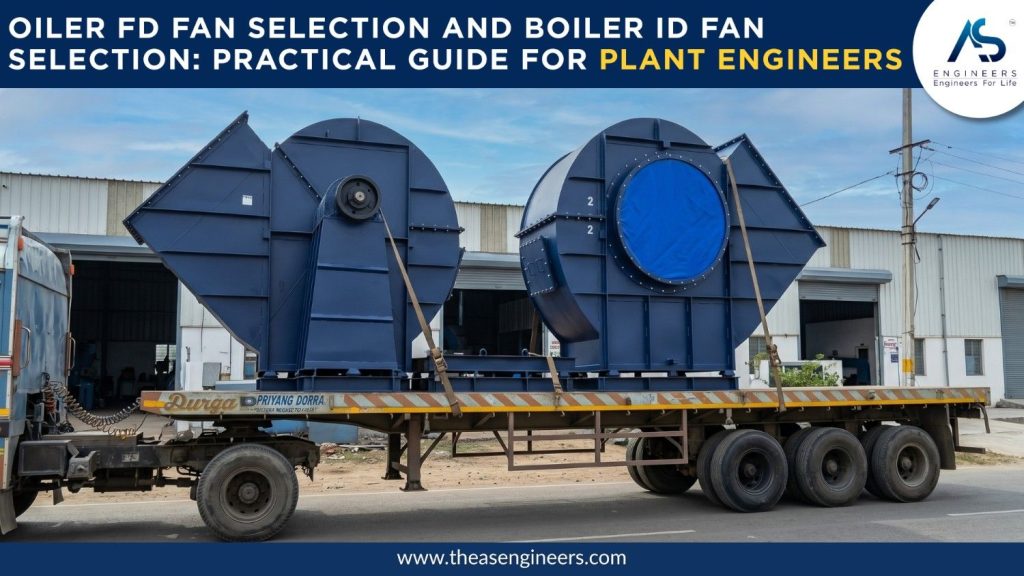
Boiler FD Fan Selection and Boiler ID Fan Selection: Practical Guide for Plant Engineers

oiler FD fan selection and boiler ID fan selection should never be done only from motor HP, old fan size, or approximate CFM. A boiler FD fan must supply the correct combustion air against system resistance. A boiler ID fan must pull flue gas through the boiler, heat recovery equipment, pollution control system, ducting, and chimney while maintaining stable draft.
For a correct selection, plant teams must share airflow, static pressure, temperature, fuel type, dust load, gas composition, duct layout, control method, motor details, and site operating conditions before asking for a quotation.
At AS Engineers, boiler fan selection is treated as a duty-specific engineering decision. A forced draft fan and an induced draft fan work together, but they do not face the same operating conditions. That difference changes impeller design, MOC, motor sizing, control philosophy, maintenance planning, and RFQ data.
For broader fan basics, you can also refer to AS Engineers’ guide on ID and FD fans and the dedicated page on boiler fan and ID fan manufacturing.
What is an FD fan in a boiler?
An FD fan, or forced draft fan, pushes fresh air into the boiler furnace for combustion. It is normally installed on the air inlet side of the boiler system and works under positive pressure.
In most boiler applications, the FD fan handles cleaner air compared to the ID fan. However, that does not mean selection is simple. The fan must supply enough air at the required pressure after considering duct losses, damper losses, air preheater resistance, windbox resistance, burner pressure drop, and load variation.
A boiler FD fan is commonly used in:
- Steam boilers
- Thermic fluid heaters
- Hot air generators
- Biomass boilers
- Coal-fired boilers
- Oil and gas-fired boilers
- Process heaters
- Captive power plant boiler systems
For detailed combustion air and boiler fan context, connect this page with AS Engineers’ fans for power plants guide.
What is an ID fan in a boiler?
An ID fan, or induced draft fan, pulls flue gas from the boiler outlet side and discharges it toward the chimney or downstream pollution control system. It normally works on the suction side and helps maintain negative draft inside the furnace and flue gas path.
The ID fan usually faces more difficult operating conditions than the FD fan because it may handle hot flue gas, fly ash, moisture, acidic gases, fumes, and abrasive dust depending on the fuel and process.
A boiler ID fan may pull gas through:
- Boiler passes
- Economizer
- Air preheater
- Ducting and bends
- Cyclone separator
- Bag filter
- ESP
- Wet scrubber
- Chimney or stack
For deeper ID fan design criteria, refer to the AS Engineers ecosystem guide on ID fan design and selection criteria.
FD fan vs ID fan in boiler selection
| Selection Point | Boiler FD Fan | Boiler ID Fan |
|---|---|---|
| Main duty | Push combustion air into the boiler | Pull flue gas out of the boiler |
| Pressure condition | Positive pressure on air side | Negative draft on furnace/flue gas side |
| Gas handled | Usually fresh air or preheated air | Hot flue gas, dust, ash, fumes, moisture |
| Temperature risk | Lower, unless air is preheated | Higher, depends on boiler and downstream system |
| Dust and abrasion | Usually low | Can be high in coal, biomass, and solid fuel boilers |
| Corrosion risk | Usually low | Can be high with sulphur, moisture, acidic gas, or wet scrubber duty |
| Main selection focus | Combustion air quantity, burner/windbox pressure, duct loss | Flue gas volume, draft requirement, equipment pressure drop, dust load |
| Common fan type | Backward curved or backward inclined centrifugal fan | Radial blade, backward inclined, or high-temperature centrifugal fan |
| Common mistake | Selecting only by boiler capacity | Ignoring actual flue gas temperature, dust load, and system resistance |
The FD fan and ID fan must be selected as part of the same boiler draft system. If the FD fan pushes more air than the ID fan can safely remove, furnace pressure can become unstable. If the ID fan pulls too much draft, combustion stability and fuel efficiency may suffer.
Balanced draft matters more than fan size alone
A boiler draft system is not only about fan capacity. It is about maintaining controlled air movement across the furnace, combustion zone, heat transfer path, pollution control equipment, and chimney.
In a balanced draft boiler, the FD fan supplies combustion air while the ID fan maintains negative pressure by removing flue gas. The aim is stable combustion, controlled furnace pressure, safe gas movement, and reliable exhaust through the stack.
When I review a boiler fan requirement, I do not start with “what HP fan is needed?” I first check the boiler duty, fuel, air requirement, flue gas path, pressure drop, operating temperature, dust load, control method, and whether the existing fan is failing because of the fan or because of system resistance.
Motor HP is the result of correct selection. It should not be the starting point.
Boiler FD fan selection criteria
Combustion air requirement
The first input for FD fan selection is the required combustion air. This depends on boiler capacity, fuel type, burner design, excess air requirement, and load range.
Coal, biomass, oil, gas, and process waste fuels do not behave the same. A biomass boiler may need a different air distribution approach than a gas-fired boiler. A stoker-fired boiler may require different pressure and distribution than a burner-based system.
Share these inputs before FD fan selection:
| FD Fan Input | Why it matters |
|---|---|
| Boiler capacity | Helps estimate full-load air demand |
| Fuel type | Affects combustion air quantity and control range |
| Burner or grate type | Changes pressure requirement and air distribution |
| Required airflow | Defines the fan capacity at duty point |
| Static pressure | Defines resistance through duct, damper, APH, windbox, burner |
| Ambient temperature | Affects air density and mass flow |
| Site altitude | Affects density and fan performance |
| Control method | VFD, damper, inlet guide vane, or burner management control |
| Motor voltage and frequency | Required for motor selection |
| Noise limits | Important for boiler house and plant boundary conditions |
Static pressure and system resistance
FD fan static pressure must account for complete air-side resistance. Do not consider only straight duct length.
Include pressure losses from:
- Louvers or inlet screens
- Silencer
- Duct length
- Bends and elbows
- Dampers
- Expansion joints
- Air preheater
- Windbox
- Burner register
- Nozzle or grate air path
A fan selected without proper resistance data may show good performance on paper but poor air delivery after installation.
Fan type and impeller design for FD fan
For many boiler FD fan applications, backward curved or backward inclined centrifugal fans are preferred because they offer good efficiency and stable operation for clean air duty.
In higher pressure applications, fan geometry must be reviewed more carefully. A high-pressure radial blade blower may be considered where pressure demand is high or where the system has a compact, high-resistance air path.
AS Engineers manufactures industrial centrifugal blowers, including backward curved blowers, backward inclined blowers, high-pressure radial blade blowers, exhauster radial blowers, high-temperature plug blowers, and exhauster air handling blowers. For product-level routing, use the centrifugal blower page.
FD fan control method
Boiler load changes throughout operation. The FD fan must support that variation without causing unstable combustion or high power consumption.
Common control options include:
| Control Method | Best suited for | Selection caution |
|---|---|---|
| Outlet damper | Basic flow control | Wastes energy if fan runs full speed continuously |
| Inlet damper | Better than outlet throttling in some cases | Must account for inlet disturbance |
| VFD | Variable boiler load and energy control | Motor, fan curve, minimum speed, and control logic must be checked |
| Burner control integration | Automated boiler operation | Requires coordination with boiler OEM or control vendor |
For replacement fans, share existing damper position during normal operation. A fan running with the damper almost closed may be oversized. A fan running with damper fully open and still giving low air may be undersized or facing higher-than-expected system resistance.
Boiler ID fan selection criteria
Flue gas volume at actual operating condition
ID fan selection must be based on actual flue gas volume at fan inlet temperature, not only standard air volume.
Hot gas has lower density. If temperature and density are ignored, the fan may fail to deliver the expected draft. This is a common reason for poor suction after installation.
Share these inputs for ID fan selection:
| ID Fan Input | Why it matters |
|---|---|
| Flue gas volume | Defines fan capacity at actual condition |
| Gas temperature | Affects density, MOC, bearing arrangement, shaft design |
| Static pressure | Defines total resistance through boiler and downstream equipment |
| Fuel type | Influences dust, ash, sulphur, moisture, corrosion risk |
| Dust load | Affects impeller wear, erosion, cleaning interval |
| Gas composition | Helps assess corrosion and material compatibility |
| Moisture content | Can create condensation and buildup risk |
| Boiler draft requirement | Ensures stable furnace suction |
| Downstream equipment | Bag filter, cyclone, scrubber, ESP, chimney resistance |
| Duct layout | Bends, transitions, and inlet condition affect fan performance |
| Control method | VFD, damper, or draft control system |
| Existing fan data | Useful for retrofit or troubleshooting |
Pressure loss through the full flue gas path
An ID fan does not only pull gas from the boiler outlet. It must overcome the pressure loss of the complete flue gas path.
Consider resistance from:
- Boiler passes
- Economizer
- Air preheater
- Duct bends
- Dampers
- Expansion joints
- Cyclone
- Bag filter
- ESP
- Wet scrubber
- Silencer
- Chimney or stack
- Any future pollution control addition
If a bag filter or scrubber is added later without checking ID fan margin, the existing fan may fail to maintain draft. This is why retrofit projects should review the fan and the entire system together.
For downstream air pollution equipment, AS Engineers also manufactures pollution control equipment including bag filters, cyclone separators, and scrubbers.
Temperature, dust, and MOC
ID fan MOC is more critical than FD fan MOC because the ID fan may handle hot, dusty, or corrosive flue gas.
Possible MOC and protection considerations include:
| Operating Condition | Selection Consideration |
|---|---|
| Clean, low-temperature gas | Standard MS or carbon steel may be suitable, subject to duty review |
| Hot flue gas | Temperature-rated casing, shaft, bearing, expansion allowance |
| Dust-laden gas | Wear-resistant impeller design, hard-facing, access for cleaning |
| Biomass ash | Check buildup, erosion, and moisture-related deposits |
| Coal fly ash | Abrasion-resistant impeller and casing protection may be required |
| Sulphur-bearing fuel | Corrosion risk and acid dew point must be checked |
| Wet scrubber outlet | Moisture and corrosion resistance become important |
| High-temperature process duty | High-temperature plug blower or custom configuration may be required |
Do not finalize MOC only from old drawings. Review the actual fuel, gas temperature, dust load, moisture, corrosion risk, and maintenance history.
For high-temperature fan applications, see AS Engineers’ high temperature plug blower page.
Which fan type is suitable for boiler FD and ID duty?
| Fan Type | Boiler FD Fan Use | Boiler ID Fan Use | Notes |
|---|---|---|---|
| Backward curved centrifugal fan | Suitable for clean air and efficient FD duty | Suitable in cleaner flue gas with correct MOC | Good efficiency, lower dust tolerance than radial blade |
| Backward inclined fan | Suitable for many combustion air duties | Suitable for moderate dust duty with correct design | Stable industrial fan option |
| Radial blade blower | Used when higher pressure or rugged duty is needed | Strong option for dusty and abrasive flue gas | Lower efficiency than backward curved in some cases, but rugged |
| High-temperature plug blower | Not common for normal FD duty | Useful for high-temperature gas handling | Needs temperature-specific design review |
| Axial fan | Usually not preferred for high-resistance boiler draft | Usually not preferred for boiler ID duty | More suitable for low-resistance ventilation duties |
AS Engineers’ centrifugal blower range is used across power plants, steel and metals, fertilizer and chemical plants, refineries, petrochemicals, cement plants, and food processing applications. The AS Engineers catalog lists power plant applications including induced draft fans, forced draft fans, primary air fans, secondary air fans, scanner cooling fans, aeration fans, and FES system fans.
Boiler fan RFQ checklist
Use this checklist before asking for a boiler FD fan or boiler ID fan quotation.
Boiler and process data
| Data Required | FD Fan | ID Fan |
|---|---|---|
| Boiler capacity | Yes | Yes |
| Fuel type | Yes | Yes |
| Steam generation or heat duty | Yes | Yes |
| Boiler OEM drawing if available | Yes | Yes |
| Existing fan datasheet | For replacement | For replacement |
| Operating load range | Yes | Yes |
| Continuous or batch operation | Yes | Yes |
Air and gas data
| Data Required | FD Fan | ID Fan |
|---|---|---|
| Airflow or gas flow | Yes | Yes |
| Static pressure | Yes | Yes |
| Temperature at fan inlet | Yes | Yes |
| Gas composition | Usually no | Yes |
| Dust load | Usually no | Yes |
| Moisture content | Usually no | Yes |
| Density or actual operating condition | Yes | Yes |
| Site altitude | Yes | Yes |
Mechanical and installation data
| Data Required | Why it matters |
|---|---|
| Inlet and outlet orientation | Prevents duct mismatch during installation |
| Direct or belt drive preference | Affects maintenance and alignment |
| Motor voltage and frequency | Required for correct motor selection |
| Foundation details | Important for vibration control |
| Available space | Critical in retrofit projects |
| Duct layout drawing | Helps identify system effect and pressure loss |
| Damper or VFD requirement | Affects control selection |
| Accessories | Guards, bellows, drain, inspection door, silencer, cooling disc, seals |
For service, retrofit, impeller inspection, balancing, and alignment, use AS Engineers’ centrifugal blower services page.
Common mistakes in boiler FD fan selection
Selecting the FD fan only from boiler capacity
Boiler capacity is only the starting point. The fan must be selected from actual combustion air requirement and air-side pressure drop.
Ignoring burner or windbox resistance
A fan may deliver airflow in open discharge conditions but fail after connection to the burner or windbox if pressure drop is underestimated.
Not checking altitude and temperature
Air density changes with temperature and altitude. If site conditions differ from standard assumptions, the fan performance must be corrected.
Oversizing for “safety”
Oversizing may look safe during procurement, but it can create poor control, higher power use, noise, vibration, and inefficient operation.
Treating damper control as a complete solution
A damper can control flow, but it does not correct wrong fan selection. If a fan is far from its duty point, damper throttling becomes a long-term operating cost.
Common mistakes in boiler ID fan selection
Using standard volume instead of actual hot gas volume
ID fan capacity should be reviewed at actual fan inlet condition. Hot gas density changes the fan duty.
Ignoring dust load and ash erosion
Coal, biomass, and some process fuels can create high dust and ash loading. The wrong impeller design may lead to fast wear and imbalance.
Underestimating pollution control pressure drop
Bag filters, cyclones, scrubbers, ESPs, and ductwork add resistance. A new pollution control system can overload an old ID fan if pressure loss is not included.
Ignoring corrosion risk
Sulphur, moisture, acidic gases, and condensation can damage casing and impeller surfaces. MOC must be selected from real gas composition, not only temperature.
Replacing the motor without checking the fan
If the ID fan is not maintaining draft, the answer is not always a bigger motor. The issue may be duct blockage, bag filter pressure drop, impeller buildup, erosion, damper position, wrong fan curve, or system effect.
For more boiler-specific ID fan reading, refer to the AS Engineers ecosystem page on boiler ID fan functionality and importance.
Replacement boiler fan selection: what to check first
For retrofit or replacement, collect operating evidence before deciding the new fan size.
Check:
- Existing fan nameplate
- Existing motor HP, RPM, voltage, and current
- Damper position at normal load
- Furnace draft reading
- Static pressure before and after fan
- Gas temperature at fan inlet
- Dust buildup on impeller
- Bearing temperature
- Vibration reading
- Belt condition or coupling alignment
- Duct condition
- Bag filter or scrubber pressure drop
- Chimney draft condition
- Any recent process change
If the existing fan failed after a new bag filter, scrubber, duct modification, fuel change, or boiler load increase, the fan should not be replaced with the same model blindly. The full system resistance must be recalculated.
Maintenance and EHS-aware selection points
Boiler fans operate near heat, rotating machinery, duct suction, pressure zones, and electrical drives. Selection should include maintenance access and safe isolation planning.
Important points include:
- Provide guards for rotating parts.
- Keep inspection doors accessible.
- Provide access for impeller cleaning.
- Check bearing location against heat exposure.
- Use expansion joints where thermal movement is expected.
- Plan drain points where condensation may occur.
- Ensure vibration monitoring access.
- Consider noise control where operators work nearby.
- Use proper lockout procedure before maintenance.
- Avoid operating near surge, unstable flow, or heavy damper throttling.
A technically correct fan that is difficult to inspect or service can still become a reliability problem later.
Practical selection path AS Engineers follows
For a boiler FD or ID fan requirement, the practical selection path is:
| Step | What is reviewed |
|---|---|
| Duty confirmation | FD, ID, PA, SA, burner air, exhaust, or retrofit duty |
| Air/gas data | Flow, pressure, temperature, density, dust, moisture, gas composition |
| Boiler and system layout | Ducting, equipment resistance, chimney, pollution control system |
| Fan type | Backward curved, backward inclined, radial blade, high-temperature design |
| MOC | MS, CS, SS, alloy, hard-facing, coating, or special construction |
| Motor and drive | RPM, HP/kW, service factor, direct or belt drive, VFD compatibility |
| Accessories | Damper, bellows, guards, inspection door, drain, seal, cooling disc |
| Installation review | Foundation, orientation, space, maintenance access |
| Testing and support | Performance review, balancing, alignment, documentation, service support |
AS Engineers’ catalog identifies blower selection factors such as application, density, temperature, dust load, humidity, site location, altitude, MOC, impeller blade design, motor mounting arrangement, capacity, static pressure, RPM, power, noise, and speed limitation.
Fit and no-fit guidance
| Situation | Recommended direction |
|---|---|
| New boiler installation | Select FD and ID fans from complete boiler duty sheet |
| Boiler retrofit | Review existing fan data and new system resistance |
| Added bag filter or scrubber | Recalculate ID fan pressure requirement |
| Fuel changed from gas to biomass or coal | Recheck ID fan dust, erosion, and MOC |
| Poor furnace draft | Check ID fan, ducting, damper, APC equipment, and chimney |
| High motor current | Check fan curve, damper position, system resistance, impeller buildup |
| Repeated bearing failure | Check alignment, balance, foundation, temperature, and operating point |
| Only motor HP is available | Do not finalize selection. Collect flow and pressure data first |
FAQs
What is the difference between boiler FD fan and boiler ID fan?
A boiler FD fan pushes fresh combustion air into the boiler furnace. A boiler ID fan pulls hot flue gas out of the furnace and moves it through the flue gas path toward the chimney or pollution control system. The FD fan usually handles cleaner air, while the ID fan may handle hot, dusty, and corrosive flue gas.
Which data is required for boiler FD fan selection?
For boiler FD fan selection, provide boiler capacity, fuel type, combustion air requirement, airflow, static pressure, air temperature, site altitude, burner or windbox pressure drop, duct layout, damper or VFD requirement, motor voltage, and operating load range.
Which data is required for boiler ID fan selection?
For boiler ID fan selection, provide flue gas volume at actual fan inlet condition, gas temperature, static pressure, fuel type, dust load, gas composition, moisture content, downstream equipment pressure drop, chimney details, duct layout, motor details, and control method.
Can one fan be used as both FD fan and ID fan?
No. FD and ID fans perform different duties. The FD fan pushes combustion air into the boiler, while the ID fan pulls flue gas out of the boiler. Their temperature, gas composition, pressure, dust load, corrosion risk, and impeller requirements are different.
Why does a boiler ID fan lose performance after some months?
A boiler ID fan may lose performance due to impeller dust buildup, fly ash erosion, bearing issues, duct leakage, bag filter pressure rise, scrubber pressure drop, damper problems, corrosion, vibration, or operation away from the selected duty point. The full system should be inspected before replacing only the motor or impeller.
Conclusion
Boiler FD fan selection and boiler ID fan selection require complete duty data, not guesswork. The FD fan must supply combustion air at the required pressure. The ID fan must pull flue gas through the boiler, heat recovery equipment, pollution control system, ducting, and chimney while maintaining stable draft.
Before finalizing a boiler fan, share airflow, static pressure, temperature, fuel, dust load, gas composition, duct layout, site condition, control method, motor details, and existing fan data if it is a replacement. AS Engineers can review the application and recommend a duty-specific centrifugal fan, blower, impeller, MOC, arrangement, retrofit, or service approach based on actual operating conditions.
For technical discussion, use the AS Engineers contact page or share the boiler fan duty sheet with the AS Engineers team.
