
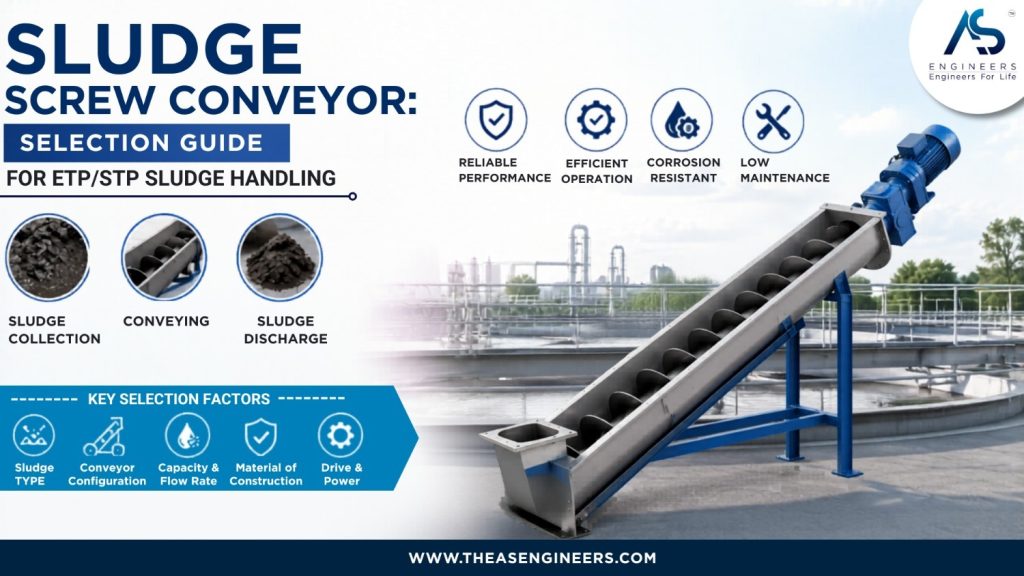
Sludge Screw Conveyor: Selection Guide for ETP/STP Sludge Handling

A sludge screw conveyor is used to transfer wet sludge, dewatered sludge cake, biosolids, filter press cake, or ETP/STP sludge from one process point to another. In sludge drying plants, it often works between the dewatering machine and the dryer, or after the dryer for dried product handling.
The main selection mistake is treating sludge like dry powder. Sludge can be sticky, abrasive, corrosive, fibrous, odorous, and inconsistent in moisture. The conveyor must be selected around actual sludge behavior, not only around motor HP or length.
At AS Engineers, sludge screw conveyor selection is usually reviewed along with the complete sludge handling and drying line, especially when the conveyor is feeding a sludge dryer manufacturer system or a paddle dryer.
What is a sludge screw conveyor?
A sludge screw conveyor is a mechanical conveyor that uses a rotating screw flight or spiral to move sludge through a trough or enclosed tube.
In wastewater and industrial plants, it is commonly used for:
| Application point | Typical sludge condition | Conveyor purpose |
|---|---|---|
| Filter press discharge | Dewatered cake, sticky lumps | Transfer to dryer, trolley, bin, or truck |
| Screw press discharge | Wet cake, fibrous sludge | Controlled discharge and transfer |
| Centrifuge discharge | Dewatered biosolids or ETP sludge | Continuous feeding to next process |
| Sludge dryer feed | Moist sludge cake | Metered feeding into dryer |
| Dryer discharge | Dried granules, powder, or flakes | Transfer to bagging, silo, or truck |
| ETP/STP plant layout | Limited space, odour control need | Enclosed transfer between units |
For sludge, the conveyor is not just a “transport item.” It directly affects feed consistency, dryer loading, housekeeping, odour control, maintenance, and plant downtime.
Why sludge is difficult to convey
Sludge is not a stable bulk solid. Its behaviour can change from shift to shift depending on feed source, dewatering quality, polymer dosage, biological load, ash content, oil/grease, and moisture variation.
A sludge screw conveyor must handle these practical issues:
- Sticky cake bridging near the inlet
- Shaft wrapping in fibrous sludge
- Sludge buildup inside the trough
- Uneven discharge from filter press or screw press
- Corrosion due to chemical sludge or industrial effluent
- Odour and leakage from open handling
- High starting torque when sludge sits inside the conveyor
- Abrasion when sludge contains grit, ash, sand, or inorganic solids
- Difficult cleaning access in compact plant layouts
When I review sludge conveyor requirements, I do not start with conveyor length alone. I first ask what is feeding the conveyor, what moisture range is expected, whether the sludge is sticky or fibrous, whether the conveyor is feeding a dryer, and how the plant plans to clean and maintain the system.
Where a sludge screw conveyor fits in a sludge drying system
In many ETP and STP plants, the sludge screw conveyor is part of a larger process line:
Dewatering machine → sludge screw conveyor → sludge dryer → discharge conveyor → bagging, silo, truck, or disposal route
AS Engineers’ paddle dryer process flow includes moist feed stored in a wet material silo and uniformly fed into the dryer through feeding options such as screw feeder, belt conveyor system, or sludge pump. The product handling stage can also include a screw conveyor, bagging system, silo, bucket elevator, or truck disposal system.
This is why conveyor selection should not be isolated from the dryer. If the screw conveyor gives irregular feed, the dryer can face unstable loading, poor residence time control, uneven drying, vapour load fluctuations, and discharge handling problems.
For a complete sludge drying line, the screw conveyor should be selected together with the paddle dryers for sludge drying system, not treated as a last-minute accessory.
Shafted vs shaftless screw conveyor for sludge
For dry powders and free-flowing solids, a shafted screw conveyor can work well. For wet sludge, dewatered cake, fibrous sludge, and sticky biosolids, a shaftless screw conveyor is often the better starting point because there is no central shaft for sludge to wrap around.
| Selection factor | Shafted screw conveyor | Shaftless screw conveyor |
|---|---|---|
| Best suited for | Dry powder, granules, free-flowing solids | Wet sludge, sticky cake, fibrous biosolids |
| Central shaft | Present | Not present |
| Risk in sludge duty | Wrapping and buildup around shaft or hanger bearing | Lower wrapping risk |
| Maintenance access | Hanger bearings may need attention in long conveyors | Fewer internal bearing points |
| Typical sludge use | Limited, only where sludge is less sticky and duty is suitable | Common for dewatered sludge cake transfer |
| Cost and design | Simpler for standard bulk solids | More application-specific |
A shaftless design is not a magic solution for every case. The full layout still needs correct trough lining, spiral design, torque margin, inlet geometry, discharge design, cover arrangement, drive selection, and cleaning access.
Trough, tube, and cover selection
The conveyor body matters as much as the screw.
U-trough screw conveyor
A U-trough conveyor is easier to inspect and clean. It is useful where maintenance access is important and the sludge is not highly odorous or hazardous. For sludge duty, covers are usually preferred to reduce smell, spillage, and operator exposure.
Enclosed tubular screw conveyor
An enclosed tube provides better containment and is useful when dust, odour, splash, or contamination control matters. However, cleaning and inspection access must be considered carefully.
Covered trough conveyor
For many sludge applications, a covered trough gives a practical balance between containment and serviceability. Inspection ports, bolted covers, drain points, and cleaning access should be discussed during design.
Key design factors for a sludge screw conveyor
A good sludge screw conveyor is selected from duty data. Guesswork creates problems later.
| Design factor | Why it matters |
|---|---|
| Sludge type | ETP sludge, STP sludge, biosolids, chemical sludge, paper sludge, textile sludge, oil sludge, and food sludge behave differently |
| Moisture content | High moisture affects stickiness, flow, torque, leakage, and dryer feed control |
| Bulk density | Required for screw sizing, motor selection, and structural loading |
| Feed consistency | Filter press discharge is often batchy; centrifuge and screw press discharge may be more continuous |
| Throughput | Conveyor must match upstream discharge and downstream dryer capacity |
| Inclination angle | Higher incline reduces conveying efficiency and increases rollback risk |
| Conveyor length | Affects torque, support, drive, and cleaning difficulty |
| Sludge temperature | Hot or warm sludge may need suitable seals, bearings, and MOC review |
| Corrosion risk | Chemical sludge may need SS304, SS316, duplex, coating, or lining review |
| Abrasion risk | Grit, ash, sand, lime, or inorganic solids increase flight and liner wear |
| Odour control | Covered or enclosed design may be needed for plant hygiene |
| Cleaning access | Essential for sticky sludge and maintenance planning |
| Integration point | Feeding a dryer needs better feed control than simple truck loading |
For AS Engineers’ custom screw conveyor selection, the material, throughput, layout, and downstream process are reviewed before configuration.
Screw conveyor for sludge dryer feeding
Feeding a sludge dryer is more sensitive than simply moving sludge into a truck.
A dryer feed conveyor must provide:
- Controlled and uniform feed rate
- Proper sealing at inlet and discharge
- Smooth transfer without bridging
- Compatibility with wet sludge cake behaviour
- Drive and torque margin for loaded starts
- Variable-speed control where feed adjustment is needed
- Correct inlet geometry from filter press, screw press, centrifuge, or wet sludge hopper
- Good access for cleaning near the feed and discharge points
If the conveyor feeds a paddle dryer for wastewater treatment, the conveyor duty should match the dryer’s thermal load, residence time requirement, and inlet moisture assumptions. A mismatch between feed conveyor and dryer can reduce the stability of the complete system.
Sludge screw conveyor vs belt conveyor vs sludge pump
A sludge screw conveyor is not always the only answer. The right choice depends on sludge consistency and layout.
| Option | Better fit | Limitations |
|---|---|---|
| Sludge screw conveyor | Dewatered sludge cake, sticky semi-solid material, enclosed short-to-medium transfer, dryer feeding | Needs correct torque, cleaning access, and sludge-specific design |
| Belt conveyor | Larger lumps, dryer discharge, visible inspection, lower stickiness | More exposure, spillage risk, odour issue, less suitable for wet sticky cake |
| Sludge pump | Pumpable sludge, long transfer distance, closed pipeline transfer | Not suitable for every dewatered cake; may need high pressure or special pump |
| Bucket elevator | Vertical dried product transfer | Not ideal for wet sticky sludge cake |
| Truck/trolley handling | Simple disposal route, low automation | More labour, housekeeping, smell, and inconsistent feeding |
AS Engineers also has belt conveyors for suitable material handling duties, but wet sludge cake feeding usually needs a more controlled review than ordinary belt transfer.
Common sludge screw conveyor mistakes
Buying a standard powder conveyor for sludge
A screw conveyor used for dry cement powder and one used for wet ETP sludge are not the same. Sludge needs more attention to stickiness, moisture, cleaning, corrosion, trough geometry, and torque.
Ignoring the upstream discharge pattern
Filter press discharge is often batch-based. A centrifuge or screw press may discharge more continuously. The inlet hopper and screw must be designed around that real discharge pattern.
Underestimating starting torque
If sludge remains inside the trough after shutdown, the conveyor may need to restart under load. This is a common reason for motor overload, gearbox stress, and repeated stoppages.
Not planning cleaning access
Sticky sludge will eventually need inspection and cleaning. Covers, access doors, drain points, and safe maintenance space should be part of design discussion.
Selecting MOC only by budget
Industrial sludge can be corrosive, abrasive, or chemically aggressive. MOC should be selected based on sludge composition, pH, chloride level, temperature, cleaning method, and expected life.
Separating conveyor and dryer suppliers without interface review
When the conveyor, dryer, and discharge system come from different suppliers, feed-rate mismatch can become a site problem. For sludge drying projects, a single engineering review of conveyor, dryer, vapour handling, and discharge handling is safer.
Safety and maintenance points
Screw conveyors contain rotating flights and drive components. They should not be operated with exposed rotating parts or open unsafe covers. Guards, emergency stops, lockout practice, access control, and operator training should be reviewed by the plant EHS team before operation.
Important checks include:
- Guarding around drive, coupling, chain, sprocket, and rotating screw areas
- Covers secured before starting
- Emergency stop access near operating points
- Lockout before cleaning or maintenance
- No manual cleaning while the conveyor is running
- Bearing temperature and gearbox oil checks
- Regular inspection of screw flight, liner, trough, seals, and discharge point
- Cleaning schedule based on actual sludge stickiness
- Vibration, noise, and overload monitoring
For safety planning, plant teams can refer to applicable local regulations and recognized conveyor safety guidance such as OSHA conveyor requirements and CEMA conveyor safety and technical resources.
RFQ checklist for sludge screw conveyor
Before asking for a quotation, prepare these inputs:
| RFQ input | What to share |
|---|---|
| Sludge source | ETP, STP, CETP, chemical, textile, pharma, food, paper, municipal, oil, or mixed sludge |
| Dewatering equipment | Filter press, belt press, screw press, centrifuge, drying bed, or hopper discharge |
| Moisture range | Inlet moisture percentage or expected cake dryness |
| Throughput | kg/hr, ton/day, or batch discharge quantity |
| Bulk density | Approximate kg/m³ if available |
| Sludge behaviour | Sticky, fibrous, abrasive, corrosive, odorous, lumpy, or free-flowing |
| Transfer route | Horizontal distance, elevation, incline angle, and layout drawing |
| Destination | Dryer, truck, trolley, silo, bagging system, or storage hopper |
| Operating hours | Batch, shift-based, or continuous operation |
| MOC requirement | MS, CS, SS304, SS316, duplex, lining, or coating requirement |
| Safety requirement | Covers, guards, emergency stop, access platform, enclosure, local EHS requirements |
| Controls | Fixed speed, variable-speed drive, interlock with dryer or upstream machine |
| Cleaning access | Washdown, inspection covers, drain points, removable covers |
| Site constraints | Space, headroom, foundation, access for maintenance, indoor/outdoor location |
A clear RFQ reduces revision cycles and helps the engineering team propose a conveyor that fits the actual plant, not just a drawing dimension.
Best-fit and no-fit guidance
A sludge screw conveyor is a strong fit when the plant needs controlled transfer of dewatered sludge cake, enclosed material movement, dryer feeding, compact layout, and reduced manual handling.
It may not be the best fit when the sludge is still highly liquid and pumpable, the transfer distance is very long, the material contains oversized tramp solids, or the plant needs frequent manual access without proper guarding and lockout systems.
For wet sludge that still behaves like slurry, a pump may be more suitable. For dried sludge granules or powder after the dryer, a screw conveyor, belt conveyor, bucket elevator, or bagging system can be reviewed based on product behaviour.
Conclusion
A sludge screw conveyor should be selected as part of the sludge handling process, not as a generic conveyor item. The most important inputs are sludge moisture, stickiness, feed pattern, throughput, incline, MOC, torque requirement, cleaning access, safety guarding, and integration with the sludge dryer or disposal route.
For ETP/STP sludge drying projects, AS Engineers can review the conveyor, sludge dryer, product handling system, and supporting equipment together so the plant does not face feed-rate mismatch after installation.
Share your sludge type, moisture level, feed source, layout, and throughput requirement with AS Engineers to get a duty-specific screw conveyor recommendation.
FAQs
What is a sludge screw conveyor used for?
A sludge screw conveyor is used to move wet sludge, dewatered sludge cake, biosolids, or industrial sludge between treatment, drying, storage, bagging, truck loading, or disposal stages.
Is a shaftless screw conveyor better for sludge?
For wet, sticky, fibrous, or dewatered sludge cake, a shaftless screw conveyor is often preferred because there is no central shaft for sludge to wrap around. Final selection still depends on sludge behaviour, throughput, incline, and plant layout.
Can a screw conveyor feed sludge into a paddle dryer?
Yes. A screw conveyor or screw feeder can be used to feed moist sludge into a paddle dryer when the feed rate, moisture, torque, inlet design, and dryer loading requirement are properly matched.
What information is needed to size a sludge screw conveyor?
Key inputs include sludge type, moisture content, bulk density, throughput, feed source, transfer length, elevation, incline angle, sludge stickiness, corrosion risk, MOC requirement, and destination equipment.
When should I avoid a sludge screw conveyor?
Avoid a screw conveyor when the sludge is too liquid and pumpable, contains large tramp solids, needs very long-distance transfer, or when safe guarding and maintenance access cannot be provided. In such cases, a sludge pump, belt conveyor, or other handling system may be better.
