
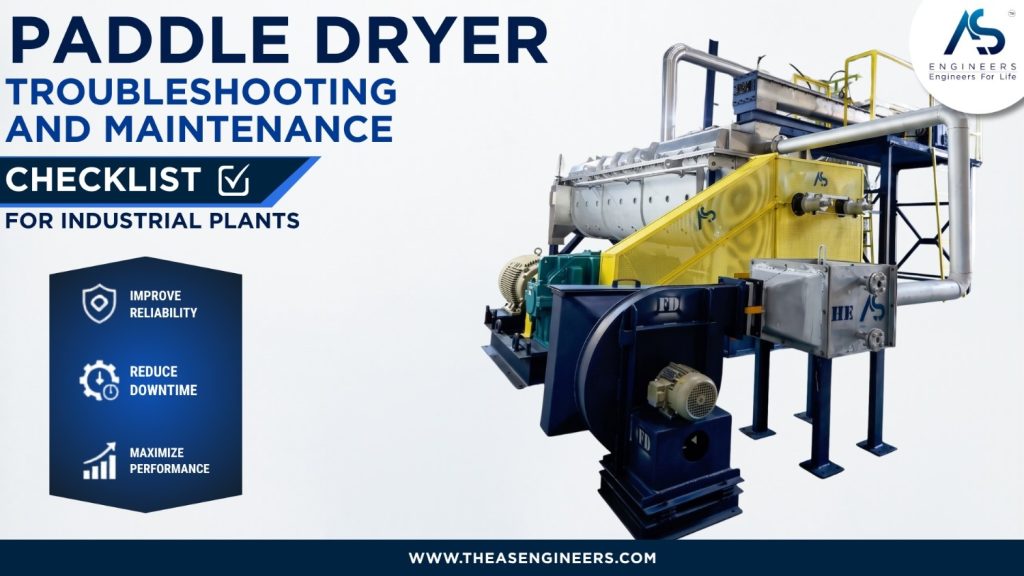
Paddle Dryer Troubleshooting and Maintenance Checklist for Industrial Plants

Paddle dryer troubleshooting should not begin with random part replacement. First check feed moisture, feed rate, heating medium, discharge moisture, vapor path, material buildup, gearbox load, bearing temperature, shaft seal condition, and drive alignment. Most paddle dryer problems show early warning signs before a shutdown, so a structured maintenance checklist helps plant teams protect drying performance, product handling, and equipment life.
For plants handling ETP sludge, STP sludge, chemical filter cake, pigments, powders, granules, or sticky wet cake, this guide explains the practical checks I would review before deciding whether the issue is process-related, mechanical, or both.
A paddle dryer uses indirect heat transfer through hollow shafts and jacketed surfaces, while paddles mix and move the material through the dryer. That means poor drying performance can come from either process-side problems or mechanical-side problems. Before replacing gearbox, bearings, seals, or paddles, the plant team should confirm the actual operating data.
Quick Paddle Dryer Troubleshooting Table
| Problem observed | Likely checks | What it may indicate |
|---|---|---|
| Poor drying performance | Feed moisture, feed rate, heating medium temperature, steam pressure, thermic fluid circulation, residence time, vapor outlet | Process imbalance, inadequate heat transfer, excessive loading, restricted vapor removal |
| Material buildup inside dryer | Paddle condition, feed stickiness, surface temperature, shutdown cleaning, internal clearance, discharge restriction | Sticky phase not breaking properly, low heat transfer, worn paddles, improper cleaning cycle |
| Gearbox overheating or noise | Oil level, oil condition, breather, alignment, coupling, load current, foundation bolts | Lubrication issue, overload, misalignment, bearing or gear wear |
| Bearing failure signs | Temperature, vibration, noise, lubrication, contamination, shaft alignment, seal condition | Inadequate lubrication, contamination, misalignment, overload, heat transfer from process |
| Shaft seal leakage | Seal face or lip, shaft wear, material pressure, vapor pressure, temperature, seal compatibility | Worn seal, wrong seal material, shaft scoring, pressure fluctuation, buildup near seal area |
| High motor load | Feed rate, material viscosity, buildup, discharge blockage, paddle obstruction, gearbox condition | Overfeeding, material compaction, mechanical drag, internal fouling |
| Unstable discharge moisture | Feed variation, heating medium variation, control sensor accuracy, residence time, buildup | Process instability or instrument error |
| Commissioning trouble | Rotation direction, no-load trial, heating ramp-up, interlocks, vapor system, discharge system | Incomplete pre-start checks or wrong sequence |
For a new or existing machine, AS Engineers’ Paddle Dryer Services can support maintenance, repair, upgrades, OEM spare parts, inspection, training, and process optimization when the issue needs site-specific review.
Start With Safety and Operating Records
Before opening guards, inspection covers, gearbox covers, seal housings, or discharge equipment, isolate the equipment as per your plant’s approved lockout/tagout procedure. OSHA describes lockout/tagout as the control of hazardous energy during machine servicing and maintenance, and this principle is especially important for equipment with electrical, mechanical, thermal, pressure, and stored-energy risks.
A paddle dryer may involve hot surfaces, rotating shafts, steam, thermic fluid, vacuum, pressure, solvent vapor, sludge, dust, or chemical residue. Do not treat troubleshooting as a trial-and-error activity while the machine is live.
Record these values before making changes:
| Data to record | Why it matters |
|---|---|
| Feed rate | Confirms whether the dryer is overloaded |
| Feed moisture | Higher inlet moisture changes heat load and residence time |
| Target final moisture | Prevents unrealistic drying expectations |
| Heating medium temperature or pressure | Confirms available heat input |
| Discharge temperature and moisture | Shows actual drying result |
| Motor current | Indicates load changes, drag, or buildup |
| Gearbox temperature | Helps detect lubrication or overload issues |
| Bearing housing temperature | Early warning for bearing stress |
| Vibration and noise | Helps identify mechanical deterioration |
| Vapor outlet condition | Shows whether vapor removal is restricted |
| Discharge flow behavior | Reveals blockage, compaction, or material handling issue |
A good troubleshooting report should include both operating data and visible symptoms. “Dryer not working properly” is not enough for diagnosis.
Paddle Dryer Poor Drying Performance
Poor drying performance is one of the most common complaints, but the root cause is not always the dryer body. It can come from wet feed variation, wrong feeding rate, heating medium instability, low residence time, buildup on heat transfer surfaces, or poor vapor evacuation.
Common causes of poor drying
| Cause | Practical check |
|---|---|
| Feed moisture increased | Test current feed moisture instead of relying on old data |
| Feed rate too high | Compare actual feed rate with design or trial condition |
| Heating medium temperature too low | Check steam, thermic fluid, or hot water supply condition |
| Condensate or thermic fluid circulation issue | Check circulation, traps, valves, pumps, filters, and return line behavior |
| Vapor outlet restriction | Inspect cyclone, duct, condenser, scrubber, ID fan, or chimney path |
| Internal material buildup | Inspect heat transfer surfaces during safe shutdown |
| Worn or damaged paddles | Check mixing, shearing, and conveying action |
| Discharge restriction | Check discharge screw, rotary valve, chute, bagging system, or downstream conveyor |
| Instrument error | Verify moisture, temperature, pressure, and level readings manually where possible |
A paddle dryer depends on indirect heat transfer. If material buildup insulates the heated surface, drying performance can fall even when the heating medium looks normal. If feed moisture increases but feed rate remains the same, the dryer may not have enough heat duty or residence time to reach the old outlet moisture target.
For plants evaluating process suitability, AS Engineers also offers a paddle dryer pilot trial route that can help verify material behavior, moisture reduction, and operating feasibility before finalizing a new drying duty.
Paddle Dryer Material Buildup
Material buildup inside a paddle dryer usually appears as lower drying efficiency, rising motor load, uneven discharge, poor heat transfer, frequent cleaning demand, or abnormal noise. In sludge and sticky cake applications, buildup can happen when the material remains in a plastic or tacky phase for too long.
Why material buildup happens
| Root cause | What to inspect |
|---|---|
| Feed is too sticky or inconsistent | Feed solids, pH, oiliness, fiber, polymer, or chemical variation |
| Heating surface is not hot enough | Heating medium supply, startup ramp, condensate removal, thermic fluid circulation |
| Feed rate is too high | Overloading can reduce mixing and residence time |
| Discharge is restricted | Material may compact near outlet |
| Paddles are worn or damaged | Reduced mixing and self-cleaning action |
| Shutdown cleaning is poor | Residual material hardens after cooling |
| Vapor path is restricted | Moisture removal slows down and material stays wet longer |
The AS Engineers Paddle Dryer design uses hollow shafts, jacket heating, and paddles for indirect drying and agitation. When buildup becomes frequent, the issue should be reviewed as a process-and-mechanical problem together, not only as a cleaning problem.
Practical corrective actions
Use controlled startup and warm-up. Do not flood the dryer with cold sticky feed before the heating surface is ready.
Keep feed rate steady. Sudden overfeeding can push the material into a sticky, compacted condition.
Inspect discharge equipment. A blocked screw conveyor, rotary valve, chute, or bagging line can make the dryer look like the problem when the outlet is the real bottleneck.
Check paddles and internal surfaces during shutdown. Worn paddles, damaged edges, or abnormal deposits can reduce shearing and self-cleaning behavior.
Review material changes. A feed that looks similar may still behave differently because of solids concentration, oil content, salts, polymer, biological matter, or upstream treatment chemistry.
For sludge-specific applications, the Sludge Dryer Manufacturer page is a useful internal reference for buyers comparing sludge drying requirements.
Paddle Dryer Gearbox Maintenance
The gearbox is a critical part of a paddle dryer because it handles low-speed, high-torque operation. Gearbox issues should be taken seriously because they can quickly affect shaft rotation, paddle movement, bearing load, and overall machine reliability.
Gearbox maintenance checklist
| Frequency | Checklist item |
|---|---|
| Daily or shift-wise | Observe abnormal noise, vibration, oil leakage, gearbox temperature, and motor current |
| Weekly | Check oil level, oil leakage marks, breather condition, foundation bolts, coupling guard, and visible alignment shift |
| Monthly | Inspect oil condition, coupling condition, mounting bolts, lubrication records, and load trend |
| Quarterly or planned shutdown | Check alignment, inspect seals, review vibration trend, inspect coupling wear, and verify oil condition |
| Annual or major shutdown | Open inspection as per OEM recommendation, review gear wear signs, bearing condition, oil analysis, and overhaul need |
Always follow the gearbox OEM lubricant grade and oil change interval. Do not mix lubricant grades unless approved by the gearbox manufacturer or qualified maintenance engineer.
Gearbox warning signs
| Warning sign | Possible cause |
|---|---|
| Rising gearbox temperature | Low oil, wrong oil, overloading, poor ventilation, bearing wear |
| Oil leakage | Worn seal, gasket issue, blocked breather, overfill, housing issue |
| Gearbox noise | Gear wear, bearing wear, misalignment, oil degradation |
| High vibration | Coupling misalignment, foundation looseness, bearing wear, load shock |
| Rising motor current | Material overload, buildup, discharge blockage, mechanical drag |
If gearbox problems return after part replacement, check the full drive train: motor alignment, coupling, shaft load, feed rate, internal buildup, foundation, and discharge restriction. Replacing only the gearbox without solving the loading problem can lead to repeat failure.
Paddle Dryer Bearing Failure
Bearing failure in a paddle dryer should never be treated as “only a bearing problem.” Bearings often show the effect of deeper issues such as misalignment, poor lubrication, contamination, overload, vibration, heat, or shaft movement. SKF’s bearing failure guidance also highlights that bearing damage can be linked to operating conditions, lubrication, contamination, misalignment, unbalance, looseness, and friction.
Common bearing failure symptoms
| Symptom | What it may mean |
|---|---|
| Bearing housing temperature rising | Lubrication issue, overload, misalignment, process heat transfer |
| Grinding or knocking noise | Bearing wear, internal damage, contamination |
| Repeated grease or oil leakage | Seal issue, over-lubrication, pressure, contamination |
| Shaft play | Bearing wear, loose fit, housing wear |
| High vibration | Misalignment, unbalance, looseness, bearing damage |
| Repeated bearing replacement | Root cause not solved |
Bearing failure troubleshooting checklist
Check lubrication practice. Confirm correct lubricant, quantity, interval, and contamination control.
Check alignment. Misalignment between motor, gearbox, coupling, and shaft can overload bearings.
Check process load. Sticky feed, buildup, or discharge blockage can increase torque and bearing load.
Check temperature transfer. High process temperature near bearing zones can affect lubricant and bearing life if not controlled properly.
Check sealing. Failed seals can allow dust, vapor, moisture, or material contamination near bearing areas.
Check installation practice. Wrong mounting, improper tools, or poor fit can damage the bearing before operation starts.
If bearing failure is repeated, AS Engineers’ Spare Parts support can help review whether the bearing, seal, coupling, shaft, or paddle condition needs replacement or deeper inspection.
Paddle Dryer Shaft Seal Leakage
Shaft seal leakage can involve material leakage, vapor leakage, solvent leakage, air ingress, or oil leakage depending on the machine design and process condition. It should be handled carefully, especially when the dryer handles solvents, odorous sludge, hot vapors, hazardous chemicals, or vacuum operation.
JTEKT’s oil seal failure guidance lists factors such as foreign matter, high temperature, poor lubrication, excessive internal pressure, and shaft wear as important seal-failure causes. In paddle dryer service, those same principles need to be combined with process-side conditions.
Common shaft seal leakage causes
| Cause | What to check |
|---|---|
| Seal wear | Seal face, lip, packing, gland, or mechanical seal condition |
| Shaft wear | Grooving, scoring, corrosion, eccentricity |
| High temperature | Seal material compatibility and cooling/insulation conditions |
| Pressure fluctuation | Vacuum, pressure, vapor surge, blocked vent, or process upset |
| Buildup near seal area | Sticky material forcing leakage path |
| Misalignment | Shaft movement or uneven seal contact |
| Wrong seal material | Chemical, solvent, temperature, or abrasion incompatibility |
| Poor installation | Incorrect fitment, uneven tightening, damaged seal during assembly |
What to do before replacing the seal
Do not replace the seal blindly. First inspect the shaft surface, bearing condition, alignment, seal housing, internal pressure behavior, and buildup near the seal zone. If the shaft is scored or misaligned, a new seal may fail quickly.
Identify what is leaking. Material leakage, vapor leakage, oil leakage, and air ingress have different root causes.
Confirm operating condition. A seal suitable for atmospheric drying may not be suitable for vacuum, pressurized, solvent, abrasive, or high-temperature service.
For seal, bearing, shaft, gearbox, and paddle replacement planning, use the Paddle Dryer Services page as the service route instead of treating every leak as a small consumable issue.
Paddle Dryer Maintenance Checklist
A practical paddle dryer maintenance checklist should cover process, mechanical, thermal, safety, and documentation points. The schedule below should be adjusted based on material abrasiveness, stickiness, temperature, operating hours, and site conditions.
Daily or shift-wise checks
| Check | What to observe |
|---|---|
| Feed flow | Stable or surging feed |
| Discharge material | Moisture, lumps, color, smell, temperature |
| Motor current | Sudden rise or unstable load |
| Gearbox | Temperature, noise, oil leakage |
| Bearings | Temperature, noise, vibration |
| Shaft seals | Leakage, dusting, vapor escape, dripping |
| Heating medium | Steam pressure, thermic fluid temperature, hot water condition |
| Vapor outlet | Condensation, blockage, abnormal odor, visible fines |
| Discharge conveyor | Choking, overflow, abnormal load |
| Safety guards | Guards, covers, and warning signs in place |
Weekly checks
| Check | What to inspect |
|---|---|
| Gearbox oil level | Correct level and no visible contamination |
| Coupling and guards | Wear, looseness, alignment signs |
| Foundation bolts | Looseness or vibration marks |
| Shaft seal area | Product buildup, leakage, overheating |
| Feed screw or pump | Smooth feeding and no choking |
| Discharge screw or rotary valve | Smooth discharge and no packing |
| Cyclone, scrubber, bag filter, or condenser | Fines buildup or flow restriction |
| Instrument readings | Compare sensor readings with manual checks |
Monthly checks
| Check | What to review |
|---|---|
| Vibration trend | Compare with baseline readings |
| Bearing temperature trend | Identify gradual rise |
| Gearbox oil condition | Color, smell, contamination, oil analysis if required |
| Paddle condition | Inspect during safe shutdown where accessible |
| Internal buildup | Check pattern, location, and severity |
| Heating medium lines | Leakage, insulation condition, valve operation |
| Control panel | Alarms, interlocks, current trend, sensor health |
| Maintenance log | Repeat issues, part life, operator remarks |
Shutdown or annual checks
| Check | What to verify |
|---|---|
| Internal inspection | Paddles, shaft, jacket, casing, buildup, wear marks |
| Shaft alignment | Shaft runout, coupling alignment, foundation movement |
| Bearing inspection | Wear, clearance, lubrication condition |
| Seal inspection | Seal face/lip, shaft condition, housing condition |
| Gearbox inspection | Gear wear, oil analysis, seals, breather, bearings |
| Discharge system | Screw conveyor, chute, rotary valve, bagging, silo |
| Vapor handling system | Ducting, cyclone, scrubber, condenser, ID fan |
| Documentation | Updated checklist, action list, spares plan, next inspection date |
Paddle Dryer Commissioning Checklist
A paddle dryer commissioning checklist helps avoid early failure, poor drying, seal leakage, overloading, and operator confusion. Use this before first startup, after major maintenance, after gearbox or bearing replacement, after seal replacement, or after a long shutdown.
Mechanical pre-start checklist
| Item | Check |
|---|---|
| Foundation | Dryer, motor, gearbox, and accessories are properly fixed |
| Alignment | Motor, gearbox, coupling, and shaft alignment checked |
| Rotation direction | Confirmed before feeding material |
| Guards | Coupling guards and safety covers installed |
| Gearbox | Correct oil grade, correct oil level, no leakage |
| Bearings | Lubricated, mounted correctly, no abnormal play |
| Shaft seals | Correctly installed and suitable for duty |
| Internal clearance | No foreign object inside dryer |
| Paddles | No visible damage, obstruction, or rubbing |
| Discharge system | Screw conveyor, rotary valve, chute, or bagging system ready |
Thermal and process checklist
| Item | Check |
|---|---|
| Heating medium | Steam, thermic fluid, or hot water system ready |
| Heating ramp-up | Controlled warm-up plan prepared |
| Condensate or return line | Open and functional |
| Feed system | Screw feeder, belt conveyor, or sludge pump checked |
| Feed properties | Moisture, solids, viscosity, stickiness, and temperature recorded |
| Vapor handling | Duct, cyclone, scrubber, bag filter, condenser, ID fan, or chimney ready |
| Scavenging air | FD blower and heat exchanger checked where applicable |
| Instrumentation | Temperature, pressure, current, and moisture checks ready |
| Emergency stop | Tested as per site procedure |
| Interlocks | Checked and not bypassed |
Trial run checklist
| Stage | What to do |
|---|---|
| No-load run | Run dryer without feed and observe noise, vibration, temperature, and motor current |
| Heating trial | Heat gradually and check thermal expansion, leakage, and abnormal sound |
| Low-rate feeding | Start with controlled feed rate instead of full load |
| Moisture verification | Test discharge moisture at intervals |
| Load monitoring | Record motor current and gearbox temperature |
| Seal observation | Watch for early leakage around shaft seals |
| Discharge observation | Check whether discharge is free-flowing or lumpy |
| Vapor path check | Confirm vapor removal and pollution-control equipment operation |
| Operator handover | Train operators on normal readings, alarms, cleaning, and reporting |
AS Engineers’ Paddle Dryer Training and Spare Parts support is useful when a plant wants operators and maintenance teams to follow a standard method after installation or recommissioning.
Common Mistakes in Paddle Dryer Troubleshooting
Do not increase heating temperature before checking feed rate and vapor removal. Extra heat may not solve poor drying if the dryer is overloaded or the vapor path is restricted.
Do not replace bearings repeatedly without checking alignment, lubrication, contamination, process load, and shaft condition.
Do not ignore small shaft seal leakage. A small leak can indicate wear, pressure fluctuation, shaft scoring, buildup, or incorrect seal selection.
Do not clean only the discharge side when buildup is inside the heating and mixing zone.
Do not assume the dryer is undersized until current feed moisture, feed rate, heating medium condition, and discharge moisture are measured.
Do not bypass interlocks, guards, or lockout procedures during inspection.
Do not use non-compatible spare parts for bearings, seals, gearbox components, or paddles. A part that fits dimensionally may still fail under actual temperature, chemical, abrasion, or load conditions.
Information to Share for Paddle Dryer Service Support
Before asking for troubleshooting or service support, prepare this information:
| RFQ or service input | Details to share |
|---|---|
| Dryer type | Standard, dual-zone, vacuum, or other configuration |
| Material | Sludge, filter cake, powder, granule, chemical, pigment, food, pharma intermediate |
| Feed moisture | Current moisture and usual moisture range |
| Final moisture target | Required outlet moisture or dryness |
| Feed rate | kg/hr or ton/day |
| Heating medium | Steam, thermic fluid, hot water, or other |
| Operating temperature or pressure | Actual site readings |
| Main problem | Poor drying, buildup, leakage, bearing failure, gearbox issue, high load, noise |
| Problem history | When it started, frequency, previous corrective actions |
| Photos/videos | Gearbox, bearing, seal area, discharge, buildup, control panel readings |
| Maintenance history | Last bearing, seal, gearbox oil, paddle, or shaft work |
| Safety condition | Solvent, toxic, abrasive, corrosive, high-temperature, vacuum, or pressure duty |
For a faster technical review, send this information through the AS Engineers Contact page or connect it with the Paddle Dryer Services team.
FAQs
What is the first step in paddle dryer troubleshooting?
The first step is to record actual operating data: feed moisture, feed rate, heating medium condition, discharge moisture, motor current, gearbox temperature, bearing temperature, vapor path condition, and discharge behavior. Without this data, troubleshooting becomes guesswork.
Why is my paddle dryer not drying properly?
A paddle dryer may show poor drying performance because of high feed moisture, excessive feed rate, low heating medium temperature, poor thermic fluid or steam performance, short residence time, internal buildup, worn paddles, vapor outlet restriction, or discharge blockage.
What causes material buildup in a paddle dryer?
Material buildup is usually caused by sticky feed behavior, low surface temperature, sudden overfeeding, poor discharge flow, worn paddles, shutdown residue, or restricted vapor removal. Sticky sludge and wet cake duties need controlled feeding and planned cleaning.
What causes paddle dryer bearing failure?
Bearing failure can be caused by poor lubrication, contamination, misalignment, overload, vibration, heat transfer from the process, incorrect installation, seal failure, or foundation movement. Repeated bearing failure needs root-cause review, not only bearing replacement.
Why is my paddle dryer shaft seal leaking?
Shaft seal leakage can come from worn seals, shaft scoring, misalignment, high temperature, pressure fluctuation, wrong seal material, poor installation, or buildup near the seal area. The leaking material should be identified before deciding the corrective action.
Conclusion
Paddle dryer troubleshooting works best when plant teams separate process problems from mechanical problems. Poor drying, buildup, gearbox issues, bearing failure, and shaft seal leakage are often connected. A feed change can increase load. Buildup can raise motor current. Higher load can stress the gearbox and bearings. Seal leakage can indicate shaft, pressure, or alignment issues.
For stable long-term operation, use a disciplined paddle dryer maintenance checklist, record operating trends, inspect the gearbox and bearings regularly, monitor shaft seals, clean buildup before it becomes severe, and follow a proper commissioning checklist after installation or major maintenance.
If your plant is facing repeated drying inconsistency, material buildup, seal leakage, gearbox trouble, or bearing failure, AS Engineers can review the operating condition, service history, spare-part requirement, and site symptoms before recommending the next step.
