
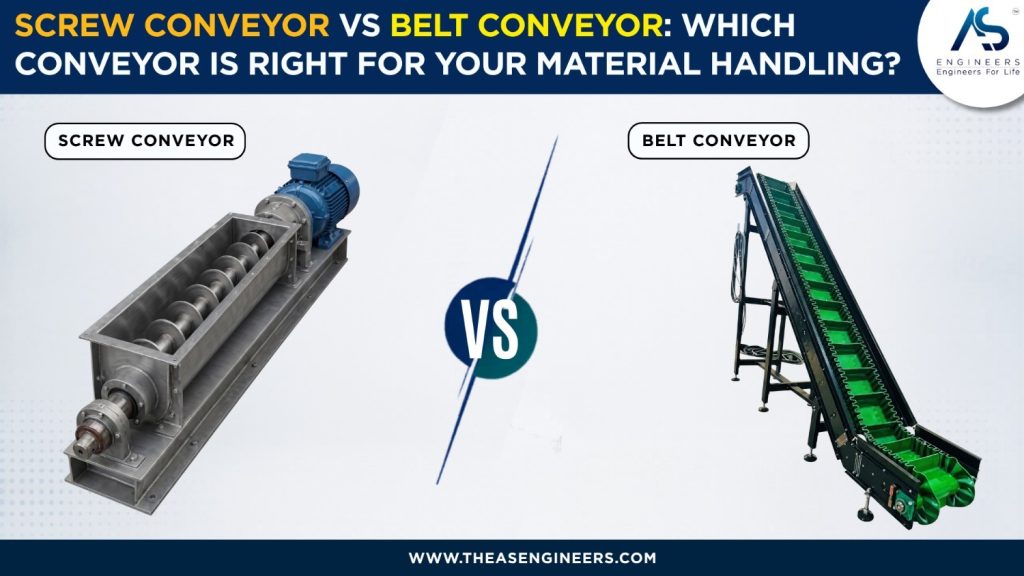
Screw Conveyor vs Belt Conveyor: Which Conveyor Is Right for Your Material Handling?

A screw conveyor is usually better for enclosed, controlled, short-distance transfer of powders, granules, wet cake, sludge, and metered feeding. A belt conveyor is usually better for longer-distance movement, higher capacity, gentler handling, and open transfer of bulk solids or packaged material. The right choice depends on material moisture, stickiness, bulk density, dusting tendency, temperature, incline, cleaning needs, plant layout, safety guarding, and whether the conveyor is used before or after a dryer.
Last updated: 30 May 2026
Author: Karan Dargode, AS Engineers
At AS Engineers, conveyor selection is not treated as a small accessory decision. In a drying system, the wrong conveyor can disturb feeding consistency, increase spillage, create dusting, overload downstream equipment, or make maintenance difficult. In a paddle dryer for sludge drying, for example, the feeding and product handling system must match the actual behavior of wet cake, dried powder, granules, or sludge.
Quick Comparison: Screw Conveyor vs Belt Conveyor
| Point | Screw Conveyor | Belt Conveyor |
|---|---|---|
| Basic working | Rotating helical screw moves material inside a trough or tube | Moving belt carries material over rollers or a flat/troughed surface |
| Best for | Powders, granules, wet cake, sludge, semi-solid material, controlled feeding | Bulk solids, bags, cartons, aggregates, dry material, long-distance transfer |
| Distance | Short to medium distance | Medium to long distance |
| Material containment | Better containment, especially in enclosed design | More open unless covered or enclosed |
| Dust control | Better for dusty powders if properly sealed | Needs covers, skirting, dust extraction, or enclosure |
| Metered feeding | Good for controlled feed rate | Possible, but usually less precise without additional controls |
| Gentle handling | Can shear or mix material | Generally gentler for fragile or degradation-sensitive material |
| Incline handling | Possible, but capacity reduces with incline | Good for inclined transfer within design limits |
| Cleaning | Can be harder if sticky material builds inside | Easier visual inspection, but belt cleaning/skirting must be managed |
| Maintenance focus | Screw flight wear, trough wear, hanger bearings, seals, drive | Belt tracking, rollers, pulleys, skirting, belt wear, drive |
| Space requirement | Compact and enclosed | Needs more linear layout space |
| Safety concern | Rotating screw flights must be guarded | Nip points, pulleys, rollers, belt movement, and walkways must be guarded |
What Is a Screw Conveyor?
A screw conveyor uses a rotating helical screw, also called an auger, to move bulk material through a trough, U-trough, or tubular casing. The material is pushed forward as the screw rotates.
In industrial plants, screw conveyors are commonly used when the material needs controlled movement, enclosed transfer, dust containment, short-distance conveying, or steady feeding into equipment.
In drying systems, a screw conveyor may be used for:
- Feeding wet cake into a dryer
- Discharging dried powder or granules
- Moving sludge after dewatering
- Transferring material between dryer, bagging, silo, or disposal points
- Controlled feed to a thermal processing system
For sludge and wet cake, the key question is not only “Can the screw move it?” The real question is whether the screw design, pitch, shaft type, speed, MOC, drive torque, and cleaning access match the material’s stickiness and moisture.
What Is a Belt Conveyor?
A belt conveyor uses a continuous moving belt to carry material from one point to another. The belt may be flat, troughed, inclined, covered, or supported by rollers depending on the duty.
Belt conveyors are widely used where the plant needs longer distance movement, higher capacity transfer, gentle handling, or visible material movement.
A belt conveyor may be suitable for:
- Dry bulk solids
- Coal, minerals, aggregates, and granules
- Bags, cartons, or packed material
- Long-distance transfer inside a plant
- Material that should not be aggressively mixed or sheared
- Applications where operators need easy visual inspection
For wet, sticky, dusty, or corrosive material, a belt conveyor needs careful design. Skirting, belt cleaning, covers, corrosion-resistant components, discharge chute design, and housekeeping become important.
The Main Difference
The main difference between screw conveyor and belt conveyor is the method of material movement.
A screw conveyor moves material by mechanical pushing inside a trough or tube. A belt conveyor carries material on top of a moving belt.
That one difference changes almost everything: containment, dusting, distance, power demand, cleaning, spillage risk, wear pattern, and maintenance access.
When Should You Choose a Screw Conveyor?
Choose a screw conveyor when your process needs compact, enclosed, controlled movement of material.
A screw conveyor is usually a better fit when:
- The transfer distance is short to medium.
- The material is powder, granule, wet cake, sludge, or semi-solid.
- The plant needs an enclosed conveying path.
- Dust escape must be reduced.
- The material must be fed at a controlled rate.
- The conveyor needs to fit below a hopper, silo, filter press, centrifuge, or dryer discharge.
- The layout has limited space.
- The material can tolerate some mixing, compression, or shear.
When I review screw conveyor requirements for sludge or wet cake handling, I first check moisture, stickiness, lump size, bridging tendency, temperature, corrosiveness, and whether the material becomes harder to move after partial drying. Many conveyor problems start because the material changes behavior between inlet and outlet.
For sludge drying projects, also review dewatering equipment before deciding the conveyor. A sludge cake coming from a filter press, belt press, or screw press can behave very differently. AS Engineers has related guidance on screw press operation and belt filter press sludge dewatering that helps clarify this upstream condition.
When Should You Choose a Belt Conveyor?
Choose a belt conveyor when the plant needs longer distance movement, higher throughput, or gentler handling.
A belt conveyor is usually a better fit when:
- The conveying distance is longer.
- The material is dry, granular, lumpy, or packaged.
- The plant needs higher capacity movement.
- The material is fragile and should not be sheared.
- The path needs visible inspection.
- The conveyor must move material between different plant areas.
- The material is not too sticky or wet.
- Spillage can be managed through proper skirting, chute design, and belt cleaning.
Belt conveyors are common in cement, mining, food processing, packaging, biomass, and bulk handling lines. They can also work in environmental plants, but wet sludge and sticky cake need careful testing before selection.
Screw Conveyor vs Belt Conveyor for Sludge Handling
Sludge is not a normal free-flowing bulk solid. It may be wet, sticky, corrosive, odorous, fibrous, abrasive, or inconsistent from batch to batch.
| Sludge condition | Better first option | Reason |
|---|---|---|
| Wet, sticky sludge cake | Screw conveyor | Better containment and controlled movement |
| Dewatered cake from filter press | Screw conveyor | Compact transfer from discharge point to dryer feed |
| Dried sludge granules | Screw or belt conveyor | Depends on distance, dust, capacity, and discharge point |
| Long-distance dried sludge transfer | Belt conveyor | Better for longer horizontal movement |
| Dusty dried powder | Enclosed screw conveyor | Better containment if sealing and extraction are planned |
| Fragile dried product | Belt conveyor | Gentler movement with less mechanical shear |
| Sludge with strong odor | Enclosed screw conveyor | Better odor containment when connected to ventilation |
| Material going to bagging | Screw conveyor or belt conveyor | Depends on packing system layout and flow rate |
In a sludge dryer system, conveyor selection should be reviewed with the dryer feed system, product discharge, vapor handling, pollution control, and plant housekeeping plan. If the conveyor is treated separately, the plant may get a mechanically correct conveyor that still performs poorly in the total process line.
Screw Conveyor vs Belt Conveyor for Paddle Dryer Feeding
In a paddle dryer system, the conveyor before the dryer must provide stable feeding. Irregular feed can create uneven residence time, unstable moisture output, and process control issues.
A screw conveyor is often useful for controlled feeding into the dryer because it can meter material from a hopper or wet material silo. A belt conveyor may be useful when the material is dry, free-flowing, or transferred from a longer distance before feeding.
AS Engineers’ paddle dryer process configuration includes feeding options such as screw feeder, belt conveyor system, and sludge pump, depending on the material and plant layout. The dryer system can also include screw conveyor, bagging system, silo, bucket elevator, or truck disposal system for product handling.
For broader dryer-side selection, the paddle dryer applications guide explains where paddle dryers are used across different industrial materials.
Which Conveyor Is Better for Dust Control?
A screw conveyor is generally better for dust control because it can be enclosed. This matters for powders, dried sludge fines, chemical powders, cement-type materials, ash, and fine granules.
A belt conveyor can also control dust, but it needs additional design measures:
- Belt covers
- Proper skirting
- Dust extraction points
- Controlled transfer chutes
- Bag filter or dust collection support
- Good belt cleaning
- Reduced drop height at transfer points
Where dried material creates fines, dust control may need to connect with bag filter selection, cyclone separator working principle, or scrubber working principle depending on the plant process.
Which Conveyor Is Better for Long Distance?
A belt conveyor is usually better for long-distance conveying. It can move material continuously over longer plant layouts with better practicality than a screw conveyor.
A screw conveyor becomes less attractive as distance increases because power demand, mechanical wear, alignment, hanger bearing requirements, and material compaction risk can increase.
Use this simple rule:
| Requirement | Preferred conveyor |
|---|---|
| Short, enclosed transfer | Screw conveyor |
| Controlled feeding | Screw conveyor |
| Long horizontal transfer | Belt conveyor |
| High capacity over distance | Belt conveyor |
| Dusty powder containment | Screw conveyor |
| Fragile material handling | Belt conveyor |
| Wet sludge cake transfer | Screw conveyor |
| Open visible inspection | Belt conveyor |
Which Conveyor Is Better for Sticky Material?
A screw conveyor is often considered first for sticky material, but it is not automatically safe for every sticky material.
Sticky material can create:
- Build-up on screw flights
- Material packing inside the trough
- Torque overload
- Blockage at discharge
- Bearing and seal contamination
- Cleaning difficulty
For very sticky sludge or fibrous material, the screw type, shaft design, liner, pitch, RPM, torque, inlet design, outlet design, and cleaning access matter. In some applications, a shaftless screw conveyor may be evaluated, but final selection should be based on material testing and equipment supplier review.
A belt conveyor can struggle with sticky material because material may stick to the belt, return side, rollers, and chute. Belt scrapers and cleaning systems can help, but they do not solve every sludge application.
Maintenance Comparison
| Maintenance point | Screw conveyor | Belt conveyor |
|---|---|---|
| Main wear areas | Screw flights, trough, liner, hanger bearings, seals | Belt, rollers, pulleys, bearings, skirting, scrapers |
| Common problem | Blockage, wear, buildup, torque overload | Belt mistracking, spillage, roller failure, belt damage |
| Inspection | More enclosed, inspection ports needed | Easier visual inspection |
| Cleaning | Can be difficult with sticky material | Easier to see, but carryback can spread material |
| Downtime risk | Blockage can stop feeding quickly | Belt damage or tracking issue can affect full line |
| Safety focus | Guarding rotating screw and drive | Guarding nip points, pulleys, rollers, and walkways |
A conveyor may look simple compared with the main process equipment, but in actual operation, it can become the reason for stoppage. Maintenance access should be part of the RFQ, not an afterthought.
Safety and EHS Considerations
Both screw conveyors and belt conveyors need guarding, emergency stops, isolation procedure, safe access, and proper operator training. Conveyor safety cannot be handled only during commissioning.
For screw conveyors, rotating screw flights must not be accessible during operation. For belt conveyors, nip points, pulleys, rollers, transfer points, and areas below overhead conveyors need safe guarding and access planning. OSHA’s conveyor requirements specifically mention emergency stop behavior, screw conveyor guarding, and guarding where conveyors pass over work areas. CEMA also publishes conveyor safety and technical resources for safe conveyor operation.
In AS Engineers content, we do not treat EHS as a brochure point. Conveyor selection should consider real plant access, cleaning behavior, walkways, dust, odor, hot surfaces, guards, lockout/tagout practice, and maintenance habits.
Common Mistakes in Conveyor Selection
Choosing only by price
Low initial cost can become expensive if the conveyor blocks, spills, wears fast, or needs frequent cleaning.
Ignoring material moisture
A conveyor that works for dry powder may fail with wet cake. A conveyor that works before drying may not be suitable after drying.
Treating sludge like normal bulk material
Sludge changes behavior with moisture, temperature, fiber content, and source process. Selection must consider actual sludge characteristics.
Not checking feed consistency
A dryer needs stable feeding. Poor conveyor selection can disturb dryer operation.
Forgetting dust and odor control
Open transfer of dried fines or odorous wet sludge can create housekeeping and EHS issues.
Ignoring maintenance access
A compact conveyor is useful only if operators can inspect, clean, and maintain it safely.
Not sharing layout details in RFQ
Distance, height difference, discharge point, inlet point, available space, and support structure affect conveyor selection.
RFQ Checklist for Screw Conveyor vs Belt Conveyor
Before asking for a conveyor recommendation, share these inputs:
| RFQ input | Why it matters |
|---|---|
| Material name | Basic selection starts with material type |
| Wet or dry condition | Changes flow behavior and cleaning requirement |
| Moisture percentage | Critical for sludge, cake, powder, and granules |
| Bulk density | Affects capacity, power, and mechanical design |
| Particle size / lump size | Affects screw pitch, belt width, chute design |
| Stickiness / flowability | Affects blockage and cleaning risk |
| Temperature | Affects MOC, belt type, bearings, seals |
| Corrosiveness / abrasiveness | Affects MOC, liner, belt, wear parts |
| Required capacity | Defines conveyor size and drive |
| Conveying distance | Key decision between screw and belt |
| Incline angle | Capacity and power change with incline |
| Inlet and outlet height | Affects layout and supporting structure |
| Dusting or odor | Affects enclosure and ventilation |
| Cleaning requirement | Important for food, pharma, sludge, chemicals |
| Upstream equipment | Hopper, filter press, centrifuge, dryer, silo |
| Downstream equipment | Dryer, bagging, truck loading, silo, disposal |
| Operating hours | Affects duty design and maintenance planning |
| Site layout drawing | Prevents installation mismatch |
Practical Selection Rule
Use a screw conveyor when you need controlled, enclosed, compact, short-distance material transfer.
Use a belt conveyor when you need longer distance, higher capacity, gentler handling, and easier visual inspection.
Use engineering review when the material is wet, sticky, hot, abrasive, corrosive, dusty, odorous, or connected to a dryer, sludge system, pollution control system, or bagging system.
Conclusion
Screw conveyor vs belt conveyor is not a one-size-fits-all decision. A screw conveyor is usually stronger for enclosed, controlled, short-distance feeding of powders, wet cake, sludge, and semi-solid materials. A belt conveyor is usually stronger for longer-distance, higher-capacity, gentler movement of bulk solids or packaged material.
For dryer and sludge handling systems, the conveyor must be selected with the complete process line in mind. Feed behavior, moisture, stickiness, dust, temperature, layout, safety guarding, cleaning access, and downstream handling all affect the final choice.
If you are selecting a conveyor for a sludge dryer, paddle dryer, dewatering system, product discharge, bagging line, or bulk material handling process, share the material details, moisture level, capacity, distance, layout, and operating conditions. The AS Engineers team can review the requirement and suggest the right conveyor approach based on actual plant duty.
FAQs
Which is better, screw conveyor or belt conveyor?
A screw conveyor is better for enclosed, controlled, short-distance movement of powders, wet cake, sludge, and metered feeding. A belt conveyor is better for longer distances, higher capacity, gentler handling, and open movement of dry bulk solids or packaged material.
Is a screw conveyor good for sludge?
Yes, a screw conveyor is often suitable for sludge or wet cake transfer, especially when containment and controlled feeding are required. However, sludge stickiness, fiber content, moisture, lump size, corrosiveness, torque requirement, and cleaning access must be checked before final selection.
Is a belt conveyor suitable for wet sludge?
A belt conveyor may not be the first choice for wet, sticky sludge because carryback, spillage, belt cleaning, and odor control can become difficult. It may be suitable for some dewatered or dried sludge applications if the layout, cleaning system, and containment are designed properly.
Which conveyor is better for dust control?
A screw conveyor is generally better for dust control because it can be enclosed. A belt conveyor can also manage dust, but it usually needs covers, skirting, chute control, dust extraction, and proper transfer-point design.
What details are needed for conveyor selection?
Key details include material type, moisture, bulk density, capacity, conveying distance, incline, temperature, abrasiveness, corrosiveness, dusting, stickiness, inlet and outlet locations, upstream equipment, downstream equipment, operating hours, and cleaning requirements.
