
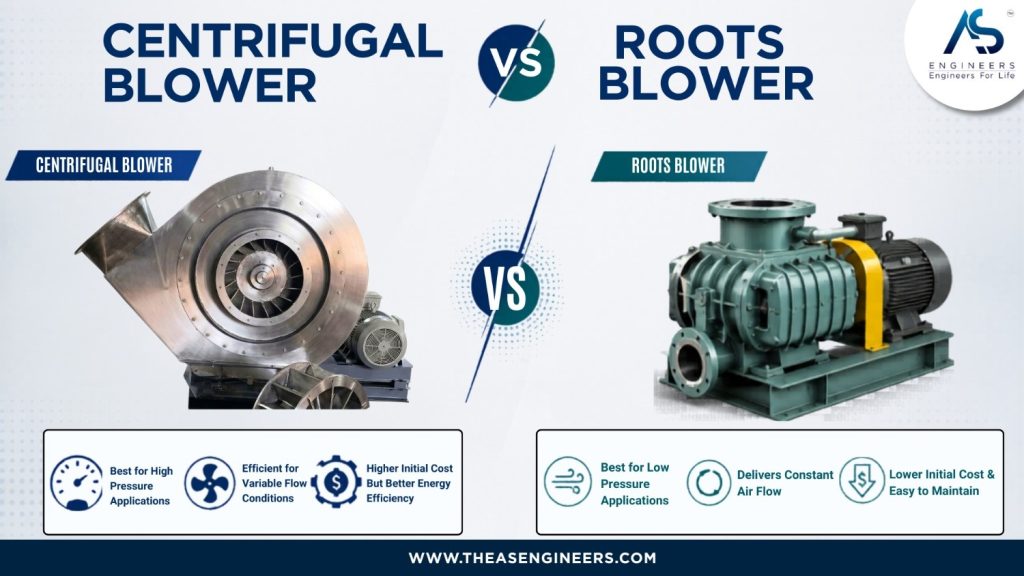
Centrifugal Blower vs Roots Blower: Which One Should You Choose?

A centrifugal blower is usually the better choice when your plant needs high airflow, ducted air movement, dust collection, scrubber airflow, combustion air, ventilation, hot air circulation, or variable-flow control. A Roots blower is usually better when the process needs a fixed volume of air per revolution, such as aeration or certain pneumatic conveying duties.
The right answer is not “centrifugal is always better” or “Roots is always better.” The correct selection depends on airflow, static pressure, gas temperature, dust load, humidity, MOC, noise limits, duty cycle, and the actual resistance of your system.
For industrial buyers, the safest starting point is to compare the blower against the process duty, not only against the blower name. AS Engineers manufactures industrial centrifugal blowers for airflow and pressure duties across plant applications where the system resistance, material condition, and operating environment must be reviewed before final selection.
Quick Answer: Centrifugal Blower or Roots Blower?
Choose a centrifugal blower when the application needs:
- High airflow through ducts, filters, scrubbers, cyclones, furnaces, dryers, or ventilation systems
- Variable airflow control with damper or VFD-based operation
- Better fit for dust-laden, hot, corrosive, or process-air applications when designed with proper MOC and impeller type
- Industrial exhaust, combustion air, bag filter suction, scrubber ID duty, dryer air handling, or pollution-control airflow
- A blower selected around system resistance and performance curve
Choose a Roots blower when the application needs:
- Fixed-volume air delivery per revolution
- Steady air supply against moderate pressure changes
- Aeration duty where constant air volume is the main requirement
- Simple positive displacement operation
- Some pressure or vacuum conveying duties where the process is built around Roots blower behavior
In many RFQs, I see buyers asking only for “blower HP” or “same as existing Roots blower.” That is not enough. A blower must be selected from duty data, not from habit.
Basic Difference Between Centrifugal Blower and Roots Blower
A centrifugal blower is a dynamic air-moving machine. Air enters near the impeller eye, gains velocity from the rotating impeller, and leaves through the casing or volute. The blower converts velocity into useful pressure. For a deeper technical explanation, read AS Engineers’ guide on centrifugal blower working principle.
A Roots blower is a positive displacement blower. It uses two rotating lobes to trap and move a fixed volume of air from inlet to outlet. Pressure is developed when that air is pushed against system resistance.
This single difference changes almost everything: airflow behavior, pressure response, energy use, control method, noise, maintenance, and application fit.
| Selection Point | Centrifugal Blower | Roots Blower |
|---|---|---|
| Working principle | Dynamic, impeller-based airflow | Positive displacement, lobe-based airflow |
| Air delivery | Varies with system resistance and speed | Fixed volume per revolution, within operating limits |
| Best fit | High airflow, duct systems, exhaust, dust collection, scrubbers, combustion air | Constant air delivery, aeration, some pressure/vacuum conveying duties |
| Flow control | Good with damper or VFD when properly selected | Possible with VFD, but pressure, temperature, and relief protection need careful review |
| System behavior | Must match fan curve and system curve | Must be protected against excessive discharge pressure |
| Dust handling | Depends on impeller type, radial blade can handle difficult dust duties | Not ideal for dirty gas streams unless the system is specifically designed for it |
| Noise | Usually application-dependent, can be managed with design and accessories | Often needs inlet/discharge silencers due to pulsation |
| Selection risk | Wrong curve point can cause poor flow, surge, overload, vibration, or low efficiency | Wrong pressure assumption can cause overheating, noise, overload, or relief-valve operation |
Where Centrifugal Blowers Perform Better
Centrifugal blowers are often stronger for industrial air movement where the plant system includes ducts, dampers, heat exchangers, filters, scrubbers, cyclones, stacks, or process equipment.
Typical centrifugal blower applications include:
- Dust collection systems
- Bag filter suction
- Cyclone separator systems
- Scrubber ID fans
- Furnace and kiln air handling
- Combustion air supply
- Hot air circulation
- Spray dryer and dryer airflow
- Boiler FD and ID air duties
- Industrial ventilation and exhaust
- Pollution-control airflow systems
- Pneumatic conveying and material handling when radial blade duty is suitable
AS Engineers’ centrifugal blower design approach begins with airflow, static pressure, gas temperature, dust load, impeller type, MOC, drive arrangement, and site condition. This matters because the same blower name can behave very differently in two plants.
A clean-air ventilation blower, a hot-air dryer blower, and a dust-laden bag filter blower should not be selected with the same thinking.
Where Roots Blowers Perform Better
Roots blowers are useful when the process depends on a relatively constant volume of air, especially where the air path is designed for positive displacement operation.
Common Roots blower applications include:
- ETP/STP aeration
- Aquaculture aeration
- Low to medium pressure air supply
- Some pneumatic conveying lines
- Vacuum or pressure conveying systems
- Process applications requiring steady displacement airflow
For smaller aeration systems, Roots blowers are common because the biological process often needs a steady air supply. But this does not mean every ETP, STP, or industrial wastewater plant should automatically use a Roots blower.
For larger systems, variable load, odor-control air handling, sludge-room ventilation, scrubber duty, and non-aeration airflow duties, a centrifugal blower may be a better fit. AS Engineers has already covered this topic in more detail in its guide on industrial blowers for ETP plants.
Centrifugal Blower vs Roots Blower for ETP and Wastewater Plants
In ETP and wastewater treatment, the blower selection should be separated into different duties.
Aeration tank air supply is one duty. Odor control, scrubber suction, sludge room ventilation, chemical handling exhaust, and treated-air discharge are different duties.
A Roots blower may be suitable when the main requirement is steady aeration air at a known pressure. But if the system includes variable demand, larger air volume, longer ducting, scrubber suction, corrosive gas, or ventilation, a centrifugal blower can become more practical.
For ETP buyers, the important questions are:
- Is the blower for aeration, odor control, scrubber suction, or ventilation?
- What is the required airflow?
- What is the discharge pressure or static pressure?
- Is the gas clean air, humid air, corrosive air, or odor-loaded air?
- Is the duty constant, batch-based, or variable?
- Are there diffusers, ducts, bends, valves, filters, or scrubbers in the air path?
- Does the system need VFD-based flow control?
- What noise level is acceptable near the blower room?
Do not buy an aeration blower and use the same logic for a scrubber ID fan. These are different applications.
Centrifugal Blower vs Roots Blower for Pneumatic Conveying
Pneumatic conveying is one area where both blower types may appear in RFQs, but the decision depends heavily on material, conveying distance, pressure, pickup velocity, and system layout.
A Roots blower may be used where the conveying system needs fixed air displacement and the material path is designed for that style of pressure or vacuum conveying.
A centrifugal blower, especially a high pressure radial blade blower, is often considered where the application involves high-pressure process air, dust collection, material-laden air, or heavy-duty industrial airflow. In AS Engineers’ ecosystem, blower sizing for pneumatic conveying systems should be matched with the conveying duty, not treated as a separate item.
Wrong blower selection in pneumatic conveying can create serious operating problems:
- Material dropout inside the pipeline
- Pipeline choking
- High power consumption
- Excessive dust carryover
- Product degradation
- Motor overload
- Vibration and bearing issues
- Frequent cleaning and shutdowns
When I review a pneumatic conveying or dust-handling blower requirement, I do not start with motor HP. I first ask what material is moving, what the conveying distance is, what pressure is required, whether the air stream is clean or dust-laden, and whether the blower will see abrasive or sticky particles.
Dust Collection, Bag Filter, and Scrubber Applications
For dust collection, bag filter, cyclone, and scrubber systems, centrifugal blowers are usually the more common industrial choice because the blower must overcome duct resistance and equipment pressure drop.
A bag filter line, for example, may include hooding, ducting, bends, dampers, filter bags, pulse-jet cleaning effects, stack resistance, and sometimes a scrubber downstream. A Roots blower is not normally selected for this type of induced draft duty.
For heavy dust, abrasive particles, or material-laden air, impeller selection becomes important. A backward curved blower may be efficient for cleaner air. A backward inclined blower may suit moderate industrial exhaust. A radial blade blower may be more suitable when dust, abrasion, or self-cleaning behavior becomes important.
AS Engineers’ pollution control equipment ecosystem includes bag filters, scrubbers, and cyclone separators, so blower selection should be reviewed as part of the full air path.
For related application reading, see the AS Engineers ecosystem guide on high pressure blowers in bag filter systems.
Energy Efficiency and Flow Control
Energy efficiency should not be judged by blower type alone. It depends on where the blower operates on its performance curve, the system resistance, control method, motor efficiency, duty cycle, and actual operating hours.
A centrifugal blower can be efficient when it is selected close to the correct duty point and controlled properly. It is often suitable for variable-flow systems because airflow can be adjusted through VFD control or damper control, depending on the design.
A Roots blower can be practical for fixed-flow duties, but if the plant demand changes frequently, the system may need bypassing, unloading, or VFD review. That can affect energy use and operating temperature.
The practical rule is simple: do not compare catalog efficiency only. Compare the complete operating point.
Check:
- Required airflow at operating condition
- Required pressure at actual system resistance
- Annual running hours
- Turndown requirement
- Control philosophy
- Motor power
- Expected operating point on the curve
- Maintenance access
- Noise treatment
- Safety and relief arrangement
Maintenance and Reliability Comparison
A blower that looks cheaper during purchase can become expensive if it vibrates, overheats, overloads, or needs frequent shutdowns.
Centrifugal blower maintenance usually focuses on:
- Impeller balance
- Bearing condition
- Shaft alignment
- Belt or coupling condition
- Foundation and vibration
- Dust buildup on impeller
- Casing wear
- Seal condition
- Motor loading
- Damper and accessory condition
Roots blower maintenance usually focuses on:
- Lobe clearance
- Timing gears
- Bearing and lubrication
- Inlet filtration
- Discharge temperature
- Silencer condition
- Relief valve operation
- Coupling alignment
- Pulsation and noise control
- Pressure limit protection
AS Engineers provides centrifugal blower services including engineering surveys, retro-fitment, repair, material identification, on-site alignment, on-site balancing, customized engineering solutions, and AMC support. For an existing plant, this service route is important because the problem may not be the blower alone. It may be duct resistance, changed process load, dust buildup, poor alignment, wrong impeller, or incorrect operating point.
Selection Table: Which Blower Fits Which Duty?
| Plant Requirement | Better Starting Point | Why |
|---|---|---|
| ETP aeration with steady air demand | Roots blower | Fixed-volume air delivery is often suitable |
| Large or variable wastewater airflow system | Centrifugal blower | Better fit where airflow changes and system resistance must be reviewed |
| Scrubber ID fan | Centrifugal blower | Must handle pressure drop, ducting, and gas condition |
| Bag filter suction | Centrifugal blower | Designed around system resistance and dust duty |
| Dust-laden primary exhaust | Centrifugal radial blade blower | Better for abrasive or dirty-air duty when correctly designed |
| General plant ventilation | Centrifugal blower or axial fan | Depends on airflow and pressure |
| Pneumatic conveying | Duty-specific | Roots or centrifugal may fit depending on material and pressure |
| Combustion air supply | Centrifugal blower | Common for controlled process air supply |
| Small fixed-flow air supply | Roots blower | Positive displacement behavior may suit the duty |
| Hot air circulation | Centrifugal blower | Suitable with correct temperature design, MOC, and arrangement |
| Corrosive industrial exhaust | Centrifugal blower | Can be designed with suitable MOC and sealing approach |
| Existing blower vibration issue | Engineering review needed | May be curve, alignment, imbalance, foundation, dust, or system resistance |
Common Mistakes When Comparing Centrifugal and Roots Blowers
Selecting only by motor HP
Motor HP does not define blower performance. Two blowers with the same motor rating can deliver very different airflow and pressure.
Ignoring system resistance
Duct length, elbows, filters, dampers, diffusers, scrubbers, cyclones, stacks, and heat exchangers all create resistance. Blower selection must account for this.
Treating all ETP duties as aeration duties
Aeration, odor control, ventilation, and scrubber suction are different duties. Do not select all of them with one blower logic.
Choosing Roots blower because the old blower was Roots
Old installations are not always correct. Sometimes the process changed, production increased, diffuser condition changed, or pressure loss increased.
Choosing centrifugal blower without checking the curve
A centrifugal blower must operate in the correct zone of its performance curve. Poor selection can cause low airflow, high power draw, surge, or vibration.
Ignoring gas condition
Temperature, humidity, corrosion, dust load, and gas composition affect MOC, impeller design, shaft sealing, bearing arrangement, and motor selection.
Forgetting noise and blower-room layout
Roots blowers often need proper silencing because of pulsation. Centrifugal blowers also need layout review for duct connection, vibration isolation, and access.
RFQ Checklist for Centrifugal Blower vs Roots Blower Selection
Before asking for a quotation, share these details:
| RFQ Input | Why It Matters |
|---|---|
| Application | Aeration, conveying, scrubber, dust collection, ventilation, combustion air, dryer airflow, etc. |
| Required airflow | Defines the basic capacity requirement |
| Static pressure or discharge pressure | Shows the resistance the blower must overcome |
| Gas or air condition | Clean air, humid air, hot air, corrosive gas, dust-laden air, fumes |
| Temperature | Affects density, MOC, bearing arrangement, and clearances |
| Dust load and particle type | Impacts impeller type and wear protection |
| Duty cycle | Continuous, batch, seasonal, standby, intermittent |
| Control method | Damper, VFD, bypass, fixed speed |
| Site altitude and ambient temperature | Changes density and performance correction |
| Inlet and outlet duct layout | Prevents system effect and wrong orientation |
| MOC requirement | MS, SS304, SS316, special alloys, liners, coatings, etc. |
| Noise limit | Helps plan silencer, acoustic enclosure, and foundation |
| Existing blower details | Useful for replacement, retrofitment, or troubleshooting |
| Space and access | Affects arrangement, maintenance, and installation |
If your application involves high dust, corrosive gas, high temperature, explosive dust, toxic fumes, or statutory pollution-control requirements, final selection should be reviewed by the plant engineering and safety team before purchase.
AS Engineers Practical Recommendation
For AS Engineers, the right blower recommendation starts with duty data.
If you need a blower for ETP aeration, tell us the tank size, diffuser requirement, air quantity, pressure, and duty cycle. If you need a blower for scrubber suction, share the scrubber pressure drop, gas condition, duct layout, and stack requirement. If you need a blower for dust collection, share dust type, temperature, air volume, bag filter/cyclone details, and whether the blower is on the dirty side or clean side.
For centrifugal applications, AS Engineers can review blower type, impeller design, MOC, RPM, motor power, drive arrangement, accessories, balancing, alignment, and service needs. You can start with the main centrifugal blower manufacturer in India page or send your requirement through AS Engineers contact.
FAQs
What is the main difference between centrifugal blower and Roots blower?
The main difference is the working principle. A centrifugal blower uses an impeller to accelerate air and convert velocity into pressure. A Roots blower is a positive displacement blower that traps and moves a fixed volume of air using rotating lobes.
Which is better: centrifugal blower or Roots blower?
Neither is universally better. A centrifugal blower is usually better for high airflow, duct resistance, dust collection, scrubber, ventilation, combustion air, and variable-flow duties. A Roots blower is usually better for fixed-volume air delivery such as aeration and some conveying duties.
Is Roots blower better for ETP aeration?
A Roots blower can be suitable for many ETP aeration applications where steady air supply is needed. However, centrifugal blowers may be better for larger, variable, or non-aeration ETP duties such as odor control, ventilation, and scrubber suction.
Can a centrifugal blower be used for pneumatic conveying?
Yes, a centrifugal blower can be used in pneumatic conveying when the blower type, impeller design, pressure, airflow, and material behavior are suitable. For abrasive or dust-laden duties, radial blade centrifugal blowers are often reviewed.
What data is needed to choose between centrifugal and Roots blower?
You need airflow, pressure, application, gas temperature, dust load, humidity, gas composition, duty cycle, control method, site condition, MOC, noise limit, and system layout. Without this data, blower selection becomes guesswork.
Conclusion
The centrifugal blower vs Roots blower decision should be based on duty, not preference. Roots blowers are strong where fixed-volume air delivery is the main need. Centrifugal blowers are strong where industrial airflow must move through ducts, filters, scrubbers, cyclones, furnaces, dryers, bag filters, and pollution-control systems.
For plant buyers, the best next step is to prepare a complete blower RFQ. Share airflow, pressure, gas condition, temperature, dust load, duty cycle, and system layout. AS Engineers can then review whether a centrifugal blower, radial blade blower, backward curved blower, backward inclined blower, or another airflow solution is the correct starting point.
