
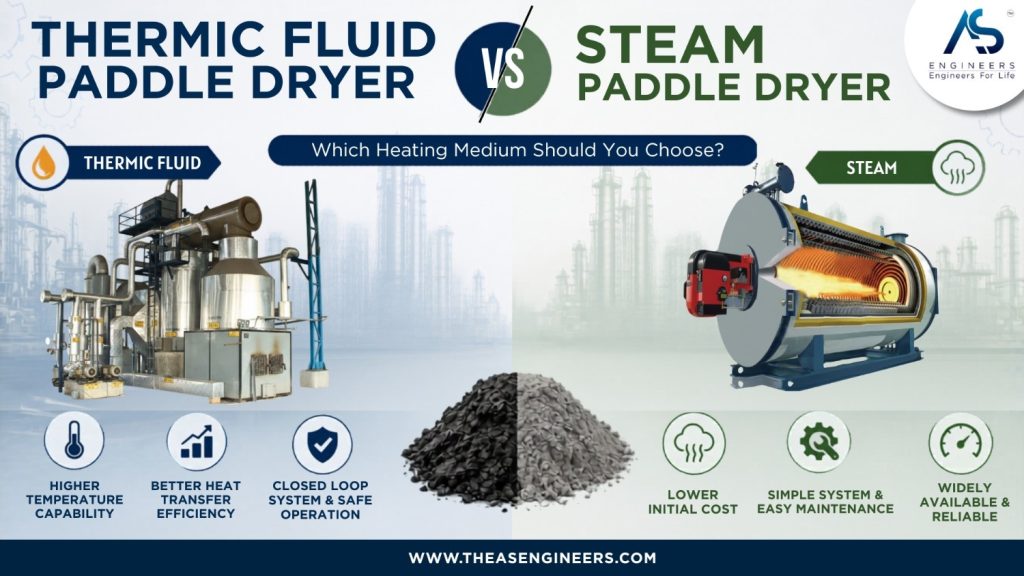
Thermic Fluid Paddle Dryer vs Steam Paddle Dryer: Which Heating Medium Should You Choose?

Thermic fluid paddle dryer vs steam paddle dryer selection depends on temperature requirement, existing plant utilities, material behavior, moisture target, operating safety, and maintenance capability. Choose steam when your plant already has reliable boiler steam and the drying duty fits the available steam pressure. Choose thermic fluid when the process needs higher temperature capability, stable thermal-oil circulation, or a dedicated heating loop independent of central steam.
The important point is simple: the paddle dryer is only one part of the decision. The heating system, piping, controls, vapour handling, operator skill, and long-term maintenance all affect the real performance.
For a broader utility overview, AS Engineers has already covered paddle dryer heating medium and fuel options. This guide goes deeper into the practical comparison between steam and thermic fluid.
Quick Answer for Plant Teams
A steam paddle dryer is a strong fit when:
- Steam boiler capacity is already available.
- The required drying temperature is within the available steam pressure range.
- Condensate return, steam traps, pressure controls, and boiler operation are already managed well.
- The plant wants to use a central utility system instead of adding a separate heating loop.
A thermic fluid paddle dryer is a strong fit when:
- The drying duty needs higher operating temperature.
- The plant prefers a circulating thermal-oil system.
- Stable high-temperature heating is needed for long continuous operation.
- The process does not fit well within practical steam pressure and temperature limits.
AS Engineers’ paddle dryer data supports indirect steam heating up to 14.06 kg/cm² and thermal oil heating up to 400°C, subject to final application review, material behavior, and design conditions.
What Stays the Same in Both Dryer Types?
In both steam and thermic fluid paddle dryers, the core drying principle remains indirect heat transfer.
The heating medium does not directly touch the material. Heat passes through the hollow shafts, wedge-shaped paddles, and jacketed trough. The dual counter-rotating shafts continuously move, shear, mix, and expose wet feed to heated surfaces.
This is why paddle dryers are often considered for difficult industrial materials such as:
- ETP and STP sludge
- Chemical sludge
- Wet cake
- Paste-like materials
- Powders and granules
- Mineral concentrates
- Polymer and chemical intermediates
- Heat-sensitive or enclosed-process materials, depending on duty
For sludge-specific applications, review AS Engineers’ guide on paddle dryers for sludge drying.
What Actually Changes Between Steam and Thermic Fluid?
The dryer body may look similar from the outside, but the heating route changes many practical details.
| Selection Factor | Steam Paddle Dryer | Thermic Fluid Paddle Dryer | Practical Meaning |
|---|---|---|---|
| Heating medium | Steam from boiler | Heated thermal oil or thermic fluid | Utility design changes upstream of the dryer |
| Typical reason to choose | Existing boiler utility and suitable temperature | Higher-temperature duty or dedicated oil loop | Selection starts with process temperature and site utility |
| Heat transfer behavior | Strong heat transfer when steam quality and condensate removal are stable | Stable heating when oil circulation and temperature control are designed well | Both need proper controls |
| Pressure consideration | Steam temperature rises with pressure | Thermal oil can operate at high temperature with lower system pressure than comparable high-temperature steam | EHS review is needed for both systems |
| Maintenance focus | Boiler, traps, condensate return, pressure controls, water treatment | Heater, pump, expansion tank, oil quality, insulation, leakage control | Match the system with plant maintenance skill |
| Best fit | Plants with reliable steam and moderate drying temperature | Plants needing higher temperature or independent thermal-oil loop | No universal winner |
| Risk if selected wrongly | Insufficient temperature, condensate issues, pressure-system complexity | Oil degradation, fouling, pump issues, fire-risk controls | Wrong utility choice affects lifecycle cost |
When a Steam Paddle Dryer Makes More Sense
A steam paddle dryer is usually the practical first option when steam already exists at the site.
Many chemical, textile, food, pharma, paper, and wastewater plants already operate boilers. If the boiler has enough spare capacity, the steam pressure is suitable, and condensate handling is reliable, steam can be a clean and familiar way to heat a paddle dryer.
Steam becomes more attractive when the plant has:
- Existing boiler infrastructure
- Experienced boiler operators
- Reliable steam pressure control
- Proper condensate recovery
- Good water treatment practice
- Steam traps and pressure controls already maintained
- Moderate drying temperature requirement
In this case, the paddle dryer becomes another heat consumer in the existing utility network. The project may become simpler because the plant does not need a separate thermic fluid heater, oil circulation pump, expansion tank, and thermal-oil loop.
But steam should not be selected only because “steam is already available.” The real checks are boiler spare capacity, steam pressure, line losses, condensate drainage, dryer heat load, and final moisture target.
Where Steam Selection Can Go Wrong
Steam paddle dryer problems often happen when the utility is assumed, not checked.
Common mistakes include:
- Assuming boiler capacity without checking existing plant load.
- Ignoring pressure drop between boiler and dryer.
- Poor condensate removal from the jacket or shaft system.
- Weak steam-trap maintenance.
- Underestimating warm-up and control behavior.
- Selecting steam even when the process needs a higher thermal driving force.
- Not checking whether the final moisture target is realistic at the available steam condition.
When I review a paddle dryer heating-medium discussion, I do not start by asking only whether steam is available. I ask whether the steam condition can actually support the required drying duty for that material, moisture load, and operating pattern.
When a Thermic Fluid Paddle Dryer Makes More Sense
A thermic fluid paddle dryer is usually preferred when the application needs higher operating temperature, stable thermal-oil heating, or an independent heating loop.
AS Engineers supports thermal oil heating up to 400°C in paddle dryer configurations, subject to final application and design review. That makes thermic fluid important for duties where steam temperature is not enough or where high-temperature steam would create unnecessary pressure-system complexity.
Thermic fluid becomes more attractive when the plant needs:
- Higher operating temperature
- Continuous stable heating
- Dedicated heater and circulation loop
- Thermal control independent of central steam
- Better fit for chemical, mineral, polymer, or higher-temperature drying duties
- Lower-pressure high-temperature heating philosophy compared with high-pressure steam
For more application-side context, review AS Engineers’ page on thermic fluid paddle dryer benefits.
Where Thermic Fluid Selection Can Go Wrong
Thermic fluid is not a magic upgrade. It is a heated oil system, and it needs disciplined operation.
Common mistakes include:
- Treating thermal oil as a simple steam replacement.
- Ignoring thermic fluid quality and degradation.
- Poor line insulation.
- Weak pump selection or poor circulation.
- Not planning expansion tank, safety interlocks, and temperature controls properly.
- Ignoring leakage and fire-risk controls.
- Running oil beyond suitable service condition without testing or maintenance.
- Forgetting that the heater, piping, pump, and control system are part of the dryer package decision.
Thermic fluid may reduce certain pressure-related concerns compared with high-temperature steam, but it introduces hot-oil housekeeping and fire-safety responsibilities. The correct decision is not “thermic fluid is safer” or “steam is safer.” The correct decision is whether the complete system can be designed, operated, and maintained safely for the actual duty.
External engineering references such as Forbes Marshall’s steam-versus-thermic-fluid heating-media discussion and Babcock Wanson’s thermal fluid-versus-steam comparison also show why temperature, pressure, water treatment, controls, and maintenance should be evaluated together instead of selecting a utility from one headline advantage.
Steam vs Thermic Fluid for Sludge Drying
For sludge drying, the heating medium decision should come after the sludge behavior is understood.
Sludge can vary widely by source. CETP sludge, ETP sludge, STP sludge, textile sludge, pharma sludge, paper sludge, and chemical sludge can all behave differently inside a dryer. Some sludge becomes sticky during drying. Some releases odour or vapour. Some needs enclosed handling. Some needs careful downstream discharge planning.
For sludge, evaluate:
- Initial moisture
- Final moisture target
- Daily sludge quantity
- Sludge stickiness
- Organic or inorganic content
- Odour and vapour handling
- Fines carryover
- Disposal or reuse objective
- Available steam or thermic fluid utility
- Pollution-control requirement
- Product handling after drying
A steam paddle dryer may work well when the available steam condition matches the moisture-removal duty. A thermic fluid paddle dryer may be better when higher temperature and stable continuous heating are needed. But neither should be selected without checking the sludge sample and full system arrangement.
For ZLD, CETP, and difficult sludge duties, the dryer should be reviewed with feeding, vapour handling, fines separation, scrubber or bag filter requirement, and final product handling. AS Engineers’ paddle dryer in ZLD plant guide is useful for that wider system view.
Steam vs Thermic Fluid for Chemical and Process Drying
For chemical and process drying, the question becomes more specific.
A chemical plant may prefer steam when the process is within a moderate temperature range and steam is already reliable. But thermic fluid may be more suitable when higher temperature, controlled thermal profile, or solvent-related process design makes steam less practical.
Chemical drying selection should check:
- Material heat sensitivity
- Solvent or water vapour release
- Required product temperature
- Maximum allowable product temperature
- Corrosion risk
- MOC requirement
- Vapour condensation or scrubbing requirement
- Batch or continuous operating pattern
- Utility availability
- EHS controls around vapour, dust, and heat source
For corrosive or chemically demanding service, see AS Engineers’ paddle dryer in chemical industry page.
Buyer Decision Matrix
Use this matrix before asking for a quotation.
| Buyer Question | If Your Answer Is “Yes” | Likely Direction |
|---|---|---|
| Do you already have reliable boiler steam with spare capacity? | Existing utility can reduce project complexity | Steam deserves first review |
| Does the process need higher temperature than practical site steam can support? | Steam may become pressure-heavy or insufficient | Thermic fluid deserves first review |
| Is the plant already operating thermic fluid heaters? | Operators and maintenance may already understand hot-oil systems | Thermic fluid may integrate well |
| Is condensate return difficult due to layout or distance? | Steam performance may suffer if condensate is not managed well | Review both options carefully |
| Is continuous stable high-temperature operation required? | Thermal-oil circulation may be more suitable | Thermic fluid may be stronger |
| Is the duty moderate and steam control is already reliable? | Existing steam network may be practical | Steam may be stronger |
| Is the material sticky, variable, or difficult to dry? | Heating medium alone will not solve the issue | Pilot trial and process review needed |
| Is vapour handling important? | Dryer selection must include off-gas and condensation planning | Review full system, not dryer alone |
RFQ Checklist for Steam or Thermic Fluid Paddle Dryer
Before requesting a quote, share these inputs with the dryer manufacturer.
Material and Process Data
- Material name
- Industry and process source
- Feed form: slurry, paste, cake, granule, powder, sludge
- Initial moisture
- Required final moisture
- Hourly or daily feed quantity
- Bulk density
- Stickiness or phase-change behavior during drying
- Heat sensitivity
- Corrosive or abrasive nature
- Solvent or water vapour release
- Required discharge condition
Utility Data
For steam:
- Available steam pressure
- Boiler spare capacity
- Distance from boiler to dryer
- Steam quality
- Condensate return arrangement
- Existing steam traps and pressure-control practice
- Boiler fuel and operating pattern
For thermic fluid:
- Existing thermic fluid heater, if any
- Available thermal oil temperature
- Oil type and service condition
- Pump and circulation capacity
- Expansion tank arrangement
- Line insulation
- Temperature control philosophy
- Safety interlocks and leak-control plan
System and Site Data
- Feeding method
- Discharge method
- Vapour handling method
- Cyclone, scrubber, condenser, or bag filter requirement
- Available floor space
- Electrical load constraints
- MOC requirement
- Automation requirement
- Site operating hours
- Maintenance access
- Expected service and spare support
AS Engineers also provides paddle dryer services for repairs, upgrades, OEM spare parts, retrofitment, and service support where the existing system needs review.
Practical Recommendation
Do not select between thermic fluid and steam only by looking at fuel price or available utility name.
The correct sequence is:
- Define the material and moisture-removal duty.
- Confirm the required product temperature and final moisture.
- Check existing plant utilities honestly.
- Evaluate steam pressure or thermic fluid temperature capability.
- Review EHS and maintenance requirements.
- Confirm vapour and off-gas handling.
- Check feeding and discharge behavior.
- Use pilot testing where material behavior is uncertain.
- Finalize dryer configuration only after the complete system is clear.
AS Engineers offers paddle dryer configurations around indirect steam, thermic fluid, and other heating arrangements depending on the process requirement. Where the duty is unclear, pilot evaluation and application review help reduce selection risk before final order placement.
FAQs
Is thermic fluid paddle dryer better than steam paddle dryer?
Not always. Thermic fluid is better when the process needs higher operating temperature, stable thermal-oil circulation, or a dedicated heating loop. Steam is better when reliable boiler steam is already available and the drying duty fits within the practical steam pressure range.
What is the maximum steam pressure for AS Engineers paddle dryers?
AS Engineers source data supports indirect steam heating up to 14.06 kg/cm². Final selection still depends on material behavior, moisture load, dryer design, utility condition, and safety review.
What is the maximum thermal oil temperature for AS Engineers paddle dryers?
AS Engineers source data supports thermal oil heating up to 400°C. This does not mean every material should be dried at that temperature. The safe operating temperature must be selected based on material, process, MOC, vapour handling, and EHS requirements.
Can the same paddle dryer be converted from steam to thermic fluid later?
It depends on the original dryer design, jacket and shaft rating, heating surface design, controls, piping, safety system, and site layout. Buyers should not assume conversion is simple. If future utility change is possible, discuss it during the initial RFQ stage.
Which heating medium is better for sludge drying?
For sludge drying, steam can be suitable when the plant already has reliable steam and the moisture-removal duty is within the available temperature range. Thermic fluid can be suitable when higher temperature or stable thermal-oil heating is required. Sludge sample behavior, final moisture target, vapour handling, and disposal objective should decide the final selection.
Conclusion
Thermic fluid paddle dryer vs steam paddle dryer selection is not a one-line decision. Steam is often practical where the plant already has reliable boiler steam, condensate handling, and a moderate drying-temperature requirement. Thermic fluid is often stronger when the process needs higher operating temperature, stable thermal-oil circulation, or an independent heating loop.
The best selection starts with the material, not the utility brochure. Share the feed moisture, final moisture target, material behavior, daily throughput, available steam or thermic fluid utility, vapour handling requirement, and site constraints. The AS Engineers team can review the duty and suggest a paddle dryer configuration based on actual plant conditions.
