
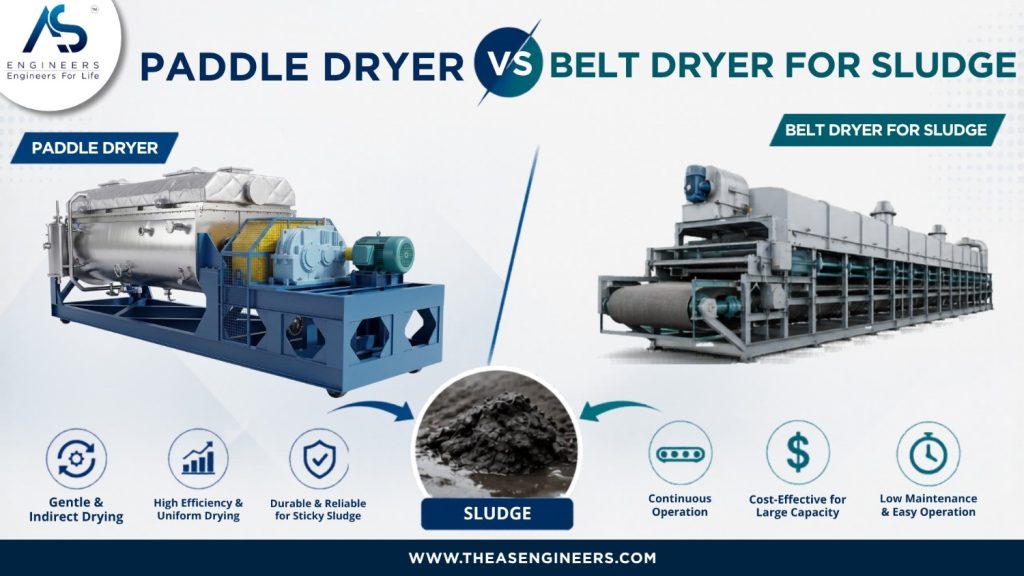
Paddle Dryer vs Belt Dryer for Sludge: Which Dryer Should You Choose?

If your sludge is sticky, pasty, odorous, inconsistent, or space-constrained, a paddle dryer is usually the safer starting point than a belt dryer. A belt dryer can work where sludge is well-dewatered, easy to spread, and the plant has enough floor area and air-handling capacity.
The right choice is not “paddle dryer or belt dryer” by name. It depends on sludge behavior, inlet moisture, final moisture target, heating medium, vapour handling, footprint, maintenance access, and the final disposal or reuse plan.
For plants evaluating a paddle dryer for sludge drying, the comparison should start with one question: Can your sludge move, mix, dry, and discharge reliably in real operating conditions?
Quick Answer: Paddle Dryer or Belt Dryer for Sludge?
Choose a paddle dryer when the sludge is sticky, wet-cake-like, pasty, variable, difficult to spread, odorous, or when the plant wants a compact enclosed drying system.
Choose a belt dryer when the sludge can be distributed evenly on a moving belt, the plant has sufficient layout space, and the air-handling, odour-control, and belt-cleaning systems are acceptable for daily operation.
In practical sludge drying projects, I would not finalize either dryer only from catalogue data. The sludge must be checked for stickiness, feed consistency, drying curve, discharge behavior, vapour load, and final handling route.
How a Paddle Dryer Dries Sludge
A paddle dryer dries sludge through indirect heat transfer. Heat passes through the hollow shafts, paddles, and jacketed surfaces while the sludge is continuously mixed inside the dryer body.
In an AS Engineers paddle dryer system, the configuration can include feed handling, heating system, paddle dryer, scavenging arrangement, pollution-control equipment, solvent or vapour management, and dried-product handling. This is important because sludge drying is not only about the dryer body. Feeding, vapour movement, fines control, discharge, and bagging or truck loading also affect the final result.
A paddle dryer is especially useful when sludge changes form during drying. Many sludges move from wet and sticky to plastic, then shearing, then granular. The mixing and shearing action helps the material keep moving through these stages.
For a broader thermal drying context, the sludge thermal drying guide can support readers who are comparing different sludge drying methods.
How a Belt Dryer Dries Sludge
A belt dryer dries sludge by spreading it on a moving belt and passing heated air through or across the material. The belt carries the sludge through the drying chamber while moisture evaporates.
This method can work well when the sludge forms a stable layer on the belt. The challenge starts when the feed is sticky, lumpy, too wet, or inconsistent. In that case, the belt dryer may need upstream conditioning, mixing, forming, extrusion, or back-mixing before the sludge can be distributed properly.
A belt dryer also depends heavily on air distribution. That means the full system must consider hot air generation, circulation fans, exhaust ducts, odour control, fines handling, cleaning access, and building layout.
Paddle Dryer vs Belt Dryer for Sludge: Buyer Comparison Table
| Buyer Factor | Paddle Dryer | Belt Dryer | What to Check Before Selection |
|---|---|---|---|
| Heat transfer method | Indirect contact heating through heated surfaces | Direct or convective hot air drying | Heating medium, fuel cost, evaporation load |
| Sticky sludge handling | Stronger for sticky, pasty, wet-cake sludge | Depends on feed conditioning and spreading | Test the sticky phase during drying |
| Feed distribution | Handles difficult feed better through mixing | Needs even spreading on belt | Check dewatering quality and sludge consistency |
| Footprint | Usually more compact | Often needs longer layout and air-handling space | Compare full installed system, not only machine body |
| Odour containment | Enclosed design can help control vapour and odour | Depends on dryer enclosure and exhaust system | Review odour-control and ventilation needs |
| Off-gas volume | Generally lower than large air-based systems | Usually higher due to air movement | Check ducts, fans, scrubber, condenser, or filters |
| Maintenance focus | Shafts, paddles, bearings, gearbox, seals, discharge | Belt, rollers, tracking, air system, cleaning | Match maintenance profile with site team |
| Final moisture control | Strong when correctly sized and tested | Can be effective when feed layer is stable | Confirm by pilot or material test |
| Best-fit sludge type | Sticky ETP sludge, STP sludge, CETP sludge, industrial wet cake | Spreadable and well-conditioned sludge | Do not assume all sludge behaves the same |
| Main selection risk | Wrong MOC, under-sizing, poor vapour planning | Uneven belt loading, fouling, larger air system | Request duty-specific proposal |
The Real Difference Is Sludge Behavior
The main difference is simple: a belt dryer needs sludge that can sit properly on a belt, while a paddle dryer is designed to keep difficult sludge moving inside the dryer.
Many ETP, STP, CETP, chemical, pharma, textile, paper, food, and municipal sludge streams are not consistent every day. Moisture changes. Polymer dosing changes. Filter press or centrifuge output changes. Organic content changes. Salt, fines, oil, or fibrous matter may also change the way sludge dries.
This is why dryer selection should include:
- Inlet moisture percentage
- Final moisture target
- Sludge stickiness
- Bulk density
- Abrasiveness
- Corrosiveness
- Odour release
- Feed variation during the week
- Heat sensitivity
- Dried sludge destination
For difficult industrial sludge, it is safer to evaluate a sludge drying system around real sludge behavior instead of comparing only dryer names.
Footprint and Layout: Do Not Compare Only the Main Machine
A common mistake is comparing only the main dryer body. That is incomplete.
A sludge drying plant may also need:
- Wet sludge storage
- Screw feeder, sludge pump, or belt conveyor
- Heating system
- FD blower or hot air system
- ID fan or vapour handling system
- Cyclone, scrubber, bag filter, or condenser
- Dried sludge screw conveyor
- Bagging system, silo, bucket elevator, or truck loading system
- Inspection and maintenance access
A paddle dryer often has an advantage when the plant has limited floor space because the drying happens inside a compact enclosed trough with heated shafts and surfaces. A belt dryer may need more length, more belt area, and more air-handling equipment.
This does not make belt dryers wrong. It means the buyer should compare the full installed footprint, not only the dryer quotation.
Odour, Vapour, and Off-Gas Handling
Sludge drying can release moisture, odour, volatile compounds, and fine particles depending on the sludge source. For ETP sludge, CETP sludge, chemical sludge, pharma sludge, textile sludge, tannery sludge, and paper sludge, vapour handling should be discussed early.
A paddle dryer’s enclosed design can make vapour handling more controlled. AS Engineers’ paddle dryer process flow includes pollution-control options such as cyclone, scrubber, and bag filter, along with solvent or vapour management options where the application requires it.
A belt dryer can also be enclosed, but because it relies on air movement, the buyer must carefully review air volume, exhaust path, odour treatment, ducting, fan selection, and cleaning access.
For wastewater and dewatering context before drying, the plate frame filter press and paddle dryer guide is a useful supporting page.
Energy and Operating Cost: Avoid One-Line Claims
No responsible supplier should say, “This dryer is always cheaper to run” without sludge data.
Operating cost depends on:
| Cost Factor | Why It Matters |
|---|---|
| Inlet moisture | Higher water load means higher evaporation duty |
| Final moisture | Lower final moisture usually needs more heat and residence time |
| Heating medium | Steam, thermic fluid, hot water, gas, coal, wood, LDO, electricity, or briquette affect operating economics |
| Operating hours | Batch-like and continuous plant patterns change cost per ton |
| Sludge behavior | Sticky material can reduce throughput if wrongly selected |
| Off-gas treatment | Scrubber, condenser, fan, and ducting add operating load |
| Maintenance | Downtime, belt cleaning, bearing service, seals, and wear parts affect lifecycle cost |
| Disposal route | Drying value depends on reduced disposal, transport, handling, or reuse potential |
AS Engineers’ official sludge drying reference gives fuel-yield examples for sludge drying from 80% initial moisture to 20% final moisture, but actual cost must be recalculated for the plant’s fuel price, sludge type, daily quantity, and final moisture requirement.
Maintenance: Which Risk Can Your Plant Handle?
Both dryers need maintenance. The correct question is not “Which dryer has no maintenance?” The correct question is: Which maintenance profile fits your sludge and plant team?
Paddle dryer maintenance focus
- Shaft condition
- Paddle wear
- Bearing and gearbox condition
- Seal condition
- Discharge behavior
- Internal buildup
- MOC suitability
- Alignment and vibration
Belt dryer maintenance focus
- Belt tracking
- Belt cleaning
- Belt wear
- Rollers and bearings
- Feed distribution system
- Air circulation system
- Exhaust ducts
- Odour-control equipment
AS Engineers supports paddle dryer users with OEM spare parts, shaft, gearbox and bearing replacement, system repair, upgrades, and retrofitment support. That matters when the buyer is not only purchasing a dryer, but planning long-term plant operation.
Where a Belt Dryer Can Make Sense
A belt dryer can be a suitable choice when:
- Sludge is already well-dewatered
- Feed can be spread evenly
- Sludge does not remain highly sticky
- Large installation space is available
- Air-handling and exhaust treatment are planned properly
- Low-temperature or waste-heat drying is part of the project concept
- Maintenance team can manage belt cleaning, tracking, and distribution issues
- The plant accepts a longer process layout
For municipal or biosolids projects with stable feed and sufficient space, belt dryers may be part of the evaluation. The key is to confirm feed formation and air-system design before finalizing.
Where a Paddle Dryer Is Usually Stronger
A paddle dryer is often stronger when:
- Sludge is sticky or pasty
- Sludge comes as wet cake from filter press or centrifuge
- Feed consistency changes daily
- Floor space is limited
- Odour containment matters
- Lower off-gas volume is preferred
- The plant wants enclosed indirect drying
- Dried sludge must become easier to handle, convey, bag, or dispose
- The project needs a custom MOC, heating medium, and process configuration
For AS Engineers, the paddle dryer is not treated as a standalone machine only. It can be evaluated as a full drying system with feeding, heating, vapour handling, pollution-control support, and dried-product handling.
Fit and No-Fit Guidance
| Plant Situation | Better Starting Point | Why |
|---|---|---|
| Sticky ETP sludge from chemical or pharma plant | Paddle dryer | Mixing and shearing help manage sticky phase |
| Sludge can be granulated and spread evenly | Belt dryer can be evaluated | Belt loading may remain stable |
| Existing plant has limited floor space | Paddle dryer | More compact enclosed system is often easier to place |
| Large municipal sludge plant with stable feed and space | Belt dryer or paddle dryer | Both need techno-commercial evaluation |
| Odour complaints are already a problem | Paddle dryer deserves strong review | Enclosed vapour handling can be planned tightly |
| Final reuse route depends on stable dryness | Test both if budget allows | Final decision should come from trial data |
| Buyer has weak maintenance bandwidth for belts and air ducts | Paddle dryer may be easier | Fewer belt-related tracking and cleaning concerns |
| Sludge is highly abrasive or corrosive | Depends on MOC and test | Do not select without material review |
RFQ Checklist for Paddle Dryer vs Belt Dryer Comparison
Before asking for a quotation, prepare these details:
- Sludge source: ETP, STP, CETP, municipal, chemical, pharma, textile, food, paper, tannery, oil, or mixed sludge
- Daily sludge quantity in kg/day or ton/day
- Inlet moisture percentage
- Required final moisture or dryness
- Dewatering method: filter press, centrifuge, screw press, belt press, or other
- Sludge form: cake, paste, slurry, lumps, sticky mass, fibrous sludge, oily sludge
- Bulk density if available
- pH and corrosive nature
- Chlorides, salts, solvents, oil, or organic load if relevant
- Heating medium available: steam, thermic fluid, hot water, gas, coal, wood, LDO, electricity, briquette
- Available floor space and height
- Vapour, odour, and fines-control requirement
- Disposal route: landfill, TSDF, co-processing, cement, fuel, composting, bricks, agriculture, or incineration
- Required automation level
- Preferred material of construction
- Operating hours per day
- Utility cost and fuel availability
- Maintenance access constraints
- Trial or sample-testing requirement
For plant teams considering drying as part of a ZLD or wastewater reduction project, the paddle dryer in ZLD plant page can support the broader decision.
Common Mistakes Buyers Should Avoid
Selecting only by dryer price
A lower machine price can become expensive if the sludge fouls the belt, does not spread, creates odour issues, or needs additional conditioning equipment.
Ignoring the sticky phase
Many sludges pass through a sticky plastic stage during drying. This stage must be tested, not assumed.
Comparing machine footprint instead of system footprint
Include feeders, conveyors, heater, fans, ducts, scrubber, condenser, bag filter, bagging, and maintenance access.
Assuming dried sludge is automatically valuable
Dried sludge may support reuse routes only when its composition, calorific value, contaminants, regulations, and buyer acceptance allow it.
Not checking final moisture realistically
Very low moisture targets can increase heat duty, residence time, and cost. Define what final moisture is commercially necessary.
Skipping pilot testing
A pilot trial can reveal buildup, discharge, odour, drying curve, and actual output quality before capital investment.
AS Engineers offers paddle dryer pilot trial support for application evaluation, and buyers can also review the dedicated paddle dryer pilot trial resource.
Final Selection Logic
Use this practical sequence:
- Check sludge behavior first.
- Confirm inlet and final moisture.
- Compare full installed system, not only the dryer.
- Review vapour and odour handling.
- Compare energy cost per ton of water evaporated.
- Check maintenance risks.
- Confirm dried sludge destination.
- Run trial testing where sludge behavior is uncertain.
- Finalize MOC, heating medium, automation, and layout.
- Ask for a duty-specific quotation, not a generic dryer price.
FAQs
Is a paddle dryer better than a belt dryer for sludge?
A paddle dryer is usually better for sticky, pasty, inconsistent, odorous, or space-constrained sludge. A belt dryer can be suitable when sludge is well-dewatered, easy to spread, and the plant has enough area for belt and air-handling systems.
Which dryer is better for sticky ETP sludge?
For sticky ETP sludge, a paddle dryer is usually the stronger starting point because it mixes and shears the sludge while drying through indirect heated surfaces. Belt dryers may need extra conditioning or forming if the sludge does not spread evenly.
Does a belt dryer need more space than a paddle dryer?
Often yes, because a belt dryer may need a longer belt path, air circulation system, exhaust ducts, odour-control equipment, and cleaning access. The exact layout depends on capacity, moisture load, and system design.
Which dryer has lower operating cost?
Operating cost depends on moisture load, fuel type, final moisture target, operating hours, maintenance, and disposal savings. It is not accurate to say one dryer is always cheaper without sludge data and utility cost.
What data should I share for sludge dryer selection?
Share sludge type, daily quantity, inlet moisture, final moisture target, dewatering method, stickiness, pH, corrosive or abrasive nature, heating medium, floor space, odour-control need, and final disposal or reuse plan.
Conclusion
For sludge drying, a paddle dryer vs belt dryer decision should be based on sludge behavior, not only machine comparison. A belt dryer can work when sludge is stable, spreadable, and the plant has enough area and air-handling capacity. A paddle dryer is often more practical for sticky, pasty, variable, odorous, and space-constrained industrial sludge.
For ETP, STP, CETP, chemical, pharma, textile, food, paper, and municipal sludge projects, share the sludge data, moisture target, utility details, vapour-handling requirement, and disposal plan before final selection. AS Engineers can review the requirement and suggest a paddle dryer configuration based on actual site and material conditions.
