
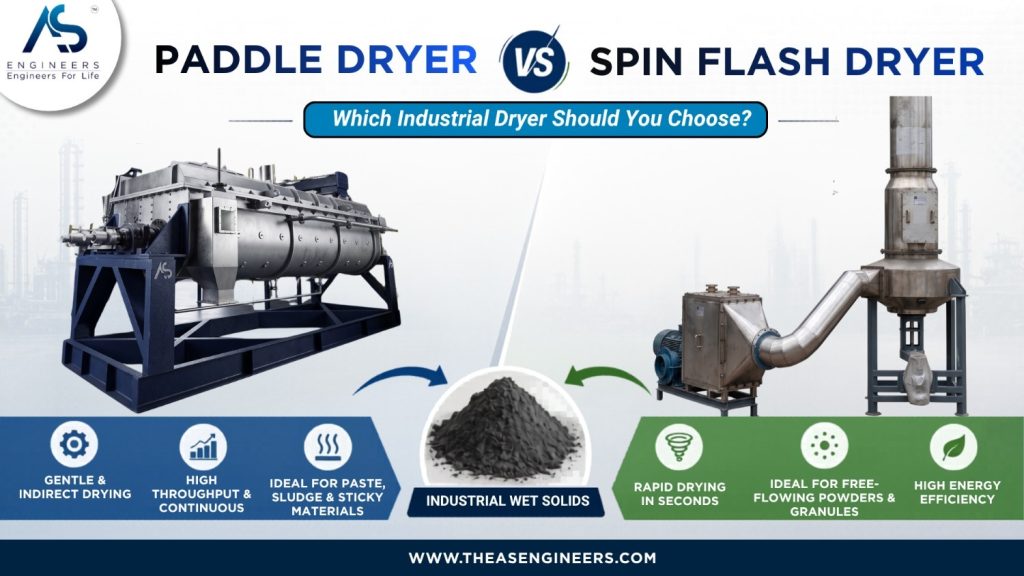
Paddle Dryer vs Spin Flash Dryer: Which Industrial Dryer Should You Choose?

Paddle dryer vs spin flash dryer selection depends mainly on feed behavior and final product requirement. A paddle dryer is usually better for sludge, sticky paste, wet cake, high-moisture waste, and controlled indirect heating. A spin flash dryer is usually better when the material can be rapidly disintegrated and dried into fine powder using hot air.
The wrong dryer choice can increase power load, off-gas treatment cost, maintenance issues, dust handling problems, and final moisture variation. So the decision should not be made only by dryer name. It should be made after checking feed moisture, stickiness, heat sensitivity, particle behavior, vapor handling, MOC, utility availability, and final product form.
At AS Engineers, I normally advise buyers to start with material behavior first. If the feed is sticky, pasty, sludge-like, or difficult to fluidize, a paddle dryer for sludge drying is often the safer direction. If the feed can be dispersed quickly and the plant wants a powder output, a spin flash dryer can be considered.
Quick Answer: Paddle Dryer vs Spin Flash Dryer
| Selection Point | Paddle Dryer | Spin Flash Dryer |
|---|---|---|
| Main drying principle | Indirect conductive heating through heated surfaces | Direct convective hot-air drying with mechanical disintegration |
| Best feed type | Sludge, wet cake, sticky paste, slurry, granules, powders | Wet cake, paste, filter cake, moist powder, dispersible feed |
| Heat transfer | Through jacket, hollow shafts, and paddles | Through high-velocity hot air contact |
| Material movement | Slow agitation, mixing, shearing, plug-flow movement | Rapid dispersion inside a hot-air stream |
| Final product | Dried cake, granules, powder, sludge solids, process solids | Usually fine powder or light dry particles |
| Off-gas volume | Generally lower because drying is indirect | Generally higher because hot air carries moisture and fines |
| Fines handling | Lower dust carryover in many sludge/paste duties | Needs proper cyclone, bag filter, and dust collection |
| Heat-sensitive material | Better where slow, controlled heating is required | Possible only if short residence time suits the material |
| Sludge drying | Strong fit for ETP/STP/industrial sludge | Possible only for suitable feed behavior and powder target |
| Solvent/vapor control | Enclosed design can support controlled vapor handling | Needs careful exhaust, dust, and vapor treatment |
| Maintenance focus | Shafts, paddles, bearings, gearbox, seals, drive system | Disintegrator, classifier, air heater, ducting, cyclone, bag filter |
| Best-fit buyer | Wastewater, chemical, pharma, food, mining, sludge handling plants | Powder processors, chemicals, minerals, pigments, food powders |
What Is a Paddle Dryer?
A paddle dryer is an indirect heat transfer dryer. The heating medium passes through heated surfaces such as the jacket, hollow shafts, and paddles. The material does not need to be suspended in a large hot-air stream. Instead, rotating paddles mix, shear, break, and move the wet feed toward discharge.
In AS Engineers paddle dryer systems, the drying process can include feeding, heating, the paddle dryer body, scavenging air, pollution control equipment, vapor or solvent management, and product handling. Depending on the material and process requirement, configuration options may include a standard dryer, dual zone dryer, or vacuum dryer.
A paddle dryer is commonly considered for:
- ETP sludge and STP sludge
- Industrial sludge from wastewater plants
- Filter press cake
- Sticky chemical paste
- Wet powders and granules
- High-moisture solid waste
- Materials where enclosed indirect heating is preferred
- Applications where the plant wants controlled discharge and easier handling
For plants working toward wastewater volume reduction or ZLD support, the paddle dryer in ZLD plant page is a useful related reference.
What Is a Spin Flash Dryer?
A spin flash dryer is a direct hot-air dryer. Wet feed enters a vertical drying chamber where a rotating disintegrator breaks the material into smaller particles. Hot air rapidly evaporates moisture, and the dried powder or fine particles are carried to downstream separation equipment such as a cyclone, bag filter, or a combination of both.
A spin flash dryer is commonly considered for:
- Dispersible wet cake
- Filter cake that can break into small particles
- Moist powder
- Pigments
- Minerals
- Chemical powders
- Food or pharma intermediates where short residence drying is suitable
- Applications where the final product should be powder-like
For technical understanding of this dryer type, refer to Acmefil’s guide on spin flash dryer working principle and spin flash dryer applications.
The Main Difference Is Not Only Dryer Design
The real difference between paddle dryer and spin flash dryer is how each dryer treats the material.
A paddle dryer handles the material as a mass. It mixes, shears, heats, and moves the product through heated surfaces. This makes it useful for sludge, wet cake, sticky feed, and materials that cannot be easily carried in hot air.
A spin flash dryer handles the material as dispersed particles. It depends on rapid contact between hot air and small particles. This makes it useful when the material can break down quickly and leave the dryer as powder.
Simple selection rule:
Choose a paddle dryer when the feed behaves like sludge, paste, sticky cake, or high-moisture mass. Choose a spin flash dryer when the feed can behave like small particles after disintegration and the final output must be powder.
When a Paddle Dryer Is the Better Choice
A paddle dryer is usually the better choice when the process needs controlled drying rather than fast air-borne drying.
Sludge and wet cake drying
ETP sludge, STP sludge, chemical sludge, paper sludge, biological sludge, and similar wet cakes are often difficult to dry in hot-air systems because they can remain sticky, form lumps, create odor, and produce inconsistent feed behavior.
A paddle dryer keeps the material inside a heated chamber and gradually removes moisture. This is useful when the plant wants volume reduction, transport cost reduction, easier disposal, or possible reuse of dried material.
For sludge-focused plants, also review efficient sludge disposal by drying and sludge drying solutions for textile industry.
Sticky paste and difficult feed
If the feed is sticky, pasty, adhesive, or semi-solid, a paddle dryer can be more practical because the paddles provide mechanical agitation and shearing. The material does not need to fluidize or travel as fine particles from the start.
This matters in chemical, pharma, dye, pigment, food, mineral, and waste-processing plants where material behavior changes during drying.
Lower off-gas volume requirement
Because a paddle dryer works mainly through indirect heating, it typically needs less process air than dryers that use hot air as the main drying carrier. This can reduce the burden on off-gas treatment equipment, but the actual system still depends on moisture load, vapor type, dust load, and downstream pollution control design.
AS Engineers’ paddle dryer system can be configured with cyclone, scrubber, bag filter, ID blower, chimney, condenser, and solvent tank options depending on process need.
Controlled vapor or solvent handling
For some materials, the vapor stream must be contained, recovered, scrubbed, condensed, or safely discharged. A paddle dryer’s enclosed design can be useful in such duties, but solvent recovery, vapor control, and EHS requirements must be reviewed case by case.
Better fit for disposal and volume reduction goals
If the plant’s main objective is to reduce wet sludge weight, reduce storage burden, improve handling, and reduce disposal frequency, a paddle dryer is often more aligned with the job than a spin flash dryer.
When a Spin Flash Dryer Is the Better Choice
A spin flash dryer becomes more relevant when the plant wants fast drying and powder output.
Powder output requirement
If the final product must be fine powder, a spin flash dryer can be a strong option. Its drying chamber, disintegrator, hot air stream, and separator system are designed to dry and carry small particles.
Feed can be disintegrated
Spin flash drying depends heavily on whether the feed can break down inside the dryer. A hard, rubbery, highly sticky, or lumpy mass may not behave properly unless it is conditioned, pre-dried, crushed, or fed through the right system.
Short residence time drying
A spin flash dryer can be suitable when quick moisture removal is needed and the material can tolerate the hot-air exposure. This is especially relevant for some chemical powders, pigments, minerals, and food ingredients.
Integrated air handling is acceptable
Spin flash systems need hot air generation, air movement, ducting, cyclone separation, bag filter or dust collection, and exhaust handling. If the plant already has enough space, dust-control infrastructure, and air-handling design support, spin flash drying may fit well.
Material Behavior Selection Table
| Feed Behavior | Better Direction | Reason |
|---|---|---|
| Sticky sludge from ETP/STP | Paddle dryer | Does not depend on full air suspension |
| Filter press cake with high moisture | Usually paddle dryer | Handles cake-like mass and gradual moisture removal |
| Cake that breaks into powder easily | Spin flash dryer may fit | Disintegrator and hot air can dry fine particles rapidly |
| Heat-sensitive paste needing controlled heating | Paddle dryer | Indirect heating and residence control can help |
| Fine powder with surface moisture | Spin flash dryer | Rapid hot-air drying can be effective |
| Solvent-laden paste | Paddle dryer or special design | Vapor handling and safety review required |
| Material with high dust explosion risk | Human review required | Needs process safety evaluation before dryer selection |
| Final product required as powder | Spin flash dryer | Designed around powder separation and collection |
| Final product acceptable as dried granules/cake | Paddle dryer | Better for controlled mass drying |
| Sludge disposal cost reduction | Paddle dryer | Aligns with volume and weight reduction goals |
Energy, Airflow, and Off-Gas Comparison
Energy comparison should not be simplified into “one dryer is always cheaper.” Drying cost depends on initial moisture, final moisture target, heat source, evaporation load, feed temperature, heat recovery, insulation, vapor treatment, dust collection, and operating hours.
Still, the drying mechanism creates different operating behavior.
| Factor | Paddle Dryer | Spin Flash Dryer |
|---|---|---|
| Main energy path | Heating medium through metal surfaces | Hot air stream contacting particles |
| Process air demand | Lower in many indirect drying duties | Higher because air is the drying carrier |
| Dust carryover | Usually lower for sludge/paste duties | Higher risk if fine powder is carried with air |
| Exhaust system | Vapor outlet, ID fan, scrubber/condenser as needed | Cyclone, bag filter, fan, ducting, exhaust system |
| Heat source | Steam, thermic fluid, hot water, or configured heating system | Hot air generator or air heater system |
| Practical caution | Check heat-transfer area and residence time | Check disintegration, air velocity, fines load, and powder collection |
Paddle Dryer vs Spin Flash Dryer for Sludge Drying
For sludge drying, the paddle dryer usually has a stronger fit because sludge is often sticky, heavy, high in moisture, and inconsistent in behavior. The goal is usually not powder production. The goal is moisture reduction, weight reduction, volume reduction, improved handling, and disposal control.
A spin flash dryer can dry some sludge-like materials only when the feed can be dispersed properly and the final product requirement supports powder collection. If the sludge remains sticky, forms lumps, or creates high dust and odor load, the spin flash route may become harder to operate.
For sludge-related site planning, connect this comparison with paddle dryer applications and plate frame filter press with paddle dryer for sludge drying.
Paddle Dryer vs Spin Flash Dryer for Chemical and Pharma Materials
Chemical and pharma materials need careful selection because moisture target, solvent presence, MOC, contamination risk, heat sensitivity, vapour handling, and cleaning access all affect the dryer design.
A paddle dryer may fit better when:
- The material is sticky or pasty.
- Slow and controlled heating is preferred.
- Solvent or vapor handling must be enclosed.
- The final product can be granule, cake, or dried mass.
- MOC selection is critical due to corrosion.
A spin flash dryer may fit better when:
- The material can break into powder.
- The process needs rapid hot-air drying.
- The final product must be fine powder.
- The plant has dust collection and air-handling capacity.
- Short residence time is suitable for the material.
Do not finalize chemical or pharma dryer selection without sharing MSDS, solvent details, temperature limits, bulk density, particle behavior, MOC preference, and cleaning requirement.
Paddle Dryer vs Spin Flash Dryer for Food and Agro Products
Food and agro materials vary widely. Starch, rice bran, fish meal, DDGS, instant coffee, cake flour, and similar materials do not behave the same way.
A paddle dryer may be considered where the feed is dense, sticky, pasty, oily, or needs slower thermal treatment. A spin flash dryer may be considered where the feed can be dispersed and powder form is required.
For food-sector applications, also review paddle dryer for cocoa and sugar where the drying requirement depends heavily on product behavior and final handling.
Buyer Decision Framework
Before selecting between paddle dryer and spin flash dryer, ask these questions.
| Question | Why It Matters |
|---|---|
| Is the feed sludge, paste, wet cake, slurry, granule, or powder? | Dryer performance depends on material behavior |
| What is the initial moisture and final moisture target? | Determines evaporation load and residence time |
| Does the material become sticky during drying? | Sticky phase can create buildup and discharge problems |
| Does the material break into powder easily? | Critical for spin flash dryer suitability |
| Is final product required as powder, granule, cake, or dry sludge? | Final form decides discharge and collection system |
| Is solvent present? | Vapor handling, condenser, scrubber, and safety review are needed |
| Is the material heat-sensitive? | Heating temperature and residence time must be controlled |
| What is the required MOC? | Corrosion, contamination, and cleanability depend on MOC |
| What utilities are available? | Steam, thermic fluid, electricity, fuel, and air system affect design |
| What downstream system is available? | Cyclone, scrubber, bag filter, condenser, chimney, and product handling must match the dryer |
| What is the daily throughput? | Determines dryer size and operating duty |
| Is a pilot trial needed? | Confirms drying behavior before final investment |
RFQ Checklist for Paddle Dryer vs Spin Flash Dryer
Send this data before asking for a quotation.
| RFQ Input | Details to Share |
|---|---|
| Material name | Sludge, chemical cake, pigment, food powder, mineral, polymer, etc. |
| Feed form | Slurry, paste, filter cake, sticky mass, granule, powder |
| Initial moisture | % moisture at dryer inlet |
| Final moisture target | Required % moisture at discharge |
| Throughput | kg/hr or ton/day wet feed |
| Bulk density | Wet and dry bulk density if available |
| Particle behavior | Sticky, lumpy, fibrous, abrasive, corrosive, powdery |
| Temperature limit | Maximum safe product temperature |
| Solvent details | Water or solvent name, if applicable |
| MOC preference | CS, SS304, SS316, Duplex, alloy, or site standard |
| Utility available | Steam, thermic fluid, hot water, electricity, gas, coal, wood, LDO |
| Pollution control need | Cyclone, scrubber, bag filter, condenser, chimney |
| Installation site data | Space, height, foundation, power, duct route, discharge point |
| Product handling | Screw conveyor, bagging, silo, bucket elevator, truck disposal |
| Trial requirement | Lab/pilot trial needed or not |
AS Engineers also supports paddle dryer training and spare parts for plants that need service, operator training, OEM spares, or retrofitment support.
Common Mistakes When Comparing These Dryers
Choosing by dryer name instead of feed behavior
A dryer that works well for powder may fail on sticky sludge. A dryer that works well for sludge may not be the best choice for powder production.
Ignoring the sticky phase
Many materials pass through a sticky phase before becoming dry. This phase can cause buildup, choking, poor heat transfer, or unstable discharge.
Underestimating off-gas and fines handling
Spin flash dryers need careful dust and air handling. Paddle dryers also need vapor and exhaust management, but the off-gas design is different.
Assuming moisture target is guaranteed without testing
Final moisture depends on feed consistency, residence time, heat input, material behavior, and operating control. For difficult materials, pilot trials are safer than assumptions.
Not checking MOC early
Material of construction should be discussed early, especially for corrosive sludge, chemicals, solvents, salts, and pharma intermediates.
Forgetting product handling after drying
Dryer output still needs conveying, bagging, silo storage, or truck loading. A good dryer selection can still fail if discharge handling is poorly planned.
When to Request a Pilot Trial
Request a pilot trial when the material is sticky, high in moisture, heat-sensitive, solvent-bearing, abrasive, corrosive, or commercially important.
A pilot trial helps check:
- Drying feasibility
- Moisture reduction behavior
- Sticky phase behavior
- Final product form
- Odor or vapor behavior
- Discharge consistency
- Heat requirement
- Dust or fines generation
- Scale-up direction
AS Engineers offers paddle dryer pilot trial support for specific material evaluation. This is especially useful before selecting a dryer for sludge, chemical cake, pigment, polymer, food, pharma, or waste-to-value applications.
FAQs
Is a paddle dryer better than a spin flash dryer?
A paddle dryer is better when the feed is sludge, sticky paste, wet cake, or high-moisture mass that needs controlled indirect heating. A spin flash dryer is better when the feed can be disintegrated into small particles and the final output should be powder.
Can a spin flash dryer dry sludge?
A spin flash dryer can dry some sludge-like materials if the feed can be dispersed properly and the final product can be collected as powder or fine dry particles. For sticky ETP/STP sludge and disposal-focused drying, a paddle dryer is often more practical.
Which dryer is better for filter press cake?
It depends on cake behavior. If the filter cake is sticky, dense, and difficult to break, a paddle dryer is usually safer. If the cake breaks easily into small particles and powder output is required, a spin flash dryer may be suitable.
Which dryer has lower off-gas volume?
A paddle dryer generally has lower off-gas volume because it uses indirect heating rather than using a large hot-air stream as the main drying carrier. The actual exhaust system still depends on moisture load, solvent, vapor, dust, and site design.
What data is needed to select between paddle dryer and spin flash dryer?
Share feed form, initial moisture, final moisture target, throughput, bulk density, stickiness, heat sensitivity, solvent details, MOC requirement, utility availability, downstream pollution control, and final product handling requirement.
Conclusion
Paddle dryer vs spin flash dryer is not a generic comparison. It is a material-behavior decision.
Choose a paddle dryer when the feed is sludge, sticky paste, wet cake, high-moisture waste, or difficult material that needs controlled indirect heating and enclosed drying. Choose a spin flash dryer when the feed can be rapidly dispersed and the required final product is powder.
For paddle dryer selection, share feed moisture, final moisture target, material behavior, daily throughput, heating medium, MOC, vapor handling need, and discharge method. The AS Engineers team can review the duty condition and suggest the right paddle dryer configuration based on actual plant requirements.
