
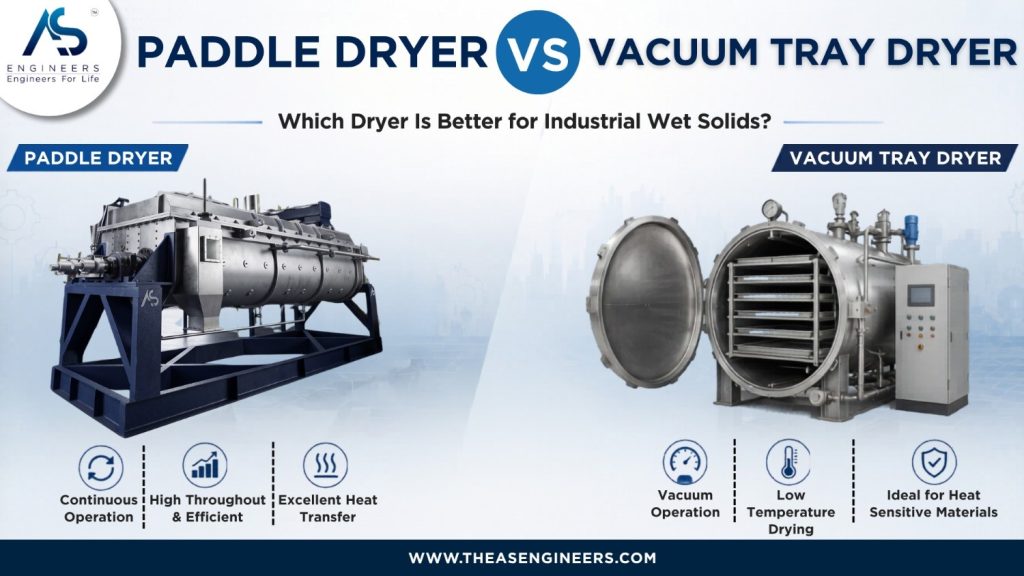
Paddle Dryer vs Vacuum Tray Dryer: Which Dryer Is Better for Industrial Wet Solids?

A paddle dryer vs vacuum tray dryer comparison mainly depends on feed behavior, batch size, heat sensitivity, labour handling, drying uniformity and whether the plant needs continuous or batch operation. A paddle dryer is usually better for sludge, wet cake, paste and sticky bulk solids. A vacuum tray dryer is usually better for small batches of heat-sensitive, high-value materials where static tray drying is acceptable.
Both dryers can use indirect heat. Both can support low-temperature drying concepts. But they solve different plant problems.
Quick Answer: Paddle Dryer vs Vacuum Tray Dryer
Choose a paddle dryer when the material needs agitation, lump breaking, enclosed drying, continuous movement and controlled discharge handling. This is common in ETP sludge, STP sludge, filter cake, chemical paste, wet minerals, pigments, food residues and industrial waste drying.
Choose a vacuum tray dryer when the batch is small, the material should remain static, drying temperature must be low, and manual loading and unloading of trays is acceptable. This is common in some pharma, lab-scale, pilot-scale, nutraceutical, herbal, chemical and heat-sensitive product drying applications.
For plants handling sticky wet solids, I normally do not compare only dryer price. I first check the feed form, moisture, stickiness, heat sensitivity, solvent vapour, batch size, cleaning requirement and final discharge form. That is where the right dryer choice becomes clear.
What Is a Paddle Dryer?
A paddle dryer is an indirect heat dryer used for bulk drying of wet solids, sludge, paste, slurry, filter cake, granules and powders. In an AS Engineers paddle dryer, heat transfers through the jacket and hollow shafts. Wedge-shaped paddles agitate the material, renew the surface contact and help break wet lumps during drying.
For more detail on the core technology, you can review the hollow paddle dryer guide and the main paddle dryer system page.
A paddle dryer can be configured as:
- Standard paddle dryer
- Dual zone dryer
- Vacuum dryer
This matters because many buyers assume a paddle dryer and vacuum dryer are separate ideas. In reality, a paddle dryer can also be designed for vacuum operation when the process requires lower drying temperature, vapour containment or solvent handling.
What Is a Vacuum Tray Dryer?
A vacuum tray dryer is a batch dryer where material is spread on trays and dried inside a vacuum chamber. Heat is generally supplied through heated shelves or trays, and vacuum reduces the boiling point of moisture or solvent. This helps dry heat-sensitive material at lower temperatures.
The important point is that the material normally remains static on the tray. There is no continuous agitation like a paddle dryer. This makes vacuum tray dryers useful for some delicate materials, but less suitable for sticky sludge, heavy wet cake and materials that need mechanical breaking during drying.
Paddle Dryer vs Vacuum Tray Dryer Comparison Table
| Factor | Paddle Dryer | Vacuum Tray Dryer |
|---|---|---|
| Best fit | Wet sludge, filter cake, paste, slurry, sticky solids, bulk moist solids | Small-batch heat-sensitive powders, crystals, extracts or pharma-type materials |
| Operation type | Usually continuous or semi-continuous | Batch |
| Material movement | Agitated by rotating paddles | Static on trays |
| Heat transfer | Indirect heat through jacket, hollow shafts and paddles | Indirect heat through heated shelves/trays |
| Vacuum possibility | Available in vacuum paddle dryer configuration | Core operating principle |
| Labour requirement | Lower manual handling with proper feed/discharge system | Higher manual tray loading, spreading and unloading |
| Drying uniformity | Stronger for sticky and lumpy wet solids because material is mixed | Depends on tray loading depth, spreading and heat contact |
| Sticky phase handling | Stronger due to mechanical agitation and self-cleaning paddle action | Weaker because material can remain stagnant |
| Throughput fit | Better for industrial bulk drying | Better for small to medium batch drying |
| Space and handling | Compact integrated system possible with conveying and bagging | Needs tray handling area and manual batch movement |
| Solvent/vapour handling | Can be enclosed with condenser, scrubber or vapour handling system | Suitable for vacuum solvent removal, depending on design |
| Cleaning | Application-specific, depends on material and MOC | Tray cleaning is manual but simpler for some clean batch products |
| Main buyer risk | Wrong sizing without moisture, feed and vapour data | Labour, uneven loading, long batch cycle and stagnant material issues |
Main Difference Between Paddle Dryer and Vacuum Tray Dryer
The main difference is agitation vs static drying.
A paddle dryer continuously moves the material with rotating paddles. This helps expose fresh wet surface to heated metal surfaces, break lumps, handle sticky phases and discharge the dried product more consistently.
A vacuum tray dryer keeps material on trays. This is gentler, but it depends heavily on manual spreading, tray depth, vacuum level, shelf heating and batch discipline. If the material cakes, crusts, cracks unevenly or remains wet inside lumps, the tray dryer may need longer drying time or manual rework.
When Paddle Dryer Is the Better Choice
A paddle dryer is usually the better choice when the material is wet, heavy, sticky, pasty or difficult to handle manually.
Common fit cases include:
- ETP sludge and STP sludge
- CETP sludge
- Filter press cake
- Centrifuge wet cake
- Chemical paste
- Pigments and dyes
- Paper sludge
- Food processing waste
- Polymer and mineral wet solids
- Slurry or semi-solid industrial waste
The paddle dryer becomes stronger when the plant wants to reduce manual handling, improve dried material movement and connect the dryer with a screw conveyor, bagging system, silo, cyclone, scrubber or condenser.
For sludge-focused applications, also connect this blog internally to paddle dryers for sludge drying and sludge thermal drying.
When Vacuum Tray Dryer Is the Better Choice
A vacuum tray dryer can be the better choice when the material is high value, heat-sensitive, delicate and produced in small batches.
Typical fit cases include:
- Pharma intermediates in small batches
- Herbal extracts
- Nutraceutical products
- Fine chemicals
- Lab-scale or pilot-scale materials
- Heat-sensitive powders
- Products where agitation may damage crystal shape or product structure
A vacuum tray dryer may also fit when the plant already has manual batch operations and does not need continuous drying. But for high-moisture sludge, sticky cake and large industrial waste streams, static tray drying usually becomes labour-heavy and inconsistent.
Important Point: Vacuum Paddle Dryer Is Also an Option
Many buyers compare paddle dryer vs vacuum tray dryer because they need low-temperature drying. But the correct comparison may be vacuum paddle dryer vs vacuum tray dryer.
A vacuum paddle dryer combines vacuum drying with mechanical agitation. This can help when the product is heat-sensitive but still needs mixing, lump breaking and better heat contact.
Vacuum paddle dryer may be considered when the material is:
- Heat-sensitive but sticky
- Solvent-bearing
- Difficult to dry uniformly on trays
- Too bulky for manual tray handling
- Likely to form lumps during static drying
- Better handled in an enclosed agitated chamber
AS Engineers’ approved product range includes standard dryer, dual zone dryer and vacuum dryer configurations, so the selection should be based on the actual process duty, not only the dryer name.
Feed Behavior Decides the Dryer First
Before comparing price or capacity, check how the feed behaves during drying.
| Feed behavior | Better dryer direction |
|---|---|
| Free-flowing powder, low batch quantity, heat-sensitive | Vacuum tray dryer may fit |
| Sticky wet cake from filter press | Paddle dryer usually fits better |
| Sludge from ETP/STP/CETP | Paddle dryer usually fits better |
| High-value crystal that should not be aggressively mixed | Vacuum tray dryer may fit |
| Paste that forms lumps while drying | Paddle dryer usually fits better |
| Material needing enclosed solvent recovery and agitation | Vacuum paddle dryer should be evaluated |
| Product requiring manual batch segregation | Vacuum tray dryer may fit |
| Bulk material requiring continuous discharge | Paddle dryer usually fits better |
Heat Transfer and Drying Uniformity
Both dryers use indirect heat, but the contact pattern is different.
In a paddle dryer, the product keeps moving across heated surfaces. The hollow shafts, jacket and paddles transfer heat while the rotating action renews product contact. This is useful when the wet material passes through a plastic or sticky phase.
In a vacuum tray dryer, the material must receive heat through tray or shelf contact. If the tray layer is too thick, drying may become slow or uneven. If the material crusts on top, internal moisture removal may take longer.
This is why tray loading depth, spreading practice and batch discipline are critical in vacuum tray dryer operation.
Labour, Hygiene and Handling Difference
For industrial sludge and wet cake, manual tray handling can become a serious plant-side issue. Operators must load wet material, spread it, unload dried solids and clean trays repeatedly. If the feed smells, sticks, stains, contains solvent or creates hygiene concerns, this becomes difficult.
A paddle dryer can be integrated with a feed system and product handling system. In AS Engineers’ paddle dryer process flow, feed can be supplied through screw feeder, belt conveyor or sludge pump, and dried product can move through screw conveyor, bagging system, silo, bucket elevator or truck disposal route.
This makes a paddle dryer more practical for plants where drying is part of a daily production or waste-management duty, not a small manual batch operation.
Solvent, Vapour and Pollution Control Considerations
Vacuum tray dryers are commonly selected for low-temperature drying and solvent-sensitive duties. But solvent handling still depends on condenser design, vacuum system, leakage control, cleaning practice and safety review.
Paddle dryers can also be designed as enclosed systems with vapour handling. Depending on the duty, the system may require cyclone, scrubber, bag filter, ID blower, chimney, condenser or solvent tank.
For any solvent, VOC, hazardous vapour, combustible dust or toxic material, do not finalize equipment only from a blog comparison. The plant should review vapour composition, flash point, dust risk, venting, sealing, MOC, vacuum system, condenser duty and EHS requirements with the equipment manufacturer and site safety team.
For related system planning, see AS Engineers’ pollution control equipment and cyclone separator manufacturer pages.
Cost Comparison: Do Not Compare Only Machine Price
A vacuum tray dryer may look simpler at the purchase stage, especially for small batches. But for industrial sludge or sticky wet cake, the real cost also includes:
- Manual loading and unloading
- Tray cleaning
- Batch cycle time
- Uneven drying risk
- Space for tray movement
- Odour or hygiene issues
- Rework for wet lumps
- Disposal handling after drying
- Operator exposure risk
- Downtime during cleaning and changeover
A paddle dryer may need stronger upfront engineering, but it can reduce manual handling and support continuous drying when the duty is large enough. That is why equipment selection should compare total operating fit, not only initial purchase price.
Common Mistakes Buyers Make
Choosing vacuum tray dryer only because the product is heat-sensitive
Heat sensitivity does not automatically mean tray drying is best. If the material is sticky or lumpy, a vacuum paddle dryer may be more practical because it combines vacuum drying with agitation.
Choosing paddle dryer without checking product fragility
Some crystals, granules or delicate products may not tolerate agitation. In such cases, static vacuum tray drying may protect product structure better.
Ignoring tray loading depth
Vacuum tray dryer performance depends heavily on how thick the material layer is. Overloading trays to save time can create uneven drying.
Ignoring the sticky phase
Wet cake and sludge often become stickier before they become dry. This is where static dryers struggle and agitated dryers become useful.
Asking for quotation without feed data
No serious dryer selection should be finalized without inlet moisture, target outlet moisture, feed rate, bulk density, stickiness, heat sensitivity, solvent content, MOC requirement and vapour handling details.
RFQ Checklist for Paddle Dryer vs Vacuum Tray Dryer Selection
Share these inputs before asking for a dryer quotation:
| RFQ input | Why it matters |
|---|---|
| Material name and industry | Identifies process risk and drying behavior |
| Feed form | Sludge, paste, wet cake, slurry, powder, crystal or granule |
| Inlet moisture | Determines evaporation load |
| Target outlet moisture | Defines drying duty and residence time |
| Wet feed rate | Required for sizing |
| Batch or continuous requirement | Decides tray dryer vs paddle dryer direction |
| Heat sensitivity | Decides surface temperature and vacuum need |
| Solvent or water content | Decides condenser, scrubber and vapour system |
| Stickiness and lumping behavior | Decides need for agitation |
| Bulk density | Affects dryer volume and loading |
| MOC requirement | CS, SS304, SS316, Duplex Steel or alloy selection |
| Heating medium available | Steam, thermic fluid, hot water or other utility |
| Final product handling | Bagging, conveying, storage, disposal or reuse |
| Cleaning requirement | Important for pharma, food and batch changeover |
| Safety/EHS conditions | Required for hazardous vapour, dust and solvent duties |
For uncertain materials, AS Engineers’ paddle dryer pilot trial option should be considered before final equipment selection.
Final Selection Guide
| Plant condition | Recommended direction |
|---|---|
| Large daily sludge generation | Paddle dryer |
| Small heat-sensitive pharma batch | Vacuum tray dryer |
| Sticky wet cake from filter press | Paddle dryer |
| Delicate product that should not be mixed | Vacuum tray dryer |
| Heat-sensitive but sticky material | Vacuum paddle dryer |
| Need lower manual handling | Paddle dryer |
| Need simple static batch drying | Vacuum tray dryer |
| Need integrated feeding, drying and discharge | Paddle dryer |
| Need solvent recovery with agitation | Vacuum paddle dryer |
| Need lab or pilot batch drying | Vacuum tray dryer |
FAQs
Is a paddle dryer better than a vacuum tray dryer?
A paddle dryer is better for sludge, wet cake, paste, slurry and sticky bulk solids because it provides agitation, indirect heat transfer and better material movement. A vacuum tray dryer is better for small heat-sensitive batches where static tray drying is acceptable.
Can a paddle dryer operate under vacuum?
Yes. A paddle dryer can be designed as a vacuum dryer depending on the material, temperature limit, vapour handling requirement and process duty.
Why is a vacuum tray dryer not ideal for sticky sludge?
Sticky sludge needs mixing and surface renewal during drying. In a vacuum tray dryer, the sludge remains static on trays, so it can dry unevenly, form lumps or require manual handling.
Which dryer is better for pharma materials?
It depends on the material. A vacuum tray dryer may suit delicate small batches. A vacuum paddle dryer may be better when the pharma intermediate is sticky, solvent-bearing or needs agitation for uniform drying.
What data is needed before selecting between these dryers?
At minimum, share material name, feed form, inlet moisture, target outlet moisture, batch size or feed rate, heat sensitivity, solvent content, stickiness, bulk density, heating medium, MOC and final discharge requirement.
Conclusion
The right choice in paddle dryer vs vacuum tray dryer is not based on dryer name alone. It is based on how the material behaves during drying.
For sludge, wet cake, paste, slurry and sticky industrial solids, a paddle dryer is usually the stronger option because it provides agitation, indirect heat transfer, enclosed drying and better discharge handling. For small, delicate, heat-sensitive batches where the product should remain static, a vacuum tray dryer can be more suitable.
Before finalizing the dryer, test the actual material, define the moisture target and review the vapour, heating, cleaning and discharge requirements. For sludge, wet cake, paste or difficult industrial material, share your feed details with AS Engineers so the team can evaluate whether a standard paddle dryer, dual zone dryer or vacuum paddle dryer is the right fit.
