
Paddle Dryer vs Fluid Bed Dryer: Which Dryer Is Better for Your Material?

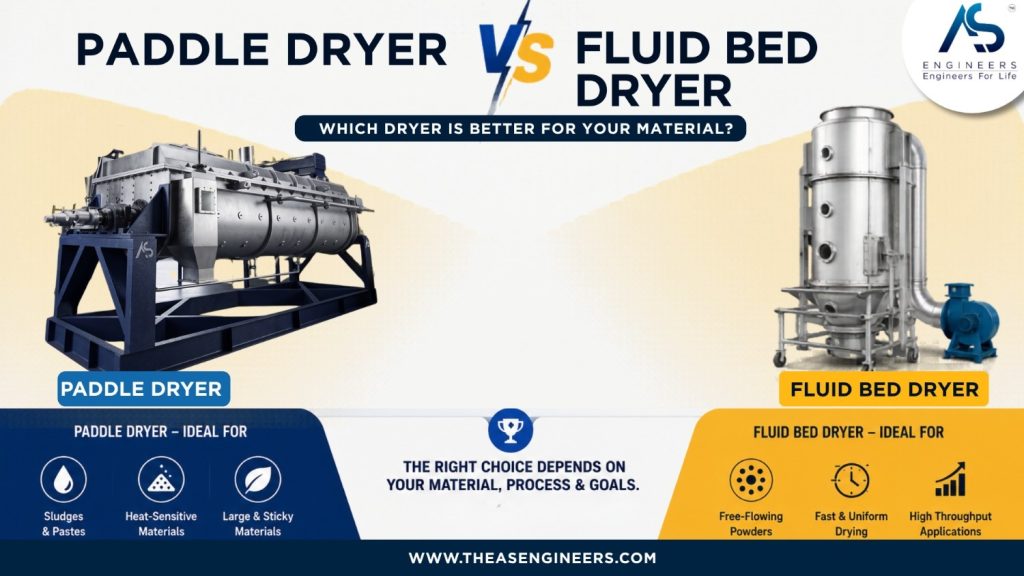
A paddle dryer is usually better for sludge, paste, slurry, wet cake, sticky feed, and semi-solid industrial waste. A fluid bed dryer is usually better for free-flowing granules, crystals, pellets, and powders that can fluidize properly in upward hot air.
The correct choice depends on feed behaviour, not only on capacity or dryer price. In real plant operation, a material that cannot fluidize properly should not be forced into a fluid bed dryer. Similarly, a clean free-flowing granule may not need the heavier mechanical agitation of a paddle dryer.
Quick Comparison: Paddle Dryer vs Fluid Bed Dryer
| Selection Point | Paddle Dryer | Fluid Bed Dryer |
|---|---|---|
| Best feed type | Sludge, slurry, paste, wet cake, sticky material, semi-solid waste | Granules, crystals, pellets, coarse powder, free-flowing particles |
| Drying method | Indirect heat transfer through jacket, hollow shafts, and paddles | Direct hot air contact through a fluidized particle bed |
| Material movement | Mechanical agitation by rotating paddles | Upward air velocity lifts and mixes particles |
| Air requirement | Lower off-gas volume compared with many direct air dryers | Higher airflow needed for fluidization |
| Dust risk | Usually lower than high-airflow systems, but depends on product | Higher fines carryover risk if particles break or are too fine |
| Sludge drying fit | Strong fit for ETP, STP, CETP, and industrial sludge | Usually not preferred for normal wet sludge |
| Granule drying fit | Possible in some cases, but not always necessary | Strong fit when particles fluidize evenly |
| Main risk | Wrong sizing due to incomplete moisture, stickiness, or heat-load data | Poor fluidization, channeling, lumping, fines carryover, filter choking |
What Is a Paddle Dryer?
A paddle dryer is an indirect-contact industrial dryer. Heat is transferred through heated surfaces such as the jacket, hollow shafts, and paddles. The paddles mix, move, shear, and expose the wet material to heated surfaces while moisture evaporates.
This design makes a paddle dryer useful for materials that are not easy to fluidize or blow with hot air, such as:
- ETP sludge
- STP sludge
- CETP sludge
- Industrial sludge
- Filter cake
- Chemical paste
- Wet cake
- Slurry
- Sticky solids
- Semi-solid process waste
- Some powders and granules requiring controlled indirect heating
AS Engineers’ hollow paddle dryer design is especially relevant when the plant needs continuous mechanical agitation, indirect heating, and controlled discharge from difficult wet feed.
What Is a Fluid Bed Dryer?
A fluid bed dryer, also called a fluidized bed dryer, dries particles by passing heated air upward through a perforated plate or distributor. When the air velocity is correct, the particles lift, mix, and behave like a fluidized bed.
Fluid bed dryers are commonly used for:
- Granules
- Crystals
- Pellets
- Seeds
- Coarse powders
- Free-flowing chemical particles
- Pharma granules
- Food particles
Technical drying references describe fluidized bed dryers as suitable for granular and crystalline materials, but they also highlight the risk of fine particles carrying over with exit gas, requiring fines recovery through filters or similar systems.
So the first question is simple:
Can your material behave like a fluidized particle bed?
If yes, a fluid bed dryer may be suitable. If the material is sticky, pasty, slimy, highly wet, or sludge-like, a standard fluid bed dryer can struggle.
Main Difference Between Paddle Dryer and Fluid Bed Dryer
The main difference is how heat reaches the material.
A paddle dryer transfers heat indirectly through metal surfaces and keeps the material moving with paddles. A fluid bed dryer transfers heat directly through hot air and keeps particles suspended through air velocity.
This changes the entire selection logic.
| Difference | Paddle Dryer | Fluid Bed Dryer |
|---|---|---|
| Heat transfer | Conductive, indirect heat transfer | Convective, direct hot air contact |
| Feed movement | Mechanical agitation | Air fluidization |
| Best physical form | Sticky, wet, dense, semi-solid | Free-flowing particles |
| Vapour handling | More controlled, often lower off-gas volume | Higher exhaust air volume |
| Dust handling | Depends on dried product, but less air-driven carryover | Fines carryover can become important |
| Selection priority | Feed moisture, stickiness, heat load, residence time | Particle size, fluidization velocity, airflow, pressure drop |
When Is Paddle Dryer Better?
A paddle dryer is usually better when the feed is difficult to dry with air alone.
Choose a paddle dryer first when the material is:
- Sludge-like
- Sticky
- Pasty
- Semi-solid
- High-moisture wet cake
- Difficult to fluidize
- Odorous or vapour-sensitive
- Variable in feed consistency
- Difficult to convey after drying starts
This is why paddle dryers are widely evaluated for ETP sludge, STP sludge, CETP sludge, paper sludge, chemical sludge, pharma sludge, dye sludge, pigment residue, and industrial waste streams.
For sludge applications, the paddle sludge dryer guide explains why indirect heating and continuous agitation are important for wet sludge treatment.
When Is Fluid Bed Dryer Better?
A fluid bed dryer is usually better when the feed is already particulate and can fluidize properly.
Choose a fluid bed dryer when the material is:
- Free-flowing
- Granular
- Crystalline
- Pelletized
- Not sticky during drying
- Consistent in particle size
- Able to tolerate airflow
- Suitable for direct hot air contact
Fluid bed dryers can offer rapid drying and good product uniformity when the bed fluidizes evenly. But if the feed contains too many fines, sticky lumps, wide particle-size variation, or material that softens during heating, problems can start quickly.
Paddle Dryer vs Fluid Bed Dryer for Sludge Drying
For sludge drying, a paddle dryer is usually the stronger first choice.
Sludge normally contains high moisture and may behave as paste, wet cake, or semi-solid mass. It may also contain organic matter, salts, fibres, chemical residue, biological solids, oil, or other contaminants depending on the plant. This kind of material usually does not form a stable fluidized bed in a standard fluid bed dryer.
A paddle dryer handles sludge differently. The heated jacket, hollow shafts, and paddles support indirect heat transfer while the paddles keep the sludge moving and expose new surface area for evaporation.
Plants comparing sludge drying routes should also review sludge drying methods before finalizing the drying system.
Paddle Dryer vs Fluid Bed Dryer for Wet Cake and Paste
Wet cake and paste are not automatically suitable for a fluid bed dryer.
A fluid bed dryer needs airflow through particles. If the feed is compact, sticky, or pasty, air may not pass uniformly. The material can form lumps, dead zones, or channels. This can lead to non-uniform drying and unstable operation.
A paddle dryer is more practical when the material needs:
- Mechanical agitation
- Shearing action
- Slow and controlled material movement
- Indirect heating
- Longer residence time
- Enclosed vapour handling
- Controlled discharge form
This is why many wet cake, paste, and sludge applications should be tested before selecting the dryer.
Paddle Dryer vs Fluid Bed Dryer for Granules, Crystals, and Powders
For free-flowing granules and crystals, a fluid bed dryer may be the better fit.
The airflow can surround particles and create strong heat and mass transfer. This can give uniform drying when the particle size distribution is controlled and the product does not become sticky during heating.
A paddle dryer can also dry some powders and granules, but it is normally selected when the process needs indirect heating, enclosed operation, solvent control, low off-gas volume, or mechanical mixing.
For example:
| Material Type | Better First Evaluation |
|---|---|
| Free-flowing chemical crystals | Fluid bed dryer |
| Granules with narrow particle size range | Fluid bed dryer |
| Fine dusty powder with carryover risk | Needs testing |
| Sticky powder during drying | Paddle dryer or other agitated dryer |
| Filter cake that breaks into granules after drying | Paddle dryer trial recommended |
| Semi-dry sludge granules | Depends on moisture and fluidization behaviour |
Heat Transfer and Energy Discussion
Paddle dryer and fluid bed dryer energy performance cannot be compared honestly without feed data.
A paddle dryer may reduce off-gas load because the main heating is indirect. This is useful when vapour handling, odour control, solvent management, or emission control is important. AS Engineers’ process flow also allows supporting systems such as cyclone, scrubber, condenser, ID blower, chimney, screw conveyor, silo, bagging, or truck disposal arrangement depending on the duty.
A fluid bed dryer may dry quickly when fluidization is correct, but it depends heavily on hot air volume, air temperature, humidity, pressure drop, filter performance, and exhaust handling.
So the correct energy question is not:
Which dryer consumes less energy?
The better question is:
Which dryer can remove the required moisture from this specific feed without poor fluidization, excessive exhaust load, product loss, or maintenance problems?
Dust, Vapour, and Emission Control
This is one of the biggest differences between both dryers.
Fluid bed drying is airflow-driven. If the particles are weak, brittle, or too fine, fines may travel with the exhaust air. This can increase the load on cyclone separators, bag filters, or dust collectors.
Paddle drying is more enclosed and generally uses lower off-gas volume compared with many direct air dryers. But vapour handling still matters. Depending on the material, the system may need a condenser, scrubber, cyclone, ID fan, chimney, solvent tank, or bag filter.
For sludge and industrial waste, vapour composition, odour, moisture load, and fines behaviour should be discussed before equipment selection.
Maintenance Comparison
| Maintenance Area | Paddle Dryer | Fluid Bed Dryer |
|---|---|---|
| Main mechanical parts | Shafts, paddles, gearbox, bearings, seals, drive | Blower, distributor plate, filters, ducting, air seals |
| Common issue | Buildup, seal wear, wrong residence time, poor feed control | Channeling, filter choking, fines carryover, poor bed fluidization |
| Inspection focus | Paddle condition, shaft alignment, bearings, gearbox, discharge | Airflow, filter pressure drop, distributor holes, blower performance |
| Material-related risk | Sticky buildup or abrasive wear | Agglomeration, attrition, entrainment |
| Service planning | Mechanical and thermal system review | Airflow and filtration system review |
AS Engineers also supports paddle dryer pilot trials for material evaluation. This is useful when the feed is new, inconsistent, sticky, or difficult to classify from lab moisture data alone.
Which Dryer Is Better for Your Industry?
| Industry / Application | Better First Choice | Reason |
|---|---|---|
| ETP sludge drying | Paddle dryer | Sludge is usually wet, sticky, and difficult to fluidize |
| STP sludge drying | Paddle dryer | Needs controlled drying and volume reduction |
| CETP sludge drying | Paddle dryer | Feed can be variable and difficult to handle |
| Chemical paste drying | Paddle dryer | Indirect heating and agitation may be needed |
| Pharma wet cake | Depends on material | Feed behaviour, MOC, solvent, and cleaning matter |
| Food granules | Fluid bed dryer | Free-flowing particles may fluidize well |
| Chemical crystals | Fluid bed dryer | Good fit when particle size is controlled |
| Fine powder | Depends on test | Carryover and dust collection must be checked |
| Paper sludge | Paddle dryer | Fibre and wet cake behaviour may resist fluidization |
| Pigment wet cake | Depends on test | Stickiness, agglomeration, and final powder form matter |
RFQ Checklist Before Selecting a Dryer
Before asking for a quotation, prepare these inputs:
| RFQ Input | Why It Matters |
|---|---|
| Material name | Defines process risk and MOC requirement |
| Industry | Helps identify typical contaminants and handling issues |
| Feed form | Sludge, slurry, paste, cake, granule, powder, crystal |
| Feed rate | Required kg/hr or ton/day capacity |
| Initial moisture | Defines evaporation load |
| Final moisture target | Controls residence time and drying duty |
| Bulk density | Affects volume and equipment sizing |
| Particle size distribution | Critical for fluid bed dryer selection |
| Stickiness behaviour | Critical for paddle dryer and fluid bed dryer fit |
| Heat sensitivity | Controls temperature and residence time |
| Solvent or water content | Defines vapour handling and safety review |
| Available utility | Steam, thermic fluid, hot water, gas, electricity |
| MOC requirement | CS, SS304, SS316, duplex, or alloy as per material |
| Discharge form | Powder, granule, cake, bagging, silo, truck disposal |
| Pollution control need | Cyclone, scrubber, bag filter, condenser, chimney |
| Site layout | Footprint, height, maintenance access, foundation |
Common Mistakes Buyers Should Avoid
| Mistake | Why It Creates Problems |
|---|---|
| Selecting fluid bed dryer for sticky sludge | Sludge may not fluidize and can form lumps or dead zones |
| Selecting paddle dryer only by capacity | Moisture load, residence time, and heat transfer still control sizing |
| Ignoring particle size in fluid bed dryer | Fines can carry over and increase filter load |
| Ignoring vapour handling in paddle dryer | Moisture, odour, solvent, and fines need a defined outlet path |
| Comparing only machine price | Utility, downtime, maintenance, dust control, and disposal cost affect real cost |
| Skipping material trial | Real feed behaviour can differ from lab moisture data |
| Not defining final product form | “Dry” can mean powder, granule, cake, lump, or disposal-ready solid |
Practical Selection Rule
Use this rule before shortlisting the dryer:
If the material behaves like sludge, paste, slurry, wet cake, or sticky semi-solid mass, evaluate a paddle dryer first. If the material behaves like a free-flowing particle bed, evaluate a fluid bed dryer.
This single rule avoids many wrong dryer selections.
FAQs
Is a paddle dryer better than a fluid bed dryer?
A paddle dryer is better for sludge, paste, wet cake, slurry, sticky feed, and semi-solid waste. A fluid bed dryer is better for free-flowing granules, crystals, pellets, and powders that can fluidize properly.
Can a fluid bed dryer dry sludge?
A standard fluid bed dryer is usually not the first choice for wet sludge because sludge does not normally fluidize well. Special fluidized sludge systems may exist, but for many ETP, STP, CETP, and industrial sludge applications, a paddle dryer is more practical.
Why is paddle dryer preferred for sticky material?
A paddle dryer uses indirect heating with mechanical agitation. The paddles mix, shear, and move sticky material across heated surfaces, which helps when the feed is too wet or cohesive for airflow-based drying.
When should I choose a fluid bed dryer?
Choose a fluid bed dryer when the feed is already granular, crystalline, pelletized, or free-flowing, and the particles can lift and mix uniformly under upward hot air without lumping or excessive carryover.
What data is required before selecting between paddle dryer and fluid bed dryer?
You need feed form, feed rate, initial moisture, final moisture target, bulk density, particle size distribution, stickiness, heat sensitivity, solvent or water content, utility availability, MOC requirement, vapour handling, and discharge requirement.
Conclusion
Paddle dryer vs fluid bed dryer is not a universal “which is better” decision. It is a material-behaviour decision.
A paddle dryer is usually the stronger choice for sludge, paste, slurry, wet cake, sticky solids, and semi-solid industrial waste. It gives indirect heating, mechanical agitation, enclosed operation, and controlled discharge handling.
A fluid bed dryer is usually the stronger choice for granules, crystals, pellets, and free-flowing powders that can fluidize properly under upward hot air.
For ETP sludge, STP sludge, CETP sludge, chemical sludge, paper sludge, filter cake, or sticky process waste, start with paddle dryer evaluation and material testing. For free-flowing particles, check fluid bed drying with particle-size, airflow, dust-control, and filter-loading data.
For AS Engineers evaluation, share feed moisture, final moisture target, material behaviour, feed rate, heating utility, vapour condition, and discharge requirement before freezing the dryer type.
