
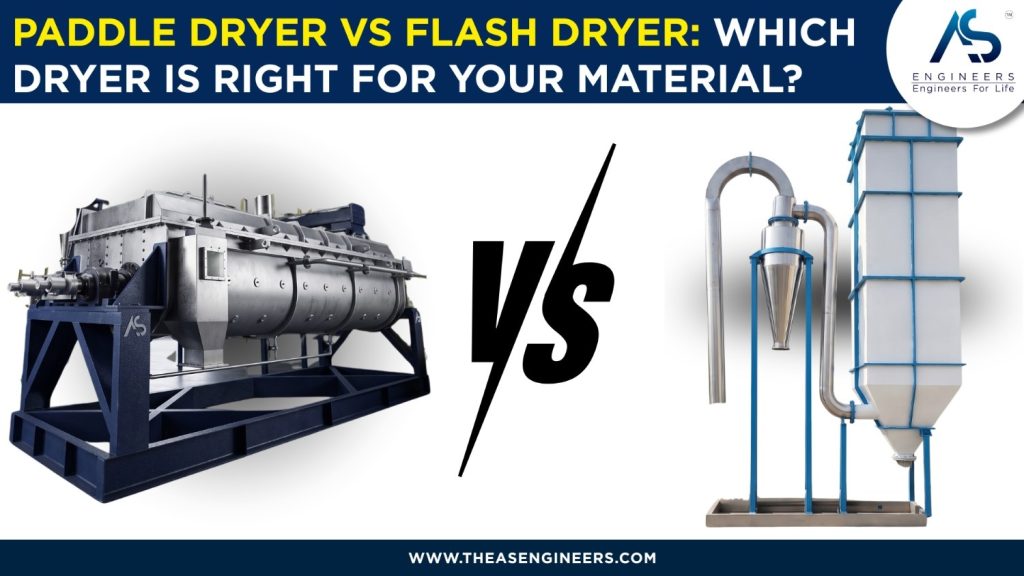
Paddle Dryer vs Flash Dryer: Which Dryer Is Right for Your Material?

When comparing paddle dryer vs flash dryer, the right choice depends mainly on feed behaviour. A paddle dryer is usually better for sludge, wet cake, sticky paste, slurry and materials that need indirect enclosed drying. A flash dryer is usually better for fine wet powder, dispersed particles and centrifuged cake that can dry rapidly in a high-velocity hot air stream.
The mistake is asking only, “Which dryer is faster?” The better question is, “Which dryer can handle my material repeatedly, safely and economically at the required outlet moisture?”
At AS Engineers, I usually start this discussion with feed condition, moisture target, utility availability, vapour handling, dust load, discharge form and downstream handling. The dryer name comes after that.
Quick Comparison: Paddle Dryer vs Flash Dryer
| Comparison Point | Paddle Dryer | Flash Dryer |
|---|---|---|
| Heat transfer method | Mainly indirect heat transfer through jacket, hollow shafts and paddles | Mainly direct contact between hot air/gas and dispersed material |
| Feed form suitability | Sludge, paste, wet cake, sticky solids, lumpy feed, slurry-like material | Fine wet powder, granules, centrifuged cake, particles that disperse easily |
| Material movement | Slow mechanical agitation and controlled movement | Pneumatic conveying in high-velocity hot air |
| Residence time | Longer and more controlled | Very short |
| Moisture removal style | Suitable for bound moisture and difficult wet feed behaviour | Best for surface moisture and quick drying |
| Off-gas volume | Usually lower because heat is indirect | Usually higher because hot air carries heat and moisture |
| Dust and carryover risk | Lower than high-airflow systems, but still depends on final dry product | Higher risk because dried powder travels in air stream |
| Best buyer fit | Plants handling sludge, ETP waste, chemical paste, filter cake or difficult solids | Plants handling dispersible powders, pigments, dyes, minerals or powdery chemicals |
| Key risk | Wrong sizing without moisture/load testing | Choking, lumping, carryover, dust handling and inconsistent drying if feed does not disperse |
Simple Definition of a Paddle Dryer
A paddle dryer is an indirect industrial dryer where heat is transferred through heated surfaces while rotating paddles mix, shear and move the feed. In AS Engineers’ paddle dryer design, heat transfer happens through the jacket, hollow shafts and paddles, while the feed is mechanically agitated inside the dryer.
This is why a paddle dryer is commonly evaluated when the material is not easy to dry using only hot air. Wet sludge, paste, filter cake, sticky chemical solids and difficult damp material usually need controlled movement as moisture is removed.
AS Engineers’ source material supports paddle dryer use for slurries, pastes, cakes, granules and powders, with heating options such as steam and thermal oil, material options such as CS, SS304, SS316, duplex steel and other alloys, and design options such as standard, dual-zone and vacuum dryer configurations.
Simple Definition of a Flash Dryer
A flash dryer is a continuous pneumatic dryer where wet material is dispersed into a high-velocity hot air stream. Heat transfer and moisture removal happen quickly while particles are suspended and conveyed through the drying line.
A flash dryer works well when the feed can break into fine particles and the moisture is mainly surface moisture. ACMEFIL’s flash dryer working principle guide explains the core sequence as controlled feeding, hot air generation, material dispersion, rapid moisture evaporation and powder separation through cyclone or bag filter equipment.
For flash drying support inside the group ecosystem, refer to ACMEFIL’s flash dryer working principle and flash dryer pages.
The Main Difference Is Feed Behaviour
The biggest difference between paddle dryer and flash dryer is not only heat source. It is how the material behaves inside the dryer.
A flash dryer needs the feed to disperse quickly. If the material enters as fine wet powder or small particles, hot air can contact a large surface area and remove moisture fast. If the material enters as heavy paste, sticky sludge, rubbery cake or large lumps, the outside may dry while the inside remains wet. This can lead to choking, wall buildup, wet pockets, uneven moisture or unstable operation.
A paddle dryer is slower, but more forgiving for difficult wet materials. The paddles continuously disturb, shear and expose the material to heated surfaces. This is useful when the feed changes from plastic or sticky form toward granular or powdery discharge during drying.
That is why sludge and filter cake buyers should not select flash drying only because the word “flash” sounds faster. Speed matters only when the feed can actually disperse and separate properly.
When a Paddle Dryer Is the Better Choice
A paddle dryer is usually the better direction when the feed has one or more of these conditions:
| Feed or Process Condition | Why Paddle Dryer Fits Better |
|---|---|
| Wet sludge from ETP, STP or CETP | Sludge often behaves as sticky, heavy, uneven material rather than free-flowing powder |
| Filter cake with high moisture | Mechanical agitation helps expose wet surfaces during drying |
| Sticky chemical paste | Indirect heat and paddle movement reduce dependence on air dispersion |
| Lumpy or plastic material | Paddles can break and move material through the dryer |
| Odorous or solvent-bearing feed | Enclosed design and vapour handling become important |
| Need for lower off-gas load | Indirect drying usually reduces the volume of exhaust gas compared with direct hot-air drying |
| Need for controlled discharge | Useful when dried material must go to screw conveyor, bagging, silo or disposal route |
For sludge-specific projects, AS Engineers’ paddle sludge dryer and ETP sludge management pages are useful supporting reads.
When a Flash Dryer Is the Better Choice
A flash dryer can be the better choice when the feed is already suitable for pneumatic drying.
It usually fits better when:
- the feed is a fine wet powder, granule or centrifuged cake
- the material can disperse quickly in hot air
- moisture is mainly surface moisture
- very short residence time is required
- the final product is powdery and suitable for cyclone or bag filter collection
- the process can safely handle higher air volume and dust separation
Flash dryers are often evaluated for dyes, pigments, chemicals, minerals and powdery products where fast moisture removal is practical. If the feed is more sticky, slimy or gelatinous, a spin flash dryer may be a better evaluation than a standard flash dryer because it adds mechanical dispersion at the feed zone.
Paddle Dryer vs Flash Dryer for Sludge
For most high-moisture industrial sludge, a paddle dryer is usually the safer first evaluation than a standard flash dryer.
Sludge is not just wet powder. It may be sticky, fibrous, odorous, lumpy, variable in moisture and difficult to convey. In these cases, a high-velocity hot-air system can struggle if the feed does not disperse properly.
A paddle dryer gives the plant more control over:
- feed movement
- moisture reduction
- vapour handling
- sludge-to-dry-solids transition
- discharge through conveyor, bagging or disposal system
- off-gas and pollution-control integration
AS Engineers’ catalogue shows paddle dryer process integration with feeding system, heating system, scavenging system, pollution control equipment, solvent management and product handling sections.
For a wider sludge drying context, you can also review sludge drying methods and AS Engineers’ paddle dryers for sludge drying.
Paddle Dryer vs Flash Dryer for Chemical and Pigment Applications
Chemical and pigment applications need closer evaluation because both dryers may be technically possible depending on feed form.
A flash dryer can work well for pigment cake, dye intermediates, powdery chemicals and products where fast surface drying is enough. But if the same material is sticky, paste-like, solvent-bearing or difficult to disperse, the plant may need either preconditioning, a spin flash dryer or an indirect dryer.
A paddle dryer can fit chemical-duty drying when the buyer needs:
- indirect heat transfer
- more enclosed processing
- controlled residence
- material-of-construction selection
- lower off-gas volume
- better handling of paste or wet cake behaviour
For chemical-duty solids, do not finalize the dryer based only on industry name. The same industry may use different dryers for different materials. Dryer selection is application-specific, and industrial drying literature also treats dryer selection as a complex flowsheet decision rather than a simple equipment-name decision.
Heat Transfer Difference: Indirect vs Direct Drying
In a paddle dryer, the heating medium transfers heat through metal surfaces. The product does not depend mainly on direct contact with a large hot-air stream. This gives better control for difficult wet materials.
In a flash dryer, hot air or gas directly contacts and carries the material. The same air stream provides heat, removes evaporated moisture and transports dried particles toward separation equipment.
This is why flash dryers often need careful attention to:
- air velocity
- inlet and outlet temperature
- feed particle size
- feed dispersion
- cyclone efficiency
- bag filter performance
- dust handling
- air leakage
- exhaust treatment
Paddle dryers need careful attention to:
- heat-transfer area
- shaft and paddle design
- feed consistency
- residence time
- torque load
- moisture target
- vapour removal
- discharge handling
- cleaning and maintenance access
Dust, Carryover and Safety Considerations
Flash dryers handle dried particles in a moving air stream, so dust load and powder carryover must be evaluated early. Cyclone separators, bag filters, ducts, rotary airlocks and exhaust systems are not side accessories. They are part of the drying system.
Combustible dust also needs proper plant-level review where applicable. OSHA’s combustible dust program highlights fire, flash fire, deflagration and explosion hazards across industries that generate or handle combustible dust, including chemicals, pharmaceuticals, wastewater treatment, wood, food, textiles, plastics and coal handling.
A paddle dryer may reduce airflow dependence, but it does not remove the need for safety review. If the final product is dusty, solvent-bearing, combustible, toxic or high-temperature sensitive, the dryer, vapour system, pollution-control equipment and plant safety practices must be reviewed together.
For off-gas, fines and downstream dust collection, AS Engineers’ pollution control equipment page should be considered early in the discussion.
Maintenance Difference
| Maintenance Area | Paddle Dryer | Flash Dryer |
|---|---|---|
| Main mechanical focus | Shafts, paddles, gearbox, bearings, seals, drive system | Blower, feeder, ducting, cyclone, bag filter, airlock, burner/HAG |
| Common operating risk | Overloading, buildup, wrong feed consistency, torque issues | Choking, duct buildup, cyclone carryover, bag filter load, air leakage |
| Cleaning focus | Internal dryer body, paddles, discharge section | Drying duct, cyclone, bag filter, airlock and exhaust line |
| Wear points | Paddles, shafts, bearings, drive and seals depending on material | Duct bends, cyclone, fan, rotary valve and filter system |
| Service planning | Mechanical inspection and spare parts planning | Airflow, separation and dust-control inspection |
AS Engineers provides paddle dryer services for repair, upgrades, retrofitment and OEM spare parts support. AS Engineers’ catalogue also lists shaft, gearbox and bearing replacement, system repair and upgrades, retrofitment solutions and OEM spare parts for paddle dryers.
RFQ Checklist Before Choosing Paddle Dryer or Flash Dryer
Before asking for a quotation, prepare these inputs. This will make the comparison more accurate and reduce the risk of wrong dryer selection.
| RFQ Input | Why It Matters |
|---|---|
| Feed name and source | Identifies sludge, chemical, pigment, mineral, food, pharma or other duty |
| Feed form | Slurry, paste, cake, powder, granule or lump changes dryer suitability |
| Initial moisture | Defines evaporation load |
| Final moisture target | Defines dryer size, heat load and discharge condition |
| Feed rate | Hourly or daily capacity affects equipment sizing |
| Bulk density | Affects residence, torque, pneumatic conveying and discharge |
| Particle size or lump size | Critical for flash dryer dispersion and paddle dryer handling |
| Stickiness and phase behaviour | Shows whether feed smears, balls, crusts or becomes granular |
| Heat sensitivity | Controls temperature and residence time limits |
| Solvent or water content | Affects vapour handling, recovery and safety |
| Available utilities | Steam, thermic fluid, hot water, hot air generator, fuel options |
| Required MOC | CS, SS304, SS316, duplex or alloy selection depends on corrosion and contamination risk |
| Off-gas treatment requirement | Determines cyclone, scrubber, bag filter or condenser needs |
| Discharge route | Screw conveyor, bagging, silo, truck disposal or further process |
| Safety constraints | Combustible dust, toxic vapour, odour, solvent or high-temperature risk |
For material validation, AS Engineers offers a paddle dryer pilot trial route. AS Engineers’ catalogue references a 50 kg/hr paddle dryer pilot trial machine for demonstrations, with trial objectives such as performance evaluation, issue identification, process optimization and feasibility assessment.
Common Mistakes in Paddle Dryer vs Flash Dryer Selection
Choosing flash dryer only because it is fast
A flash dryer is fast when the material can disperse properly. If the feed is sticky or lumpy, speed can turn into choking, uneven moisture and carryover.
Choosing paddle dryer only because the feed is wet
Not every wet feed needs a paddle dryer. If the material is a free-flowing powder with surface moisture, a flash dryer may be more suitable.
Ignoring off-gas and dust handling
Dryer selection is not only the dryer body. Flash dryers especially need proper cyclone, bag filter, blower and ducting design.
Comparing only equipment price
The real comparison should include fuel, utilities, maintenance, manpower, floor space, emissions handling, spare parts, cleaning downtime and final product handling.
Skipping trial or sample testing
For new materials, pilot testing or sample evaluation is important. A brochure comparison cannot fully predict how a feed will smear, lump, foam, crust, fluidize, atomize or discharge.
Which Dryer Should You Choose?
Choose a paddle dryer if your material is sludge, paste, wet cake, sticky solid, lumpy feed or difficult industrial waste that needs indirect heat, agitation and controlled discharge.
Choose a flash dryer if your material is fine, powdery, dispersible and suitable for rapid drying in a hot air stream with cyclone or bag filter separation.
Choose neither blindly. For serious plant decisions, the dryer should be selected after reviewing feed behaviour, moisture load, final moisture target, utilities, safety, off-gas treatment and downstream handling.
FAQs
Is a paddle dryer better than a flash dryer?
A paddle dryer is better when the feed is sticky, pasty, sludge-like, lumpy or difficult to disperse. A flash dryer is better when the feed is powdery, fine and able to dry quickly in hot air.
Can a flash dryer dry sludge?
A standard flash dryer is usually not the first choice for heavy sticky sludge because sludge may not disperse properly in hot air. Some conditioned sludge or special designs may be evaluated, but most sludge projects should first compare indirect drying, paddle drying or other sludge-specific systems.
Which dryer is more energy efficient?
It depends on material, moisture load, heat source, airflow, exhaust loss and final moisture target. A paddle dryer can reduce off-gas volume through indirect heating. A flash dryer can be efficient for fast surface-moisture removal from suitable powders.
Which dryer is better for heat-sensitive material?
Both can be used in heat-sensitive duties depending on design. Flash dryers provide short exposure time, while paddle dryers can offer controlled indirect heating and vacuum options. The right answer depends on product degradation temperature, residence time and moisture target.
What should I test before finalizing the dryer?
Test feed stickiness, particle size, initial and final moisture, lump formation, bulk density, heat sensitivity, vapour load, dust risk, discharge behaviour and whether the product becomes powdery, granular, pasty or crusty after partial drying.
Conclusion
The practical answer to paddle dryer vs flash dryer is simple: match the dryer to the feed behaviour.
A paddle dryer is stronger for sludge, wet cake, sticky paste, lumpy feed and difficult industrial materials that need indirect heat, agitation, enclosed vapour handling and controlled discharge. A flash dryer is stronger for dispersible wet powders and fine particles that can dry rapidly in a high-velocity hot air stream.
For AS Engineers, the next step is not to force one dryer name. Share the feed sample, moisture data, final moisture target, throughput, utility details, vapour condition and discharge requirement. The AS Engineers team can review whether a paddle dryer is technically suitable, whether pilot testing is needed, and how the system should connect with feeding, heating, pollution control and product handling.
For project discussion, contact AS Engineers with your material details and RFQ inputs.
