
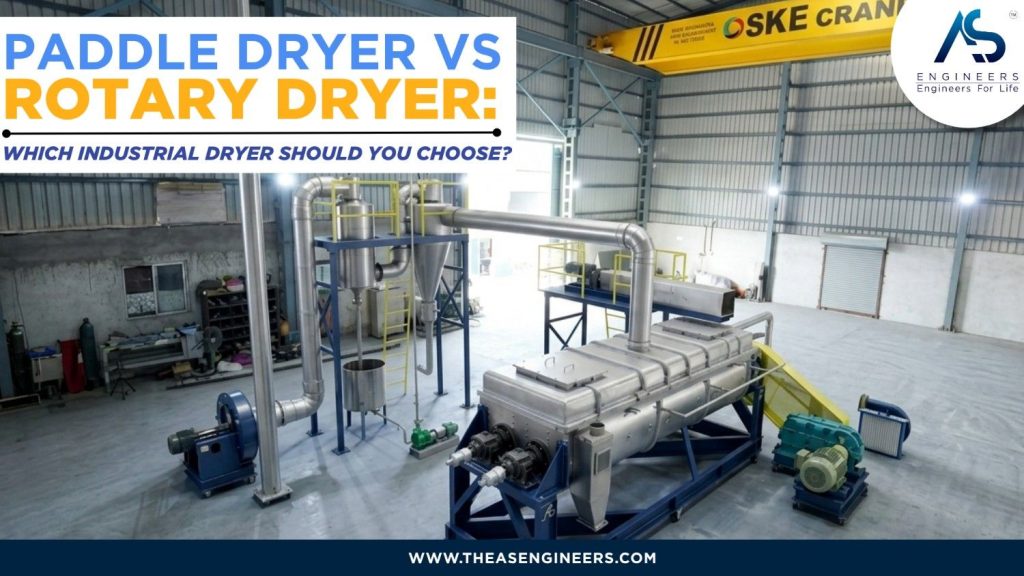
Paddle Dryer vs Rotary Dryer: Which Industrial Dryer Should You Choose?

Paddle dryer vs rotary dryer selection depends on material behavior first. A paddle dryer is usually better for sludge, sticky paste, wet cake, filter cake, heat-sensitive material, solvent-bearing feed, and applications needing enclosed indirect drying. A rotary dryer is usually better for free-flowing minerals, sand, aggregates, biomass, fertilizer granules, and high-throughput bulk solids where tumbling and hot gas contact are acceptable.
The correct question is not “which dryer is best?” The correct question is “which dryer matches my feed moisture, stickiness, heat sensitivity, off-gas load, plant layout, utility cost, and discharge requirement?”
For plant teams comparing industrial paddle dryer technology with rotary drying, this guide gives a practical selection view.
Quick Answer: Paddle Dryer vs Rotary Dryer
| Comparison Point | Paddle Dryer | Rotary Dryer |
|---|---|---|
| Heat transfer | Mostly indirect through hollow shafts, paddles, and jacket | Usually direct hot gas contact, or indirect in special designs |
| Best feed type | Sludge, paste, wet cake, filter cake, sticky solids, powders, granules | Free-flowing granules, minerals, sand, biomass, coal, fertilizer, aggregates |
| Sticky material handling | Strong fit because paddles knead, shear, mix, and move material | Risk of buildup, balling, coating, and uneven drying if feed is sticky |
| Off-gas volume | Usually lower because heating medium does not directly pass through material | Usually higher in direct rotary dryers because hot air/gas passes through the drum |
| Footprint | Compact for many sludge and paste duties | Often larger due to drum, burner, ducting, cyclone/bag filter, and exhaust system |
| Heat-sensitive feed | Better controlled when indirect heating is suitable | Depends on gas temperature, residence time, and product exposure |
| Dust carryover | Lower in many enclosed indirect systems | Can be higher where air velocity lifts fines |
| Maintenance focus | Shafts, paddles, bearings, gearbox, seals, discharge, heating surfaces | Drum alignment, tyres, rollers, flights, seals, burner, ducting, dust collection |
| Best buying approach | Material testing and process-duty review | Bulk solids flow and throughput review |
How a Paddle Dryer Works
A paddle dryer uses indirect heat transfer. Heat enters through hollow shafts, paddles, and the heated jacket. The wet material does not depend on direct flame or large hot-air flow for drying. The rotating paddles continuously mix, shear, lift, knead, and move the material through the dryer.
This is why a paddle dryer is useful when material is difficult to handle. Many sludges and filter cakes do not behave like dry granules. They may enter as wet cake, pass through a sticky plastic phase, then become more granular near discharge. A paddle dryer supports this change because agitation and heat transfer happen together.
AS Engineers’ paddle dryer design is built around indirect heating, dual counter-rotating shafts, wedge-shaped paddles, plug-flow movement, and self-cleaning paddle action. For a deeper technical explanation, connect this page with the sludge drying guide.
How a Rotary Dryer Works
A rotary dryer uses a rotating cylindrical drum. The material is fed from one end and moves through the drum as it rotates. In many direct rotary dryers, internal flights lift the material and shower it through hot gas. Moisture evaporates as the material contacts the drying air.
This design is strong when the feed can tumble, cascade, and flow. Rotary dryers are commonly considered for sand, minerals, coal, biomass, aggregates, fertilizers, and other bulk solids. They can handle large throughputs when the material has suitable particle size, flowability, and thermal tolerance.
The limitation appears when the feed is sticky, pasty, lumpy, fibrous, or difficult to tumble. In those cases, the material may coat flights, form balls, block discharge zones, or dry unevenly.
The Main Selection Difference Is Feed Behavior
When I review a paddle dryer vs rotary dryer requirement, I do not start with the dryer name. I first look at the material.
A good selection starts with these questions:
| Feed Question | Why It Matters |
|---|---|
| Is the feed free-flowing or sticky? | Sticky feed usually needs kneading and shear, not only tumbling. |
| Is it sludge, paste, cake, powder, or granule? | Each form behaves differently during drying. |
| What is the inlet moisture? | High moisture affects residence time, heat load, and vapour load. |
| What is the final moisture target? | Outlet dryness decides heat duty and discharge design. |
| Does the material pass through a sticky phase? | This is a major risk for rotary drying. |
| Is the feed heat-sensitive? | Indirect heating can offer better control in many cases. |
| Is there solvent, odor, dust, or hazardous vapour? | Enclosed drying and off-gas handling become more important. |
| Is the plant short on space? | Paddle dryers are often preferred where footprint is limited. |
For ETP sludge, STP sludge, CETP sludge, biosludge, paper sludge, pigment cake, chemical paste, and filter cake, a paddle dryer is usually the safer starting point for evaluation. For sand, minerals, granules, biomass, coal, and other free-flowing bulk solids, a rotary dryer may be more suitable.
Paddle Dryer vs Rotary Dryer for Sludge
For sludge drying, a paddle dryer is generally more practical than a rotary dryer. Sludge is usually wet, sticky, odorous, and difficult to tumble. It may also require enclosed handling, lower off-gas volume, better vapour control, and predictable discharge.
A rotary dryer can dry some sludge-like materials, but the feed often needs conditioning, mixing with dry product, or special handling to avoid coating and balling. That adds system complexity.
A paddle dryer is better aligned with sludge because it uses:
- Indirect heat transfer
- Continuous agitation
- Self-cleaning paddle action
- Enclosed drying
- Lower off-gas volume compared with many direct-contact systems
- Controlled movement from wet cake to dischargeable dry solids
For wastewater and sludge-focused buyers, also review paddle dryers vs belt dryers because belt dryers are another common comparison in sludge projects.
Paddle Dryer vs Rotary Dryer for Filter Cake and Paste
Filter cake and paste are risky materials for rotary dryers because they may not cascade properly. If the feed sticks to the drum or internals, drying becomes uneven and maintenance increases. The material may form lumps that are wet inside and overdried outside.
A paddle dryer is usually better for filter cake and paste because the paddles keep turning the bed, breaking lumps, exposing fresh surface area, and moving the material through the heated zone.
This does not mean every paste automatically fits a paddle dryer. Final selection still depends on:
- Cake thickness
- Stickiness during heating
- Solids percentage
- Abrasiveness
- Corrosion risk
- Temperature sensitivity
- Vapour characteristics
- Final discharge form
This is why a paddle dryer pilot trial is valuable before final sizing.
Paddle Dryer vs Rotary Dryer for Free-Flowing Bulk Solids
A rotary dryer can be a strong choice when the material is free-flowing, granular, and suitable for tumbling. Examples include many minerals, sand, limestone, fertilizer granules, coal, biomass chips, and aggregates.
In these applications, the rotary drum’s main advantage is its ability to process continuous bulk solids at high throughput. The material can move through the drum, contact hot gas, and discharge as dried granules.
A paddle dryer may still be used for powders, granules, crystals, and certain process materials, but it should not be forced into every bulk-solids duty. If the application is mainly high-volume free-flowing drying with acceptable hot-gas contact, a rotary dryer may be more commercially practical.
Heat Transfer and Off-Gas Difference
The heat-transfer method changes the full plant layout.
In a paddle dryer, steam or thermal oil heats the metal surfaces. Heat moves into the product through conduction, while the paddles mix and renew the material surface. Because the heating medium does not directly pass through the full material bed, the off-gas volume is usually lower than many direct rotary drying systems.
In a direct rotary dryer, hot gas passes through the drum and contacts the material. This can be effective for bulk solids, but it also increases the amount of exhaust gas that may need dust collection, cyclones, bag filters, scrubbers, fans, and ducting.
This matters for plants handling:
- Fine powders
- Dusty solids
- Odorous sludge
- Solvent-bearing material
- Combustible dust risk
- EHS-sensitive discharge
- Space-constrained installation
For combustible dust, solvent vapour, toxic fumes, or hazardous sludge, do not select any dryer only from a comparison article. Review the actual material with plant engineering, EHS, and qualified safety specialists.
Maintenance Comparison
Neither dryer is maintenance-free. The maintenance risk changes with dryer design and material behavior.
| Maintenance Area | Paddle Dryer | Rotary Dryer |
|---|---|---|
| Main moving parts | Shafts, paddles, gearbox, bearings, seals | Drum, tyres, rollers, drive, flights, seals |
| Buildup risk | Lower when self-cleaning paddles suit the material | Higher when feed is sticky or does not cascade well |
| Alignment concern | Shaft and drive alignment | Drum, tyre, roller, and drive alignment |
| Dust handling | Lower risk in many enclosed indirect duties | Higher risk where hot gas carries fines |
| Cleaning need | Depends on feed stickiness and dryer design | Depends on buildup on flights, shell, and discharge |
| Wear risk | Abrasive feed affects paddles and trough surfaces | Abrasive feed affects shell, flights, seals, ducting |
| Shutdown trigger | Bearing, gearbox, seal, discharge, buildup | Drum misalignment, roller wear, flight damage, burner, dust system |
When feed behavior is unknown, the real maintenance cost cannot be judged from equipment type alone. It must be judged from material testing, moisture curve, duty cycle, and plant operating conditions.
When to Choose a Paddle Dryer
Choose or evaluate a paddle dryer when your material is:
- Sludge, wet cake, filter cake, paste, or high-moisture semi-solid
- Sticky during drying
- Difficult to tumble
- Sensitive to direct hot gas
- Odorous or containment-sensitive
- Solvent-bearing or vapour-control-sensitive
- Fine, dusty, or likely to create carryover in high airflow
- Required to discharge as dry cake, granule, powder, or manageable solid
- Located in a plant where footprint and off-gas handling are important
For AS Engineers, paddle dryer selection can include steam or thermal oil heating, atmospheric or vacuum configuration, MOC selection, vapour handling, pollution control, feeding, discharge, conveying, and bagging based on the application.
When to Choose a Rotary Dryer
Choose or evaluate a rotary dryer when your material is:
- Free-flowing
- Granular or particulate
- Suitable for tumbling and cascading
- Not highly sticky during drying
- Not highly sensitive to direct hot gas exposure
- High-throughput bulk material
- Commonly handled in mineral, sand, aggregate, biomass, coal, fertilizer, or similar bulk solids drying
A rotary dryer may not be the best fit when the feed smears, cakes, balls, coats the drum, creates high dust carryover, or needs tightly controlled enclosed vapour handling.
RFQ Checklist for Paddle Dryer vs Rotary Dryer Selection
Before asking for a quotation, share this data:
| RFQ Input | What to Provide |
|---|---|
| Material name | Sludge, filter cake, paste, powder, granule, mineral, biomass, chemical solid |
| Industry | ETP, STP, CETP, pharma, chemical, food, paper, mining, pigment, fertilizer |
| Feed form | Slurry, paste, cake, semi-solid, powder, granule |
| Inlet moisture | Percentage by weight |
| Final moisture target | Required outlet moisture or dryness |
| Feed rate | kg/hr, TPD, batch/continuous duty |
| Material behavior | Sticky, abrasive, corrosive, heat-sensitive, fibrous, lumpy |
| Heating medium | Steam, thermic fluid, hot water, direct hot gas, available utilities |
| Temperature limit | Product temperature sensitivity and heating medium temperature |
| Vapour condition | Water vapour, solvent vapour, odor, fumes, hazardous gases |
| Dust condition | Fine particles, combustible dust concern, carryover risk |
| MOC requirement | CS, SS304, SS316, duplex, alloy, hard-facing need |
| Discharge form | Powder, granule, cake, flakes, bagging, conveying, silo, truck loading |
| Site layout | Available area, height, foundation, access for maintenance |
| Pollution control | Cyclone, scrubber, bag filter, condenser, ID fan, chimney |
| Testing need | Pilot trial required or previous drying data available |
Common Buying Mistakes
A wrong dryer selection usually starts before the purchase order. These are the mistakes plant teams should avoid:
- Comparing only equipment price instead of total system cost.
- Assuming a rotary dryer can handle sticky sludge just because it handles bulk solids.
- Assuming a paddle dryer is correct for every high-throughput granular duty.
- Ignoring the sticky phase between wet feed and dry discharge.
- Not checking off-gas volume, dust load, and vapour treatment.
- Finalizing MOC without corrosion and pH review.
- Ignoring bearing, seal, gearbox, drum, flight, and alignment maintenance.
- Not asking for pilot testing when material behavior is uncertain.
- Giving only daily tonnage without inlet moisture and final moisture target.
- Treating sludge drying as a machine decision instead of a full sludge-management decision.
FAQs
Is a paddle dryer better than a rotary dryer?
A paddle dryer is better for sludge, sticky paste, filter cake, wet cake, heat-sensitive material, solvent-bearing feed, and enclosed indirect drying. A rotary dryer is better for many free-flowing minerals, aggregates, biomass, coal, sand, and granules where tumbling and hot gas contact are acceptable.
Which dryer is better for sludge drying?
A paddle dryer is usually better for sludge drying because sludge is wet, sticky, difficult to tumble, and often needs controlled vapour handling. Rotary dryers can dry some sludge-like materials, but sticky sludge may create buildup, balling, and uneven drying unless the system is specially engineered.
Which dryer has lower off-gas volume?
A paddle dryer usually has lower off-gas volume than many direct rotary dryers because heat is transferred indirectly through heated surfaces. Direct rotary dryers move hot gas through the drum, which can increase exhaust volume, dust collection load, fan duty, and air-pollution-control equipment size.
Can a rotary dryer dry filter cake?
A rotary dryer can dry some filter cakes when the material is conditioned, blended, or free-flowing enough to tumble. Sticky filter cake can coat the drum, form lumps, or dry unevenly. A paddle dryer is usually the safer evaluation path for sticky cakes and pastes.
Should I do a pilot trial before selecting a dryer?
Yes, if the material is sticky, variable, heat-sensitive, solvent-bearing, or new to your plant. Pilot testing helps confirm feed behavior, moisture reduction, vapour load, discharge form, buildup tendency, and approximate process suitability before final dryer sizing.
Conclusion
Paddle dryer vs rotary dryer selection should be based on material behavior, not only dryer name. Use a paddle dryer when the feed is sludge, paste, wet cake, filter cake, sticky solid, heat-sensitive material, or an enclosed indirect drying duty. Use a rotary dryer when the feed is free-flowing, granular, high-throughput, and suitable for tumbling with hot gas or drum-based heat transfer.
For AS Engineers paddle dryer selection, share your feed moisture, final moisture target, material behavior, throughput, heating medium, vapour condition, MOC requirement, and site layout. The AS Engineers team can review whether a paddle dryer is the right fit or whether your material needs a different drying route.
