
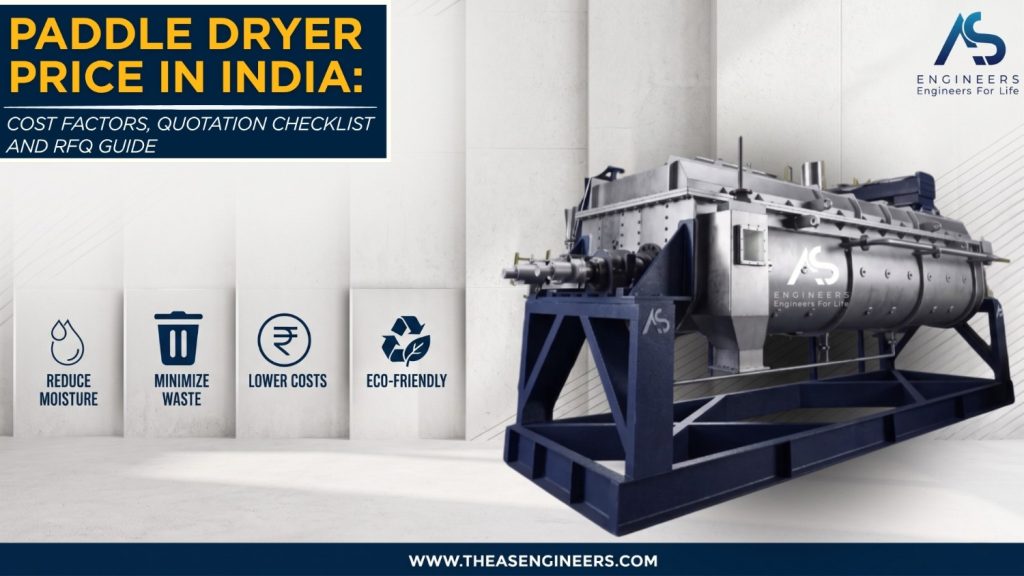
Paddle Dryer Price in India: Cost Factors, Quotation Checklist and RFQ Guide

Paddle dryer price in India is not a fixed catalogue number because an industrial paddle dryer is usually engineered around feed moisture, final moisture target, evaporation load, heating medium, material of construction, vapour handling, automation, and site layout. A serious paddle dryer quotation should be based on your process data, not only on machine size or motor HP.
For buyers comparing paddle dryer cost in India, the better question is not “What is the lowest price?” The better question is “What exactly is included in the quotation, and will the dryer match my material, utilities, handling requirement, and long-term operating cost?”
If you are new to this equipment, first understand the basic sludge drying with paddle dryer technology before comparing offers.
Why Paddle Dryer Price in India Varies So Much
A paddle dryer is not like a standard pump, motor, or valve that can be priced only by size. Two plants may both ask for a “paddle dryer,” but their real process duty can be completely different.
One plant may need a dryer for ETP sludge with high moisture and sticky behaviour. Another may need it for chemical cake, mineral slurry, food residue, pigment, gypsum, polymer, or pharmaceutical intermediate. The dryer body may look similar from outside, but the internal design, MOC, heat transfer area, drive selection, vapour handling, and discharge system can change the project cost.
The main price drivers are:
| Cost Factor | Why It Changes Paddle Dryer Cost | What Buyer Should Share |
|---|---|---|
| Feed quantity | Decides machine size and residence time | kg/hr or ton/day feed rate |
| Initial moisture | Higher moisture usually increases evaporation load | Moisture percentage or lab report |
| Final moisture target | Lower final moisture may require more heat duty | Required outlet moisture or dryness |
| Feed behaviour | Sticky, abrasive, corrosive, pasty, or dusty material needs different design attention | Sample, photos, handling notes |
| Heating medium | Steam, thermic fluid, hot water, or other utility changes design and control scope | Available pressure, temperature, fuel |
| Material of construction | CS, SS304, SS316, Duplex Steel, or alloy selection affects cost and life | pH, chlorides, solvent, corrosion data |
| Vapour handling | Water vapour, solvent vapour, fines, odour, and dust require different treatment | Vapour composition and EHS requirement |
| Automation level | PLC, sensors, alarms, torque monitoring, temperature controls, and interlocks affect scope | Manual, semi-automatic, or automatic need |
| Feeding and discharge | Screw feeder, sludge pump, conveyor, bagging, silo, or truck loading changes layout | Site layout and handling method |
| Testing and trial | Pilot trials reduce sizing and performance risk | Sample availability and trial objective |
Direct Answer for Buyers: Is There an Average Paddle Dryer Cost in India?
There is no reliable average paddle dryer cost in India without process data. Any single price range can be misleading because many online listings mix small machines, lab-scale units, rotary vacuum paddle dryers, basic dryer bodies, and complete industrial paddle dryer systems.
For industrial purchase, compare the quotation scope instead of only the price line.
A low-price offer may exclude:
- feeding system
- heating system interface
- vapour ducting
- cyclone, scrubber, bag filter, or condenser
- discharge conveyor
- bagging system
- electrical panel and automation
- installation support
- trial support
- OEM spare parts
- after-sales service
This is why a complete paddle dryer quotation should clearly say whether it is only for the dryer body or for a full drying system.
For buyers handling sludge specifically, the paddle sludge dryer guide is useful because sludge behaviour directly affects cost, layout, and long-term operation.
What a Good Paddle Dryer Quotation Should Include
A proper paddle dryer quotation should not look like a one-line machine price. It should define the basis of design and commercial scope.
A good quotation should include:
| Quotation Item | Why It Matters |
|---|---|
| Feed basis | Confirms what material and moisture condition the offer is designed for |
| Evaporation load | Helps compare true drying duty, not only feed quantity |
| Final moisture target | Prevents confusion about outlet dryness |
| Dryer model and size | Shows machine selection logic |
| Heat transfer area | Important for drying capacity and residence time |
| Heating medium | Steam, thermic fluid, hot water, or other utility basis |
| MOC | Confirms compatibility with corrosion, abrasion, and product safety |
| Drive and gearbox | Important for torque and continuous operation |
| Feeding arrangement | Controls stable feed into the dryer |
| Vapour handling | Covers water vapour, solvent vapour, odour, and fines |
| Pollution control equipment | May include cyclone, scrubber, or bag filter depending on duty |
| Discharge system | Avoids manual handling, dusting, spillage, or choking |
| Controls and automation | Supports stable operation and safety logic |
| Testing or pilot trial | Reduces uncertainty for difficult materials |
| Installation and commissioning | Clarifies site responsibility |
| Service and spare parts | Important for long-term dryer reliability |
AS Engineers’ paddle dryer system design can include heating, feeding, scavenging, pollution control, solvent management, and product handling as part of the overall process flow. This matters because the dryer alone is only one part of a workable industrial drying installation.
Paddle Dryer RFQ Checklist for Purchase Teams
Use this paddle dryer RFQ checklist before asking any manufacturer for price.
| RFQ Input | Details to Provide |
|---|---|
| Material name | Sludge, wet cake, slurry, paste, powder, granule, chemical cake, food residue, pigment, mineral, etc. |
| Industry | ETP, STP, CETP, chemical, pharma, food, paper, textile, mining, polymer, pigment, municipal, or waste management |
| Feed quantity | kg/hr, ton/day, batch quantity, or daily sludge generation |
| Initial moisture | Moisture percentage by weight, ideally with lab report |
| Required final moisture | Target final moisture or dryness objective |
| Operating hours | Hours/day and days/month |
| Bulk density | If available |
| Particle size or lumps | Important for feeding and discharge |
| Stickiness | Whether material sticks to screw, wall, conveyor, or dryer surfaces |
| Abrasion risk | Sand, grit, mineral content, catalyst, metal powder, or abrasive particles |
| Corrosion risk | pH, chlorides, acids, alkalis, solvent, salt, or chemical composition |
| Temperature sensitivity | Maximum safe product temperature |
| Heating medium available | Steam, thermic fluid, hot water, natural gas, wood, coal, LDO, electricity, briquette, or other |
| Utility details | Steam pressure, thermic fluid temperature, fuel availability, power supply |
| Vapour details | Water vapour, solvent vapour, odour, fumes, dust, or hazardous content |
| Pollution control need | Cyclone, scrubber, bag filter, condenser, chimney, or plant-specific requirement |
| Site layout | Available space, height, access, foundation, maintenance clearance |
| Feeding method | Screw feeder, belt conveyor, sludge pump, hopper, silo, manual feed |
| Discharge method | Screw conveyor, bagging, silo, bucket elevator, truck loading |
| Automation requirement | Manual, semi-automatic, PLC, alarms, interlocks, instrumentation |
| Trial requirement | Whether material sample is available for pilot trial |
| Commercial scope | Dryer only, dryer with auxiliaries, or complete drying system |
Copy-Paste RFQ Format for Paddle Dryer Quotation
You can send this format to AS Engineers or any serious paddle dryer manufacturer.
Subject: Paddle Dryer Quotation Required for [Material Name] Drying
Message:
We need a paddle dryer quotation for drying [material name] from [initial moisture %] to [target final moisture %]. Our feed quantity is [kg/hr or ton/day], and the plant will operate for [hours/day]. The material is [sticky / pasty / abrasive / corrosive / solvent-bearing / heat-sensitive / free-flowing]. Available heating medium is [steam / thermic fluid / hot water / other] with [pressure/temperature details]. We require [dryer only / complete system with feeding, vapour handling, pollution control and discharge]. Please review the duty and suggest suitable paddle dryer configuration, MOC, heating arrangement, automation level, and quotation scope.
Attach:
- material photos
- lab report
- moisture analysis
- MSDS, if available
- site layout
- existing dewatering details
- required final use or disposal method
Why Feed Moisture and Final Moisture Decide Cost
The biggest technical driver in paddle dryer cost is often water evaporation load.
Feed quantity alone is not enough. For example, drying 1 ton/day of material from 80% moisture to 20% moisture is different from drying 1 ton/day from 50% moisture to 10% moisture. The dryer must be selected around the actual amount of water to be evaporated, not only the wet feed weight.
This affects:
- heat transfer area
- residence time
- heating medium demand
- shaft torque
- vapour load
- fuel consumption
- dryer size
- discharge behaviour
- pollution control load
For sludge drying projects, AS Engineers’ published fuel benchmark uses a basis of 80% initial moisture to 20% final moisture. On that basis, 1 kg wood dries 5 kg sludge, 1 kg coal dries 8.25 kg sludge, 1 Nm³ gas dries 22.5 kg sludge, and 1 kg LDO dries 21 kg sludge.
These figures are useful for early comparison, but final operating cost should still be calculated from actual moisture, local fuel price, plant hours, dryer scope, and heat losses.
Heating Medium and Utility Cost
The heating medium has a direct impact on both project cost and operating cost.
AS Engineers’ paddle dryer design supports indirect heating through steam or thermal oil. Steam heating can be used up to 14.06 kg/cm², while thermal oil can be used up to 400°C, depending on application requirements.
The right choice depends on:
- available utility at site
- required drying temperature
- product temperature sensitivity
- energy cost
- safety requirement
- control philosophy
- maintenance capability
- plant preference
A buyer should not choose heating medium only because one option looks cheaper in the quotation. If the plant utility does not match the drying duty, the dryer may become difficult or expensive to operate.
MOC and Surface Finish Can Change the Price
Material of construction is a major cost factor in paddle dryer pricing.
Common options include:
- Carbon Steel
- SS304
- SS316
- Duplex Steel
- other alloy steels, where required
For non-corrosive materials, a simpler MOC may be suitable. For chemical sludge, solvent-bearing cake, salt-rich material, acidic or alkaline feed, or chloride-bearing sludge, MOC selection needs more care.
Choosing a lower-cost MOC without checking corrosion risk may reduce purchase price but increase future leakage, wear, downtime, and repair cost.
Surface finish can also matter for sticky, food, pharma, chemical, or product-sensitive applications. Options such as buffing, hard facing, or electropolishing should be discussed only when the process requires them.
Dryer Only vs Complete Paddle Dryer System
Many quotation mismatches happen because one vendor quotes only the dryer body, while another quotes a complete system.
A complete paddle dryer system may include:
- wet material silo
- belt conveyor, screw feeder, or sludge pump
- heating system interface
- FD blower and heat exchanger
- paddle dryer body
- ID fan
- cyclone separator
- scrubber
- bag filter
- condenser and solvent tank, where required
- screw conveyor
- bagging system
- silo
- bucket elevator
- truck disposal system
- electrical panel and automation
- installation and commissioning support
When comparing paddle dryer cost in India, ask every supplier for a scope matrix. Without scope clarity, the lowest quote may simply be the most incomplete quote.
For vapour and fines handling, related equipment such as cyclone separators, scrubbers, and bag filters may be required depending on the process.
When a Pilot Trial Should Be Part of the Buying Decision
A pilot trial is strongly useful when the material is unknown, sticky, corrosive, solvent-bearing, heat-sensitive, difficult to discharge, or commercially critical.
A trial can help verify:
- whether the material can be dried properly
- expected outlet moisture
- change in material phase during drying
- stickiness and buildup risk
- discharge behaviour
- vapour and odour behaviour
- drying temperature sensitivity
- process feasibility before full-scale investment
AS Engineers offers a paddle dryer pilot trial using a 50 kg/hr pilot trial machine. The trial can be done at AS Engineers’ works or at the client’s site on a minimal paid basis, with the fee waived upon order placement.
For high-risk materials, a trial can be more valuable than negotiating a lower price without process confidence.
How Paddle Dryer Cost Connects to Sludge Disposal Savings
For sludge applications, buyers should compare the machine cost with the long-term cost of wet sludge handling.
Wet sludge usually creates:
- high transport cost
- high labour requirement
- large storage requirement
- odour and hygiene issues
- difficult handling
- disposal pressure
- site housekeeping problems
AS Engineers’ sludge drying example shows 10 tons/day of wet sludge reducing to 2 tons/day after drying in a specific disposal-cost case. The same material may also be considered for alternative fuel, cement, bricks, or fertilizer use depending on sludge composition and local rules.
This does not mean every plant will get the same financial result. It means the purchase decision should include disposal cost, transport cost, moisture reduction, storage space, fuel cost, and end-use possibility.
For buyers evaluating technology options, the paddle dryer vs belt dryer comparison can help clarify when indirect paddle drying is suitable.
Common Mistakes While Comparing Paddle Dryer Quotations
Comparing Only Machine Price
A low machine price is not useful if the offer excludes vapour handling, automation, feeding, discharge, service, or commissioning.
Not Sharing Moisture Data
Without initial and final moisture data, the supplier may only guess the drying load.
Ignoring Material Behaviour
Sticky sludge, abrasive slurry, corrosive cake, and free-flowing powder cannot be treated as the same duty.
Not Checking MOC
Wrong MOC can create future corrosion, leakage, contamination, or repair cost.
Ignoring Vapour and Pollution Control
Water vapour, solvent vapour, odour, fumes, and fines need proper handling. This should be reviewed carefully with plant EHS and process teams.
Buying Without Trial for Difficult Material
For unknown or high-risk feed, trial data is safer than assumption-based sizing.
Ignoring Service and Spares
A paddle dryer is a long-life industrial asset. Service support, OEM spare parts, shaft support, gearbox support, bearing replacement, retro-fitment, alignment, and maintenance support should be reviewed before purchase.
For long-term support, review AS Engineers paddle dryer services before finalizing the buying decision.
AS Engineers as a Paddle Dryer Manufacturer in India
AS Engineers manufactures paddle dryer and sludge dryer systems from Ahmedabad, Gujarat. The company works in fluid mechanics and drying solutions, including paddle dryers, sludge dryers, centrifugal blowers, pollution control equipment, and turnkey solutions.
AS Engineers’ paddle dryer design uses indirect heat transfer through hollow shafts and jacketed surfaces. Dual counter-rotating shafts, wedge-shaped self-cleaning paddles, plug-flow movement, and enclosed vapour handling make the machine suitable for many industrial drying duties.
The paddle dryer can be configured for:
- drying
- solvent stripping
- heating
- calcining
- roasting
- cooling
It can handle different feed forms such as slurry, paste, cake, granules, and powders, depending on application testing and design review.
If your plant needs temporary evaluation or short-term use before full purchase, you can also review the paddle dryer rental service.
What to Send AS Engineers for a Faster Quotation
To get a meaningful paddle dryer price in India, share the following data:
- company name and plant location
- material name and industry
- present feed quantity
- initial moisture
- target final moisture
- operating hours
- available heating medium
- available steam pressure or thermic fluid temperature
- current sludge handling or material handling method
- MOC expectation, if already known
- corrosion or solvent data
- vapour, odour, or emission concern
- desired discharge form
- available installation space
- automation expectation
- photos, lab report, and sample availability
The more complete the RFQ, the faster the quotation becomes technically useful.
Conclusion
Paddle dryer price in India should be evaluated as a process-based quotation, not a fixed machine rate. The real cost depends on moisture load, material behaviour, heating medium, MOC, vapour handling, feeding, discharge, automation, trial requirement, and after-sales support.
If you are comparing paddle dryer cost in India, do not finalize only on the lowest initial quote. Compare the design basis, included scope, evaporation load, utility logic, MOC, pollution control requirement, service support, and pilot trial option.
For a technically useful quotation, share your material data, moisture target, heating medium, operating hours, and site requirement with AS Engineers. A clear RFQ helps the team recommend the right paddle dryer configuration instead of giving a generic machine price.
FAQs
What is the paddle dryer price in India?
There is no fixed paddle dryer price in India for industrial applications. The price depends on feed material, feed rate, initial moisture, final moisture target, heating medium, MOC, vapour handling, automation, and total system scope.
Why do paddle dryer quotations differ between suppliers?
Quotations differ because one supplier may quote only the dryer body, while another may include feeding, heating interface, vapour handling, pollution control, automation, discharge, testing, installation, and service support. Always compare the scope line by line.
What details are needed for a paddle dryer RFQ?
A proper paddle dryer RFQ should include material name, feed quantity, initial moisture, final moisture target, operating hours, heating medium, MOC expectation, vapour details, site layout, feeding method, discharge method, and automation requirement.
Should I ask for a pilot trial before buying a paddle dryer?
A pilot trial is recommended for sticky, unknown, corrosive, solvent-bearing, heat-sensitive, or high-value materials. It helps verify drying behaviour, outlet moisture, discharge quality, and process feasibility before full-scale investment.
Is the lowest paddle dryer cost always the best option?
No. A low-cost quote may exclude essential systems or use unsuitable design assumptions. Better value comes from correct sizing, suitable MOC, stable drying, lower downtime, proper vapour handling, service support, and long-term operating reliability.
