
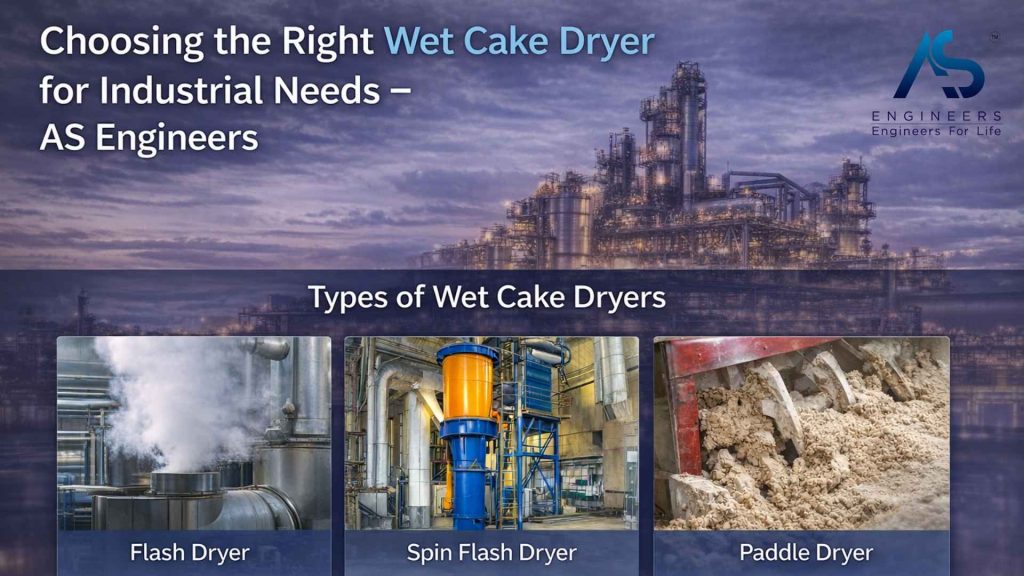
Wet Cake Dryer Selection Guide: Why the Paddle Dryer Handles What Other Systems Cannot

Filter press cake from a chemical plant. Centrifuge cake from a pharmaceutical API process. Belt press discharge from an ETP. These are not free-flowing powders, and they are not pumpable slurries. They are semi-solid materials with 40 to 65 percent moisture, often sticky, sometimes abrasive, sometimes containing solvent vapour – and they sit at the edge of what most conventional dryers can process reliably.
Getting the dryer selection wrong on wet cake costs more than the capital value of the equipment. A rotary drum dryer that clumps the material on its shell walls, a flash dryer that passes the cake through at insufficient residence time, or a spray dryer that cannot even accept a feed with this consistency – each of these is a project rework. This guide explains what wet cake actually does during drying, why specific dryer types fail, and what parameters to specify when sizing a paddle dryer for your application.
What Is Wet Cake and Why Does It Behave Differently During Drying?
Wet cake is the solid output of a filtration or centrifugation step. A filter press discharges it as a slab. A centrifuge discharges it as a moist crumble. A belt press produces a continuous sheet. In all cases, the material contains both free moisture (water held between particles, removed relatively easily) and bound moisture (water chemically or physically held within the particle structure, requiring more heat and residence time to remove).
The behaviour that makes wet cake difficult to dry is the sticky phase. As the material heats and free moisture evaporates, it passes through a zone where the outer surface dries while the interior remains wet and plastic. At this point, the material is at its stickiest. In a rotary drum dryer, it adheres to the shell walls and stops moving forward. In a spray dryer, it cannot even be atomised at inlet moisture levels above 20 to 25 percent. In a flash dryer, the residence time of seconds is insufficient for the bound moisture phase.
The paddle dryer handles the sticky phase through two counter-rotating shafts fitted with wedge-shaped hollow paddles. As the paddles intermesh, they continuously break up lumps, scrape the trough walls, and expose fresh material surface to the heated contact area. The material cannot adhere because the mechanical action prevents it. This is the fundamental reason paddle dryers work on wet cake when other dryer types fail — not because of superior heating media alone, but because the agitation mechanism is specifically designed for the sticky-phase transition.
Why Conventional Dryers Fail on Wet Cake
| Dryer Type | Heat Transfer | Why It Fails on Wet Cake |
|---|---|---|
| Rotary drum dryer | Convection + contact | Sticky cake adheres to shell; lumps form and do not break up; inconsistent discharge moisture |
| Flash dryer | Convection (hot air) | Residence time of 1–5 seconds insufficient for bound moisture; cannot accept high-viscosity feed |
| Spray dryer | Convection (atomised) | Cannot process feed above ~25% inlet moisture; wet cake cannot be atomised without dilution |
| Spin flash dryer | Convection (air) | Handles pastes and light sludge; struggles with heavy sticky filter cake and abrasive content |
| Paddle dryer (indirect) | Conduction (contact) | Designed for this duty — counter-rotating shafts handle sticky phase; controllable residence time |
The paddle dryer column in this table does not fail because the agitation mechanism, the indirect heat transfer, and the controllable residence time address each of the failure modes of the other types. Heat transfer is always indirect contact through the heated paddle faces and jacketed trough – never hot air, never direct flame.
Key Parameters for Wet Cake Dryer Selection
Before approaching any manufacturer for a sizing, define these five parameters. Without them, any selection is an estimate.
Inlet and target outlet moisture content. Wet cake inlet moisture for chemical filter cakes typically ranges from 30 to 65 percent. For ETP centrifuge cake it is often 70 to 80 percent. Target outlet moisture depends on the downstream use — landfill disposal, co-processing as fuel, or further processing in a downstream step. For co-processing in cement kilns, a calorific value of approximately 3,500 kcal/kg is achievable at outlet moisture below 15 percent.
Throughput in kg/hr of wet feed. This determines dryer size and heating area. For an ETP generating 500 kg/day of dried output from wet cake, a paddle dryer runs at operating costs of Rs 5.45 to 7.50 per kg of dried output (at Rs 10/kWh electricity cost). Against a disposal cost of approximately Rs 25 per kg at an authorised TSDF facility, the savings case is straightforward.
Material characteristics. Is the cake thixotropic (thins under shear) or purely plastic? Does it contain abrasive particles that will wear paddle faces? Does the process generate solvent vapour that must be contained? Vapour-containing cake from pharmaceutical or specialty chemical processes requires a vapour-tight dryer design with shaft seals rated for the vapour type and a connected condenser or scrubber.
Heating media available on site. The paddle dryer for chemical industry applications typically uses thermic fluid (up to 400°C) for high-temperature duties. Steam at available plant pressure is suitable for moderate-temperature duties. Hot water serves heat-sensitive materials where temperature must be kept below 90 to 95°C.
Heat sensitivity. For thermolabile materials such as APIs, enzyme preparations, or certain food ingredients, the paddle dryer can operate under vacuum. Vacuum reduces the boiling point of moisture, allowing drying at significantly lower surface temperatures than atmospheric operation. For food industry paddle dryer applications, this preserves colour, aroma, and bioactive content that would degrade at atmospheric drying temperatures.
Material Selection Guide: Matching Wet Cake Characteristics to Dryer Configuration
| Wet Cake Characteristic | Recommended Configuration |
|---|---|
| Sticky, plastic, high inlet moisture (50–80%) | Standard dual-shaft paddle dryer, thermic fluid heating |
| Abrasive (catalyst, mineral cake) | Hard-faced paddle surfaces, increased shaft clearance |
| Heat-sensitive (API, enzyme, food) | Vacuum paddle dryer, steam or hot water heating |
| Hazardous vapour / VOC content | Vapour-tight design with shaft seals, connected condenser or scrubber |
| High throughput (industrial scale ZLD cake) | Multiple dryers in parallel or larger shaft diameter configuration |
| Corrosive cake (acidic or alkaline) | SS 316 or SS 316L trough and paddle construction |
India’s Regulatory Context for Wet Cake Treatment
Wet cake classification under the Hazardous Waste Management, Handling and Transboundary Movement Rules 2016 (HW Rules 2016) determines whether a plant’s filter cake is classified as hazardous waste requiring authorised TSDF disposal or whether it can be co-processed or reused after drying. Many filter cakes from chemical, dye, and pharmaceutical processes are Schedule I or Schedule II listed wastes.
For these materials, TSDF disposal costs are a direct operating cost — typically Rs 15 to 30 per kg depending on waste category, moisture content, and distance to the TSDF facility. Volume reduction through drying (80 to 90 percent volume reduction is achievable) reduces the TSDF disposal cost proportionally. For plants under Zero Liquid Discharge (ZLD) compliance conditions imposed by NGT orders or SPCB consent conditions, the press cake from the evaporator or MEE system also requires a downstream drying step before the solid is in a form acceptable for co-processing or storage.
The CPCB’s guidance on co-processing of industrial waste in cement kilns creates a pathway for dried filter cake with adequate calorific value to be supplied as alternate fuel — a cost saving versus TSDF disposal and, in some cases, a small revenue from cement plants.
What AS Engineers Supplies for Wet Cake Drying
AS Engineers manufactures paddle dryers for wet cake and sludge drying applications across chemical, pharmaceutical, food, and ETP sectors. All dryers use the dual counter-rotating shaft design with wedge-shaped hollow paddles. Heating media options are thermic fluid, steam, and hot water. Vapour-tight and vacuum configurations are available for hazardous and heat-sensitive materials.
For plants evaluating the technology before committing to capital purchase, a paddle dryer rental is available for trial runs on your specific wet cake material. Post-installation, paddle dryer services cover shaft seal inspection and replacement, paddle surface inspection for wear, and performance testing against original duty data.
Frequently Asked Questions
What is a wet cake dryer and how does it differ from a sludge dryer?
A wet cake dryer and a sludge dryer operate on the same paddle dryer platform. The distinction is the feed material: wet cake arrives from a filter press, centrifuge, or belt press as a semi-solid solid with defined structure. Sludge arrives as a pumpable or semi-pumpable fluid. Both pass through a sticky phase during drying. The paddle dryer handles both because the counter-rotating shaft agitation manages the sticky phase regardless of starting consistency. Feed system design (screw feeder vs pump) differs between the two.
Why does wet cake cause problems in rotary drum and flash dryers?
Wet cake passes through a sticky plastic phase as free moisture evaporates from the outer surface while the interior remains wet. In a rotary drum dryer, this phase causes the material to stick to the shell walls and form lumps that do not break up. In a flash dryer, the residence time of 1 to 5 seconds is insufficient to drive off bound moisture, so the product is consistently over-moist. The paddle dryer’s counter-rotating agitation continuously breaks up lumps and prevents wall adhesion throughout this transition.
What inlet and outlet moisture levels does a paddle dryer handle for wet cake?
Inlet moisture for wet cake from filter presses and centrifuges typically ranges from 30 to 65 percent. ETP centrifuge cake can be 70 to 80 percent. Outlet moisture is controlled to 5 to 15 percent by adjusting shaft speed and heating temperature. For co-processing in cement kilns, outlet moisture below 15 percent is generally the target.
Can a paddle dryer handle wet cake containing solvents or hazardous vapour?
Yes. A vapour-tight configuration with appropriate shaft seals operates the dryer under slight negative pressure, containing vapour within the system. The vapour outlet connects to a condenser for solvent recovery or to a scrubber for treatment before discharge. This configuration is standard for pharmaceutical API cake, specialty chemical intermediates, and any wet cake classified as hazardous under HW Rules 2016.
How do I determine the right paddle dryer size for my wet cake duty?
Supply four inputs to AS Engineers: inlet moisture content (percent wet basis), target outlet moisture content, wet feed throughput (kg/hr or kg/day), and material characteristics — sticky, abrasive, heat-sensitive, or hazardous vapour content. If heating media on site is known (thermic fluid, steam, or hot water), include that. The team will calculate the required heat transfer area, shaft size, and motor power. Contact AS Engineers to start the sizing.
What is the operating cost of a paddle dryer for wet cake drying?
At Rs 10/kWh electricity cost, operating costs for a paddle dryer on wet cake duty run between Rs 5.45 and Rs 7.50 per kg of dried output. Against typical TSDF disposal costs of Rs 15 to 30 per kg (depending on waste classification and distance), the saving per kilogram is substantial. For a plant generating 500 kg/day of dried output, payback on the capital investment typically falls within 12 to 13 months.
Can I trial a paddle dryer on my wet cake material before committing to purchase?
Yes. AS Engineers offers a paddle dryer rental service specifically for trial runs and proof-of-concept testing on specific materials. This allows your team to verify the outlet moisture, residence time, and product characteristics on your actual wet cake before finalising the capital specification. Contact AS Engineers to discuss the rental process and availability.
