
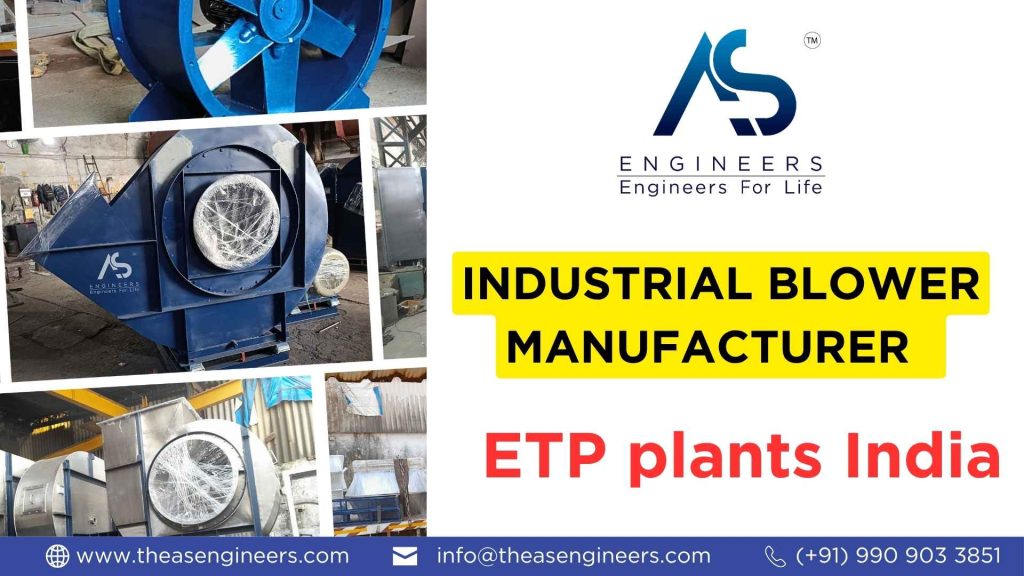
Industrial Blower for ETP Plants: Why Centrifugal Blowers Are the Right Choice for Large-Scale and Multi-Duty Applications

Most ETP operators think about blowers once — when they’re sizing the aeration system. Then the plant starts up, CPCB inspection notices arrive, odour complaints come in from the boundary, or the press filter room ventilation proves inadequate, and it becomes clear that the aeration blower is just one of several air system duties an ETP actually demands.
This article covers the full range of blower duties in an effluent treatment plant, where centrifugal blowers are the right choice over positive displacement roots blowers, what specifications to use when sizing them, and what India’s regulatory framework requires of the facilities driving this demand.
Blower Duties in an ETP: More Than Just Aeration
Aeration is the most discussed blower duty in ETP design, but it is not the only one. A plant engineer specifying air systems for a full ETP layout will encounter at least four distinct duties, each with different airflow volumes, static pressure requirements, and material of construction (MOC) implications.
| ETP Duty | Blower Function | Typical Static Pressure | MOC Consideration |
|---|---|---|---|
| Aeration tank | Supply air to diffusers for biological oxygen demand (BOD) removal | 200–600 mmWC (depending on submergence depth) | MS or SS 304 for clean air service |
| Odour control scrubber | Force odorous air through wet scrubbing media | 400–900 mmWC | SS 316 or SS 304 for H₂S-bearing air |
| Sludge handling ventilation | Exhaust air from enclosed sludge thickener, belt press, or centrifuge rooms | 150–400 mmWC | SS 316 for high humidity and H₂S |
| Biogas handling (where applicable) | Circulate or compress biogas from digester for reuse or flaring | 300–800 mmWC | SS 316L, spark-proof design |
| Equalization tank mixing | Air agitation for equalization basin contents | 250–500 mmWC | MS for general duty |
A positive displacement roots blower handles the aeration duty acceptably at small to medium plant scales. At larger airflow volumes, or where the ETP requires multiple air system duties on a single site, centrifugal blowers offer better long-term economics and greater application flexibility.
Where Centrifugal Blowers Outperform Roots Blowers in ETP Applications
The standard industry response to “what blower for ETP aeration?” has long been the twin-lobe roots blower. It delivers constant volume at modest pressure and handles the activated sludge aeration duty at plant capacities below roughly 500–1,000 m³/day. For larger plants, or for any of the non-aeration duties listed above, the case for centrifugal blowers is stronger.
Centrifugal blowers for ETP applications are available across an airflow range of 100 to 2,50,000 m³/hr and static pressures from 25 to 2,100 mmWC, tested to IS 4894. This range covers both the smallest ETP aeration diffuser bank and the largest odour control scrubber on a chemical plant site.
The specific advantages of centrifugal blowers for ETP duty:
- VFD compatibility: A centrifugal blower paired with a variable frequency drive adjusts airflow continuously to match the biological oxygen demand, which varies with industrial production schedules. A roots blower at fixed speed delivers constant volume regardless of whether the aeration tank needs it. Over a year of operation, VFD-controlled centrifugal blowers can reduce aeration energy consumption materially compared to fixed-speed positive displacement units.
- Corrosive gas service: For odour control scrubbers and sludge room ventilation, the gas stream contains hydrogen sulphide (H₂S) and ammonia. Centrifugal blowers in SS 316 or SS 316L are manufactured specifically for this duty. Roots blowers are generally available only in standard grades.
- Multi-duty flexibility: A single centrifugal blower specification — correctly sized and in the right MOC — can serve the aeration duty and the scrubber duty on a smaller plant, where running two separate positive displacement units adds cost and maintenance complexity.
- High-pressure ETP applications: Deep aeration tanks (submergence depth above 5 metres), or diffuser systems with high resistance media, require static pressures above 600 mmWC. This is beyond the comfortable operating range of most standard roots blowers without going to high-pressure multi-lobe configurations. The high pressure radial blade blower covers these duties directly.
India’s Regulatory Context: What Is Driving ETP Investment
The scale of ETP installation and upgrade activity across India is driven by several converging regulatory requirements:
CPCB maintains industry-specific effluent discharge standards under the Environment (Protection) Act 1986. These standards vary significantly by sector — a pharmaceutical manufacturer faces different BOD, COD, and suspended solids limits than a textile dyeing unit or a chemical plant. As these standards are periodically revised and as State Pollution Control Board (SPCB) consent conditions tighten, plants are required to upgrade their biological treatment capacity, which directly increases aeration blower load.
NGT orders have further accelerated ETP compliance timelines in several industrial clusters, including GIDC estates in Gujarat. Common effluent treatment plants (CETPs) serving these clusters require reliable, continuous-duty aeration equipment because a blower failure at a CETP serving 50 or 100 member units is not an operational problem — it is a regulatory event.
The NMCG (National Mission for Clean Ganga) and AMRUT 2.0 programmes have funded significant STP (sewage treatment plant) capacity additions in towns and cities, many of which specify centrifugal blowers for aeration at flows above 5 MLD where the energy economics favour variable-speed operation.
Specifying a Centrifugal Blower for ETP Aeration: Key Parameters
To specify correctly, the engineer needs four inputs. Without these, any blower selection is an approximation:
1. Required airflow (m³/hr at operating conditions). For biological aeration, this is derived from the oxygen transfer rate required, which itself comes from the BOD load and the MLSS (mixed liquor suspended solids) target. A typical secondary treatment system running the activated sludge process requires roughly 1–2 kg O₂ per kg BOD removed; translating this to airflow at your diffuser’s oxygen transfer efficiency gives the blower duty point.
2. Static pressure (mmWC). This is the sum of diffuser submergence pressure, diffuser resistance, and ductwork friction. For a 4-metre deep aeration tank with coarse bubble diffusers, total static pressure is typically in the 500–700 mmWC range. Fine bubble diffusers at the same submergence add another 50–150 mmWC for diffuser resistance.
3. Gas stream characteristics. For clean aeration duty, standard MS or SS 304 construction applies. For odour control or scrubber service with H₂S content, SS 316 is the minimum. For biogas duty, a spark-proof design and appropriate pressure rating are required.
4. Operating profile. If oxygen demand varies significantly across shifts (as it does in pharmaceutical or food processing ETPs tied to production schedules), VFD compatibility should be designed in from the start, not retrofitted later.
AS Engineers manufactures centrifugal blowers for ETP duty across the full range of these applications — from aeration to odour control to sludge room ventilation. The backward curved centrifugal blower is the preferred selection for clean aeration service where efficiency is the priority. The backward inclined blower handles moderately contaminated gas streams. SS 316 or SS 316L configurations cover the corrosive gas duties.
After-Sales Support for ETP Blowers
A blower failure on an aeration system is not a planned maintenance event — it typically happens during continuous operation and brings the biological process to a halt within hours. The speed of response from your blower supplier determines how long the treatment process is disrupted.
AS Engineers provides centrifugal blower services including on-site performance testing, bearing and seal replacement, impeller re-balancing to IS 4894 G6.3 standard, and spare parts supply from original manufacturing data. For ETPs requiring a non-standard duty — unusual pressure, corrosive gas, or a confined installation envelope — the make-to-order blower service covers fully custom-engineered specifications.
Frequently Asked Questions
Are centrifugal blowers or roots blowers better for ETP aeration?
For plants below roughly 500–1,000 m³/day of wastewater treatment with simple aeration-only duty and no variation in oxygen demand, roots blowers are adequate and widely available. For larger plants, plants with variable organic loading (tied to batch production), plants with multiple air system duties (aeration plus odour control or sludge ventilation), or deep aeration tanks requiring pressure above 600 mmWC, centrifugal blowers are the better fit — particularly when paired with VFDs for energy management.
What airflow and pressure do ETP aeration blowers typically require?
This depends on tank depth, diffuser type, and BOD load. As a reference range: aeration duties in secondary treatment typically fall between 500 and 15,000 m³/hr at static pressures of 200–700 mmWC. Odour control scrubber duties are typically lower volume but higher pressure — 200–2,000 m³/hr at 400–900 mmWC. AS Engineers can calculate the duty point from your tank dimensions and BOD loading data.
What MOC is correct for ETP odour control blower service?
For H₂S-bearing air from sludge thickeners, belt press rooms, or raw sewage pump stations, SS 316 is the minimum. If ammonia concentration is also significant, SS 316L provides better resistance. Standard MS construction is not appropriate for continuous H₂S exposure above a few hundred ppm.
Can centrifugal blowers be used with VFDs for ETP aeration?
Yes. Centrifugal blowers are inherently compatible with VFD operation. Adjusting motor speed to match actual oxygen demand (which varies with BOD load across production shifts) reduces energy consumption compared to a fixed-speed blower supplying constant air volume. This is particularly relevant for ETPs serving pharmaceutical, food processing, or batch chemical plants where wastewater generation is uneven.
What CPCB standards apply to ETP design in India?
CPCB issues industry-specific effluent discharge standards under the Environment (Protection) Act 1986. Standards vary by sector: pharmaceutical units face different BOD, COD, TSS, and heavy metal limits than textile or chemical plants. The blower sizing in an ETP is directly tied to the BOD removal load that these standards impose on the biological treatment stage. Your SPCB consent to operate will specify the applicable effluent standards for your plant.
What maintenance does an ETP centrifugal blower require?
Bearing lubrication at intervals specified by the manufacturer, belt tension check and wear inspection for belt-drive configurations (every 3 months minimum), impeller inspection for material build-up or corrosion (every 6 months), and an annual performance check against the original duty point. For corrosive gas applications in SS 316, inspect shaft seals more frequently. AS Engineers provides maintenance contracts covering all these checks.
How do I get a blower specification for my ETP from AS Engineers?
Provide: your wastewater flow in m³/day, the aeration tank dimensions (length, width, water depth), diffuser type if known, SPCB-specified BOD and COD removal targets, and whether you need the blower for aeration only or also for odour control or sludge handling duty. AS Engineers’ engineering team will produce a duty point calculation and blower recommendation. Contact AS Engineers to start the enquiry.
