
Centrifugal Blower Spare Parts List: Complete Guide for Industrial Plants

A centrifugal blower spare parts list usually includes the impeller, shaft, bearings, bearing housing, V-belts, pulleys, coupling, motor mount, seals, gaskets, casing, inlet cone, outlet diffuser, dampers, expansion bellows, guards, access doors, fasteners, base frame, liners, and application-specific accessories. The exact spare part depends on blower type, RPM, static pressure, temperature, dust load, gas condition, MOC, and site arrangement.
At AS Engineers, centrifugal blower spare parts are not treated as simple replacement items. A wrong impeller, shaft, bearing fitment, pulley size, or seal arrangement can increase vibration, reduce airflow, damage bearings, and create repeated shutdowns.
For plant maintenance teams, purchase teams, EPCs, and utility engineers, the better question is not only “What spare parts are available?” The better question is, “Which spare part is critical for my blower duty, and what information should I share before ordering?”
Complete centrifugal blower spare parts list
The following list covers the common spare parts used in industrial centrifugal blowers, ID fans, FD fans, exhaust fans, dust collector fans, scrubber fans, hot air circulation fans, and process-air systems.
| Spare part | Function | When it may need replacement |
|---|---|---|
| Impeller / fan wheel | Generates airflow and pressure by rotating inside the casing | Erosion, dust buildup, blade crack, imbalance, reduced airflow, high vibration |
| Shaft | Transfers rotation from drive to impeller | Runout, bending, worn bearing seat, coupling misalignment, vibration |
| Bearings | Support the rotating assembly | Heating, noise, repeated failure, lubrication issues, abnormal vibration |
| Bearing housing / plummer block | Holds bearings in correct position | Cracks, bore wear, loose fitment, lubrication leakage |
| V-belts | Transfer power from motor pulley to blower pulley | Cracks, slip, uneven wear, frequent belt breakage |
| Pulleys | Maintain drive speed ratio and power transmission | Groove wear, misalignment, wrong speed, vibration |
| Coupling | Connects motor and blower shaft in direct-drive systems | Misalignment, worn spider, loose fit, coupling vibration |
| Motor mount / motor base | Holds motor in correct alignment | Loose mounting, base crack, motor vibration |
| Casing / housing / scroll | Guides airflow from inlet to outlet | Corrosion, erosion, leakage, deformation, rubbing noise |
| Inlet cone / inlet bell mouth | Guides air smoothly into impeller | Wear, damage, clearance issue, airflow loss |
| Outlet diffuser / discharge elbow | Supports pressure recovery and discharge connection | Wear, leakage, duct mismatch, pressure loss |
| Shaft seals | Reduce leakage around shaft entry | Air leakage, dust leakage, worn seal faces |
| Gaskets | Seal casing joints and access covers | Leakage, hardening, tearing, repeated opening during maintenance |
| Access door / inspection cover | Allows inspection and cleaning | Damaged hinge, leakage, poor sealing |
| Damper | Controls flow or isolation in the system | Jamming, corrosion, leakage, blade wear |
| Expansion bellow | Absorbs duct movement and vibration | Cracks, leakage, hardening, misalignment stress |
| Guards | Protect belt, coupling, and rotating parts | Damage, missing guard, unsafe access |
| Base frame / pedestal | Supports blower and motor assembly | Cracks, corrosion, foundation looseness |
| Fasteners and foundation bolts | Hold casing, frame, guards, and accessories | Loosening, corrosion, missing fasteners |
| Wear liners / hard-facing parts | Protect against abrasive dust | Wear-through, erosion, uneven metal loss |
| Cooling disc | Used in some high-temperature duties | Heat stress, deformation, poor cooling effect |
| Stuffing box / mechanical seal | Used where leakage control is important | Leakage, wear, process contamination risk |
| Anti-vibration pads / isolators | Reduce vibration transfer to foundation | Compression, cracking, loss of isolation |
| Lubrication accessories | Support bearing lubrication | Blocked grease nipple, oil leakage, poor lubrication flow |
This list should be used as a practical starting point. For final selection, always match the spare part with the blower drawing, duty condition, direction of rotation, shaft size, bearing number, impeller diameter, RPM, MOC, and site installation details.
Critical spare parts plant teams should keep ready
Not every spare part needs to be stocked in the same way. Some parts are shutdown-critical, while others can be planned during maintenance.
| Criticality | Spare parts | Why they matter |
|---|---|---|
| Very high | Bearings, V-belts, shaft seals, gaskets, coupling elements | These parts commonly affect uptime and can stop the blower quickly |
| High | Impeller, shaft, bearing housing, pulleys, inlet cone | These affect airflow, vibration, pressure, and rotating stability |
| Medium | Damper parts, expansion bellow, access door, guards, fasteners | These affect safety, leakage, flow control, and service access |
| Application-specific | Wear liners, cooling disc, stuffing box, mechanical seal, special MOC parts | These depend on dust, temperature, corrosive gas, or process duty |
| Planned replacement | Casing sections, base frame, outlet diffuser, support brackets | Usually replaced during refurbishment or retrofit work |
In many plants, I see teams stock belts and bearings but ignore shaft seals, gaskets, coupling elements, and fasteners. During shutdown, these smaller parts can create the same delay as a major component because the blower cannot be safely closed, aligned, or restarted without them.
Main components of centrifugal blower spare parts
Impeller or fan wheel
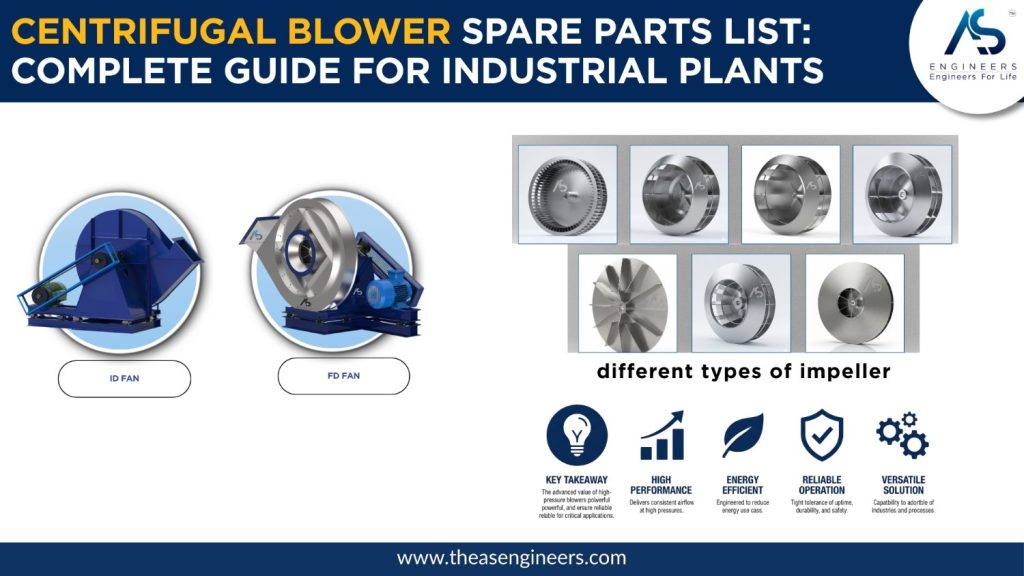
The impeller is the main rotating component of a centrifugal blower. It directly affects airflow, static pressure, efficiency, power load, and vibration. AS Engineers manufactures centrifugal blower types such as backward curved blowers, backward inclined blowers, high-pressure radial blade blowers, high-temperature plug blowers, and exhauster air handling blowers for different industrial applications.
Impeller replacement may be needed when there is blade erosion, crack formation, rubbing marks, dust buildup, corrosion, or repeated imbalance after cleaning and balancing.
For abrasive dust applications, the impeller should not be selected only by matching the diameter. Blade profile, width, MOC, hard-facing, hub design, rotation direction, RPM, and balancing requirement also matter.
Shaft
The shaft connects the impeller to the drive arrangement. A damaged shaft can create vibration even after new bearings are installed. Shaft replacement or repair may be needed when there is bending, runout, keyway damage, worn bearing seating area, coupling-end wear, or repeated misalignment.
Before ordering a new blower shaft, share shaft drawing, bearing numbers, coupling details, impeller hub dimensions, overall length, keyway size, and failed shaft photos.
Bearings and bearing housing
Bearings are among the most commonly replaced centrifugal blower spare parts. Bearing failure may come from poor lubrication, misalignment, wrong bearing selection, overload, dust ingress, high temperature, imbalance, or foundation looseness.
Do not replace bearings repeatedly without checking the root cause. Repeated bearing failure usually means the plant should inspect alignment, shaft condition, impeller balance, belt tension, foundation, lubrication practice, and actual operating duty.
For wider blower service support, AS Engineers provides centrifugal blower services including performance analysis, engineering surveys, repair, retro-fitment, on-site balancing, on-site alignment, customized engineering solutions, AMC, and site-based design.
V-belts, pulleys, and coupling
In belt-driven blowers, V-belts and pulleys control power transmission and speed. Incorrect belt tension can overload bearings, while loose belts can slip, heat, and reduce airflow.
In direct-drive blowers, coupling alignment becomes critical. If the coupling is misaligned, the blower may show high vibration, coupling wear, motor load variation, and bearing heating.
When ordering drive-related spares, share drive type, motor HP, RPM, pulley diameter, belt section, center distance, coupling type, and photos of the existing drive arrangement.
Casing, inlet cone, and outlet parts
The casing, scroll, inlet cone, and outlet diffuser guide air through the blower. Even if the rotating assembly is healthy, damaged casing geometry can reduce performance.
Casing-related replacement may be required when there is corrosion, abrasion, leakage, rubbing, inlet cone damage, outlet flange mismatch, or deformation due to duct stress.
For retrofit or replacement projects where the original blower drawing is not available, a make-to-order blower approach may be better than forcing a standard part into an old installation.
Seals and gaskets
Seals and gaskets look minor, but they directly affect leakage, suction stability, dust escape, and casing closure. Shaft seals, access door gaskets, casing joint gaskets, stuffing box parts, and mechanical seals should be checked during shutdown.
In hot gas, dust-laden, or corrosive applications, seal material and gasket material should be selected carefully. Do not use a generic gasket material without checking temperature and gas condition.
Dampers, expansion bellows, and guards
AS Engineers catalog data includes accessories such as dampers, expansion metallic bellows, cooling discs, mechanical seals, stuffing boxes, and guards as part of proper blower accessory selection.
Dampers control flow. Expansion bellows reduce duct stress and absorb movement. Guards protect people from rotating belts, couplings, and shafts. These parts are important for reliability and plant safety.
Never restart a blower with missing belt guards, coupling guards, loose access covers, or unverified rotating part clearance.
Spare parts by blower application
Different applications damage different parts first. A clean-air HVAC blower and a cement plant dust collector blower do not fail in the same way.
| Application | Common spare parts to monitor | Main reason |
|---|---|---|
| Bag filter blower | Impeller, bearing, shaft seal, casing, belts | Dust buildup, abrasion, pressure fluctuation |
| Scrubber ID fan | Impeller, casing, shaft seal, gasket, damper | Moisture, corrosive gas, leakage |
| Boiler FD fan | Bearings, belts, coupling, inlet cone, motor mount | Continuous duty, vibration, alignment |
| Boiler ID fan | Impeller, shaft, bearing housing, casing, expansion bellow | Hot gas, dust, negative draft duty |
| Cement plant blower | Impeller, wear liners, casing, shaft, bearings | Abrasive dust, high load, continuous duty |
| Furnace blower | Impeller, cooling disc, bearing, expansion bellow, seals | High temperature and thermal expansion |
| Chemical plant blower | MOC-specific impeller, casing, seals, gaskets | Corrosion and process gas compatibility |
| Food processing blower | Impeller, gaskets, seals, access covers | Hygiene, cleaning, product safety |
| Wastewater and ETP blower | Impeller, shaft seals, bearings, coupling, casing | Moisture, fumes, duty variation |
AS Engineers’ centrifugal blowers are used across industries such as steel and metals, automobile, power plants, fertilizer and chemical, refinery and petrochemicals, cement, and food processing.
When should centrifugal blower spare parts be replaced?
Centrifugal blower spare parts should be inspected or replaced when the plant notices rising vibration, unusual noise, bearing heating, reduced airflow, unstable static pressure, belt slip, casing leakage, impeller rubbing, frequent bearing failure, or corrosion inside the casing.
A simple warning rule: if a blower was running smoothly and now needs frequent adjustment, the problem is usually not only the visible failed part.
| Symptom | Parts to inspect first |
|---|---|
| High vibration | Impeller, shaft, bearings, coupling, pulley, foundation bolts |
| Bearing heating | Bearings, lubrication, shaft, belt tension, alignment |
| Low airflow | Impeller, inlet cone, damper, belts, casing leakage, duct blockage |
| High noise | Bearings, impeller rubbing, loose casing parts, guards, coupling |
| Frequent belt failure | Pulley alignment, belt tension, pulley groove, motor base |
| Air or dust leakage | Shaft seals, gaskets, access door, casing joint |
| Repeated bearing failure | Shaft runout, impeller balance, foundation, alignment, operating load |
| Rust or corrosion | Casing, impeller, fasteners, access doors, damper |
| Dust buildup | Impeller, inlet cone, casing, access door, duct connection |
For high-pressure blower maintenance and troubleshooting topics, AS Engineers’ ecosystem also supports deeper reading through high-pressure blower maintenance guidance and blower troubleshooting guidance.
OEM spare parts vs local fabrication
Local fabrication may look faster for simple plates, guards, covers, or frames. But for rotating parts, airflow parts, and fitment-critical components, accuracy matters.
| Part type | Local fabrication risk | Recommended approach |
|---|---|---|
| Impeller | High risk of imbalance, wrong blade geometry, poor efficiency | Use engineered replacement with balancing |
| Shaft | Runout and bearing fitment issue | Use accurate machining and material verification |
| Bearing housing | Misfit and vibration | Match bearing size, bore, mounting, lubrication |
| V-belt and pulley | Speed mismatch, belt slip | Match section, ratio, alignment |
| Casing and inlet cone | Airflow loss, rubbing, leakage | Match dimensions and clearance |
| Guard and access cover | Lower risk if made correctly | Ensure safety and fitment |
| Seal and gasket | Leakage and temperature failure | Match material with duty condition |
For older blowers, especially where drawings are missing, AS Engineers can support spare parts and repair discussions based on site data, drawings, dimensions, and equipment photos.
RFQ checklist for centrifugal blower spare parts
To get the right spare part faster, share the following information with your supplier or AS Engineers team:
| RFQ input | Details to share |
|---|---|
| Blower details | Manufacturer, model, serial number, tag number if available |
| Application | Boiler, scrubber, bag filter, dryer, furnace, cement, chemical, food, ETP, etc. |
| Duty condition | Airflow, static pressure, temperature, gas type, dust load, humidity |
| Operating speed | Blower RPM and motor RPM |
| Motor details | HP / kW, voltage, drive type, mounting arrangement |
| Rotation direction | Clockwise or anticlockwise from drive end |
| Spare part required | Impeller, shaft, bearing, pulley, belt, casing, seal, damper, etc. |
| Dimensions | Shaft size, bearing number, impeller OD, width, bore, keyway, flange sizes |
| Material requirement | MS, CS, SS304, SS316, hard-facing, FRP, alloy, or existing MOC |
| Site photos | Nameplate, blower assembly, failed part, inlet/outlet connection |
| Drawings | GA drawing, shaft drawing, impeller drawing, foundation drawing if available |
| Problem faced | Vibration, noise, low airflow, bearing failure, leakage, rubbing, corrosion |
| Shutdown timeline | Emergency, next planned shutdown, annual maintenance, retrofit project |
For urgent cases, photos and measurements are better than only saying “same as old blower.” For critical rotating parts, a technical review should be done before manufacturing or dispatch.
Common mistakes while ordering blower spare parts
Selecting only by motor HP
Motor HP does not define the spare part. The same HP blower can have different impeller diameter, blade profile, shaft size, RPM, pressure range, and MOC.
Replacing bearings without checking vibration
If the bearing failed due to imbalance, misalignment, or belt over-tension, a new bearing may fail again.
Ignoring impeller balancing
An impeller should not be treated like a simple fabricated wheel. It is a rotating aerodynamic part. Balancing and fitment accuracy are critical.
Not checking rotation direction
Wrong rotation direction or wrong blade orientation can severely affect airflow and pressure.
Reusing damaged pulleys
New belts on worn pulley grooves can fail early. Pulley condition should be inspected before belt replacement.
Missing gasket and fastener planning
During shutdown, plants often remember the major part but forget gaskets, bolts, nuts, washers, seal plates, and access door sealing.
Using wrong MOC
Dust, temperature, moisture, and corrosive gas can make a standard material fail early. MOC should match the process condition.
Practical maintenance checklist for blower spare parts
Use this as a maintenance planning checklist, not as a substitute for site-specific OEM instructions.
| Frequency | What to check |
|---|---|
| Daily / shift check | Noise, vibration, bearing temperature, belt noise, air leakage |
| Weekly | Belt condition, guard condition, fastener looseness, visible dust buildup |
| Monthly | Bearing lubrication, pulley alignment, coupling condition, casing leakage |
| Quarterly | Impeller inspection, vibration trend, shaft seal condition, damper movement |
| Shutdown | Internal casing inspection, impeller cleaning, balancing review, gasket replacement |
| Annual | Full performance review, alignment, bearing condition, foundation, duct stress |
The maintenance schedule should be tighter for high-temperature, high-dust, corrosive, continuous-duty, or critical process blowers.
How AS Engineers supports centrifugal blower spare parts
AS Engineers works in centrifugal blowers, industrial fans, paddle dryers, sludge dryers, and air pollution control equipment. The official catalog lists industrial centrifugal blower types, blower performance ranges, selection factors, accessories, and centrifugal blower services.
For centrifugal blower spare parts, AS Engineers can support requirements related to:
- Impeller replacement
- Shaft replacement
- Bearing and bearing housing support
- V-belt, pulley, and drive-related parts
- Casing, scroll, inlet, outlet, and access parts
- Seals, gaskets, and stuffing box-related parts
- Damper, bellow, guard, and accessory replacement
- Site-based review for old or modified blower systems
- Repair, retrofitment, on-site alignment, and on-site balancing support
Where the requirement is not a simple replacement, AS Engineers can also review the blower application through centrifugal blower services before recommending the spare part.
Safety and EHS note
Centrifugal blower maintenance involves rotating equipment, electrical isolation, hot surfaces, duct pressure, dust exposure, and sometimes corrosive or hazardous gases. Before opening a blower casing, removing guards, changing belts, or replacing bearings, follow plant lockout, isolation, cooling, ventilation, and permit procedures.
For hazardous gas, explosive dust, high-temperature gas, or statutory pollution-control applications, spare part replacement should be reviewed by the plant safety team and a qualified technical person before restart.
FAQs
What are the main spare parts of a centrifugal blower?
The main spare parts of a centrifugal blower are the impeller, shaft, bearings, bearing housing, V-belts, pulleys, coupling, casing, inlet cone, outlet diffuser, seals, gaskets, dampers, expansion bellows, guards, access doors, fasteners, and base frame components.
Which centrifugal blower spare parts should be kept in stock?
For most industrial plants, bearings, V-belts, shaft seals, gaskets, coupling elements, fasteners, and lubrication-related consumables should be kept ready. For critical applications, plants may also keep an impeller, shaft, bearing housing, pulley set, and application-specific seals or liners based on shutdown risk.
Can I replace a blower impeller without changing the shaft?
Yes, it may be possible if the shaft is straight, the bearing seats are healthy, the keyway is not damaged, and the impeller fitment is correct. But the complete rotating assembly should be checked for runout, balance, alignment, and clearance before restart.
Why do centrifugal blower bearings fail repeatedly?
Repeated bearing failure can happen due to poor lubrication, impeller imbalance, shaft runout, wrong belt tension, coupling misalignment, high operating temperature, dust ingress, foundation looseness, or operation outside the design range. Replacing only the bearing may not solve the root cause.
What details are needed to order centrifugal blower spare parts?
Share the blower model, application, airflow, static pressure, temperature, RPM, motor HP, drive type, rotation direction, spare part name, dimensions, material requirement, photos, drawings if available, and the problem faced at site. This helps avoid wrong fitment and repeated replacement.
Conclusion
A centrifugal blower spare parts list is useful only when it is connected to real plant duty. The impeller, shaft, bearings, belts, pulleys, coupling, seals, casing, dampers, bellows, guards, and accessories all affect airflow, pressure, vibration, safety, and uptime.
Before ordering any critical spare part, do not rely only on the part name or motor HP. Share the duty condition, failed part details, photos, dimensions, operating symptoms, and shutdown timeline.
For centrifugal blower spare parts, repair, retrofitment, alignment, balancing, or custom replacement support, share your blower details with the AS Engineers team for technical review.
