
Bagging System for Dried Sludge: Selection, Working, and RFQ Checklist

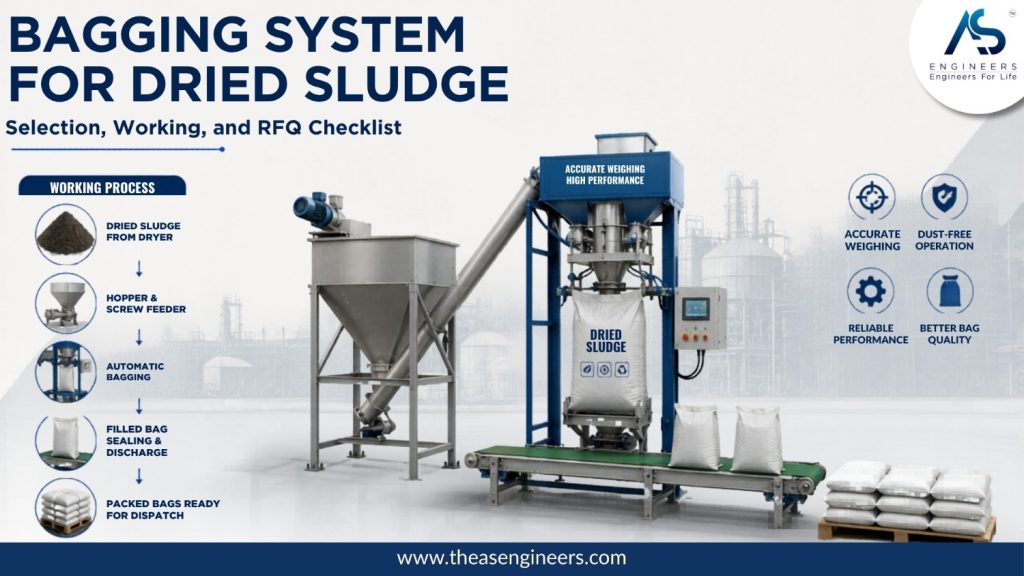
A bagging system for dried sludge is the downstream product-handling setup used after a sludge dryer to collect, weigh, fill, and dispatch dried sludge into bags, jumbo bags, liners, drums, or other approved packaging. It should be selected based on final moisture, outlet temperature, bulk density, dust level, particle size, daily throughput, bag size, and disposal or reuse route.
In many plants, the dryer is selected carefully, but the dried sludge discharge and bagging system is treated as a small accessory. That mistake can create dusting, spillage, inaccurate weighing, bag breakage, operator exposure, and stoppage after the dryer.
What Is a Bagging System for Dried Sludge?
A bagging system for dried sludge is a product-handling arrangement installed after a sludge dryer, screw conveyor, discharge conveyor, silo, or storage hopper. Its purpose is to make dried sludge easier to handle, store, transport, dispose, or send for approved reuse.
Depending on the plant requirement, the system may include:
- Discharge screw conveyor
- Buffer hopper
- Lump breaker or screen, where required
- Weighing hopper or load-cell based filling
- Bag clamping unit
- Dust extraction hood
- Bag sealing, stitching, or liner closing arrangement
- Belt conveyor or roller conveyor for filled bags
- Jumbo bag or FIBC filling station
- Palletizing or truck-loading support
At AS Engineers, we review bagging as part of the complete paddle dryer and sludge drying line, not as an isolated machine. The dryer, discharge screw, bagging system, silo, dust handling, and dispatch method should work together.
Where the Bagging System Fits After the Sludge Dryer
A typical sludge drying and product-handling line may follow this sequence:
| Stage | Equipment | Purpose |
|---|---|---|
| Dewatered sludge feed | Wet sludge silo, screw feeder, sludge pump, or belt conveyor | Feed wet sludge uniformly into the dryer |
| Drying | Paddle dryer or sludge dryer | Reduce moisture through indirect heat transfer |
| Discharge | Screw conveyor or discharge conveyor | Move dried sludge from dryer outlet |
| Intermediate handling | Hopper, silo, or bucket elevator | Buffer or lift dried product if layout needs it |
| Final dispatch | Bagging system, silo loading, truck disposal, or jumbo bag station | Pack, store, or dispatch dried sludge |
For dried sludge that is granular, powdery, or fine after thermal drying, the discharge system must be designed carefully. A wrong transition from dryer to bagging can cause bridging, sudden surges, dust leakage, or material fallback.
Why Plants Use Bagging After Sludge Drying
Bagging is useful when the plant wants controlled handling instead of loose dumping. It is especially practical when dried sludge needs to be stored, weighed, sampled, sold, sent to a disposal agency, sent for co-processing, or moved in smaller batches.
Bagging may help with:
- Cleaner product handling after drying
- Easier dispatch and transport planning
- Better weighing and documentation
- Reduced loose material spillage
- Improved housekeeping near the dryer outlet
- More controlled storage than open dumping
- Easier sample collection and batch tracking
- Better handling where silo or direct truck loading is not practical
Dried sludge may sometimes be considered for alternative fuel, cement production, bricks, or agriculture, but this should not be assumed automatically. The final route depends on sludge composition, calorific value, contaminants, moisture level, buyer acceptance, and applicable regulatory clearance.
Semi-Automatic vs Automatic Bagging System for Dried Sludge
The right choice depends on daily output, bag size, operator availability, dust level, required weighing accuracy, and dispatch method.
| Bagging option | Best fit | How it works | Key caution |
|---|---|---|---|
| Semi-automatic bagging system | Small to medium dried sludge output | Operator places bag, machine clamps and fills by weight or volume | Needs trained operator and dust control at bag mouth |
| Automatic bagging system | Higher repetitive output and regular dispatch | Automated dosing, weighing, filling, conveying, and sometimes sealing | Higher control complexity and higher initial investment |
| Jumbo bag or FIBC filling station | Bulk dried sludge dispatch | Fills large bags using controlled discharge and weighing | Needs proper bag support, lifting arrangement, and dust control |
| Silo or truck loading | Plants avoiding bagging | Dried sludge moves directly to silo or truck disposal route | Not suitable where small-batch dispatch or bagged storage is required |
| Manual bagging | Very low output or temporary setup | Operator fills bags manually from discharge point | Higher exposure, dusting, inconsistency, and housekeeping risk |
For most industrial sludge drying lines, manual bagging should be avoided unless the output is very low and the material is safe, cool, low-dust, and easy to handle. In regular plant operation, semi-automatic or automatic bagging gives better control.
Key Design Inputs Before Selecting a Bagging System
Do not select the bagging system only by bag size or machine capacity. Dried sludge behavior changes with moisture, temperature, feed chemistry, fines percentage, and dryer discharge consistency.
| Input | Why it matters |
|---|---|
| Final moisture percentage | Too much residual moisture can make sludge sticky and difficult to bag |
| Dryer outlet temperature | Hot material can soften liners, release vapour, or affect bag handling |
| Bulk density | Required for hopper sizing, weighing, bag size, and conveyor selection |
| Particle size | Granules, powder, flakes, and fines behave differently during filling |
| Dustiness | Defines the need for dust extraction, enclosure, and operator protection |
| Abrasiveness | Affects MOC, chute wear, screw conveyor design, and valve life |
| Corrosiveness | Helps decide contact-part MOC, coating, lining, and cleaning access |
| Bag type | HDPE bags, liner bags, FIBC, jumbo bags, drums, or site-specific packaging |
| Target bag weight | Commonly selected by dispatch and manual handling limits |
| Daily tonnage | Decides semi-automatic vs automatic bagging and number of filling points |
| Working hours | Affects hourly bagging rate and buffer hopper capacity |
| Disposal or reuse route | TSDF, co-processing, cement, brick, fuel, landfill, or internal storage route |
| Floor space and height | Influences gravity flow, screw conveyor angle, hopper design, and platform need |
| EHS classification | Hazardous, non-hazardous, combustible dust, odour, or toxic exposure controls |
When I review dried sludge bagging requirements, I first ask how the material behaves after drying. If the dried sludge is still warm, sticky, dusty, or variable in density, the bagging station must be designed around that behavior.
Dust, Odour, and Safety Points
Dried sludge is easier to handle than wet sludge, but it can create new handling risks. Fine dried particles can become airborne during discharge, bag filling, bag removal, and transfer to storage. Organic sludge, chemical sludge, textile sludge, paper sludge, and pharma sludge may also need material-specific EHS review.
Important safety points include:
- Provide a dust extraction point near the bag filling mouth where required
- Avoid uncontrolled open discharge from height
- Review whether dried fines can form combustible dust
- Check whether the sludge needs hazardous waste packaging and labelling
- Use suitable PPE and operator access control
- Avoid bagging hot material before cooling or stabilizing, where needed
- Keep weighing and bagging area clean to prevent secondary dust buildup
- Provide proper earthing and electrical protection where dust risk is identified
- Keep inspection and cleaning access practical for maintenance teams
This article is not a substitute for site EHS review. For hazardous sludge, combustible dust, toxic fines, solvent traces, or statutory disposal requirements, the plant team should verify packaging, labelling, handling, and transport requirements with the applicable authority and qualified safety personnel.
Common Problems When Bagging Is Treated as an Afterthought
A dried sludge bagging system can fail even when the dryer is working correctly. The most common reason is poor downstream handling design.
| Problem | Likely cause | Practical correction |
|---|---|---|
| Dust escapes during filling | Open bag mouth, high drop height, no extraction | Use bag clamp, dust hood, controlled feeding, and extraction |
| Bag weight varies too much | No weighing hopper or poor feeder control | Use load-cell based weighing and stable feed control |
| Hopper bridging | Sticky, flaky, or uneven material | Improve hopper angle, agitation, screw feeder, or discharge geometry |
| Bag breaks during handling | Wrong bag material or excessive temperature | Check bag type, liner, cooling, and filled weight |
| Screw conveyor chokes | Material still wet or lumpy | Review final moisture, lump breaker, screw speed, and discharge opening |
| Operator exposure increases | Manual filling and open transfer | Use semi-automatic bag clamp, enclosure, and local extraction |
| Dispatch is slow | Bagging rate lower than dryer output | Add buffer hopper or increase bagging station capacity |
| Corrosion near discharge | Unsuitable MOC or residual chemical content | Review sludge chemistry and contact-part material |
A bagging system should not become the bottleneck after the dryer. Its hourly capacity should match the real dryer discharge rate, not only the average daily tonnage.
Best Fit and No-Fit Guidance
| Situation | Bagging system suitability |
|---|---|
| Dried sludge is granular or powdery and needs controlled dispatch | Good fit |
| Plant wants batch-wise weighing and documentation | Good fit |
| Material is going to approved co-processing or third-party handling | Good fit, subject to acceptance and regulation |
| Plant has limited silo space | Good fit |
| Dried sludge is still too wet or sticky | Not ideal without further drying or conditioning |
| Material is too hot at discharge | Needs cooling or suitable packaging design |
| Sludge contains hazardous constituents | Needs EHS and regulatory packaging review |
| Dust is combustible or toxic | Needs engineered dust-control and safety review before selection |
| Plant wants only direct bulk loading | Silo or truck loading may be better than bagging |
Bagging System Components to Review
A practical dried sludge bagging line may include several small but important components.
Discharge conveyor
The discharge conveyor transfers dried sludge from the dryer outlet to the bagging station. For enclosed movement, a sludge screw conveyor is often reviewed because it can move dried sludge in a controlled route between equipment.
Buffer hopper
A buffer hopper prevents small fluctuations in dryer discharge from disturbing the bagging operation. It should be designed to prevent bridging, dead zones, and sudden material surges.
Weighing and filling unit
The weighing system may be gross weighing or net weighing, depending on required accuracy and speed. For higher throughput, a net weigh system with controlled dosing can reduce variation.
Bag clamp and dust hood
The bag clamp holds the bag mouth during filling. A dust hood or extraction point helps reduce airborne fines during discharge.
Bag sealing or stitching
Depending on bag type and dispatch route, the system may use stitching, heat sealing, liner tying, or manual closure. Hazardous or fine material may require more controlled closure.
Filled bag conveyor
After filling, bags may move through a belt conveyor, roller conveyor, pallet station, or forklift handling area. This section should be planned with plant movement and truck loading in mind.
Semi-Automatic Bagging System Working Sequence
A semi-automatic dried sludge bagging system generally works like this:
- Dried sludge comes from dryer discharge through screw conveyor or hopper.
- Operator places the bag at the filling spout.
- Bag clamp holds the bag mouth.
- Feeder or valve starts filling.
- Weighing system stops feeding at target weight.
- Dust extraction controls fines near the bag mouth, where provided.
- Filled bag is released.
- Bag is sealed, stitched, tied, or moved for dispatch.
- Filled bag goes to pallet, storage, or vehicle loading area.
This setup is often practical when the plant has moderate throughput and needs flexibility in bag size.
Automatic Bagging System Working Sequence
An automatic dried sludge bagging system may include automatic bag placement, dosing, weighing, filling, closing, conveying, and sometimes palletizing. It is more suitable when output is regular and high enough to justify automation.
Automatic bagging is not always the best answer. If the dried sludge is inconsistent, sticky, very dusty, or produced in small batches, the plant may need a simpler semi-automatic system with better access and easier cleaning.
RFQ Checklist for Dried Sludge Bagging System
Before asking for a quotation, share the following details:
- Sludge source: ETP, STP, CETP, paper, textile, pharma, chemical, food, refinery, or municipal
- Sludge type: biological, chemical, hazardous, non-hazardous, oily, paper, mixed, or mineral
- Feed moisture before dryer
- Final moisture target after dryer
- Dryer output in kg/hr or TPD
- Outlet temperature of dried sludge
- Bulk density of dried sludge
- Particle form: powder, granules, flakes, lumps, fines, or mixed
- Dust level during discharge
- Any odour, solvent, oil, chemical, or hazardous characteristic
- Bag type: HDPE, liner bag, jumbo bag, FIBC, drum, or site-specific packaging
- Target bag weight
- Required weighing accuracy
- Operating hours per day
- Required bags per hour
- Available floor space and height
- Existing discharge conveyor details
- Need for screw conveyor, bucket elevator, silo, or truck loading
- Dust collection requirement
- MOC preference for contact parts
- Cleaning and maintenance access requirement
- Electrical area classification, if applicable
- Final disposal or reuse route
The more accurate the input data, the safer and more practical the system selection becomes.
How AS Engineers Reviews Dried Sludge Bagging Requirements
AS Engineers reviews dried sludge bagging as part of the full sludge drying and product-handling system. The review can include paddle dryer selection, discharge screw conveyor, product handling route, bagging system, silo, bucket elevator, truck loading, and dust-control requirements.
For sludge drying lines, AS Engineers can review:
- Feed behavior and final moisture target
- Paddle dryer output rate
- Dried sludge discharge behavior
- Screw conveyor routing
- Bagging system type
- Silo or truck loading requirement
- Pollution control and dust handling
- Service and maintenance access
- Site layout constraints
- RFQ data for practical quotation
AS Engineers’ paddle dryer system is designed around indirect heat transfer, hollow shafts, jacket heating, and controlled product discharge. The product-handling system should be selected with the same care as the dryer because poor discharge handling can reduce the benefit of good drying.
Conclusion
A bagging system for dried sludge is not just an end-of-line accessory. It decides how safely, cleanly, and efficiently dried sludge leaves the dryer area. The right system depends on final moisture, temperature, bulk density, dustiness, bag type, dispatch route, and EHS requirements.
For a practical recommendation, share your sludge source, final moisture target, dryer capacity, dried sludge temperature, particle form, bag size, daily output, and disposal or reuse route. AS Engineers can review the sludge dryer, discharge conveyor, bagging system, and downstream product-handling arrangement together.
FAQs
What is a bagging system for dried sludge?
A bagging system for dried sludge is the downstream handling equipment used after a sludge dryer to fill dried sludge into bags, jumbo bags, liners, drums, or other approved packaging. It usually includes feeding, weighing, bag clamping, filling, dust control, sealing, and dispatch support.
Can dried sludge go directly from the dryer to the bagging system?
Yes, dried sludge can go directly from the dryer discharge to a bagging system if the temperature, moisture, particle form, and flow behavior are suitable. In many plants, a discharge screw conveyor, hopper, or buffer arrangement is used between the dryer and bagging station.
Should I choose semi-automatic or automatic bagging for dried sludge?
Choose semi-automatic bagging for moderate output, flexible bag sizes, and lower automation needs. Choose automatic bagging when the dried sludge output is regular, higher in volume, and requires faster repetitive filling with lower manual intervention.
What information is needed to size a dried sludge bagging system?
You need dried sludge output rate, final moisture, outlet temperature, bulk density, particle size, dustiness, bag type, target bag weight, working hours, disposal route, floor layout, MOC requirement, and EHS classification before selecting the bagging system.
Can all dried sludge be reused after bagging?
No. Dried sludge reuse depends on chemical composition, calorific value, contaminants, heavy metals, application route, buyer acceptance, and regulatory clearance. Bagging improves handling, but it does not automatically make sludge suitable for fuel, cement, bricks, agriculture, or other reuse.
