
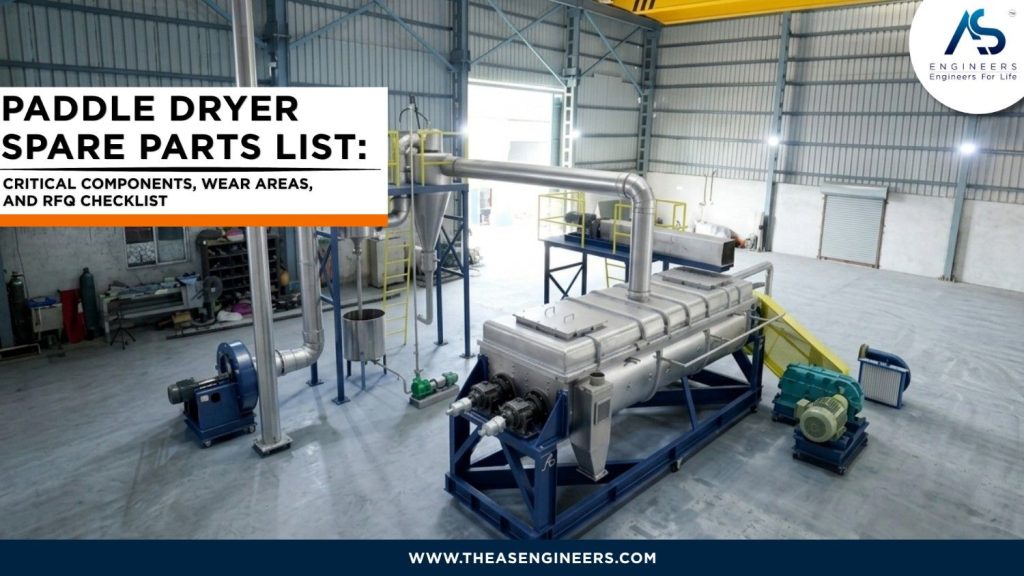
Paddle Dryer Spare Parts List: Critical Components, Wear Areas, and RFQ Checklist

A practical paddle dryer spare parts list should cover the rotating assembly, drive system, bearings, seals, heating connections, feed system, discharge system, instrumentation, and safety parts. The list should not be copied blindly from another dryer because spare requirements change with sludge type, feed moisture, final moisture target, temperature, material of construction, abrasiveness, corrosion risk, and operating hours.
For plants using a paddle dryer for sludge drying, spare parts planning is directly connected to uptime. A small seal leak, bearing heat, gearbox noise, or feed screw issue can affect drying consistency, outlet moisture, and shutdown planning.
Quick Paddle Dryer Spare Parts List
Use this list as a practical starting point for maintenance planning, shutdown preparation, and RFQ discussion.
| Dryer Area | Common Spare Parts | Why It Matters |
|---|---|---|
| Shaft and paddle assembly | Hollow shaft, paddle blades, paddle arms, shaft sleeves, end plates, keys, fasteners | Affects mixing, heat transfer, torque load, and drying uniformity |
| Bearing system | Bearings, bearing housings, plummer blocks, sleeves, lock nuts, seals, lubrication fittings | Supports shaft rotation and prevents vibration, heat, and misalignment |
| Gearbox and drive | Gearbox, gear set, oil seals, motor, coupling, chain, sprocket, belt, pulley, guards | Transfers power to the paddle shaft and controls stable rotation |
| Shaft sealing system | Mechanical seals, gland packing, stuffing box parts, O-rings, gaskets, seal sleeves | Prevents material leakage, vapor escape, air ingress, and oil leakage |
| Heating connection | Rotary joints, steam/thermic fluid hoses, flanges, gaskets, valves, pressure gauges | Maintains heat transfer through hollow shaft and jacketed surfaces |
| Dryer body and covers | Cover gaskets, inspection door gaskets, liners, fasteners, insulation sheets | Helps control heat loss, vapor leakage, access safety, and body sealing |
| Feed system | Screw feeder shaft, screw flights, bearings, seals, coupling, sludge pump wear parts | Controls stable feed rate and prevents surging or choking |
| Discharge system | Discharge screw, rotary airlock valve, chute liners, conveyor parts, bagging accessories | Prevents outlet choking and supports smooth dry material handling |
| Vapour and fines handling | Duct gaskets, cyclone spares, scrubber nozzles, bag filter bags, ID fan accessories | Supports vapour removal, fines collection, and connected pollution-control performance |
| Instrumentation and electrical | RTD, temperature sensor, pressure gauge, limit switch, level switch, VFD, control panel spares | Helps track operating condition and detect abnormal load or temperature |
| Safety and access parts | Coupling guards, belt guards, handrail parts, inspection covers, warning plates, fasteners | Keeps maintenance access safer and supports plant safety discipline |
The final spare parts list should always be checked against the actual GA drawing, machine model, heating medium, shaft arrangement, and process duty.
Critical Spare Parts to Track First
Not every spare part has the same urgency. In a paddle dryer, priority should start from parts that can stop rotation, cause leakage, damage the shaft, or disturb drying quality.
Hollow shaft and paddle parts
The hollow shaft and paddles are central to paddle dryer operation. They support heat transfer, mixing, shearing, and material movement. In a hollow paddle dryer, the spare part strategy should give special attention to shaft condition, paddle wear, paddle welding condition, and any visible scoring, bending, or abnormal load pattern.
Track these parts carefully:
- Hollow shaft
- Paddle blades or paddle arms
- Shaft sleeves
- Shaft end components
- Keys and keyways
- Fasteners and locking elements
- Wear plates or liners where applicable
If shaft or paddle wear repeats, the maintenance team should not treat it as only a spare part purchase. Check feed consistency, material abrasiveness, moisture variation, torque load, buildup, bearing condition, and alignment.
Bearings and bearing housing
Bearings are small compared to the full dryer, but bearing failure can create major downtime. Bearing heat, noise, vibration, oil contamination, foundation looseness, and repeated seal leakage can all point toward a bigger mechanical issue.
Track these parts:
- Drive-end and non-drive-end bearings
- Bearing housings or plummer blocks
- Bearing sleeves
- Lock nuts and washers
- Grease fittings or lubrication accessories
- Bearing seals
- Foundation bolts and mounting hardware
Repeated bearing failure needs root-cause checking. Do not replace only the bearing if shaft alignment, foundation movement, lubrication practice, process heat, or overload is the real issue.
Gearbox, motor, and coupling parts
The gearbox and drive system handle continuous torque. Sticky sludge, heavy wet cake, high feed variation, or product buildup can increase load on the drive. If the gearbox starts heating, leaking oil, producing abnormal noise, or showing jerky motion, inspect before damage spreads to the shaft and bearings.
Track these parts:
- Gearbox
- Gearbox oil seals
- Gear set or internal gearbox parts where serviceable
- Drive motor
- Flexible coupling
- Coupling bolts and inserts
- Chain, sprocket, belt, or pulley where used
- Drive guards
- Base frame fasteners
For major gearbox or coupling replacement, use the paddle dryer services route so alignment, load condition, and commissioning checks are handled together.
Shaft seals and leakage-control parts
Shaft seal leakage is one of the most common maintenance complaints in drying equipment. The visible leak may look simple, but the cause can be seal wear, shaft scoring, wrong seal material, poor installation, pressure fluctuation, high temperature, product buildup, or misalignment.
Track these parts:
- Mechanical seals
- Gland packing
- Stuffing box parts
- Seal sleeves
- Lip seals
- O-rings
- Gaskets
- Seal housing fasteners
- Cooling or flushing accessories where applicable
Do not select seals only by size. Seal material and design must match temperature, product chemistry, abrasive load, vacuum or pressure condition, solvent presence, and shaft condition.
Spare Parts by Maintenance Priority
| Priority Level | Parts | Stocking Logic |
|---|---|---|
| Critical shutdown spares | Bearings, seals, coupling inserts, essential gaskets, fasteners, rotary joint spares | Keep ready if the plant cannot afford long stoppage |
| Planned shutdown spares | Paddle repair parts, shaft sleeves, gearbox oil seals, inspection cover gaskets, discharge screw parts | Order after inspection and shutdown planning |
| Engineering-review spares | Hollow shaft, paddle assembly, gearbox, drive motor, rotary joint, major liners | Confirm drawing, MOC, alignment, and duty before procurement |
| Consumables | Gland packing, O-rings, lubrication items, standard gaskets, hardware | Keep controlled inventory with batch and size records |
| Connected system spares | Feed screw parts, rotary airlock valve parts, bag filter bags, scrubber nozzles, ID/FD blower accessories | Plan based on complete drying system layout |
OEM vs Local Spare Parts
OEM paddle dryer spare parts are usually safer for critical areas such as shaft assemblies, paddles, bearings, gearbox, seals, coupling, rotary joints, and customized dryer parts. Local parts may reduce purchase cost, but wrong fitment, wrong metallurgy, weak balancing, poor tolerances, or incorrect seal material can create higher downtime risk.
Use OEM or engineering-approved parts when the spare affects:
- Shaft alignment
- Heat transfer
- Dryer torque
- Bearing life
- Gearbox load
- Seal leakage
- Vacuum, pressure, or solvent handling
- Product-contact MOC
- Dryer safety guarding
Local fabrication may be considered only for non-critical supports, guards, simple brackets, or site-specific accessories after engineering review.
For plants that want direct support, AS Engineers provides paddle dryer spare parts and service assistance for replacement planning, repair, retrofitment, and maintenance support.
Symptoms That Indicate Spare Part Replacement
| Symptom | Possible Spare Part Area | What to Check Before Ordering |
|---|---|---|
| Bearing heating | Bearing, housing, lubrication system, alignment | Temperature trend, grease/oil condition, shaft movement, foundation bolts |
| Gearbox noise | Gearbox, coupling, motor, overload condition | Oil level, oil contamination, coupling alignment, load variation |
| Seal leakage | Seal, sleeve, shaft surface, stuffing box, gasket | Leakage type, shaft scoring, pressure fluctuation, product buildup |
| Poor drying | Paddles, hollow shaft, heating connection, feed system | Feed moisture, shaft rotation, steam/thermic fluid condition, buildup |
| High motor current | Drive system, feed system, buildup, shaft load | Feed rate, discharge choking, paddle buildup, gearbox condition |
| Uneven discharge | Paddles, discharge screw, outlet chute, rotary valve | Outlet moisture, product flow, blockage, screw wear |
| Vibration | Bearings, coupling, shaft, foundation, gearbox | Alignment, balance, loose bolts, bearing condition, load variation |
| Vapor leakage | Cover gaskets, shaft seals, duct gaskets, vapour outlet | Seal condition, gasket compression, vent blockage, pressure behavior |
Vibration and rotating equipment checks should be handled by competent maintenance personnel. Where applicable, plants may refer to recognized vibration evaluation frameworks such as ISO 20816-3 for industrial machinery, while applying the correct machine-specific criteria.
Maintenance Spares for Sludge Dryer Applications
For ETP, STP, CETP, chemical, pigment, pharma, paper, and food-processing sludge, the spare parts list should be adjusted to actual feed behavior. Sticky sludge, abrasive sludge, solvent-bearing material, corrosive material, and high-moisture wet cake do not create the same wear pattern.
For sludge drying applications, focus on:
- Shaft seal compatibility with moisture, vapor, and temperature
- Paddle wear due to sticky or abrasive feed
- Feed screw choking and flight wear
- Discharge screw or rotary valve blockage
- Bearing heat caused by overload or buildup
- Gearbox load due to feed surging
- Vapour outlet choking due to fines or condensation
- Gasket condition around covers and ducting
If the dryer is part of a wastewater or sludge handling line, also review connected process pages such as paddle dryer for wastewater treatment and sludge drying in water treatment before finalizing spare inventory.
RFQ Checklist for Paddle Dryer Spare Parts
Send these details when requesting paddle dryer spare parts. This helps avoid wrong sizing, wrong MOC, wrong seal selection, and delayed quotation.
| RFQ Input | Why It Is Needed |
|---|---|
| Dryer make, model, and serial number | Identifies original design reference |
| GA drawing or spare part drawing | Confirms dimensions, mounting, and assembly fit |
| Photos and videos of the part | Helps identify wear, damage, and installation condition |
| Part name and location | Avoids confusion between drive-end, non-drive-end, feed-end, and discharge-end parts |
| Material being dried | Indicates abrasion, corrosion, stickiness, and contamination risk |
| Feed moisture and final moisture target | Helps understand process load |
| Heating medium | Steam, thermic fluid, hot water, or other heating condition affects seals and thermal parts |
| Operating temperature and pressure condition | Important for seal, gasket, rotary joint, and MOC selection |
| Operating hours per day | Helps judge wear and criticality |
| Failure symptom | Noise, heat, leakage, vibration, choking, poor drying, or high current |
| Past replacement history | Repeated failure needs root-cause review |
| Required urgency | Planned shutdown, emergency breakdown, or inventory stocking |
| Site location and service need | Determines whether on-site inspection, alignment, or commissioning support is needed |
Common Mistakes in Spare Parts Buying
Buying by dimension only
A part may match dimensionally but fail under actual torque, temperature, corrosion, or abrasion. Dryer spare parts should be selected by duty condition, not only by size.
Replacing the failed part without root-cause checking
If the same bearing, seal, or coupling fails again, the issue may be alignment, overload, product buildup, wrong lubrication, wrong seal material, or feed variation.
Ignoring connected equipment
A paddle dryer does not work alone. Feed screw, sludge pump, discharge conveyor, cyclone, scrubber, bag filter, ID fan, FD blower, condenser, and bagging system can also affect dryer reliability.
Keeping no shutdown spares
Plants that operate continuously should keep critical spares ready. Waiting until the dryer stops can increase downtime, especially for customized shafts, seals, rotary joints, or gearbox parts.
Opening guards without safety control
Before inspection, cleaning, or replacement work, follow the plant’s lockout/tagout procedure and keep guards in place after service. OSHA’s control of hazardous energy and machine guarding references are useful general safety references for maintenance teams.
When Repair Is Better Than Replacement
Repair may be suitable when the part can be restored without compromising geometry, strength, alignment, sealing, or heat transfer. Examples may include controlled refurbishment, resurfacing, reconditioning, or replacement of subcomponents.
However, replacement is usually safer when:
- Shaft scoring is deep
- Paddle geometry is damaged
- Bearing seat is worn
- Gearbox damage is severe
- Seal face cannot be restored
- Rotary joint leakage repeats
- Corrosion has reduced strength
- Alignment cannot be maintained
- The part has already failed repeatedly
For old dryers, retrofitment may be better than repeatedly replacing individual parts. A combined review of shaft, gearbox, bearings, seals, feed behavior, and heating performance gives a clearer decision.
AS Engineers Support for Paddle Dryer Spare Parts
AS Engineers supports paddle dryer users with spare parts, service, shaft replacement, gearbox and bearing replacement, repair, retrofitment, system upgrades, AMC, and operator training. The right support route depends on whether the requirement is a simple spare, planned shutdown, breakdown recovery, or process improvement.
For major parts such as shafts, paddles, gearbox, bearings, seals, and rotary joints, share the dryer details before ordering. A correct part should restore stable operation, not only restart the same failure cycle.
For group-level engineering context, AS Engineers is backed by Acmefil Engineering Systems. Relevant support references include Acmefil’s genuine spare parts and system retrofits and upgrades pages.
FAQs
What are the most important paddle dryer spare parts?
The most important paddle dryer spare parts are hollow shaft components, paddles, bearings, gearbox parts, couplings, seals, rotary joints, gaskets, feed screw parts, discharge parts, and instrumentation spares. Priority depends on operating hours, material behavior, temperature, and failure history.
Should I buy OEM paddle dryer spare parts or local parts?
Use OEM or engineering-approved parts for critical items such as shafts, paddles, bearings, gearbox, seals, coupling, and rotary joints. Local parts may be acceptable for non-critical accessories only after checking fitment, MOC, and duty suitability.
How often should paddle dryer spare parts be inspected?
Inspection frequency depends on duty cycle, material abrasiveness, temperature, moisture load, and operating hours. Daily checks should cover noise, leakage, temperature, vibration, current, feed stability, and discharge condition. Detailed mechanical inspection is better planned during shutdown.
Why do paddle dryer bearings fail repeatedly?
Repeated bearing failure can come from poor lubrication, contamination, misalignment, overload, vibration, high process temperature, wrong installation, foundation looseness, or seal failure. Replacing only the bearing may not solve the root cause.
What details are needed for a paddle dryer spare parts quotation?
Share the dryer model, serial number, drawings, part photos, part location, material being dried, feed and final moisture, heating medium, temperature, pressure condition, operating hours, failure symptoms, and urgency. This helps the supplier recommend the correct spare part and service path.
Conclusion
A reliable paddle dryer spare parts list should be built around the complete dryer system, not only one failed component. Start with critical rotating parts, bearings, gearbox, shaft seals, rotary joints, feed and discharge systems, gaskets, instrumentation, and safety guards. Then adjust the list based on sludge type, process temperature, moisture load, MOC, operating hours, and failure history.
If your paddle dryer is showing bearing heat, seal leakage, gearbox noise, vibration, poor drying, or repeated shutdowns, do not order parts blindly. Share the duty details, photos, symptoms, and maintenance history with AS Engineers so the right spare part, repair, or retrofitment route can be selected.
