
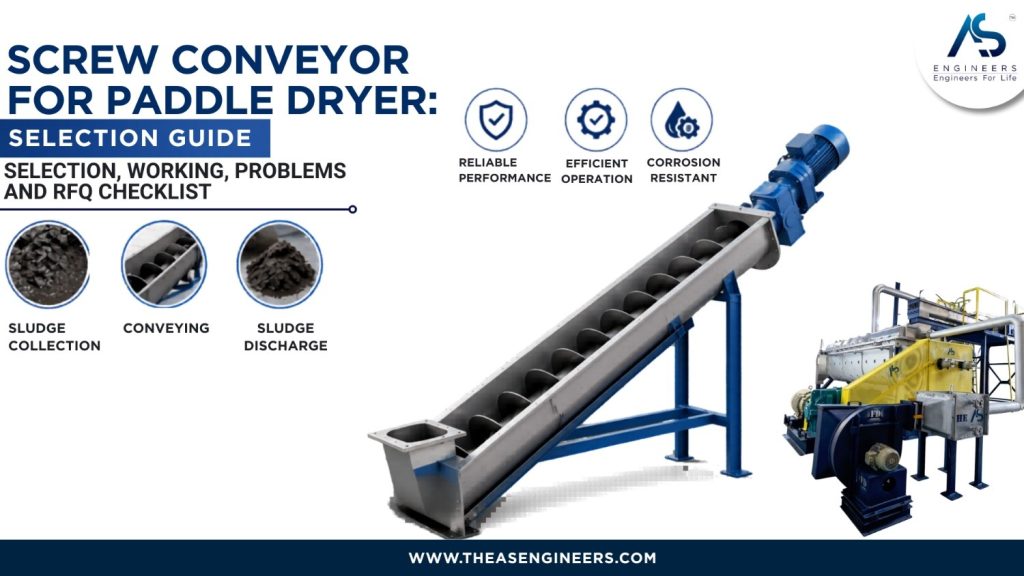
Screw Feeder for Paddle Dryer: Selection, Working, Problems and RFQ Checklist

A screw feeder for paddle dryer is used to control how wet cake, sludge, paste, powder, or granular material enters the dryer. In a paddle dryer system, the feeder is not just a conveyor. It directly affects dryer loading, residence time, vapour generation, heat transfer stability, final moisture control, and maintenance.
For sludge and wet cake applications, the screw feeder must be selected along with the paddle dryer, not as a last-minute accessory.
What is a screw feeder in a paddle dryer system?
A screw feeder is a controlled feeding device that uses a rotating screw flight inside a trough or tube to move material from a hopper, silo, filter press discharge, centrifuge discharge, or wet material storage point into the paddle dryer inlet.
In a paddle dryer line, the screw feeder usually sits before the dryer:
Wet material hopper or silo → screw feeder → paddle dryer inlet → vapour handling → product discharge conveyor or bagging system
AS Engineers’ paddle dryer process flow includes moist feed storage and uniform feeding into the paddle dryer through a screw feeder, belt conveyor system, or sludge pump. The same process flow also includes hollow shafts, jacket heating, pollution control equipment, solvent management, and product handling as part of the complete drying system.
Why feeding control matters in paddle drying
A paddle dryer works best when the feed rate is controlled. If the screw feeder gives irregular feed, the dryer may face unstable loading.
That can create:
- Uneven residence time
- Poor final moisture consistency
- Sudden vapour load changes
- Material buildup near the inlet
- Overloading of shafts and drive system
- Poor discharge behaviour
- Higher cleaning and maintenance interruptions
The paddle dryer itself uses indirect heat transfer through hollow shafts and jacket surfaces, while paddles break down feed and remove bound moisture. This means the feed must enter in a controlled way so the dryer can maintain proper contact, agitation, and thermal loading. AS Engineers’ catalogue confirms the use of hollow shafts, jacket heat transfer, hammer/wedge paddles, and screw feeder feeding as part of the paddle dryer process flow.
Screw feeder vs screw conveyor for paddle dryer feeding
Many plants use the terms screw feeder and screw conveyor loosely. For paddle dryer duty, the difference matters.
| Factor | Screw Feeder | Screw Conveyor |
|---|---|---|
| Main purpose | Controls feed rate into the dryer | Transfers material from one point to another |
| Typical location | Below hopper, silo, dewatering discharge, or dryer inlet | Between process stages |
| Feed condition | Often flood-loaded at inlet | Usually receives controlled feed |
| Control requirement | Higher, especially with VFD/load-based control | Lower, unless used as metering conveyor |
| Dryer impact | Directly affects dryer loading and residence time | Affects transfer and housekeeping |
| Best use in paddle dryer line | Metered inlet feeding | Material transfer before or after dryer |
A screw conveyor can act as a feeder only when it is designed for metering duty, not just transfer duty. The recent AS Engineers sludge screw conveyor guide explains that conveyor selection should be reviewed with the complete sludge dryer line because irregular feed can cause dryer loading and residence time issues.
Where the screw feeder fits in the paddle dryer process
In a practical drying line, the screw feeder is part of the feeding system, but it must be matched with the complete process.
| Process area | Typical equipment | Why it affects screw feeder selection |
|---|---|---|
| Upstream dewatering | Filter press, centrifuge, screw press, belt press | Determines whether feed is batchy, crumbly, sticky, lumpy, or semi-continuous |
| Wet material storage | Hopper, silo, pit, intermediate bin | Affects bridging, ratholing, inlet pressure, and feed consistency |
| Feeding system | Screw feeder, belt conveyor, sludge pump | Controls how material enters the dryer |
| Paddle dryer | Standard, dual-zone, or vacuum dryer | Determines required feed stability, sealing, and residence time |
| Vapour handling | ID fan, cyclone, scrubber, bag filter, condenser | Affected by feed rate and evaporation load |
| Product handling | Screw conveyor, bagging, silo, bucket elevator, truck loading | Depends on dried product form |
For sludge applications, do not size the feeder only from “tons per day.” The real question is how the material behaves at the feeder inlet and inside the dryer.
Materials that can need screw feeding before a paddle dryer
A screw feeder may be suitable for many semi-solid and bulk material duties, including:
- Dewatered ETP sludge cake
- STP sludge cake
- Filter press cake
- Centrifuge cake
- Chemical wet cake
- Pharmaceutical intermediate cake
- Food processing residue
- Paper sludge
- Pigment cake
- Gypsum
- Metal powder or catalyst cake, where material behaviour allows
- Granules and powders that need controlled feed
AS Engineers’ paddle dryer material range includes slurries, pastes, cakes, granules, and powders, with material examples such as paper sludge, sewage treatment plant sludge, biosludge, pigment, gypsum, starch, calcium and sodium carbonate, lithium hydroxide, coal/lignite, DDGS, rice bran, fish meal, polymer, and polyester chips.
When a screw feeder is a good fit
A screw feeder is usually a strong fit when the plant needs:
- Controlled feed into a paddle dryer
- Enclosed handling of wet cake or sludge
- Reduced manual feeding
- Better housekeeping near the dryer inlet
- Variable feed adjustment during operation
- Compact layout between dewatering and drying
- Consistent loading for continuous drying
- Integration with hopper, silo, or filter press discharge
For ETP/STP sludge and wet cake, the feeder should be selected with the same seriousness as the dryer because the dryer cannot correct a badly designed inlet system.
When a screw feeder may not be the right choice
A screw feeder may not be suitable when:
- The material is still highly liquid and pumpable
- The feed contains oversized tramp solids
- The sludge is too watery for screw engagement
- The material hardens quickly during stoppage
- The transfer distance is very long
- The application needs frequent open manual access but cannot provide safe guarding
- The material has explosive, toxic, solvent-rich, or highly hazardous vapours without proper containment review
For pumpable slurry, a sludge pump may be more suitable. For large lumps or open discharge after drying, a belt conveyor or other product handling arrangement may be better.
Key screw feeder selection factors for paddle dryer duty
A screw feeder should be selected from process data, not guesswork.
| Selection factor | Why it matters |
|---|---|
| Feed material | Sludge, wet cake, paste, powder, granule, or slurry-like feed behave differently |
| Inlet moisture | High moisture changes stickiness, torque, leakage risk, and dryer heat load |
| Outlet moisture target | Determines the dryer residence time and feed rate stability needed |
| Bulk density | Needed for feeder sizing, motor load, and hopper load review |
| Feed rate | Must match dryer capacity and thermal loading |
| Feed source | Filter press, centrifuge, screw press, silo, or hopper affects discharge pattern |
| Stickiness | Causes bridging, buildup, screw choking, and inlet blockages |
| Lump size | Oversized cake lumps may need breaking or hopper design review |
| Abrasion | Grit, sand, ash, catalyst, or inorganic solids affect screw and trough wear |
| Corrosion | Chemical sludge may require SS304, SS316, duplex, coating, or lining review |
| Temperature | Hot or reactive material affects seals, bearings, and safety |
| MOC | Material of construction should match corrosion, abrasion, hygiene, and process risk |
| Screw speed | Too fast can cause poor filling, wear, heat, or material fallback |
| Torque margin | Important for loaded starts and sticky sludge |
| Sealing | Needed for vapour, odour, solvent, dust, and splash control |
| Cleaning access | Critical for sticky or fouling materials |
| Control system | VFD, interlock, level sensor, and torque monitoring improve stable operation |
Screw feeder design points that affect dryer performance
Hopper and inlet geometry
Most feed problems start before the screw. If the hopper outlet is too small or the wall angle is poor, sludge or wet cake may bridge before reaching the screw.
Important checks include:
- Hopper outlet size
- Wall angle
- Live-bottom requirement
- Agitator or lump breaker need
- Inlet opening length
- Whether the inlet is flood-fed or controlled-fed
- Whether filter press discharge is batchy
- Whether the feeder can restart under load
Screw diameter, pitch, and speed
The screw diameter, pitch, and RPM decide how much material moves per rotation. A slow, controlled feeder is usually better than a high-speed feeder that throws sticky material against the trough wall.
Variable speed drive control is useful when the dryer must handle changing moisture, bulk density, or feed availability. General screw feeder guidance also confirms that screw feeders are used for metering bulk materials and that variable speed drives can improve feed rate control.
Shafted or shaftless screw
For dry powders and free-flowing materials, a shafted screw can work well. For sticky sludge, fibrous sludge, or wet cake, shaftless designs may reduce wrapping around the center shaft.
Final selection depends on:
- Stickiness
- Fiber content
- Required feed accuracy
- Screw length
- Incline
- Cleaning access
- Torque requirement
- MOC
- Maintenance preference
Trough or tubular body
A U-trough screw feeder gives better access for cleaning and inspection. A tubular feeder gives better enclosure but can be harder to clean.
For paddle dryer feed, a covered trough can be a practical balance when the material is sticky and odorous but the plant still needs inspection access.
Drive, gearbox, and torque
Wet sludge and cake can sit inside the feeder during shutdown. If the feeder restarts loaded, torque demand rises.
Review:
- Starting torque
- Gearbox service factor
- Motor power
- VFD range
- Overload protection
- Coupling and bearing arrangement
- Access for maintenance
- Emergency stop and guarding
Sealing and vapour containment
A paddle dryer may handle water vapour, solvent vapour, odour, fines, or process fumes depending on the material. The feeder-to-dryer connection must be reviewed so vapour does not escape from the inlet area.
For solvent, combustible dust, toxic vapour, or hazardous sludge, the plant should involve process safety and EHS review. OSHA notes that combustible dust can become explosible when suspended in air under the right conditions, so dust-generating or fine-powder applications need proper hazard review, housekeeping, containment, and safety controls. OSHA combustible dust guidance is a useful external reference for EHS teams.
Common screw feeder problems before a paddle dryer
| Problem | Likely cause | Practical correction |
|---|---|---|
| Bridging in hopper | Sticky sludge, poor hopper angle, small outlet | Review hopper geometry, add agitator/live bottom, increase outlet size |
| Irregular dryer feed | Batchy upstream discharge, poor screw filling, no VFD | Add surge hopper, VFD, level control, better inlet design |
| Screw blockage | Oversized lumps, high stickiness, wrong RPM | Add lump breaker, reduce speed, review screw pitch and torque |
| Motor overload | Loaded restart, material compaction, undersized drive | Add torque margin, no-load logic, VFD, overload protection |
| Vapour or odour leakage | Poor inlet sealing, open covers, wrong connection | Use covered/enclosed design and proper sealing |
| Material buildup | Sticky feed, dead zones, poor cleaning access | Add inspection ports, drain/cleaning access, better trough design |
| Shaft wrapping | Fibrous sludge or stringy material | Review shaftless screw or anti-wrap design |
| Excess wear | Abrasive solids, grit, ash, catalyst particles | Review MOC, liner, hard facing, screw thickness |
| Dryer final moisture variation | Feed rate fluctuation or moisture variation | Stabilize feed rate and upstream dewatering quality |
| Poor housekeeping | Open feeding, splash, spillage | Use covered feeder, proper chute, drip tray, cleaning plan |
How screw feeder control affects final moisture
Final moisture from a paddle dryer depends on multiple factors:
- Feed moisture
- Feed rate
- Heating medium temperature or pressure
- Heat transfer area
- Shaft speed
- Residence time
- Vapour removal
- Material behaviour
- Discharge condition
The screw feeder affects the first two directly: how much material enters and how consistently it enters.
If the feeder suddenly overloads the dryer, the material may not get enough residence time. If the feed drops too low, the dryer may run underloaded, and the process may become unstable or inefficient.
For this reason, the feeder should normally be connected with dryer control logic where the project needs stable continuous operation.
Screw feeder for filter press cake to paddle dryer
Filter press cake is often batch-based. It may fall in slabs, lumps, or uneven chunks. This makes feeding more difficult than a continuous slurry stream.
For filter press cake, review:
- Cake lump size
- Whether cake needs breaking before feeding
- Hopper volume between filter press and feeder
- Batch discharge frequency
- Screw torque for loaded starts
- Inlet opening length
- Cleaning access below filter press
- Whether bridging will occur inside the hopper
If your plant uses a filter press before drying, also review AS Engineers’ guide on filter press and sludge dewatering to connect the dewatering stage with the dryer feed requirement.
Screw feeder for screw press or centrifuge cake
A screw press or centrifuge usually gives a more continuous discharge than a filter press, but the sludge may still vary in moisture and structure.
For this duty, review:
- Discharge consistency
- Polymer dosage impact
- Moisture fluctuation
- Fiber or hair content in sludge
- Flow interruptions
- Odour containment
- Whether the feeder needs a small buffer hopper
If the upstream system is a screw press, connect the feeder discussion with the screw press dewatering guide so the dewatering and drying stages are not treated separately.
Screw feeder for chemical and pharmaceutical wet cake
Chemical and pharmaceutical wet cake can be corrosive, solvent-bearing, heat-sensitive, or hazardous. In these duties, the screw feeder must be reviewed as part of a contained process system.
Important inputs include:
- Solvent or VOC presence
- pH and chloride level
- Corrosion risk
- Flammability or dust hazard
- Material temperature
- Required MOC
- Shaft seal requirement
- Vapour-tight connection
- Cleaning and contamination control
- Whether vacuum drying is required
For these applications, do not select a standard feeder only from capacity. The material safety data, process chemistry, and cleaning method should be reviewed before final design.
Screw feeder for ETP and STP sludge dryer systems
ETP and STP sludge feeding is difficult because sludge behaviour changes with upstream process conditions.
Moisture, polymer dosage, ash content, biological content, oil and grease, and grit can change from shift to shift. This affects feeder torque, flowability, odour, and dryer loading.
For ETP/STP plants, discuss the screw feeder together with the sludge thermal drying line, dewatering method, wet sludge storage, vapour handling, and discharge route.
Paddle dryer inlet feeding mistakes to avoid
Treating the screw feeder as a simple accessory
The feeder controls the dryer’s inlet load. A poor feeder can make a good dryer look unstable.
Ignoring feed moisture variation
A feeder sized for one moisture level may struggle when sludge becomes wetter, stickier, or heavier.
Buying a standard powder screw for wet sludge
Wet sludge needs different attention to torque, cleaning, covers, sealing, and corrosion.
Ignoring loaded restart
If sludge remains inside the screw feeder after shutdown, the feeder may need to restart under load. This must be considered in motor and gearbox selection.
Not planning inspection access
Sticky sludge and wet cake need cleaning access. A fully enclosed feeder without practical access may create maintenance problems.
Separating dryer and feeder suppliers without interface review
The connection between feeder and dryer matters. If the feeder outlet does not match the dryer inlet, site teams may face spillage, vapour leakage, bridging, or uneven loading.
Selecting MOC only by price
Chemical sludge, pharma cake, and acidic/alkaline materials need MOC review based on corrosion and cleaning requirements.
Screw feeder selection table for paddle dryer applications
| Feed material | Recommended feeding approach | Watch-outs |
|---|---|---|
| ETP sludge cake | Covered screw feeder with torque margin and VFD | Sticky feed, odour, variable moisture |
| STP sludge cake | Covered screw feeder or sludge pump depending on consistency | Fibers, biological odour, moisture variation |
| Filter press cake | Hopper + screw feeder, possible lump breaker | Batch discharge, slabs, bridging |
| Centrifuge cake | Screw feeder with buffer hopper | Moisture fluctuation, continuous discharge variation |
| Chemical wet cake | Sealed screw feeder with MOC review | Corrosion, solvent, fumes, cleaning |
| Pharma intermediate cake | Contained feeder, suitable MOC, possible vacuum-compatible design | Solvent, contamination, heat sensitivity |
| Food residue | Hygienic design review, easy cleaning | Odour, cleaning, contamination risk |
| Dry powder/granules | Screw feeder or rotary valve depending on flow and sealing | Dust control, feed accuracy, bridging |
RFQ checklist for screw feeder for paddle dryer
Before asking for a quotation, prepare these inputs:
| RFQ input | Details to provide |
|---|---|
| Material name | Sludge, wet cake, chemical cake, food residue, powder, granule |
| Industry | ETP, STP, chemical, pharma, food, paper, pigment, minerals |
| Feed source | Filter press, centrifuge, screw press, silo, hopper, wet pit |
| Feed moisture | Current range and expected variation |
| Target outlet moisture | Required after paddle dryer |
| Required feed rate | kg/hr, ton/day, batch frequency |
| Bulk density | Approximate wet bulk density if available |
| Material behaviour | Sticky, fibrous, abrasive, corrosive, lumpy, free-flowing |
| Lump size | Maximum expected lump size |
| pH / chloride / chemical nature | Needed for MOC review |
| Temperature | Feed temperature and plant ambient condition |
| Available space | Layout, elevation, inlet height, dryer position |
| Transfer angle | Horizontal or inclined feeding |
| Operating hours | Batch, shift operation, continuous duty |
| Cleaning requirement | Manual cleaning, CIP-style cleaning, washdown, inspection doors |
| Safety requirement | Covers, guards, emergency stop, interlocks, dust/vapour containment |
| Control need | Fixed speed, VFD, level sensor, torque monitoring, PLC integration |
| Dryer details | Paddle dryer size, inlet height, heating medium, vapour system |
| Site utilities | Power supply, control panel location, compressed air if needed |
| Documentation | MOC certificate, GA drawing, motor/gearbox details, inspection plan |
Practical selection advice from AS Engineers
When I review a screw feeder for paddle dryer duty, I do not start with only length, diameter, or motor HP. I first check what material is entering the feeder, how it leaves the upstream equipment, whether it bridges, whether it restarts under load, and how tightly the dryer feed rate must be controlled.
For sludge and wet cake, the correct question is not “What is the cheapest screw feeder?” The correct question is:
Will this feeder give the paddle dryer a stable, controlled, clean, and maintainable inlet feed under real plant conditions?
AS Engineers can review the feeder, paddle dryer, vapour handling, pollution control system, and discharge arrangement together so the plant does not face feed-rate mismatch after installation.
Maintenance and safety checks
A screw feeder has rotating parts, drive components, and possible pinch points. It should not be operated with open unsafe covers or exposed rotating parts.
Plant teams should review:
- Guarding around rotating parts
- Emergency stop access
- Lockout and tagout practice
- Cleaning access and safe cover opening
- Bearing and seal inspection
- Gearbox oil level
- Screw flight wear
- Trough wear or liner wear
- Motor current trend
- Abnormal vibration or noise
- Material buildup near inlet and discharge
- Odour or vapour leakage
- Electrical suitability for dusty or hazardous areas where applicable
For combustible dust, solvent vapour, or hazardous material duties, final design should go through plant EHS and process safety review before purchase.
Conclusion
A screw feeder for paddle dryer duty should be selected as a process-control item, not only as a material-handling item. The feeder controls how material enters the dryer, so it affects residence time, heat load, vapour load, final moisture stability, housekeeping, and maintenance.
For sludge, wet cake, chemical cake, pharma cake, and sticky industrial materials, the most important RFQ inputs are feed moisture, throughput, material behaviour, feed source, bulk density, stickiness, corrosiveness, abrasiveness, layout, MOC, sealing, cleaning access, torque margin, and control requirement.
Share your material details, upstream dewatering method, feed moisture, target outlet moisture, layout, and throughput with AS Engineers. The team can review the screw feeder and paddle dryer as one integrated drying system.
FAQs
What is a screw feeder for paddle dryer?
A screw feeder for paddle dryer is a controlled feeding device that transfers wet cake, sludge, paste, powder, or granules into the paddle dryer inlet at a controlled rate. It helps maintain stable dryer loading, residence time, vapour load, and final moisture consistency.
Is a screw feeder better than a sludge pump for paddle dryer feeding?
A screw feeder is usually better for dewatered sludge cake, filter press cake, centrifuge cake, and sticky semi-solid material. A sludge pump may be better when the material is still liquid, pumpable, or slurry-like. Final selection depends on moisture, solids content, stickiness, distance, and dryer inlet design.
Can a screw conveyor be used as a paddle dryer feeder?
Yes, but only if it is designed for feeding duty. A normal screw conveyor mainly transfers material, while a screw feeder meters material into the dryer. For paddle dryer inlet feeding, variable-speed control, proper hopper design, sealing, torque margin, and cleaning access are important.
What causes screw feeder blockage before a paddle dryer?
Common causes include sticky sludge, oversized wet cake lumps, poor hopper geometry, high screw speed, low torque margin, loaded restart, fibrous material wrapping, and poor cleaning access. The solution depends on the material, feed source, screw design, hopper outlet, and control system.
What information is needed to size a screw feeder for a paddle dryer?
Key inputs include material type, feed moisture, target outlet moisture, wet feed rate, bulk density, feed source, lump size, stickiness, abrasiveness, corrosiveness, temperature, layout, inclination, operating hours, MOC requirement, sealing need, and dryer inlet details.
