
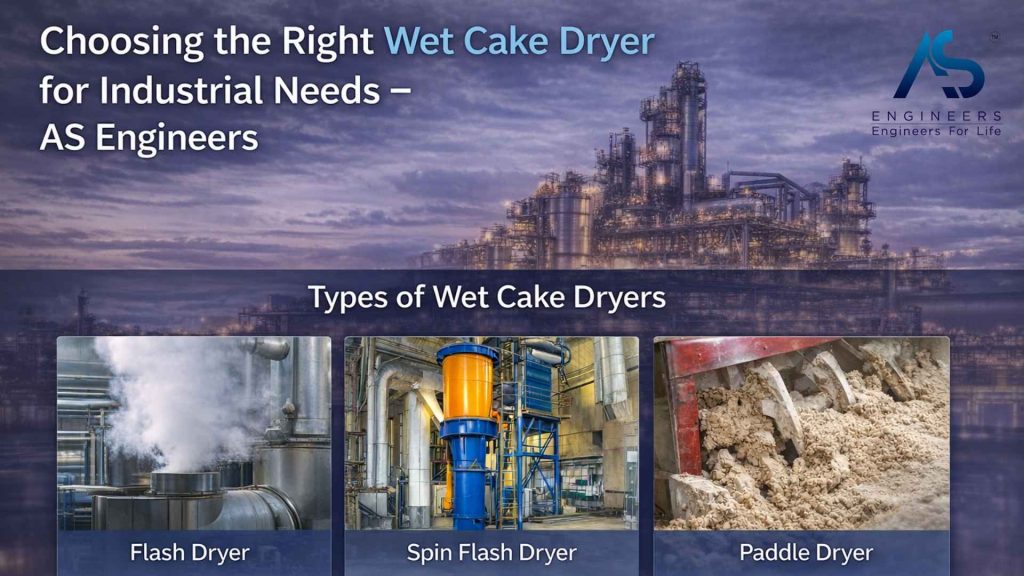
Choosing the Right Wet Cake Dryer for Industrial Needs – AS Engineers
-
 AS Engineers
- in Blog

Choosing the right industrial drying system is a critical decision that directly impacts your product quality, operational efficiency, and bottom line. When dealing with difficult-to-handle wet filter cakes, such as chemical pastes, centrifuged sludges, or ETP waste, a generic drying solution won’t suffice. You need a specialized wet cake dryer designed for your specific material rheology. This guide will walk you through the essential factors to consider, compare different dryer types, and show you how to select the most effective system for your plant.
What Is a Wet Cake Dryer? Definition and Process Overview
A wet cake dryer is a conduction or convection-based drying system used for processing semi-solid materials like pastes, sludges, and filter cakes into a dry, solid form. Unlike dryers for free-flowing liquids or powders, these systems are built to handle materials with a high viscosity or “sticky” consistency that requires mechanical agitation to break up lumps and ensure uniform heat transfer.
The process begins at the feed system, where the wet cake is conveyed – often via a screw feeder or pump – into the main drying chamber. Inside, the material is exposed to a controlled heat source. Mechanical components, such as the paddle shafts in an AS Engineers dryer, continuously agitate the material to renew the surface area for efficient moisture evaporation. The dried product is then discharged as a powder or granule, while the vapor is exhausted through a dust collector or scrubber system.
Key Industrial Applications
Wet cake dryers are indispensable in sectors where filtration or centrifugation processes leave behind a semi-solid material.
-
Chemical and Petrochemical: Catalyst recovery, polymer drying.
-
Pharmaceuticals: Active Pharmaceutical Ingredients (APIs), intermediates.
-
Food Processing: Starches, proteins, fiber waste.
-
Wastewater Treatment: ETP/STP sludge reduction (Zero Liquid Discharge).
Critical Factors When Selecting a Wet Cake Dryer
Selecting the correct dryer is not a one-size-fits-all task. Overlooking a single factor can lead to inconsistent product quality or frequent mechanical failures.
1. Process Requirements: Moisture & Sensitivity
Before selecting a dryer, document your parameters:
-
Initial vs. Final Moisture: Are you going from 60% to 5%? This dictates the required residence time.
-
Material Characteristics: Is the cake thixotropic (thins when mixed) or sticky? Sticky materials require high torque agitation.
-
Heat Sensitivity: Thermolabile materials (like enzymes or APIs) degrade at high temperatures. These cannot be processed in standard high-heat flash dryers.
2. Evaluating Efficiency & Maintenance
A dryer is a mechanical system under high thermal stress.
-
Energy Efficiency: Look for indirect heating methods (like Paddle Dryers) which recycle heat more effectively than single-pass air systems.
-
Maintenance: Regular checks are not optional. You must have a clear schedule for inspecting mechanical seals and bearings. Checking the mechanical seal every 300 hours is non-negotiable for preventing leaks in vacuum systems.
The AS Engineers Advantage: Why Paddle Dryers Win
Achieving efficient drying of difficult sludge requires precise control. Standard dryers often fail when faced with sticky materials, leading to “clumping” inside the drum.
At AS Engineers, we utilize advanced Paddle Dryer technology that focuses on conductive heat transfer. According to performance data from AS Engineers, upgrading to a dual-shaft design can increase thermal transfer efficiency by up to 25% compared to single-shaft alternatives.
Performance Comparison: Flash vs. Spin Flash vs. Paddle Dryer
| Feature | Flash Dryer | Spin Flash Dryer | AS Engineers Paddle Dryer |
| Heat Transfer | Convection (Air) | Convection (Air) | Conduction (Contact) |
| Material Handling | Non-sticky powders | Pastes & light sludges | Heavy pastes, sticky sludge, filter cakes |
| Heat Sensitivity | Poor (High Temp) | Moderate | Excellent (Low Temp / Vacuum) |
| Residence Time | Seconds | Minutes | Controllable (Minutes to Hours) |
| Energy Efficiency | Moderate | Moderate | High (Thermal Oil/Steam) |
Conclusion
Choosing the right wet cake dryer is crucial for optimizing operational efficiency. While Flash Dryers suit simple powders, the AS Engineers Paddle Dryer stands out for handling heat-sensitive and sticky materials with precision. Its robust dual-shaft design ensures superior thermal transfer and long-term reliability.
Frequently Asked Questions
Q: What routine maintenance ensures optimal performance of a wet cake dryer?
A: Optimal performance requires a strict maintenance schedule. We advise operators to regularly inspect and lubricate bearings and drive systems using high-temperature grease. It is also critical to check the integrity of the mechanical seals to prevent vacuum leaks and periodically clean the drying chamber to prevent hardened product buildup.
Q: How does a paddle dryer handle heat-sensitive materials safely?
A: A paddle dryer excels with heat-sensitive materials because it uses conduction (heated walls/shafts) rather than a blast of superheated air. This allows drying at much lower temperatures (often under vacuum), avoiding thermal shock and product degradation.
Q: Which industries benefit most from advanced wet cake dryers?
A: Industries dealing with “difficult” waste or high-value solids benefit most. This includes ETP Sludge Treatment (to reduce disposal weight), Pharmaceuticals (to protect API quality), and Specialty Chemicals.