
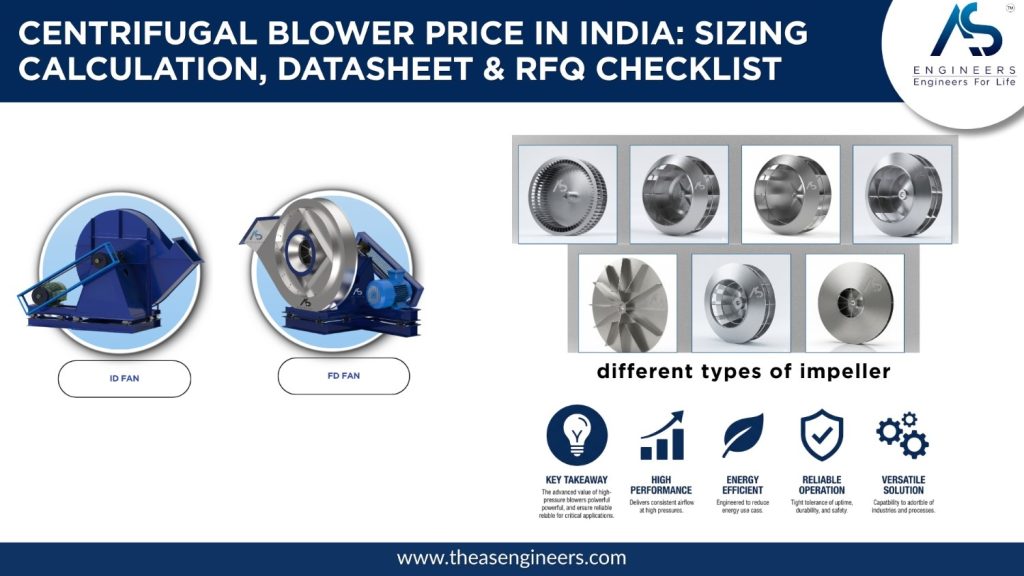
Centrifugal Blower Price in India: Sizing Calculation, Datasheet & RFQ Checklist

Centrifugal blower price in India cannot be judged only by motor HP or CFM. A reliable price depends on airflow, static pressure, gas temperature, dust load, material of construction, impeller type, drive arrangement, testing, accessories, and site conditions.
For an industrial blower quotation, share the duty point first: required flow, pressure, temperature, application, gas condition, layout, and operating hours. Without these inputs, a low quoted price can later become a high operating cost.
At AS Engineers, we treat blower selection as an engineering decision, not a catalogue shortcut. For centrifugal blowers, the same 5 HP or 10 HP rating can behave very differently depending on static pressure, fan speed, impeller geometry, MOC, and system resistance. You can also review our main centrifugal blower manufacturer page for blower types and application fit.
What decides centrifugal blower price in India?
The price of a centrifugal blower is mainly decided by the duty condition. Two blowers with the same motor HP can have different prices because one may handle clean air at low pressure, while another may handle dusty, hot, corrosive gas at higher pressure.
| Price factor | Why it changes cost | What buyer should specify |
|---|---|---|
| Airflow capacity | Higher flow needs larger impeller, casing, inlet, outlet, and structure | CFM, CMH, or m³/hr |
| Static pressure | Higher pressure may need stronger design, different impeller, higher RPM, and higher motor load | mmWC, Pa, mbar, or in. WG |
| Motor HP | Motor cost increases with power, but HP alone is not enough for selection | Required duty point and running hours |
| Impeller type | Backward curved, backward inclined, radial blade, and exhauster designs suit different duties | Clean air, dust, abrasion, high pressure, or exhaust |
| Material of construction | MS, CS, SS304, SS316, FRP lining, hard facing, and special alloys change fabrication cost | Gas composition, corrosion, temperature, dust |
| Temperature | Hot gas needs design changes, bearing protection, cooling, expansion allowance, and suitable MOC | Operating and peak temperature |
| Dust load | Abrasive dust may need radial blades, wear protection, inspection access, and stronger construction | Dust type, loading, particle nature |
| Drive arrangement | Direct drive, belt drive, or coupling drive affects layout, maintenance, and cost | Space, speed, access, service preference |
| Accessories | Dampers, expansion bellows, guards, silencers, cooling disc, seals, base frame, VFD, instruments | Required scope of supply |
| Testing and documentation | Balancing, performance testing, MTC, PMI, NDT, QAP, and inspection documents add value and cost | Project or consultant requirement |
A useful quotation should clearly mention what is included and what is excluded. Many price disputes happen because accessories, inspection, foundation scope, ducting, electrical panel, site installation, or testing documents were not defined before order finalization.
Why fixed blower price tables can mislead buyers
A fixed price table may help for small standard blowers, but it is risky for industrial centrifugal blowers. In real plant applications, a blower is part of a system. The ducting, bends, filters, bag filters, scrubbers, cyclones, dampers, inlet condition, outlet condition, temperature, gas density, and site altitude all influence the final selection.
When I review a blower requirement, I do not start from “5 HP blower price” or “10 HP blower price.” I first ask what the blower has to overcome in the system. A 5 HP blower for ventilation and a 5 HP blower for high static pressure dust collection are not the same buying decision.
AS Engineers’ industrial blower range covers multiple centrifugal blower types such as backward curved blowers, backward inclined blowers, high pressure radial blade blowers, exhauster radial blowers, high temperature plug blowers, and exhauster air handling blowers. The catalog range covers airflow from 300 CFM to 2,00,000+ CFM, pressure up to 1700 mmWG for centrifugal blowers, speed from 300 RPM to 4500 RPM, and motor power from 0.5 HP to 500 HP. Final selection depends on application data and engineering review.
For a broader equipment overview, see our guide on industrial blowers manufacturer in India.
Centrifugal blower price vs operating cost
The lowest blower price is not always the lowest plant cost. A wrongly selected blower can create higher electricity consumption, high noise, vibration, damper throttling, bearing load, low airflow, process upset, and repeated maintenance.
A good industrial blower quotation should help answer these questions:
| Buyer question | Why it matters |
|---|---|
| Is the blower selected at the required duty point? | Prevents undersized or oversized selection |
| Is the fan operating near a stable efficiency zone? | Reduces power waste and unstable operation |
| Is static pressure calculated properly? | Avoids low airflow after installation |
| Is gas density corrected for temperature or altitude? | Prevents wrong motor HP and curve reading |
| Is the impeller suitable for dust or corrosion? | Reduces wear, imbalance, and failure |
| Is the motor margin practical? | Avoids overloading during real operation |
| Is the fan curve provided? | Helps verify performance before purchase |
| Are accessories included? | Prevents scope gaps after PO release |
Fan system guidance also warns that oversized fans may not operate at their best efficiency point and can create unnecessary noise, stress, and system performance problems.
Centrifugal blower sizing calculation: what must be known first
Before doing a centrifugal blower sizing calculation, collect the process data. Do not calculate motor HP from CFM alone.
Minimum data required
| Input | Unit examples | Why it is needed |
|---|---|---|
| Airflow | CFM, CMH, m³/hr, m³/s | Defines volume handled |
| Static pressure | mmWC, Pa, mbar, in. WG | Defines system resistance |
| Gas temperature | °C | Affects density and material selection |
| Gas composition | Air, flue gas, fumes, vapour, corrosive gas | Affects MOC and safety |
| Dust load | mg/Nm³, g/m³, light/moderate/heavy | Affects impeller and wear protection |
| Application | Bag filter, scrubber, boiler, furnace, dryer, exhaust | Determines blower type |
| Location and altitude | Site elevation and ambient temperature | Affects density and motor loading |
| Operating hours | Batch/continuous, daily hours | Affects design and motor economics |
| Layout | Inlet/outlet ducting, bends, dampers, filters | Affects static pressure and system effect |
| Required accessories | Damper, VFD, silencer, bellows, guard, seal, inspection door | Affects quotation scope |
AS Engineers considers application, density, temperature, dust load, humidity, site location, altitude, MOC, impeller blade design, motor mounting arrangement, flow, static pressure, RPM, power, noise, speed limitation, accessories, and quality documentation during blower selection.
Centrifugal blower capacity calculation
Blower capacity is the air volume handled by the blower. It is usually expressed in CFM, CMH, m³/hr, or m³/s.
CFM to CMH blower calculation
Use this conversion:
1 CFM = 1.699 CMH
CMH = CFM × 1.699
CFM = CMH ÷ 1.699
| Requirement | Calculation | Result |
|---|---|---|
| 1,000 CFM to CMH | 1,000 × 1.699 | 1,699 CMH |
| 5,000 CFM to CMH | 5,000 × 1.699 | 8,495 CMH |
| 10,000 CMH to CFM | 10,000 ÷ 1.699 | 5,886 CFM |
| 25,000 CMH to CFM | 25,000 ÷ 1.699 | 14,714 CFM |
Capacity from duct area and velocity
For metric calculation:
Airflow in CMH = Duct area in m² × Air velocity in m/s × 3600
Example:
- Duct area = 1.2 m²
- Air velocity = 12 m/s
Airflow = 1.2 × 12 × 3600 = 51,840 CMH
For imperial calculation:
Airflow in CFM = Duct area in ft² × Air velocity in FPM
This is useful when a plant has measured velocity but does not know exact blower flow. However, final sizing should still be confirmed through system pressure and fan curve.
Fan static pressure calculation
Static pressure is the resistance the blower must overcome. It is not only duct length. It includes resistance from duct friction, bends, transitions, dampers, filters, bag filters, scrubbers, cyclones, heat exchangers, inlet losses, outlet losses, and stack losses.
Basic static pressure method
Total static pressure = duct friction loss + fitting loss + equipment pressure drop + inlet loss + outlet/system effect allowance
| Component | Example pressure contributor |
|---|---|
| Straight duct | Friction loss due to length, duct size, velocity, and roughness |
| Bends and elbows | Loss due to direction change |
| Reducers and expanders | Loss due to velocity change and turbulence |
| Dampers | Loss due to throttling or control position |
| Bag filter | Pressure drop across bags and dust cake |
| Scrubber | Packing, spray zone, mist eliminator, and liquid/gas resistance |
| Cyclone | Tangential entry and separation pressure drop |
| Heat exchanger | Coil or tube bank resistance |
| Stack/chimney | Outlet and discharge effects |
| Poor inlet/outlet ducting | System effect losses |
AMCA describes system effect as performance loss caused by adverse flow conditions such as turbulence or swirl near the fan inlet or outlet. This matters because a blower that performs correctly in a test setup may underperform in a poor duct layout.
Static pressure unit conversion
Useful conversions:
| Unit conversion | Formula |
|---|---|
| mmWC to Pa | Pa = mmWC × 9.80665 |
| Pa to mmWC | mmWC = Pa ÷ 9.80665 |
| in. WG to Pa | Pa = in. WG × 249.09 |
| mbar to Pa | Pa = mbar × 100 |
Example:
150 mmWC = 150 × 9.80665 = 1,471 Pa
This pressure value is needed for motor HP calculation and fan curve verification.
Blower motor HP calculation
Motor HP should be calculated from airflow and pressure, then checked against fan efficiency, drive efficiency, density correction, service margin, and fan curve BHP.
Metric formula
Air power kW = Airflow in m³/s × pressure in Pa ÷ 1000
Required shaft/motor kW = air power kW ÷ fan efficiency ÷ drive efficiency
Motor HP = motor kW ÷ 0.746
Then add a practical safety/service margin based on application, temperature, dust condition, starting method, motor standard size, and expected operating range.
Example motor HP calculation
Assume:
- Airflow = 10,000 CMH
- Static pressure = 150 mmWC
- Fan efficiency = 65%
- Drive efficiency = 95%
- Service margin = 10%
Step 1: Convert flow to m³/s
10,000 CMH ÷ 3600 = 2.78 m³/s
Step 2: Convert pressure to Pa
150 mmWC × 9.80665 = 1,471 Pa
Step 3: Calculate air power
2.78 × 1,471 ÷ 1000 = 4.09 kW
Step 4: Correct for fan and drive efficiency
4.09 ÷ 0.65 ÷ 0.95 = 6.63 kW
Step 5: Add 10% margin
6.63 × 1.10 = 7.29 kW
Step 6: Convert to HP
7.29 ÷ 0.746 = 9.77 HP
In this example, the practical motor selection may move toward the next suitable standard motor rating after checking the fan curve, starting condition, temperature, density, and operating range. This example is for understanding only. Final motor HP should be confirmed through engineering selection and the manufacturer’s fan curve.
Imperial formula
A commonly used fan power formula is:
BHP = CFM × static pressure in inches WG ÷ 6356 ÷ fan efficiency
For belt or coupling drives, also consider drive efficiency. For real industrial duty, motor HP should not be finalized from this formula alone. It must be checked against the selected fan curve.
How to read a centrifugal blower fan curve
A centrifugal blower fan curve shows how the blower performs across different airflow and pressure conditions. It helps verify whether the selected blower can deliver the required duty without unstable operation or motor overload.
A fan curve usually includes:
| Curve item | What it means |
|---|---|
| Airflow axis | Usually CFM, CMH, or m³/hr |
| Static pressure axis | Usually mmWC, Pa, or in. WG |
| BHP or power curve | Power required at different airflow points |
| Efficiency curve | Where the blower operates most efficiently |
| RPM | Fan speed for that curve |
| Operating point | Intersection of system requirement and fan curve |
| System curve | How system pressure changes as airflow changes |
| Recommended operating zone | Stable and efficient range |
To read a fan curve:
- Find the required airflow on the horizontal axis.
- Move vertically until it intersects the selected static pressure curve.
- Check whether this point is in the stable operating range.
- Read the required BHP or kW at that operating point.
- Check fan efficiency at the same point.
- Confirm RPM, noise, motor margin, and impeller type.
- Check whether the blower can handle expected variation in filter pressure, dust buildup, damper position, or process load.
Aerovent’s fan curve guidance explains that BHP can be read by extending vertically from the CFM point to the BHP curve and then reading across to the BHP scale. It also defines the operating point as the pressure and airflow condition where the fan and system are in stable equilibrium.
Common fan curve mistakes
| Mistake | Result in plant |
|---|---|
| Selecting at maximum flow point | Poor efficiency, possible instability |
| Ignoring BHP curve | Motor overload risk |
| Ignoring system curve | Actual airflow may differ from quotation |
| Using clean filter pressure only | Low airflow after dust loading |
| Ignoring density correction | Wrong power and pressure prediction |
| Selecting too close to stall region | Vibration, pulsation, noise |
| Not checking impeller type | Poor performance in dust or abrasive duty |
| Not asking for curve | Hard to verify supplier selection |
For detailed selection fundamentals, you can also read our centrifugal blower selection guide.
Centrifugal blower datasheet: fields every buyer should ask for
A centrifugal blower datasheet should make the quotation technically clear. It should not only mention “5 HP blower” or “10 HP blower.”
| Datasheet field | Required detail |
|---|---|
| Application | Bag filter, scrubber, boiler, dryer, furnace, dust collector, ventilation, process exhaust |
| Airflow | Required flow in CFM, CMH, or m³/hr |
| Static pressure | Required pressure in mmWC, Pa, mbar, or in. WG |
| Temperature | Operating and peak temperature |
| Gas handled | Air, flue gas, fumes, corrosive gas, vapour, dusty gas |
| Dust load | Type and concentration of dust |
| Gas density | Actual density or basis for correction |
| Blower type | Backward curved, backward inclined, radial blade, exhauster, plug fan |
| Impeller details | Diameter, blade type, construction, balancing grade |
| MOC | Casing, impeller, shaft, inlet cone, guards, base frame |
| Drive type | Direct, belt, or coupling |
| Motor | HP/kW, RPM, voltage, frequency, enclosure, efficiency class |
| Fan speed | RPM at duty point |
| Efficiency | Fan efficiency at duty point |
| BHP/kW | Power absorbed at duty point |
| Noise level | dB(A), if required |
| Accessories | Damper, bellows, silencer, VFD, cooling disc, seals, guards |
| Testing | Performance test, balancing, inspection, QAP, NDT, PMI, MTC |
| Painting/coating | Standard paint, epoxy, heat-resistant paint, special coating |
| Scope | Supply only, supply with accessories, installation, commissioning |
| Documents | GA drawing, foundation drawing, fan curve, motor datasheet, test certificates |
Centrifugal blower specification sheet format
Use this simple specification sheet before asking for a quotation.
| Field | Buyer input |
|---|---|
| Company name | |
| Contact person | |
| Plant location | |
| Application | |
| New project or replacement | |
| Existing blower details, if replacement | |
| Required airflow | |
| Static pressure | |
| Gas temperature | |
| Gas composition | |
| Dust load and dust type | |
| Moisture or corrosive fumes | |
| Operating hours per day | |
| Motor voltage and frequency | |
| Preferred drive type | |
| Required MOC | |
| Inlet and outlet orientation | |
| Space constraints | |
| Duct layout available? | |
| Required accessories | |
| Inspection requirement | |
| Required documents | |
| Delivery requirement | |
| Site installation required? | |
| Commissioning support required? |
For replacement projects, attach photos of the existing blower nameplate, impeller, casing, motor, duct layout, foundation, inlet/outlet connection, damper position, and any vibration or failure history.
Centrifugal blower quotation checklist
Before comparing centrifugal blower price in India, check whether every quotation includes the same scope.
| Checklist item | Why it matters |
|---|---|
| Duty point mentioned clearly | Prevents vague selection |
| Airflow and pressure units clear | Avoids CFM/CMH confusion |
| Fan curve attached | Verifies operating point |
| Motor HP and absorbed power shown | Prevents underpowered selection |
| Fan RPM mentioned | Helps assess noise and mechanical loading |
| Impeller type mentioned | Confirms application fit |
| MOC clearly stated | Prevents corrosion or wear mismatch |
| Accessories listed | Avoids hidden cost |
| Testing scope stated | Helps quality comparison |
| Documents included | Important for EPC and consultant projects |
| Exclusions listed | Prevents scope disputes |
| Warranty and service terms clear | Helps maintenance planning |
| Delivery timeline stated | Helps project planning |
| Payment and tax terms clear | Prevents commercial confusion |
A quotation without a fan curve, duty point, MOC, motor details, and accessory scope is not a complete industrial blower quotation. It may look cheaper, but it is harder to verify.
Industrial blower RFQ checklist
Use this RFQ checklist when sending an enquiry to AS Engineers or any blower manufacturer.
Process data
- Application name
- Required airflow
- Required static pressure
- Gas temperature
- Gas composition
- Dust load
- Humidity or moisture
- Corrosive or abrasive content
- Continuous or batch operation
- Plant altitude and ambient condition
Mechanical data
- Blower arrangement
- Inlet and outlet orientation
- Rotation direction
- Foundation limitation
- Space limitation
- Existing duct connection size
- Preferred drive type
- Required MOC
- Maintenance access requirement
Electrical data
- Motor HP or expected motor range, if known
- Voltage
- Frequency
- Phase
- Starter or VFD requirement
- Flameproof or special motor requirement, if applicable
- Motor efficiency class requirement
Accessory data
- Inlet damper
- Outlet damper
- Flexible bellows
- Expansion joint
- Silencer
- Cooling disc
- Bearing temperature sensor
- Vibration sensor
- Mechanical seal or stuffing box
- Safety guards
- Base frame
- Anti-vibration mounts
Quality and documentation
- Fan curve
- GA drawing
- Foundation drawing
- Motor datasheet
- Impeller balancing certificate
- Material test certificate
- QAP
- Inspection requirement
- Performance test requirement
- Painting or coating specification
Which centrifugal blower type affects price?
The blower type changes fabrication, impeller, pressure capability, dust handling, efficiency, and maintenance requirement.
| Blower type | Suitable duty | Price impact |
|---|---|---|
| Backward curved blower | Clean air, FD/ID duties, efficient operation | Often selected for efficiency-sensitive duties |
| Backward inclined blower | High volume, moderate pressure, industrial exhaust | Balanced option for many process applications |
| High pressure radial blade blower | High pressure, dust, pneumatic conveying-style resistance | Stronger design and power need may increase cost |
| Exhauster radial blower | Dusty exhaust, construction, mineral, abrasive duty | Wear-resistant construction can change cost |
| High temperature plug blower | Furnace, oven, heat-processing equipment | Temperature design and special parts affect cost |
| Exhauster air handling blower | Fresh air, light dust, large air handling | Cost depends on size and airflow |
For specific blower type selection, review AS Engineers pages on backward curved centrifugal blowers, backward inclined blowers, and high pressure radial blade blowers.
Application-wise price and selection logic
Bag filter and dust collector blower
For bag filters and dust collectors, the blower must handle system resistance from ducting, filter bags, dust cake, hopper leakage, dampers, and stack. Static pressure usually changes as bags load with dust, so motor margin and fan curve checking are important.
Wrong selection can create low suction, poor dust capture, bag blinding, high differential pressure, or high power consumption.
Scrubber ID fan
A scrubber ID fan must handle pressure drop from the scrubber body, packing or spray zone, mist eliminator, ducting, bends, and stack. Gas may be wet, corrosive, and temperature-sensitive. MOC, drainage, corrosion allowance, and impeller selection matter.
For related equipment context, see AS Engineers’ pollution control equipment page.
Boiler ID fan and FD fan
Boiler fans need careful handling of draft, flue gas temperature, ash/dust, duct resistance, damper control, and operating variation. ID fan and FD fan selection should consider actual boiler duty, fuel, combustion air requirement, and chimney/system resistance.
You can also read our guide on ID and FD fans for related draft system understanding.
Dryer and hot air circulation fan
Dryer fans need correct airflow, temperature handling, material carryover consideration, and sealing arrangement. For dryers, incorrect airflow can affect heat transfer, moisture removal, vapour handling, and product consistency.
Cement and mineral process fan
Cement and mineral applications often involve dust, abrasion, high load variation, and heavy-duty operation. Impeller wear protection, balancing, inspection access, and service support should be included in the RFQ.
Common mistakes while buying centrifugal blowers in India
| Mistake | Practical impact |
|---|---|
| Asking price by HP only | Wrong selection and misleading comparison |
| Not sharing static pressure | Low airflow after installation |
| Confusing CFM and CMH | Major capacity mismatch |
| Ignoring temperature | Wrong density and motor calculation |
| Not sharing dust load | Impeller wear, vibration, imbalance |
| Selecting only by lowest price | Higher power and maintenance cost |
| Not asking for fan curve | No technical verification |
| Ignoring inlet/outlet duct layout | System effect and poor performance |
| Not defining accessories | Scope gap after order |
| Not defining testing documents | Project approval delay |
| Not considering service access | Difficult maintenance later |
When a plant calls after installation and says “airflow is low,” the reason is often not the blower alone. It can be wrong pressure estimation, changed duct routing, clogged filter, improper damper position, poor inlet condition, dust buildup, wrong rotation, leakage, or system effect.
When a low-price blower may be acceptable
A lower-cost blower may be acceptable when:
- The application is clean air or simple ventilation
- Static pressure is low and known
- Temperature is ambient
- Dust load is low
- No corrosive gas is present
- Standard MOC is suitable
- Testing and documentation requirements are simple
- Duty is not critical to production or pollution control
When a custom-engineered blower is safer
A custom-engineered blower is safer when:
- Static pressure is high
- Dust is abrasive
- Gas is corrosive
- Temperature is high
- Application is scrubber, bag filter, furnace, boiler, dryer, or process exhaust
- Existing blower has repeated failure
- Duct layout is complex
- Motor overload or vibration has occurred
- EPC or consultant documentation is required
- Plant cannot afford airflow failure or downtime
For service, repair, alignment, balancing, and retrofit support, see AS Engineers’ centrifugal blower services.
What to send AS Engineers for a better quotation
Send the following details:
- Application name and industry
- Airflow requirement in CFM or CMH
- Static pressure in mmWC, Pa, mbar, or in. WG
- Gas temperature and gas composition
- Dust load, moisture, corrosion, or abrasion details
- Required MOC, if already specified
- Duct layout or process sketch
- Existing blower datasheet, if replacement
- Required accessories and scope
- Required testing and documentation
- Site location and operating hours
- Photos or videos of existing blower, if troubleshooting or retrofit
The more complete the RFQ, the more accurate the blower selection and price discussion becomes.
Conclusion
Centrifugal blower price in India should be evaluated through duty data, not only HP, CFM, or a generic catalogue price. A technically correct industrial blower quotation should include airflow, static pressure, fan curve, motor HP, absorbed power, impeller type, MOC, drive arrangement, accessories, testing, documents, and clear scope.
If you are planning a new blower, replacing an old blower, or comparing quotations, share your actual operating data with AS Engineers. Our team can review the requirement and suggest a suitable centrifugal blower configuration for your process conditions.
FAQs
What is the price of a centrifugal blower in India?
The price depends on airflow, static pressure, motor HP, impeller type, MOC, temperature, dust load, corrosion risk, accessories, testing, and documentation. A reliable industrial blower price needs a technical RFQ, not only HP or CFM.
What details are required for a centrifugal blower quotation?
The main details are airflow, static pressure, gas temperature, application, dust load, gas composition, MOC, drive type, operating hours, site condition, accessories, testing requirements, and documentation scope.
How do I calculate blower motor HP?
Motor HP can be estimated from airflow and pressure. In metric terms, air power kW equals airflow in m³/s multiplied by pressure in Pa divided by 1000. Then correct for fan efficiency, drive efficiency, and service margin before selecting the motor.
What is the difference between CFM and CMH?
CFM means cubic feet per minute. CMH means cubic metres per hour. For conversion, 1 CFM equals approximately 1.699 CMH. To convert CMH to CFM, divide CMH by 1.699.
Why is a fan curve important in centrifugal blower selection?
A fan curve shows airflow, static pressure, absorbed power, efficiency, and operating point. It helps confirm whether the blower will run in a stable and efficient range without motor overload or low airflow.
