
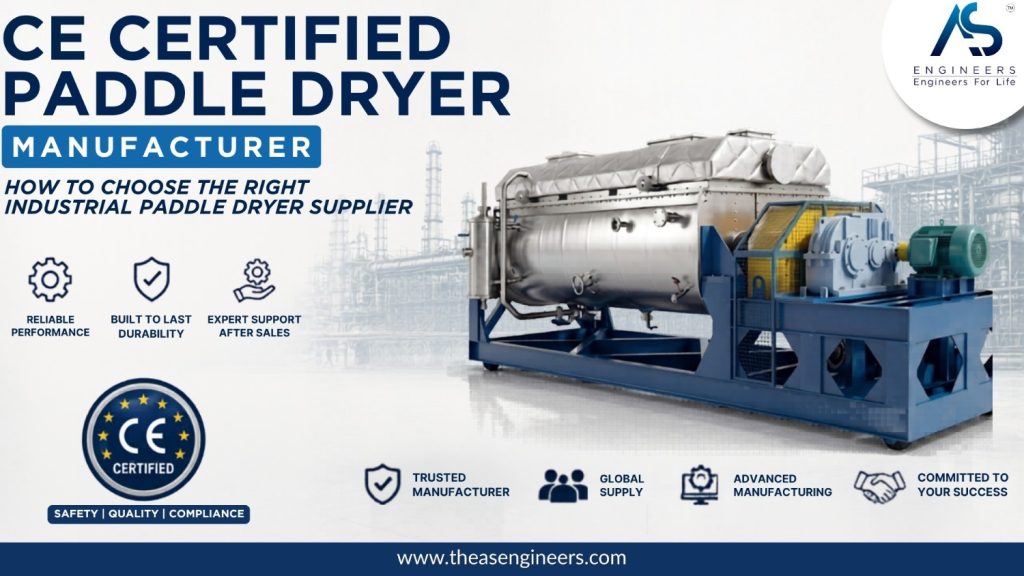
CE Certified Paddle Dryer Manufacturer: How to Choose the Right Industrial Paddle Dryer Supplier

A CE certified paddle dryer manufacturer should not only supply a dryer with a CE claim. The manufacturer should help you verify the dryer design, heating system, safety documentation, material of construction, vapour handling, controls, and operating conditions before final selection. At AS Engineers, we manufacture paddle dryer systems for industrial sludge, chemical wet cake, pharma intermediates, food residues, pigments, paper sludge, minerals, and other difficult drying applications where process fit matters more than catalogue selection.
What does CE certified mean for a paddle dryer?
In practical buyer language, “CE certified paddle dryer” usually means the equipment is supplied with CE-related documentation for applicable European conformity requirements. Officially, CE is a marking, not a general quality ranking. The European Commission explains that CE marking indicates that a product sold in the European Economic Area has been assessed to meet applicable safety, health, and environmental protection requirements.
For industrial buyers, this means one important thing: do not stop at the words “CE certified.” Ask for the documentation scope.
A paddle dryer is normally a custom-engineered system. The dryer body, shaft design, drive system, gearbox, control panel, heating medium, vapour handling, condenser, scrubber, cyclone, bag filter, safety guards, and discharge equipment may change from project to project. If the machine is customized, the documentation should match the final supplied system.
Why CE certification matters in paddle dryer procurement
CE certification becomes important when the buyer is exporting machinery, installing equipment for an international group, working with a European customer, or following strict internal procurement standards.
For a paddle dryer project, CE-related documentation helps the purchase team and plant team check whether the manufacturer has considered:
- Machine safety and guarding
- Electrical and control-panel safety
- Mechanical risk points
- Heating system boundaries
- Rotating parts and access points
- Emergency stop and operator interface
- Documentation traceability
- User manual and installation guidance
- Conformity scope for the supplied machine
CE does not automatically prove that a dryer is right for your process. A wrongly sized CE marked dryer can still fail if the feed data, moisture target, vapour load, discharge behaviour, or heating medium is not properly reviewed.
AS Engineers as a CE certified paddle dryer manufacturer in India
AS Engineers is an Ahmedabad-based manufacturer working in paddle dryers, sludge dryers, centrifugal blowers, pollution control equipment, and turnkey industrial solutions. AS Engineers’ official company material identifies the company as ISO 9001:2015 and CE Certified, with 25+ years of experience, 500+ clients, and 1500+ projects.
For paddle dryers, the engineering focus is not only on the dryer shell. A working industrial drying system may include feeding, heating, drying, scavenging air, vapour handling, pollution control, solvent management, product handling, conveying, bagging, and service support.
When I review a paddle dryer requirement, I do not start with dryer size alone. I first check the material condition, feed moisture, final moisture target, heating medium, sticky phase behaviour, vapour load, MOC requirement, discharge form, and maintenance access. CE documentation is important, but process fit decides whether the dryer will work smoothly in the plant.
How an industrial paddle dryer works
An industrial paddle dryer uses indirect heat transfer. Heat is transferred through hollow shafts, paddles, and jacketed surfaces into the wet material. The material is mixed, sheared, moved forward, and dried inside an enclosed chamber.
AS Engineers paddle dryer design is built around practical drying requirements such as:
- Indirect heating using steam, thermic fluid, or hot water based on site utility
- Hollow shafts and jacketed surfaces for heat transfer
- Dual counter-rotating shafts for mixing and movement
- Wedge-shaped, self-cleaning paddles to reduce buildup
- Plug-flow movement for controlled residence time
- Handling of slurries, pastes, cakes, granules, powders, and sludge
- Options for atmospheric, vacuum, or pressurized operation based on application
- MOC options such as CS, SS304, SS316, Duplex Steel, and other alloys as required
This makes paddle dryers useful where wet material is sticky, difficult to convey, moisture-heavy, expensive to transport, or sensitive to direct hot air exposure.
For sludge drying applications, you can also review AS Engineers’ guide on paddle dryers for sludge drying.
CE certified manufacturer vs process-capable manufacturer
A CE claim is one checkpoint. It should not be the only checkpoint.
| Buyer checkpoint | What to verify | Why it matters |
|---|---|---|
| CE documentation | CE certificate, declaration, applicable scope, machine model, control panel scope | Prevents vague or mismatched documentation |
| Process experience | Similar materials handled before, sludge or wet cake behaviour, sticky phase understanding | Reduces risk of poor drying and buildup |
| Heating design | Steam, thermic fluid, hot water, temperature limit, pressure condition | Affects drying rate, operating cost, and safety |
| MOC selection | CS, SS304, SS316, Duplex, alloy requirement | Controls corrosion, contamination, and service life |
| Vapour handling | Water vapour, solvent, odour, fines, condenser, scrubber, cyclone, bag filter | Critical for plant safety and emission handling |
| Pilot trial | Sample trial, 50 kg/hr trial, process observation | Reduces guesswork before order |
| Maintenance access | Shaft, paddles, bearings, gearbox, seals, discharge equipment | Reduces shutdown time |
| After-sales support | OEM spares, on-site alignment, repair, retrofitment, AMC | Protects lifecycle performance |
What documents should buyers ask from a CE certified paddle dryer manufacturer?
Before finalizing a paddle dryer supplier, ask for documentation that matches the project scope. The exact list depends on the application, destination market, and buyer’s internal procurement standards.
Useful documents to ask for include:
- CE certificate or CE-related conformity documentation, where applicable
- EU Declaration of Conformity, when required for the supplied scope
- General arrangement drawing
- Technical datasheet
- MOC details
- Motor, gearbox, bearing, and drive details
- Control panel and electrical scope
- Safety guarding details
- Operating and maintenance manual
- Utility requirement sheet
- Installation and commissioning checklist
- Spare parts list
- Inspection and test plan, if required
- Material test certificates for critical parts, if required
- Documentation for bought-out components, where applicable
For export-oriented or multinational plant projects, this documentation can be as important as the machine price.
Where CE documentation becomes more sensitive
CE review needs extra care when the paddle dryer is part of a high-risk process condition. Do not treat these as routine quote items:
- Solvent-bearing material
- Flammable vapour
- Combustible dust
- Toxic fumes
- High-temperature operation
- Vacuum or pressure operation
- Hazardous sludge
- Corrosive chemical wet cake
- Food or pharma material with contamination sensitivity
- Integration with scrubber, condenser, bag filter, or chimney system
For such applications, the buyer should involve plant engineering, EHS, project consultants, and the dryer manufacturer before freezing the scope.
Industries that use paddle dryers
Paddle dryers are used across industries where controlled indirect drying is required. AS Engineers’ paddle dryer material scope includes industrial sludge, STP sludge, bio-sludge, paper sludge, gypsum, pigments, starch, calcium and sodium carbonate, copper concentrate, lithium hydroxide, manganese dioxide, coal or lignite, DDGS, rice bran, fish meal, polymer, PET chips, and related industrial materials.
Common buyer segments include:
- Chemical and petrochemical plants
- Pharmaceutical and API intermediate plants
- Food and beverage processors
- Mining and metal processors
- Paper and pulp mills
- Environmental and waste management plants
- ETP, STP, CETP, and ZLD plants
- Pigment and dye manufacturers
- Polymer and plastic processors
- Fertilizer and biosolid handling plants
For ZLD and sludge-heavy projects, AS Engineers has also covered paddle dryer use in ZLD plants and CETP sludge drying with paddle dryers.
When a paddle dryer is a good fit
A paddle dryer is usually a strong fit when the material is wet, sticky, sludge-like, paste-like, difficult to handle, or costly to dispose of in wet form.
It is especially useful when:
- Direct hot air contact is not preferred
- Low off-gas volume is important
- Enclosed drying is preferred
- Solvent or vapour handling must be planned
- The material passes through a sticky or plastic phase
- The plant wants lower wet sludge transport or disposal load
- Final product handling, bagging, or reuse is part of the project
- Moisture reduction must be controlled based on process requirement
When a paddle dryer may not be the best fit
A paddle dryer is not automatically the right choice for every drying duty.
It may not be the first option when:
- The material is already free-flowing and easy to dry in a simpler dryer
- Very high evaporation duty is needed and another dryer type is more economical
- The process needs extremely short residence time
- The buyer cannot provide feed moisture, final moisture target, or material sample
- The vapour is hazardous but no safe vapour handling system is planned
- The site has no suitable heating utility or space for auxiliary equipment
This is why supplier selection should include material testing, duty review, utility review, and layout discussion before commercial comparison.
RFQ checklist for a CE certified paddle dryer
To get a useful quotation, share complete duty data. A serious paddle dryer manufacturer should ask for these inputs before sizing the system.
| RFQ input | Details to share |
|---|---|
| Material name | Sludge, wet cake, slurry, paste, powder, granule, or specific chemical |
| Feed rate | kg/hr, TPD, batch size, or continuous duty |
| Feed moisture | Initial moisture percentage and whether it varies |
| Final moisture target | Required outlet moisture or dryness |
| Material behaviour | Sticky, abrasive, corrosive, heat-sensitive, toxic, odorous, solvent-bearing |
| Heating medium | Steam, thermic fluid, hot water, electricity, boiler availability |
| Utility limits | Steam pressure, thermic fluid temperature, fuel type, power availability |
| Operating mode | Continuous, batch, vacuum, atmospheric, or pressurized |
| MOC requirement | CS, SS304, SS316, Duplex, hard facing, electropolishing |
| Vapour handling | Water vapour, solvent, odour, condenser, scrubber, cyclone, bag filter |
| Discharge form | Powder, granule, cake, semi-dry sludge, bagging, silo, truck disposal |
| Site layout | Available area, height, access, foundation, maintenance clearance |
| Documentation | CE, ISO, manual, drawing, inspection documents, MTC, control panel scope |
| Service requirement | Installation, commissioning, training, AMC, OEM spares |
For plants that need service, retrofitment, or spare parts support, AS Engineers also provides paddle dryer services, maintenance, repair, and OEM spare parts.
Common mistakes when buying a CE certified paddle dryer
Treating CE as proof of process performance
CE documentation does not confirm drying capacity, moisture result, or product behaviour. These depend on the feed material, heat transfer area, residence time, utility condition, vapour handling, and system design.
Comparing only price
A cheaper dryer can become expensive if it needs repeated cleaning, has poor discharge, lacks proper vapour handling, or creates unplanned shutdowns.
Ignoring auxiliary systems
A paddle dryer is often part of a complete system. Feeding, heating, scavenging, cyclone, scrubber, condenser, bag filter, screw conveyor, bagging system, silo, or truck disposal may be required.
Not checking documentation scope
If the dryer is custom-built, CE documents should match the supplied scope. Do not accept generic paperwork without checking model, equipment boundaries, and included systems.
Skipping pilot trials for difficult materials
Sticky, abrasive, solvent-bearing, or unknown sludge should be tested where possible. AS Engineers offers paddle dryer pilot trials, and buyers can also review the dedicated paddle dryer pilot trial resource.
Why documentation and after-sales support matter
The real cost of a paddle dryer is not only purchase price. It includes installation, utilities, maintenance, shutdown risk, spare parts availability, operator training, and long-term process stability.
AS Engineers’ paddle dryer support scope includes shaft, gearbox, and bearing replacement, system repair and upgrades, retrofitment solutions, OEM spare parts, operator training, process optimization, on-site service, and AMC support.
This matters because a paddle dryer works under mechanical, thermal, and material-handling stress. Bearings, seals, paddles, shaft alignment, gearbox condition, heating surface cleanliness, and discharge behaviour all affect long-term performance.
AS Engineers engineering support for paddle dryer buyers
AS Engineers can support buyers who need CE certified paddle dryer manufacturing, sludge drying systems, industrial drying equipment, pilot trials, process review, and lifecycle support.
A practical discussion should start with:
- What material do you want to dry?
- What is the feed moisture?
- What final moisture do you need?
- What heating medium is available?
- Is the material sticky, corrosive, abrasive, or solvent-bearing?
- Is vapour recovery, scrubbing, or condensation required?
- What documentation does your project require?
- What installation space and discharge method are available?
For larger industrial drying or wastewater projects, AS Engineers also benefits from group engineering backing through Acmefil Engineering Systems, the parent company of AS Engineers.
Conclusion
A CE certified paddle dryer manufacturer should be evaluated on documentation, engineering depth, process fit, material handling, vapour safety, MOC selection, pilot testing, and after-sales support. CE certification is useful, but it should not replace proper dryer selection.
If you are planning a paddle dryer for sludge, chemical wet cake, pharma intermediate, food residue, pigment, paper sludge, mineral, or ZLD-related duty, share your feed moisture, final moisture target, material behaviour, heating utility, vapour handling need, MOC requirement, and documentation requirement with the AS Engineers team.
You can contact AS Engineers through the official contact page for paddle dryer selection, CE documentation discussion, pilot trial, or RFQ support.
Frequently asked questions
What is a CE certified paddle dryer manufacturer?
A CE certified paddle dryer manufacturer is a supplier that can provide CE-related conformity documentation for applicable paddle dryer machinery scope. Buyers should verify the certificate or declaration scope, machine model, control panel, safety guarding, and supplied accessories before accepting the claim.
Does CE certification mean the paddle dryer will achieve my required moisture?
No. CE certification relates to applicable conformity and safety requirements. Drying performance depends on feed moisture, final moisture target, material behaviour, heat transfer area, residence time, heating medium, vapour handling, and correct system sizing.
What should I ask before buying a CE certified paddle dryer?
Ask for the CE documentation scope, technical datasheet, general arrangement drawing, MOC details, heating medium requirement, control panel scope, safety guarding details, user manual, utility requirement, inspection documents, and spare parts support.
Is a paddle dryer suitable for sludge drying?
Yes, a paddle dryer is commonly used for industrial sludge, STP sludge, ETP sludge, bio-sludge, paper sludge, and other wet sludge applications. The final selection should be based on sludge moisture, stickiness, chemistry, disposal route, heating utility, and vapour handling requirement.
Does AS Engineers provide paddle dryer pilot trials?
Yes. AS Engineers’ source material mentions a 50 kg/hr paddle dryer pilot trial machine for demonstrations, with trial options at AS Engineers’ facility or at the client site on a minimal paid basis, where applicable. Buyers should confirm current pilot trial availability before scheduling.
