

Sludge Management in Wastewater Treatment: A Practical Guide for ETP and STP Operators

Every ETP and STP generates sludge. The treatment and disposal of that sludge is, in most industrial plants, the part of wastewater management that costs the most, causes the most compliance pressure, and receives the least engineering attention until a problem forces it.
This guide covers how sludge forms, how it moves through a treatment train, where the drying stage fits, and what the economics of proper sludge drying look like for an Indian industrial facility.
How Sludge Forms in Wastewater Treatment
Wastewater treatment generates sludge at two distinct stages.
Primary sludge forms when raw wastewater enters a settling tank. Suspended solids heavier than water settle by gravity to form a semi-solid layer at the bottom. This primary sludge is high in organic content, has a strong odour, and typically carries 95 to 99 percent moisture at this stage.
Secondary sludge, also called biological sludge or waste activated sludge, forms during aerobic biological treatment. Microorganisms consume dissolved organic matter in the presence of air, supplied by aeration blowers. As the microbial population grows and is periodically wasted from the system, it exits the aeration tank as secondary sludge. Secondary sludge is more difficult to dewater than primary sludge because of the filamentous structure of the biomass.
In industrial ETPs, chemical sludge is also generated when coagulants and flocculants are dosed during physico-chemical treatment. The quantity and characteristics of this sludge depend on the industry and the raw effluent composition.
The Sludge Treatment Train: Stages Before Drying
Before sludge reaches the drying stage, it passes through two upstream steps that determine how much it costs to dry.
Thickening reduces sludge volume by removing free water. Gravity thickeners work for primary sludge. Secondary sludge typically needs dissolved air flotation (DAF) or gravity belt thickening because the low density of biological floc does not settle readily. After thickening, sludge moisture typically drops from 99 percent to 93 to 97 percent – still very high, but meaningfully reduced in volume.
Dewatering further reduces moisture, usually through a centrifuge, belt filter press, or filter press. Properly dewatered sludge coming off a centrifuge or belt press typically contains 70 to 80 percent moisture. This is the feed condition at which most Indian ETP operators hand sludge over for disposal.
At 70 to 80 percent moisture, sludge is not yet a manageable solid. It cannot be landfilled without further treatment under the Solid Waste Management Rules 2016. It cannot be co-processed in cement kilns without reaching a moisture level below 25 to 30 percent. And if the sludge is classified as hazardous under the Hazardous and Other Wastes (Management and Transboundary Movement) Rules 2016, CPCB guidelines require records of quantity, disposal method, and treatment before disposal. Drying is the stage that makes these downstream options viable.
Why Sludge Drying Is Now Non-Negotiable for Indian ETPs
Three regulatory pressures are converging on Indian industrial sludge management.
The National Green Tribunal has consistently ruled against open dumping and untreated sludge disposal in cases across Gujarat, Maharashtra, Maharashtra, and Tamil Nadu. SPCBs are tightening inspection frequency for industrial ETP compliance. The Faecal Sludge and Septage Management (FSSM) Policy 2017 and AMRUT 2.0 targets have increased scrutiny on sludge handling by Urban Local Bodies and industrial clusters.
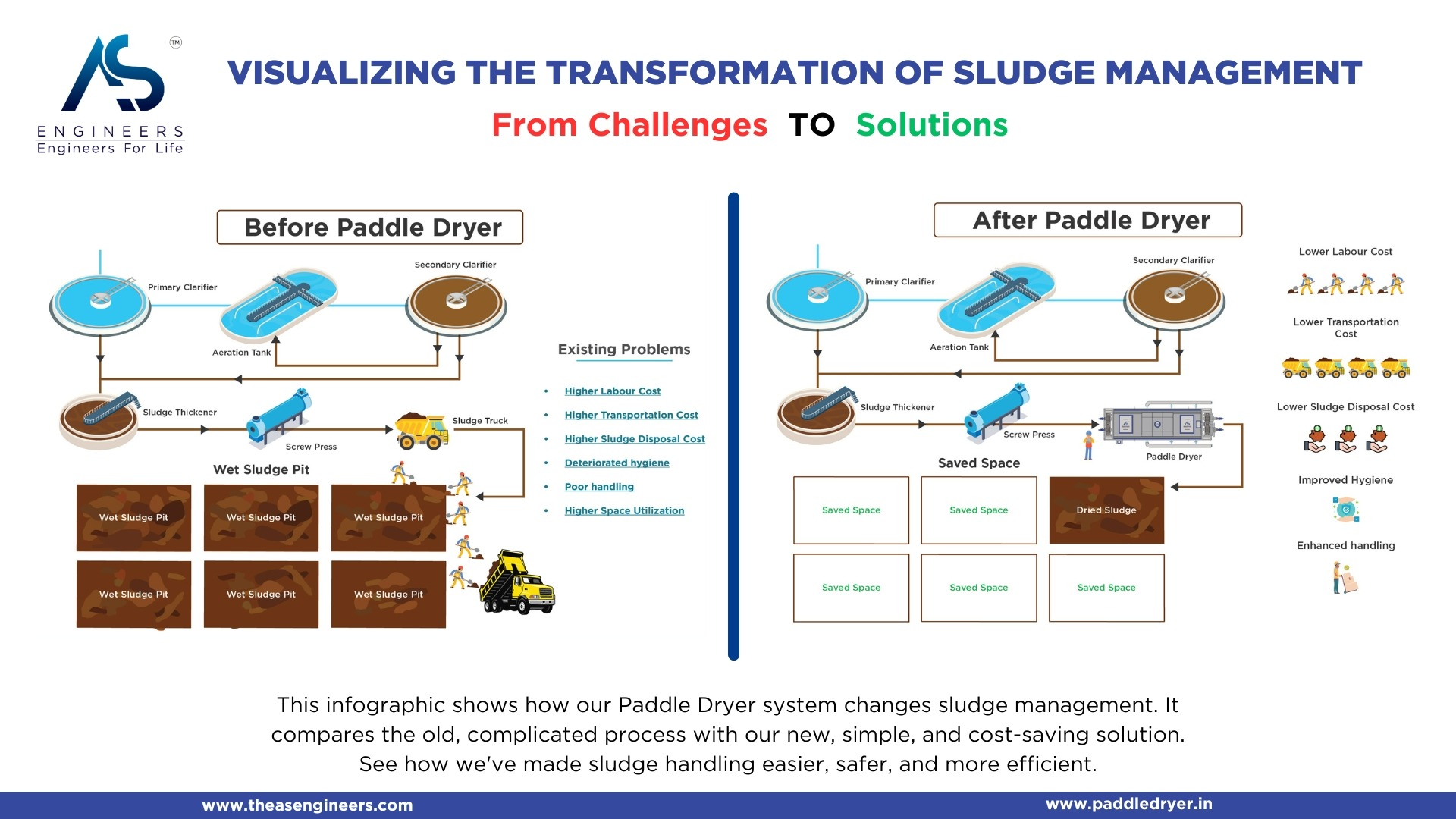
Separately, the economics have shifted. Sludge disposal contractors charge approximately Rs 20 to 25 per kg of wet sludge for transport and disposal. For a plant generating 500 kg/day of dewatered sludge at 75 percent moisture, that is Rs 10,000 to 12,500 per day, or Rs 36 to 45 lakh per year in disposal costs alone. Drying that sludge to below 15 percent moisture reduces its mass by 80 to 90 percent. The same 500 kg becomes 60 to 80 kg, and disposal cost drops proportionally.
sludge wastewater treatment methods – thickening, stabilization, dewatering & more
Drying Technology Options: What Actually Works at Plant Scale
Not all sludge drying technologies suit the same operating conditions. The table below maps the main options against the parameters that matter most at the plant specification stage.
| Technology | Typical Outlet Moisture | Heat Source | Footprint | Capital Cost | Suitable for Hazardous Sludge |
|---|---|---|---|---|---|
| Paddle Dryer (indirect) | 5 to 15% | Steam / thermic fluid / hot water | Compact, indoor | Medium | Yes — closed system |
| Solar Drying Bed | 20 to 35% | Solar (free) | Very large, outdoor | Low | No — open exposure |
| Rotary Drum Dryer (direct) | 10 to 15% | Hot gas / flue gas | Large | High | Limited — open flame |
| Belt Dryer | 10 to 20% | Low-temperature heat | Medium | Medium-High | Limited |
| Centrifuge + Landfill | 70 to 80% | None | Minimal | Low equipment | No — regulatory exposure |
For ETP operators in chemical, pharma, dye, and textile sectors where sludge is classified as hazardous, the closed-system design of a paddle dryer is a direct compliance requirement. Open technologies expose operators to CPCB inspection risk.
How a Paddle Dryer Handles Sludge: The Operating Principle
A paddle dryer for sludge uses indirect heat transfer. The heating medium — steam, thermic fluid, or hot water — circulates through the hollow shaft and hollow wedge-shaped paddles. Sludge contacts the heated surfaces, moisture evaporates, and the vapour exits through a controlled exhaust. At no point does the heating medium contact the sludge directly.
This indirect design matters for three reasons. First, exhaust vapour volume is low because no combustion gases or large air volumes pass through the material — this simplifies vapour handling and odour control. Second, the process is fully enclosed, which is necessary for hazardous sludge. Third, energy consumption is lower than direct-contact drying because heat transfer occurs through surface contact rather than convective air exchange.
Typical paddle dryer performance on ETP sludge:
- Feed moisture: 40 to 85 percent (after dewatering)
- Outlet moisture: 5 to 15 percent
- Volume reduction: 80 to 90 percent
- Heat media temperature: up to 400°C (thermic fluid), lower with steam
- Operating cost at Rs 10/kWh energy cost: Rs 5.45 to 7.50 per kg of dried output
What Happens After Drying: Disposal and Reuse Options
Dried sludge at 5 to 15 percent moisture is a fundamentally different material from dewatered sludge cake. It is friable, low in odour, and easy to handle.
For non-hazardous sludge, dried product with a calorific value of approximately 3,500 kcal/kg qualifies for co-processing as alternate fuel in cement kilns. This converts a disposal liability into a material with recoverable value, and several cement plants in Gujarat and Rajasthan accept pre-qualified industrial sludge under this route.
For hazardous sludge, dried material still requires disposal at a TSDF (Treatment, Storage, and Disposal Facility) authorised under the HW Rules 2016 — but the transport and TSDF acceptance cost per tonne drops by 80 to 90 percent because the mass has been reduced.
Some operators also explore composting of non-hazardous biological sludge post-drying, subject to SPCB approval for the specific sludge composition.
Economics: A Representative Case
A chemical plant in Gujarat generating 500 kg/day of dewatered sludge at 75 percent moisture, spending Rs 22/kg on disposal, carries an annual disposal burden of approximately Rs 40 lakh. Installing a paddle dryer of appropriate capacity reduces the dried output to approximately 65 to 75 kg/day. Disposal cost on dried material at similar per-kg rates drops to approximately Rs 5.2 to 6.0 lakh annually.
The paddle dryer rental service offered by AS Engineers allows operators to run a trial with their specific sludge before committing to capital purchase. This is relevant when sludge composition is variable or when the plant wants to demonstrate drying performance to the SPCB before commissioning a permanent installation.
At the confirmed operating cost of Rs 5.45 to 7.50/kg dried output and disposal cost savings of Rs 18 to 20/kg, payback on a well-sized paddle dryer installation typically falls in the 12 to 13 month range for a 500 kg/day scenario.
Submitting Sludge Data for a Paddle Dryer Sizing
Accurate sizing requires the following information from your plant:
- Quantity of sludge after dewatering (kg/day or kg/batch)
- Inlet moisture percentage
- Sludge composition: organic, inorganic, chemical classification (hazardous / non-hazardous)
- Target outlet moisture
- Available heat source: steam pressure and availability, thermic fluid system if present
- Available floor space and preferred installation orientation
Send your sludge data to the AS Engineers engineering team and receive a sizing recommendation with operating cost and payback estimate. No obligation and no generic brochure — a technically specific response based on your plant parameters.
Frequently Asked Questions
What moisture level does sludge need to reach before it can be co-processed in cement kilns?
Most cement kilns accepting alternate fuels require moisture below 25 to 30 percent, and many prefer below 20 percent. Paddle dryers regularly achieve outlet moisture of 5 to 15 percent, which comfortably meets this specification. The specific moisture requirement varies by kiln operator and pre-qualification criteria.
Is a paddle dryer suitable for hazardous industrial sludge?
Yes. The closed indirect-contact design of a paddle dryer makes it appropriate for hazardous sludge classified under HW Rules 2016. Exhaust vapour is captured and treated separately. The process does not expose operators or the environment to the sludge during drying.
What is the regulatory basis for sludge drying compliance in India?
The primary framework is the Hazardous and Other Wastes (Management and Transboundary Movement) Rules 2016 for industrial hazardous sludge, and the Solid Waste Management Rules 2016 for non-hazardous municipal and industrial sludge. CPCB and respective SPCBs enforce these rules. NGT orders have consistently required proper treatment before disposal. Drying reduces volume and enables compliant disposal routes.
What heat sources can a paddle dryer use?
AS Engineers’ paddle dryers accept steam, thermic fluid (up to 400°C operating temperature), and hot water. The choice depends on what is already available in the plant. Thermic fluid is common in chemical plants. Steam is the standard in pharmaceutical facilities. If neither is available, an auxiliary thermic fluid heater can be integrated.
How long does paddle dryer installation and commissioning take?
This depends on size and site conditions. For a typical industrial ETP sludge dryer, manufacturing lead time is 10 to 14 weeks after order confirmation and drawing approval. Commissioning requires 2 to 3 days on site. For operators who want to evaluate performance before purchase, the paddle dryer rental service allows a trial with your actual sludge before capital commitment.
