

Sludge Dryers, Aeration Blowers, and Pollution Control Equipment for Environmental Engineering Applications

India’s environmental compliance load on industrial plants and urban local bodies has increased significantly since the National Green Tribunal’s orders on sludge disposal and the Central Pollution Control Board’s revised effluent treatment standards. Plants that once managed sludge through landfilling are now under pressure to reduce disposal volumes, meet moisture limits for co-processing, and prove compliance during inspections.
AS Engineers manufactures three categories of equipment that directly address these requirements: sludge dryers (paddle dryer type) for volume reduction, centrifugal blowers for aeration and odour-control air supply, and pollution control equipment including bag filters, cyclone separators, and scrubbers. All three are manufactured at our Ahmedabad facility and have been supplied to water treatment, chemical, pharma, and municipal sector clients since 1997.
This page covers how each equipment type applies to environmental engineering operations, the regulatory context driving demand in India, and the technical specifications that matter when selecting equipment.
The Regulatory Context Driving Equipment Decisions in India
The following policy and regulatory instruments directly affect equipment specification decisions for ETP, STP, and CETP operators:
- CPCB Effluent Discharge Standards set limits on suspended solids, BOD, and COD for industrial wastewater discharge. Plants that cannot meet these standards face closure notices. Sludge generated during treatment must be managed separately from treated effluent.
- Solid Waste Management Rules, 2016 and the Hazardous Waste Management, Handling and Transboundary Movement Rules, 2016 require classified industrial sludge to be treated before disposal. Many industrial sludge streams are classified as hazardous waste, making uncontrolled landfilling illegal.
- National Faecal Sludge and Septage Management (FSSM) Policy, 2017 provides the framework for urban faecal sludge treatment, creating demand for thermal drying as a volume reduction and pathogen destruction method.
- AMRUT 2.0 and National Mission for Clean Ganga (NMCG) have both funded STP upgrades across Indian cities. Many of these projects require sludge management as a defined output, not an afterthought.
- NGT Orders on Sludge Disposal have prohibited open dumping of untreated sludge in multiple jurisdictions. The NGT’s principal bench has consistently held that sludge must be treated to meet land application or co-processing standards before disposal.
The practical result: an ETP or STP operator who previously left sludge in drying beds and sent it to landfill now needs a mechanical solution that reduces moisture content, reduces disposal weight, and produces a dried output suitable for co-processing in cement kilns or for agricultural land application.
Sludge Drying: How Paddle Dryers Work and What They Cost to Operate
A paddle dryer is an indirect contact thermal dryer. The sludge never contacts the heating medium directly. Instead, steam, thermic fluid, or hot water circulates through hollow paddle shafts and wedge-shaped paddle blades, transferring heat to the sludge through conduction. This eliminates the risk of combustion in the drying zone and allows vapour to be captured and treated separately.
Process sequence:
Wet sludge (typically 40-85% inlet moisture) enters through an inlet at one end. Two counter-rotating shafts with intermeshing hollow paddles move the sludge forward while continuously exposing fresh surfaces to the heated paddle faces. Vapour is extracted through the dryer top and routed to a condenser or scrubber. Dried sludge exits at 5-15% residual moisture from the discharge end.
Key output specifications:
| Parameter | Typical Range |
|---|---|
| Inlet moisture | 40-85% |
| Outlet moisture | 5-15% |
| Volume reduction | 80-90% |
| Calorific value of dried output | ~3,500 kcal/kg |
| Heating media options | Steam, thermic fluid (up to 400°C), hot water |
| Operating cost (at Rs 10/kWh) | Rs 5.45-7.50/kg of dried sludge |
| Landfill/transport cost avoided | ~Rs 25/kg of wet sludge |
| Typical payback period | 12-13 months (500 kg/day scale) |
The Rs 25/kg disposal cost figure is what most ETP operators are actually paying when they account for transportation, landfill tipping fees, and contractor charges. The paddle dryer replaces most of that cost with a Rs 5.45-7.50/kg thermal drying cost, while simultaneously producing a dried output that is either saleable to cement companies as co-processing fuel or acceptable for land application after testing.
Why paddle dryers are preferred over belt dryers and spray dryers for sludge:
- Indirect contact means no combustion risk with organics-heavy municipal or industrial sludge
- Can handle sticky, fibrous, and high-viscosity sludge that chokes belt dryers
- Compact footprint relative to throughput (dual-shaft intermeshing design packs more heat transfer area into smaller floor space than single-shaft configurations)
- Vapour-tight construction available for sludge streams with odour or VOC concerns
- No carrier gas required, which eliminates the need for a separate downstream gas treatment system
AS Engineers supplies sludge dryers for ETP/STP plants, CETPs, pharmaceutical plants, textile units, and municipal wastewater treatment facilities. Our systems handle inlet moisture up to 85% and throughput requirements from small industrial ETP scale up to large municipal STP applications.
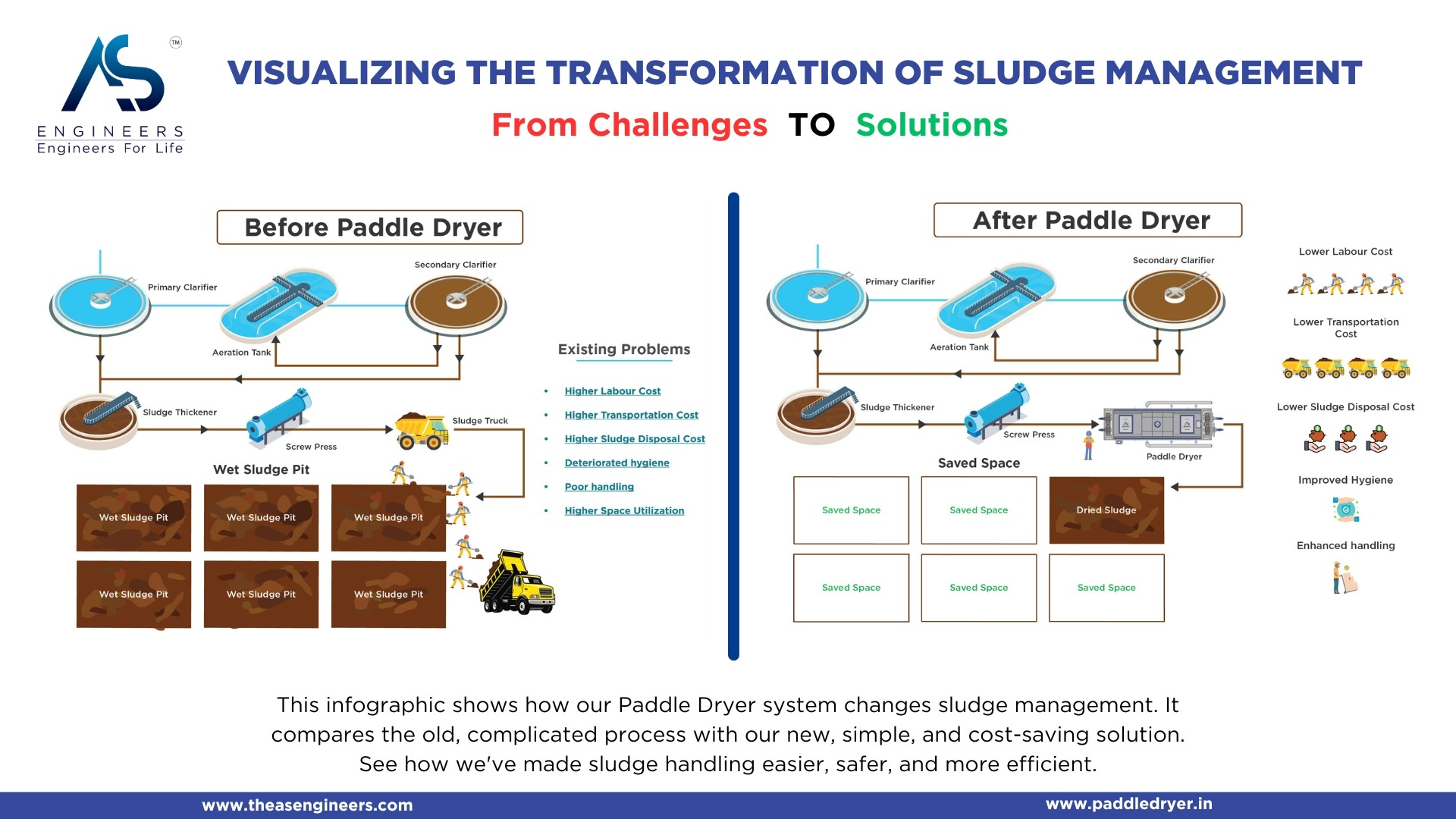
Efficient paddle dryers for sludge drying in environmental engineering. Improve wastewater treatment with sustainable, low-energy drying solutions.
Aeration Blowers for ETP and STP: What Matters When Selecting
Activated sludge process ETP and STP tanks require continuous air supply for biological oxidation. The blower is the heart of this system. Selecting an undersized blower reduces dissolved oxygen and degrades treatment efficiency. Selecting an oversized blower adds unnecessary energy cost to the plant’s monthly operating budget.
AS Engineers manufactures centrifugal blowers covering airflow from 100 m³/hr to 2,50,000 m³/hr and static pressure from 25 mmWC to 2,100 mmWC. For ETP aeration applications, the following blower types are commonly specified:
- Backward curved centrifugal blowers for clean-air aeration duty where efficiency is the primary criterion
- Backward inclined blowers for aeration with moderate humidity or fine particulate carry-over
- High pressure radial blade blowers for fine-bubble diffuser systems requiring higher discharge pressure
Blowers are designed to specific airflow and pressure requirements, not selected from a catalog. Every blower from AS Engineers is custom-engineered to the declared operating point, which means the delivered machine actually operates at the design efficiency point rather than at a compromise between standard catalog sizes.
Testing is carried out per IS 4894. Dynamic balancing is certified to G6.3 or G2.5 as per the application and customer requirement.
Pollution Control Equipment for Environmental Engineering Plants
Environmental engineering plants produce dust, particulate, and acid fumes at multiple process points. Three equipment types from AS Engineers address these:
Bag Filters collect particulate from process air streams. In ETP and STP applications, bag filters are used on sludge dryer vapour duct exhaust, on compost turning operations, and on lime dosing systems. Bag filters can handle fine particulate loads that cyclones alone cannot achieve, and they are the standard final-stage collection device for CPCB compliance on particulate emissions.
Cyclone Separators provide primary dust separation upstream of bag filters. In sludge dryer systems, a cyclone in the vapour path removes dried fines before the gas stream reaches the condenser or scrubber. Cyclones are also specified for bulk sludge or dried-product handling lines where coarse particulate must be separated before fine filtration.
Scrubbers handle odour and acid fumes. STP and CETP operations often carry H2S and ammonia loads that bag filters cannot capture. A wet scrubber with appropriate reagent dosing addresses these gas streams. Chemical industry ETP plants handling acidic wastewater may also need a scrubber on vent streams from storage tanks and reaction vessels.
AS Engineers: What We Manufacture and What We Verify
AS Engineers is ISO 9001:2015 certified and has supplied blowers and drying systems to water treatment, chemical, and pharma sector clients since 1997. We do not white-label or resell. Every machine is designed, fabricated, assembled, and tested at our Vatva, Ahmedabad facility.
Specific capabilities relevant to environmental engineering:
- Material of construction options covering MS, SS 304, SS 316, SS 316L (for pharma/food-grade sludge requirements), and Duplex SS 2205 for corrosive sludge streams
- Vapour-tight paddle dryer construction for sludge streams with VOC or odour concerns
- Performance test certificates and material test certificates issued with every machine
- Dynamic balancing reports for blowers issued to G6.3 / G2.5 as required
- After-sales support including on-site commissioning, operator training, and spare parts availability
One differentiation relevant to ETP operators evaluating paddle dryers for the first time: AS Engineers offers a paddle dryer rental service for trial runs before capital commitment. This allows an operator to validate the drying performance on their actual sludge before placing a capital equipment purchase order. This service is not standard in the Indian paddle dryer market.
Frequently Asked Questions
What moisture content can a paddle dryer achieve from ETP sludge?
A paddle dryer can reduce inlet moisture from 40-85% down to 5-15% residual moisture depending on sludge composition, heating medium temperature, and residence time. For most municipal and industrial ETP sludge, the target output of less than 10% moisture is achievable, which brings the dried sludge within the co-processing acceptance range for cement kiln fuel substitution.
Is a paddle dryer suitable for hazardous industrial sludge classified under HW Rules 2016?
Yes, with appropriate design choices. For sludge streams classified as hazardous waste under the Hazardous Waste Management Rules 2016, AS Engineers can supply vapour-tight paddle dryer configurations with sealed vapour extraction connected to a condenser and treatment system. MOC selection (SS 316L, Duplex SS 2205) depends on the specific chemical composition of the sludge. Provide your sludge characterisation report to our team for a proper recommendation.
Why should we add a paddle dryer if we already have a centrifuge or belt press for dewatering?
Centrifuges and belt presses reduce moisture from 85-95% down to 70-80%. That reduces transport weight but still leaves a material that is classified as wet sludge for disposal purposes. A paddle dryer takes the dewatered cake from 70-80% moisture down to below 15%, which qualifies the output for co-processing, land application, or composting. The two processes are complementary, not substitutes. Many plants run a dewatering step followed by a paddle dryer stage to minimise dryer throughput requirement and therefore capital cost.
What is the typical lead time for a sludge dryer from AS Engineers?
Lead time depends on throughput capacity and MOC requirements. For standard configurations, typical manufacturing lead time is 10-16 weeks from order confirmation and drawing approval. For large municipal STP capacity or non-standard materials, lead time should be confirmed at the enquiry stage. We recommend starting the technical discussion and plant trial (if applicable) early to avoid project schedule delays.
What aeration blower capacity is required for a 1 MLD ETP?
This depends on the oxygen transfer efficiency of the diffuser system and the BOD/COD load of the incoming wastewater. A rough starting estimate for a standard activated sludge system is 40-60 m³/hr of air per 1 KLD of wastewater, but this varies significantly with organic loading. AS Engineers sizes blowers to the declared process requirements. Share your ETP design basis or aeration consultant’s air demand figures for a specific selection.
Discuss Your Application with Our Engineering Team
If you are evaluating equipment for an ETP, STP, CETP, or industrial wastewater treatment project, the starting point is a technical discussion with our team. We will review your sludge characterisation data, aeration air demand, or pollution control requirement and recommend the right configuration.
Submit an enquiry at theasengineers.com/contact or call us at +91 99090 33851. Catalog downloads are available on the website for paddle dryers and centrifugal blowers.
For detailed sludge dryer selection guidance, visit sludgedryer.in.
