
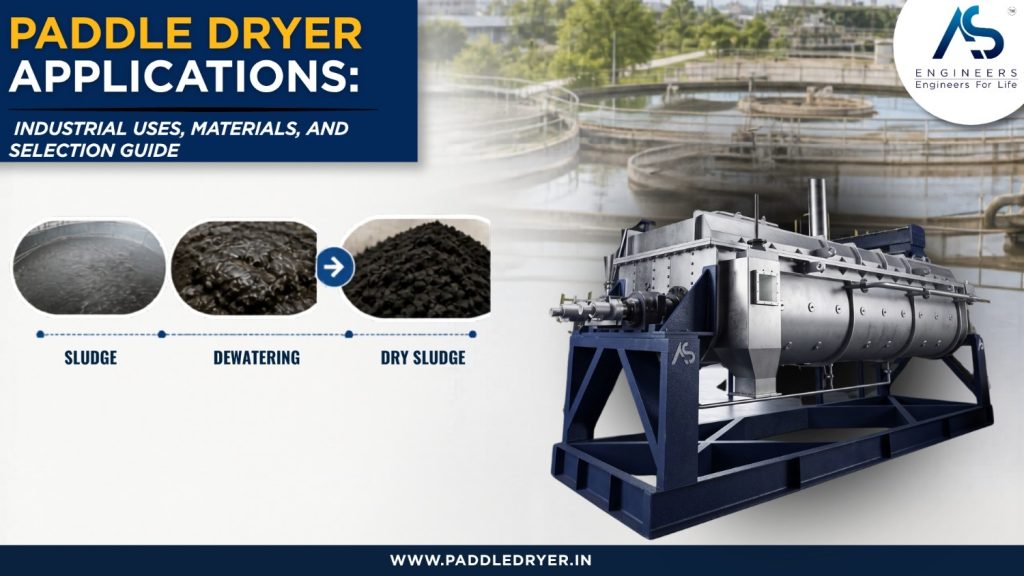
Paddle Dryer Applications: Industrial Uses, Materials, and Selection Guide

Paddle dryer applications cover much more than sludge drying. A paddle dryer can be used for industrial drying, heating, cooling, solvent stripping, calcining, roasting, and controlled thermal processing when the material needs indirect heat transfer, continuous agitation, and enclosed handling. Common applications include ETP sludge, STP sludge, chemical intermediates, pigments, starch, PET chips, gypsum, metal powders, paper sludge, food by-products, and mining materials.
The main point is simple: a paddle dryer should not be selected only by industry name. It should be selected by material behavior, moisture load, final moisture target, heating medium, vapour handling requirement, MOC, discharge condition, and downstream use.
AS Engineers already covers the equipment foundation on the main Paddle Dryer page. This guide focuses specifically on where a paddle dryer fits across industries and how plant teams should evaluate the application before sending an RFQ.
What is a paddle dryer used for?
A paddle dryer is used for drying, heating, cooling, solvent stripping, calcining, roasting, and controlled moisture reduction of wet or difficult materials. It is especially useful when the feed is sticky, pasty, sludge-like, wet cake, granular, powdery, or variable in moisture.
Unlike many direct hot-air dryers, a paddle dryer works mainly through indirect heat transfer. Heat is supplied through the hollow shafts, jacket, and heated contact surfaces, while rotating paddles move and mix the material. For a deeper equipment-level explanation, plant teams can also review the paddle dryer working principle.
A paddle dryer is commonly considered when the plant wants:
| Requirement | Why paddle dryer can fit |
|---|---|
| Controlled indirect heating | Useful when direct hot gas contact is not preferred |
| Handling of sticky feed or wet cake | Agitation helps break, mix, and move material |
| Sludge volume reduction | Moisture removal can reduce handling and transport burden |
| Enclosed drying | Useful for vapour, odour, dust, and solvent-management requirements |
| Continuous operation | Suitable where steady feed and discharge are required |
| Lower off-gas volume than many direct dryers | Can reduce load on downstream vapour or pollution-control systems |
| Process flexibility | Can be designed for drying, heating, cooling, solvent stripping, and related duties |
Major paddle dryer applications by industry
Paddle dryer applications are broad, but the best fit depends on the actual feed material. The same dryer category may behave very differently with municipal sludge, sodium sulphate, starch, PET chips, pigment, or copper concentrate.
| Industry | Typical paddle dryer applications | Common material examples |
|---|---|---|
| Wastewater and sludge handling | Moisture reduction, volume reduction, improved handling, downstream disposal or reuse preparation | ETP sludge, STP sludge, municipal sludge, bio-sludge, paper sludge, livestock sludge |
| Chemical and petrochemical | Drying, solvent stripping, heating, cooling, calcining, reaction-support duty | Aluminum hydroxide, sodium chloride, ammonium nitrate, sodium cyanide, ammonium sulphate, sodium sulphate, PTBBA powder |
| Mining and metals | Drying and conditioning mineral or metal-based wet solids | Copper concentrate, lithium hydroxide, manganese dioxide, coal/lignite, metal powders |
| Agriculture and animal feed | Drying by-products and feed-related materials | DDGS, rice bran, fish meal |
| Plastics and polymers | Drying and thermal conditioning polymer materials | Polymer, PET chips, superabsorbent polymers, plastic-lumber fillers |
| Construction and building materials | Drying minerals and construction-related process solids | Gypsum and related mineral materials |
| Paper and pulp | Drying paper sludge and fiber-rich process residues | Paper sludge |
| Pigments and dyes | Controlled drying of pigment and dye-related solids | Pigments, TiO₂, dye intermediates |
| Food and beverage | Drying or thermal treatment where controlled handling is needed | Starch, chocolate, cake flour, instant coffee, meat, food by-products |
| Pharmaceuticals and healthcare | Drying selected intermediates and inorganic materials where process control is important | API intermediates, calcium carbonate, sodium carbonate |
| Petroleum and oil & gas | Drying or recovery-oriented treatment of process residues | Drilling mud reclamation, selected oily or process wastes after evaluation |
Sludge drying applications
Sludge drying is one of the strongest paddle dryer applications because sludge is often wet, heavy, difficult to handle, and costly to transport. A Sludge Dryer is usually considered when the plant wants to reduce moisture before disposal, reuse, incineration, cement co-processing, or other approved downstream handling.
Typical sludge applications include:
- ETP sludge from chemical, textile, pharma, dye, food, paper, and process industries
- STP sludge and municipal sewage sludge
- Bio-sludge from biological treatment plants
- Paper and pulp sludge
- Livestock sludge from animal-related facilities
- Industrial sludge from CETP or common treatment operations
For sludge, the dryer selection should not be based only on tons per day. The practical inputs are initial moisture, final moisture target, sludge stickiness, salt load, fibre content, oil/grease content, odour, pH, corrosiveness, disposal route, and vapour-treatment requirement.
The important question is not only “Can the dryer remove moisture?” The better question is: Will the dried sludge be easier, safer, and more economical to handle under the plant’s approved disposal or reuse route?
For sludge-related external context, EPA’s biosolids guidance explains that sewage sludge management commonly involves options such as land application, landfilling, and incineration. The final route depends on treatment quality and local regulation, so the dryer should be selected with the disposal pathway in mind.
Chemical industry applications
Chemical plants use paddle dryers when the process needs controlled drying, solvent stripping, calcining, cooling, or thermal conditioning of organic and inorganic materials. The Paddle Dryer in Chemical Industry page is the best internal next step for chemical-duty buyers.
Common chemical-duty applications include:
- Drying of inorganic salts
- Drying of chemical intermediates
- Solvent stripping and recovery-oriented duties
- Calcining of selected materials
- Cooling of hot powders or solids
- Drying of catalysts and metal powders
- Handling of wet cakes from filter presses or centrifuges
In chemical applications, the major selection factors are MOC, corrosion risk, solvent presence, vapour handling, dust potential, operating temperature, retention time, and whether the process needs atmospheric, vacuum, or pressurized operation.
When I review a chemical paddle dryer requirement, I do not start with only capacity. I first ask what the material does inside the dryer: does it smear, crust, agglomerate, foam, release solvent, become dusty, corrode contact parts, or change phase during drying? That behaviour decides the real dryer design.
Food and beverage applications
Food and beverage applications require careful review because drying is not only about moisture removal. Product quality, temperature sensitivity, cleanability, handling, hygiene expectation, and final texture can matter as much as evaporation load.
The Paddle Dryer in Food Industry page should be used for food-specific evaluation.
Typical food-related paddle dryer uses include:
| Food-related material | Common process objective |
|---|---|
| Starch | Controlled moisture reduction |
| Rice bran | Drying or stabilization before storage or downstream use |
| Fish meal | Moisture reduction and handling improvement |
| Cake flour or powdery food materials | Controlled drying where overheating must be avoided |
| Instant coffee or granular material | Moisture conditioning, subject to process validation |
| Food by-products | Drying for easier handling or downstream value recovery |
Food applications need plant-specific confirmation. A dryer suitable for a non-food chemical duty should not be automatically assumed suitable for food-grade duty without reviewing surface finish, cleaning access, contact-part MOC, process temperature, contamination risk, and plant hygiene standards.
Pharmaceutical and healthcare applications
Paddle dryers may be used for selected pharmaceutical intermediates, healthcare-related inorganic materials, and heat-sensitive process solids when indirect heating, enclosed handling, and controlled drying are required.
Typical evaluation points include:
- API intermediate behavior
- Temperature sensitivity
- Solvent or vapour release
- Required final moisture
- Cleaning and cross-contamination expectations
- Contact-part material
- Vacuum drying requirement
- Batch traceability and documentation expectation
For pharma-related duty, the equipment discussion must remain material-specific. Do not assume one paddle dryer design can serve all pharma materials. Some products may need vacuum operation, special MOC, surface finish control, or alternate dryer technology.
Mining, metals, and mineral applications
Mining and metal-related paddle dryer applications are usually driven by moisture reduction, improved flowability, downstream handling, or preparation before further processing.
Common materials include:
- Copper concentrate
- Lithium hydroxide
- Manganese dioxide
- Coal and lignite
- Metal powders
- Metal hydroxides
- Metal oxides
- Gypsum and mineral solids
For these applications, abrasion and material bulk density become very important. A mineral feed may be less sticky than sludge but more abrasive. The dryer design must consider paddle wear, shaft torque, contact-part MOC, drive load, and discharge arrangement.
If the material can become fine and dusty after drying, dust collection and combustible-dust evaluation should not be ignored. OSHA’s combustible dust guidance notes that many powdered materials can present fire or explosion hazards when processed in fine form, so dust behaviour should be reviewed before finalizing the system.
Pigment, dye, and specialty chemical applications
Pigments and dye intermediates often need controlled drying because product quality, colour, residual moisture, and contamination risk can affect downstream use. Paddle dryers can be considered where slow, controlled, indirect heating is more suitable than aggressive direct-contact drying.
Common examples include:
- Pigments
- TiO₂
- Dye intermediates
- Optical brightening agents
- Metal salts and specialty powders
The key application checks are product sensitivity, discoloration risk, final moisture requirement, dust release after drying, MOC, cleaning access, and whether the material tends to form lumps or crusts during drying.
Plastics and polymer applications
Paddle dryers are used in polymer and plastic-related applications where the material requires heating, drying, crystallizing, cooling, or conditioning before downstream processing.
Typical materials include:
- PET chips
- Polymer materials
- Superabsorbent polymers
- Fillers for plastic lumber
- Selected polymer intermediates
For polymer duty, the selection should consider softening temperature, stickiness, residence time, heat-transfer rate, discharge form, and whether the material may smear or melt if overheated.
Agriculture, animal feed, and by-product applications
Agriculture and animal feed applications often focus on moisture reduction, stabilization, storage improvement, or by-product valorization.
Common materials include:
- DDGS
- Rice bran
- Fish meal
- Livestock sludge
- Organic by-products
For these applications, feed variability is common. Moisture can change seasonally, oil content may vary, and biological materials may generate odour. This is why the dryer should be selected with pilot testing or material evaluation wherever possible.
Paddle dryer application fit guide
Use this table before deciding whether a paddle dryer is the right fit.
| Feed or duty condition | Paddle dryer fit |
|---|---|
| Sticky sludge, paste, wet cake, or high-moisture mass | Strong fit |
| Material needs indirect heating instead of direct hot-gas exposure | Strong fit |
| Plant needs enclosed vapour or odour handling | Strong fit, with proper vapour system |
| Drying plus heating, cooling, calcining, or solvent stripping | Possible fit, duty-specific |
| Material is abrasive mineral or metal powder | Possible fit, MOC and wear design are critical |
| Material is heat-sensitive | Possible fit, often with vacuum or lower-temperature design |
| Material becomes combustible dust after drying | Needs EHS and dust-hazard review before final selection |
| Material must become very fine powder instantly | May need comparison with spin flash, spray dryer, or other technology |
| Feed is very dilute liquid | Usually not the first dryer choice without concentration or dewatering |
| Product needs strict hygienic or GMP-grade design | Needs special review, not generic selection |
Application selection checklist for RFQ
Before asking for a paddle dryer quotation, share these details with the AS Engineers team:
| RFQ input | Why it matters |
|---|---|
| Material name and industry | Helps identify corrosion, abrasion, hygiene, and EHS concerns |
| Feed form | Slurry, sludge, paste, wet cake, granule, powder, or mixed form |
| Initial moisture | Determines evaporation load |
| Final moisture target | Defines drying duty and residence time |
| Feed rate | Required for capacity and heat-load calculation |
| Bulk density | Affects hold-up, torque, discharge, and equipment sizing |
| Material temperature limit | Important for heat-sensitive products |
| Available heating medium | Steam, thermic fluid, hot water, or another utility |
| Solvent or vapour details | Needed for condenser, scrubber, cyclone, ID fan, or chimney planning |
| MOC expectation | CS, SS304, SS316, duplex, or special alloy depending on duty |
| Discharge requirement | Bagging, screw conveyor, silo, bucket elevator, truck disposal |
| Pollution-control requirement | Cyclone, scrubber, bag filter, condenser, or combination |
| Operating hours | Batch, semi-continuous, continuous, single shift, or 24-hour duty |
| Site layout | Height, access, foundation, maintenance space, and utility location |
| Dust/fire/explosion risk | Critical for dried powders, organic dusts, metals, and combustible materials |
| Trial requirement | Useful when material behavior is uncertain |
AS Engineers also offers Paddle Dryer Services for maintenance, repairs, upgrades, retro-fitment, OEM spare parts, and process optimization support. For uncertain materials, a paddle dryer pilot trial can help verify product viability and process feasibility before final equipment selection.
Common mistakes in paddle dryer application selection
Selecting only by industry name
A paddle dryer for chemical sludge and a paddle dryer for food ingredients may look similar at a category level, but the design requirements can be very different. Material behavior should lead the selection.
Ignoring final discharge behavior
Some materials dry into free-flowing granules. Others dry into lumps, sticky mass, flakes, fines, or powder. The discharge condition affects screw conveyor design, bagging, dust collection, and downstream handling.
Underestimating vapour handling
Drying does not end inside the dryer. Vapours, odour, solvent, fines, and moisture-laden gas must be managed through the correct downstream system. In many applications, cyclone separator, scrubber, condenser, ID fan, chimney, or bag filter selection becomes part of the dryer system decision.
Asking for price without duty data
A serious paddle dryer quotation needs material data. Without feed moisture, final moisture, feed rate, heating medium, MOC, vapour details, and plant layout, any price will be too rough for real project planning.
Treating ROI as fixed
Sludge drying may reduce handling and disposal burden, but the actual ROI depends on moisture reduction, disposal cost, transport distance, fuel cost, operating hours, labour, maintenance, and local rules. Do not use a generic savings number without plant-specific calculation.
When should you choose a paddle dryer?
Choose a paddle dryer when your application needs controlled indirect heating, continuous agitation, enclosed operation, and practical handling of wet or difficult solids. It is especially relevant for sludge, wet cake, sticky paste, chemical intermediates, pigments, minerals, polymers, food by-products, and selected pharmaceutical materials.
A paddle dryer is not automatically the right answer for every material. It should be compared with other dryer technologies when the feed is very dilute, extremely heat-sensitive, explosive, highly volatile, or when the required final form is a very fine powder with rapid flash drying.
FAQs
What are the main applications of a paddle dryer?
The main paddle dryer applications include sludge drying, chemical drying, solvent stripping, heating, cooling, calcining, roasting, food by-product drying, pigment drying, polymer processing, gypsum drying, mining material drying, paper sludge drying, and pharmaceutical intermediate drying.
Is a paddle dryer suitable for ETP and STP sludge?
Yes, a paddle dryer is commonly considered for ETP sludge, STP sludge, municipal sludge, bio-sludge, paper sludge, and industrial sludge. Final suitability depends on moisture, stickiness, salt load, odour, disposal route, and vapour-handling requirement.
Can a paddle dryer be used in the chemical industry?
Yes, paddle dryers are used in chemical-industry applications for drying, solvent stripping, calcining, heating, cooling, and controlled processing of organic and inorganic materials. MOC, solvent handling, corrosion, dust, and process temperature must be reviewed before selection.
Can a paddle dryer handle food materials?
A paddle dryer can be considered for selected food and by-product applications such as starch, rice bran, fish meal, and other moisture-control duties. Food applications need careful review of hygiene, surface finish, cleaning access, MOC, temperature sensitivity, and plant quality requirements.
What details are needed for a paddle dryer quotation?
A proper paddle dryer RFQ should include material name, feed form, feed rate, initial moisture, final moisture target, bulk density, temperature limit, heating medium, solvent or vapour details, MOC, discharge method, operating hours, site layout, and any dust or EHS concerns.
Conclusion
Paddle dryer applications are broad, but the right selection is always material-specific. The strongest fit is usually found where the plant needs indirect heating, continuous agitation, controlled moisture reduction, enclosed vapour handling, and reliable movement of sludge, wet cake, paste, powder, or granular material.
For sludge, chemicals, pigments, minerals, polymers, food by-products, and selected pharma materials, the paddle dryer can be a practical process solution when the duty data is clear. Before final selection, share the feed condition, moisture target, heating medium, vapour details, MOC requirement, discharge plan, and operating hours with the AS Engineers team.
For uncertain applications, do not finalize only from a brochure. Use material evaluation or pilot testing to confirm drying behaviour, residence time, discharge quality, and system configuration before project execution.
