
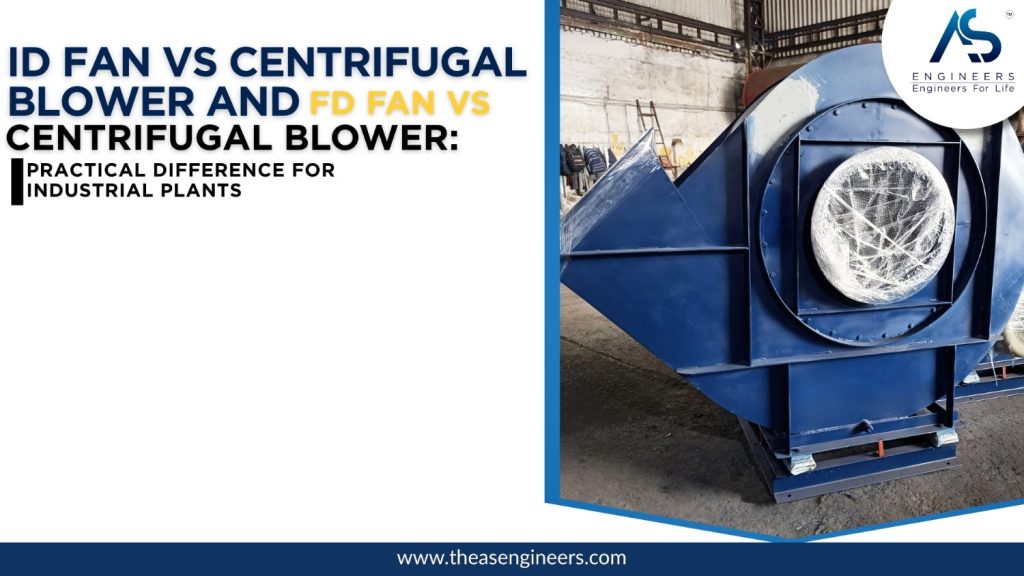
ID Fan vs Centrifugal Blower and FD Fan vs Centrifugal Blower: Practical Difference for Industrial Plants

An ID fan or FD fan is not the exact opposite of a centrifugal blower. ID fan and FD fan describe the duty of the fan in the plant, while centrifugal blower describes the fan or blower design. An ID fan pulls gas from a system. An FD fan pushes air into a system. A centrifugal blower may be used for ID duty, FD duty, exhaust duty, process-air duty, or pollution-control duty depending on airflow, static pressure, gas temperature, dust load, and application.
This difference matters because many plants ask for “ID fan vs centrifugal blower” or “FD fan vs centrifugal blower” when the real question is: what duty, pressure, airflow, gas condition, and impeller design does the application need?
For related product information, AS Engineers covers centrifugal blower systems, ID and FD fans, and centrifugal blower services for industrial fan applications.
Quick answer: ID fan, FD fan, and centrifugal blower are not the same type of comparison
| Term | What it describes | Basic function | Common plant location | Can it be centrifugal? |
|---|---|---|---|---|
| ID fan | Duty/application | Pulls flue gas, fumes, vapour, dust-laden air, or exhaust gas | Downstream side, near outlet, scrubber, bag filter, cyclone, chimney, stack, or exhaust line | Yes |
| FD fan | Duty/application | Pushes fresh air, combustion air, scavenging air, or process air | Upstream side, before boiler, furnace, burner, dryer, air heater, or process chamber | Yes |
| Centrifugal blower | Equipment/design category | Moves air or gas using a rotating impeller and casing | Depends on application | It can work as ID, FD, exhaust, process-air, or high-pressure duty |
In simple words: ID fan = pulling duty. FD fan = pushing duty. Centrifugal blower = design used to move air or gas against system resistance.
What is an ID fan?
An ID fan, or induced draft fan, is used to pull air, flue gas, fumes, vapours, or dust-laden gas through a system. It usually creates negative draft in the process line.
In a boiler or furnace system, the ID fan helps remove flue gas from the combustion chamber and moves it toward the pollution-control system or chimney. In scrubbers, bag filters, cyclones, dryers, and process exhaust systems, the ID fan helps maintain suction so contaminated or hot gas does not escape into the plant area.
Common ID fan applications
| Application | ID fan role |
|---|---|
| Boiler system | Pulls flue gas after combustion |
| Furnace | Maintains negative draft and removes hot gases |
| Scrubber system | Pulls fumes through scrubber packing or spray section |
| Bag filter | Creates suction through dust collection bags |
| Cyclone separator | Pulls dust-laden air through the separator |
| Paddle dryer or sludge dryer exhaust | Moves vapour, fines, and exhaust gas toward pollution-control equipment |
| Cement, steel, chemical, and food processing plants | Handles exhaust, fumes, hot air, or process gas depending on duty |
For boiler-specific selection context, refer to AS Engineers’ guide on boiler fan and ID fan manufacturers.
What is a centrifugal blower?
A centrifugal blower uses an impeller to move air or gas radially outward through a casing. It is commonly selected where the system has duct resistance, pressure drop, bends, filters, scrubbers, heat exchangers, dampers, cyclones, bag filters, or other restrictions.
Centrifugal blowers are used in process-air, exhaust-air, combustion-air, dust collection, hot air circulation, cooling air, pollution-control, and drying applications. AS Engineers’ centrifugal blower range includes different configurations such as backward curved blowers, backward inclined blowers, high-pressure radial blade blowers, high-temperature plug blowers, and exhauster-type blowers.
ID fan vs centrifugal blower: the real difference
The correct comparison is not “which is better?” because both terms belong to different categories.
An ID fan tells you the fan is used to pull gas from the system. A centrifugal blower tells you the machine uses centrifugal action to move air or gas. In many industrial plants, the ID fan itself may be a centrifugal fan or centrifugal blower.
| Point | ID fan | Centrifugal blower |
|---|---|---|
| Category | Duty-based term | Design-based term |
| Main action | Pulls gas through a system | Moves air or gas using centrifugal force |
| Pressure condition | Usually creates negative draft | Can work in positive or negative pressure duty |
| Gas condition | Often hot, dusty, corrosive, abrasive, moist, or fume-laden | Depends on application |
| Selection focus | Draft requirement, gas temperature, dust load, corrosion, duct resistance, outlet path | Airflow, static pressure, impeller type, RPM, motor HP, casing, MOC, arrangement |
| Plant use | Boiler exhaust, scrubber suction, bag filter suction, dryer exhaust, furnace exhaust | FD fan, ID fan, exhaust blower, process blower, material handling support, pollution-control fan |
| Main buyer risk | Selecting without considering gas condition and system resistance | Selecting only by HP or CFM without pressure and duty details |
Practical answer
Choose an ID fan duty when the plant needs suction or negative draft. Choose a centrifugal blower design when the system needs a fan/blower that can handle required airflow and static pressure through ducts, filters, scrubbers, cyclones, heat exchangers, or process equipment.
What is an FD fan?
An FD fan, or forced draft fan, is used to push air into a system. It commonly supplies fresh air, combustion air, scavenging air, cooling air, or process air.
In boiler and furnace applications, the FD fan supplies air needed for combustion. In dryers, the FD fan may push fresh or heated air into the system depending on the process design. In paddle dryer systems, an FD blower may be part of the scavenging system where filtered air is heated and directed into the dryer arrangement, while an ID blower may help move vapour or exhaust toward cyclone, scrubber, chimney, or solvent-handling sections.
FD fan vs centrifugal blower: the real difference
An FD fan describes what the fan does. A centrifugal blower describes how the fan is built and how it moves air.
| Point | FD fan | Centrifugal blower |
|---|---|---|
| Category | Duty-based term | Design-based term |
| Main action | Pushes air into a system | Moves air or gas through centrifugal impeller action |
| Pressure condition | Usually positive pressure at discharge side | Can be used for positive or negative pressure duty |
| Gas condition | Usually cleaner air, combustion air, ambient air, or filtered air | Depends on application |
| Common location | Before boiler, furnace, burner, heat exchanger, dryer, or process chamber | Depends on whether it is used as FD, ID, exhaust, or process blower |
| Selection focus | Combustion/process air demand, air density, static pressure, damper/VFD control, motor rating | Airflow, pressure, impeller type, MOC, RPM, motor HP, arrangement |
| Main buyer risk | Undersized air supply causing poor combustion or process instability | Wrong blower type or impeller selection for the actual duty |
Practical answer
Choose an FD fan duty when the plant needs air pushed into a boiler, furnace, dryer, burner, or process chamber. Use a centrifugal blower when the selected equipment design must overcome system resistance and deliver the required airflow and pressure.
ID fan vs FD fan vs centrifugal blower in one plant layout
A typical industrial airflow path may look like this:
| Stage | Equipment | Airflow role |
|---|---|---|
| Fresh air inlet | FD fan or FD centrifugal blower | Pushes air into the process |
| Process equipment | Boiler, furnace, dryer, hot air generator, reactor, scrubber, or bag filter | Uses air, heat, or gas movement |
| Exhaust side | ID fan or ID centrifugal blower | Pulls flue gas, vapour, fumes, or dust-laden gas out |
| Pollution-control side | Cyclone, scrubber, bag filter, chimney | Separates dust/fumes or discharges treated gas |
In many real projects, both FD and ID fans can be centrifugal. The difference is not the impeller alone. The difference is where the fan is installed and what duty it performs.
When should an ID fan be centrifugal?
An ID fan is commonly selected as a centrifugal fan or blower when the exhaust side has pressure drop and resistance.
This may happen when the system includes:
- Long ducting
- Multiple bends
- Dampers
- Heat exchangers
- Cyclones
- Bag filters
- Scrubbers
- Chimney or stack resistance
- Dust load
- High-temperature gas
- Corrosive or moist fumes
- Abrasive particles
For dust collection or air pollution control, the ID fan must be reviewed with the complete system, not as a standalone fan. A fan that looks correct on airflow alone may fail if the static pressure, dust load, temperature, or material of construction is wrong.
You can also review AS Engineers’ pages on scrubber in air pollution control, bag filter working principle, and cyclone separator working principle to connect the fan duty with pollution-control equipment.
When should an FD fan be centrifugal?
An FD fan may be selected as a centrifugal blower when the air supply side needs controlled pressure and reliable air delivery through ducting or resistance.
This is common in:
| Application | Why centrifugal design may be selected |
|---|---|
| Boiler combustion air | Controlled air delivery against duct and burner resistance |
| Furnace air supply | Airflow support for combustion or process heating |
| Hot air generator | Air movement through heating system and ducts |
| Dryer system | Process air or scavenging air movement |
| Air pollution control support | Air supply, dilution air, or process air depending on design |
| Industrial ventilation with resistance | Ducted air supply where pressure drop is significant |
The selection should not be based only on fan name. It should be based on duty condition.
Key selection factors for ID fan, FD fan, and centrifugal blower
When I review an ID fan, FD fan, or centrifugal blower requirement, I do not start with motor HP alone. I first check duty, airflow, static pressure, gas temperature, density, dust load, humidity, duct resistance, impeller type, RPM, MOC, motor mounting arrangement, and site condition.
| Selection input | Why it matters |
|---|---|
| Airflow, CFM or CMH | Defines the required volume flow |
| Static pressure, mmWC/mmWG or Pa | Shows resistance the fan must overcome |
| Gas temperature | Affects density, material choice, bearing arrangement, and safety margin |
| Dust load | Impacts impeller type, wear, balancing, cleaning, and erosion risk |
| Gas composition | Important for corrosion, fumes, solvent vapour, or chemical compatibility |
| Humidity or moisture | Can affect corrosion, buildup, and condensation |
| Altitude and ambient temperature | Changes air density and fan performance |
| Duct layout | Bends, length, dampers, filters, scrubbers, and silencers add resistance |
| MOC | CS, SS, alloy, lining, or coating depends on gas and dust condition |
| Impeller type | Backward curved, backward inclined, radial blade, plug type, or exhauster design |
| RPM and drive | Affects performance, noise, maintenance, and balancing |
| Motor HP | Must match duty after pressure and flow are finalized |
| Accessories | Damper, expansion bellow, guards, cooling disc, stuffing box, seal, base frame |
| Testing and documentation | Fan curve, balancing certificate, performance test, MTC, PMI, NDT where required |
For deeper technical reading, see AS Engineers’ resources on centrifugal blower working principle, centrifugal blower design, and choosing the right blower and fan impellers.
Common buyer mistakes in ID fan and FD fan selection
Selecting by motor HP only
Motor HP is not the starting point. A 20 HP fan and another 20 HP fan can behave very differently depending on impeller design, RPM, pressure, airflow, and system resistance.
Treating ID fan and centrifugal blower as separate alternatives
In many plants, the selected ID fan itself may be a centrifugal blower or centrifugal fan. The correct question is not “ID fan or centrifugal blower?” The correct question is “Which centrifugal fan/blower design is suitable for this ID duty?”
Ignoring temperature and dust load
ID fans often handle hotter and dirtier gas than FD fans. If dust load, temperature, moisture, or corrosive gas is ignored, the plant may face vibration, impeller wear, bearing issues, leakage, or frequent stoppage.
Using the same fan for changed process conditions
If the plant adds a scrubber, bag filter, cyclone, damper, duct extension, or chimney modification, resistance changes. The old fan may not deliver the same airflow after system changes.
Not sharing duct layout during RFQ
A fan supplier cannot correctly judge static pressure without understanding the system resistance. Duct length, bends, entry condition, discharge condition, filters, and equipment pressure drop matter.
RFQ checklist for ID fan, FD fan, or centrifugal blower
Before asking for a quotation, share this data:
| RFQ input | Required detail |
|---|---|
| Application | Boiler, furnace, scrubber, bag filter, cyclone, dryer, hot air generator, ventilation, process exhaust |
| Duty | ID, FD, exhaust, process air, hot air circulation, cooling air |
| Airflow | CFM, CMH, or m³/hr |
| Static pressure | mmWC/mmWG or Pa |
| Gas handled | Fresh air, flue gas, fumes, vapour, dust-laden gas, hot air |
| Temperature | Normal and maximum operating temperature |
| Dust load | Type of dust, approximate load, abrasive nature |
| Moisture/corrosion | Humidity, acidic fumes, solvent vapour, corrosive gases |
| MOC preference | CS, SS304, SS316, alloy, lining, coating, hard-facing if needed |
| Site condition | Altitude, ambient temperature, available space |
| Drive preference | Direct drive, belt drive, coupling drive, VFD requirement |
| Accessories | Damper, expansion bellow, guards, silencer, base frame, vibration isolator |
| Testing | Fan curve, dynamic balancing, performance test, inspection documents |
| Documentation | GA drawing, datasheet, MTC, PMI, NDT, QAP, test certificates if required |
This RFQ data helps AS Engineers review the actual duty instead of giving a generic fan quote.
Which one should you choose?
| Requirement | Better selection direction |
|---|---|
| Need to pull flue gas from boiler or furnace | ID fan duty, often centrifugal |
| Need to push combustion air into boiler or furnace | FD fan duty, often centrifugal |
| Need suction through scrubber, bag filter, cyclone, or duct | ID centrifugal fan/blower |
| Need process air supply against duct resistance | FD centrifugal blower |
| Need high pressure with industrial resistance | Centrifugal blower or high-pressure radial blade blower |
| Need clean air movement with low resistance | FD fan or axial fan may be considered depending on duty |
| Need dirty, abrasive, dust-laden exhaust handling | ID fan with suitable impeller, MOC, and wear consideration |
| Need high-temperature exhaust | ID fan or high-temperature plug blower design, reviewed by actual temperature and gas condition |
Maintenance signs that the fan selection or operating condition may be wrong
A fan problem is not always a fan manufacturing problem. Many issues come from wrong duty data, changed resistance, poor installation, dust buildup, poor alignment, or operation away from the correct fan curve.
Watch for:
- High vibration
- Bearing temperature rise
- Repeated bearing failure
- Impeller wear
- Low airflow
- High motor current
- Noise increase
- Damper kept too restricted
- Dust buildup inside casing
- Foundation looseness
- Belt slippage or misalignment
- Shaft seal leakage
- Frequent balancing requirement
If these symptoms appear, review the fan with actual process data, not only nameplate data. AS Engineers also provides support for centrifugal blower services, including performance review, alignment, balancing, repair, retrofitment, and site-based design support.
Practical selection example
| Plant condition | Wrong approach | Better approach |
|---|---|---|
| Boiler needs flue gas removal | Ask only for “centrifugal blower 30 HP” | Ask for boiler ID fan with airflow, static pressure, flue gas temperature, duct layout, chimney resistance, dust load, and MOC |
| Furnace needs air supply | Ask only for “FD fan price” | Share combustion air requirement, burner condition, duct pressure drop, air temperature, control method, and motor preference |
| Scrubber has poor suction | Increase motor HP directly | Check scrubber pressure drop, duct choking, fan curve, damper position, impeller buildup, RPM, and actual airflow |
| Bag filter airflow is low | Replace fan immediately | Check bag blinding, differential pressure, duct leakage, fan speed, impeller wear, and static pressure |
| Dryer exhaust has vapour/fines | Use standard clean-air blower | Select ID duty based on vapour load, fines, temperature, condensation risk, cyclone/scrubber resistance, and MOC |
FAQs
Is an ID fan the same as a centrifugal blower?
No. An ID fan is a duty where the fan pulls gas from a system. A centrifugal blower is a design type that moves air or gas using a centrifugal impeller. Many ID fans are centrifugal, but “ID fan” and “centrifugal blower” are not the same category of term.
Is an FD fan the same as a centrifugal blower?
No. An FD fan pushes air into a system. A centrifugal blower may be used as an FD fan if the application requires that design, airflow, and pressure capability. The final selection depends on air volume, static pressure, temperature, duct resistance, and process duty.
Which is better, ID fan or centrifugal blower?
Neither is automatically better. If you need suction or negative draft, you need ID fan duty. If you need a fan/blower design for higher duct resistance or pressure drop, a centrifugal blower may be suitable. In many cases, the right answer is an ID centrifugal fan or ID centrifugal blower.
Which is better, FD fan or centrifugal blower?
An FD fan is chosen when the plant needs air pushed into a boiler, furnace, dryer, burner, or process system. A centrifugal blower is chosen when the air supply duty needs a centrifugal design. The right choice depends on pressure, airflow, duty cycle, air density, and system layout.
What data is required to select an ID or FD centrifugal blower?
Share application, airflow, static pressure, gas temperature, dust load, humidity, gas composition, duct layout, MOC requirement, RPM preference, motor HP, operating duty, and required documentation such as fan curve, balancing certificate, GA drawing, and material test certificate.
Conclusion
For industrial plants, the most accurate answer is this: ID fan and FD fan describe plant duty, while centrifugal blower describes equipment design.
Use an ID fan when the system needs suction or negative draft. Use an FD fan when the system needs air pushed into the process. Use a centrifugal blower or centrifugal fan design when the duty requires reliable airflow against duct resistance, pressure drop, filters, scrubbers, cyclones, heat exchangers, or process equipment.
For correct selection, do not finalize the fan only from HP or fan name. Share airflow, static pressure, temperature, dust load, gas condition, duct layout, MOC, and duty cycle. AS Engineers can review the application and suggest an ID fan, FD fan, or centrifugal blower configuration based on actual site conditions.
