
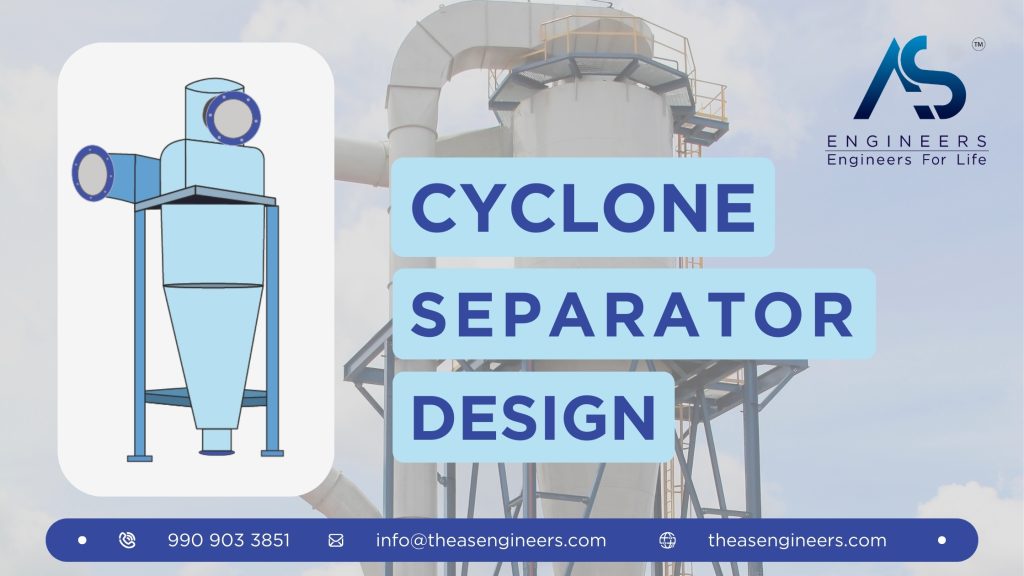
Cyclone Separator Design: What Affects Performance and Selection

Cyclone separator design is not just about choosing a diameter and a dust outlet. In practical plant use, cyclone performance depends on how the separator is matched to particle size, dust loading, gas volume, pressure drop limits, wear conditions, and downstream discharge handling.
For most buyers, the real question is simple: will the cyclone work properly in this process? That answer depends on the material, the airflow, and the operating conditions around the separator. A good design improves coarse-particle separation, protects downstream equipment, and keeps the system easier to maintain over time.
What is cyclone separator design?
Cyclone separator design is the process of configuring a cyclone to separate particulate matter from an air or gas stream using centrifugal force. The design has to balance separation performance with practical operating factors such as pressure drop, wear resistance, temperature, dust discharge, and maintenance access.
In industrial applications, a cyclone is often selected when the process involves dry particulate and the plant needs a simple, robust separator for continuous duty.
For a product-focused overview, see our cyclone separator page.
How a cyclone separator works
A cyclone separator works by introducing dust-laden gas tangentially into the body of the unit. This creates a spinning flow pattern inside the cyclone.
As the gas rotates, heavier particles move outward toward the wall due to centrifugal action. These particles lose momentum, move downward into the dust collection section, and are discharged. The cleaned gas then exits through the top outlet.
The principle is simple, but the actual performance depends heavily on how the cyclone is designed for the real process.
Why cyclone separator design matters
A poorly matched cyclone can create multiple problems at the same time. It may collect less dust than expected, create unnecessary pressure loss, wear out too quickly, or struggle with reliable dust discharge.
A well-designed cyclone should help the plant:
- separate coarse particulate effectively
- reduce dust loading on downstream equipment
- handle the process airflow without unnecessary restriction
- operate reliably under the expected temperature and dust conditions
- maintain consistent discharge of collected solids
In many systems, the cyclone is also used as a pre-separation stage before another device such as a bag filter.
Key factors that affect cyclone separator design
Particle size and density
Cyclones are generally more effective for larger and denser particles than for very fine, light particulate. That is why the particle profile should be understood early instead of assuming the same cyclone design will suit every dust stream.
Gas volume
The airflow rate affects cyclone size, inlet condition, residence pattern, and the overall separator geometry. An undersized cyclone can create high pressure drop and operational instability, while an oversized one may reduce separation effectiveness.
Inlet velocity
The inlet arrangement and gas velocity strongly influence vortex formation. Too low, and separation weakens. Too high, and pressure drop, erosion, and re-entrainment risk can increase.
Cyclone diameter and body proportions
Cyclone dimensions affect both capacity and separation behavior. In practical terms, geometry is not chosen in isolation. The cyclone body, cone section, inlet, vortex finder, and outlet all need to work together.
Pressure drop
Cyclone design always involves a trade-off between separation performance and pressure loss. Plants usually need a design that supports good particulate control without creating avoidable load on the fan or blower system.
Dust loading
The amount of particulate entering the cyclone affects wear, hopper design, and discharge reliability. High-dust applications should be reviewed carefully at the inlet and discharge stages, not just at the cyclone body.
Material of construction
Abrasive, corrosive, or high-temperature service conditions may require different material choices, wear liners, or protective design features.
Dust discharge arrangement
A cyclone does not end at the cone. The hopper, rotary valve, screw conveyor, or discharge point must also be designed properly so collected dust leaves the system reliably without re-entrainment.
When a cyclone separator is the right choice
A cyclone separator is often a practical option when the process involves dry particulate and the plant needs a simple, robust, low-maintenance separator for continuous service.
It is commonly considered when:
- the dust stream contains coarse or medium particulate
- the cyclone is needed as a pre-separator before a finer collection stage
- the process involves higher temperatures or heavier dust loading
- the plant wants a compact mechanical separator without filter media
- the application requires straightforward operation and practical maintenance
In many plants, a cyclone is not the only device in the line. It may work as part of a wider pollution control equipment system depending on the process requirement.
Cyclone separator vs bag filter vs scrubber
A cyclone separator is not the right answer for every dust-control problem.
A cyclone is generally used for mechanical separation of particulate from an air or gas stream, especially where the dust is relatively heavier or where the cyclone is used ahead of another stage.
A bag filter is usually considered where finer dry particulate capture is more critical.
A scrubber becomes relevant where the process includes gaseous contaminants, fumes, or wet pollutant handling.
The right choice depends on the pollutant, the process condition, and the required outcome.
Common mistakes in cyclone separator design projects
Designing around airflow only
Air volume matters, but particle size, dust loading, wear tendency, and pressure-drop limits matter just as much.
Ignoring the discharge side
A cyclone can separate dust well and still underperform if the hopper or discharge system allows buildup, choking, or re-entrainment.
Using the same design for all dust types
Fine powder, abrasive solids, fibrous dust, and sticky particulate do not behave the same way in a cyclone.
Underestimating wear
Abrasive service conditions can shorten cyclone life quickly if material selection and wear protection are not addressed early.
Treating the cyclone as a stand-alone item
The cyclone, ducting, fan, discharge arrangement, and downstream equipment all affect real plant performance.
Practical design questions to ask before selecting a cyclone
Before finalizing a cyclone separator design, it helps to review:
- what particle size range is actually present
- how much dust is entering the system
- what gas volume and temperature must be handled
- whether the cyclone is the primary separator or a pre-separator
- how the collected dust will be discharged
- what wear or corrosion risk exists in the service
- what pressure drop the full system can accept
These questions usually matter more than broad sales language or generic size charts.
Where AS Engineers fits
AS Engineers supports cyclone separator applications where the requirement is not just “a cyclone,” but a separator matched to the actual process condition. That includes review of airflow, dust behavior, temperature, construction, and integration with the rest of the line.
Depending on the application, the cyclone may be part of a broader pollution-control setup that includes a bag filter, scrubber, or other pollution control equipment.
Frequently asked questions
What is the main purpose of cyclone separator design?
The purpose is to configure the cyclone so it separates particulate effectively while staying practical on pressure drop, wear life, and discharge reliability.
Does a cyclone separator remove very fine dust well?
That depends on the dust profile and the system objective. Cyclones are often better suited to coarse or medium particulate and are frequently used before a finer collection stage.
What affects cyclone separator performance the most?
Particle size, gas volume, inlet condition, cyclone geometry, pressure drop, and discharge design are all important.
Is cyclone design only about the cyclone body?
No. The inlet, vortex region, cone, dust outlet, hopper, ducting, and downstream equipment all influence actual results.
Discuss your cyclone separator requirement
If your plant is evaluating a cyclone separator, the next step is to review the dust type, airflow, temperature, discharge arrangement, and system objective together. Contact AS Engineers to discuss the application in practical terms.
