Blog

Cyclone Separator Design: What Affects Performance and Selection
Cyclone Separator Design

Cyclone Separator Design: What Affects Performance and Selection

Cyclone separator design is not just about choosing a diameter and a dust outlet. In practical plant use, cyclone performance depends on how the separator is matched to particle size, dust loading, gas volume, pressure drop limits, wear conditions, and downstream discharge handling. For most buyers, the real question is simple: will the cyclone work…

read more
https://theasengineers.com/wp-content/uploads/2024/06/AS-Cyclone-Separator-Design.jpg 2240 1260 Karan Dargode Karan Dargode https://secure.gravatar.com/avatar/07f947d181586fd469037ee6d94835706ec75f702a883122f4a4178a43622649?s=96&d=mm&r=g
Cyclone Separator Diagram and Working Principle: A Technical Guide
cyclone separator diagram

Cyclone Separator Diagram and Working Principle: A Technical Guide

Quick answer: A cyclone separator removes dust from a gas stream using centrifugal force. Dirty gas enters tangentially and spins down the cylinder and cone as an outer vortex. Heavier particles hit the wall and slide into the dust outlet, while the cleaned gas turns into an inner vortex and leaves upward through the central…

read more
https://theasengineers.com/wp-content/uploads/2024/06/AS-Cyclone-Separator-Diagram.jpg 2240 1260 Karan Dargode Karan Dargode https://secure.gravatar.com/avatar/07f947d181586fd469037ee6d94835706ec75f702a883122f4a4178a43622649?s=96&d=mm&r=g
Tube Axial Fans: Industrial Selection Guide for Plant Engineers
Tube Axial Fans

Tube Axial Fans: Industrial Selection Guide for Plant Engineers

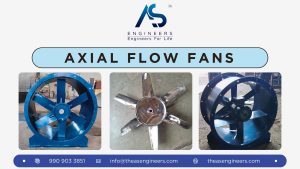
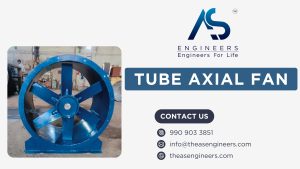
Most ventilation problems in industrial plants come down to choosing the wrong fan type at the specification stage. A tube axial fan handles high-volume, low-resistance airflow efficiently. Put it in a high-static-pressure system and it struggles. Understanding where it fits, and where it does not, is what this guide covers. What Is a Tube Axial…

read more
https://theasengineers.com/wp-content/uploads/2024/06/AS-AXIAL-FAN-2.jpg 2240 1260 Karan Dargode Karan Dargode https://secure.gravatar.com/avatar/07f947d181586fd469037ee6d94835706ec75f702a883122f4a4178a43622649?s=96&d=mm&r=g
Axial Flow Fans and Axial Fan Flow: How They Work and Where They Fit
axial flow fans axial fan flow

Axial Flow Fans and Axial Fan Flow: How They Work and Where They Fit

Quick answer: In an axial flow fan, air enters and leaves parallel to the fan shaft. The rotating blades work like aerofoils that push air along the axis, which gives high airflow at low pressure. That makes axial flow fans suited to ventilation, cooling and short-ducted systems rather than high-resistance duties. Axial flow fans are…

read more
https://theasengineers.com/wp-content/uploads/2024/06/AS-Centrifugal-Exhaust-Fan-2.jpg 2240 1260 Karan Dargode Karan Dargode https://secure.gravatar.com/avatar/07f947d181586fd469037ee6d94835706ec75f702a883122f4a4178a43622649?s=96&d=mm&r=g
Centrifugal Exhaust Blowers and Fans for Industrial Exhaust Systems
Centrifugal Exhaust Fan

Centrifugal Exhaust Blowers and Fans for Industrial Exhaust Systems

Quick answer: A centrifugal exhaust blower removes fumes, hot air, dust-laden air or contaminated process air from a plant and sends it through ducting to a filter, scrubber or stack. The right choice depends on airflow, static pressure, gas temperature and dust or corrosive content. Air-handling designs suit cleaner air, while radial designs suit dusty…

read more
https://theasengineers.com/wp-content/uploads/2024/06/Centrifugal-Exhaust-Fan.jpg 2240 1260 Karan Dargode Karan Dargode https://secure.gravatar.com/avatar/07f947d181586fd469037ee6d94835706ec75f702a883122f4a4178a43622649?s=96&d=mm&r=g
Centrifugal Blower Diagram: Parts, Airflow Path, and How to Read It
Centrifugal Blower Diagram

Centrifugal Blower Diagram: Parts, Airflow Path, and How to Read It

Quick answer: A centrifugal blower diagram shows the inlet, impeller, scroll casing, outlet, shaft, bearings and drive, and the path the air takes through them. Air enters at the eye of the impeller, is thrown outward by the blades, and leaves the casing at 90 degrees to the inlet. Reading the diagram correctly helps with…

read more
https://theasengineers.com/wp-content/uploads/2024/06/Centrifugal-Blower-Diagram.jpg 2240 1260 Karan Dargode Karan Dargode https://secure.gravatar.com/avatar/07f947d181586fd469037ee6d94835706ec75f702a883122f4a4178a43622649?s=96&d=mm&r=g
Vacuum Paddle Dryer for Heat-Sensitive and Controlled Drying Applications
vacuum paddle dryer

Vacuum Paddle Dryer for Heat-Sensitive and Controlled Drying Applications

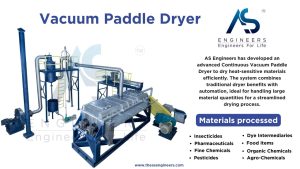
When the material cannot tolerate aggressive drying, a standard dryer discussion is not enough. The real question is whether the process needs lower-temperature moisture removal, a more enclosed drying environment, and better protection for product quality. That is where a vacuum paddle dryer becomes relevant. ASE’s current vacuum-dryer and main paddle-dryer pages already position this…

read more
https://theasengineers.com/wp-content/uploads/2024/06/Thermal-Drying-of-Sludge-with-Paddle-Sludge-Dryers-2.jpg 1280 720 Karan Dargode Karan Dargode https://secure.gravatar.com/avatar/07f947d181586fd469037ee6d94835706ec75f702a883122f4a4178a43622649?s=96&d=mm&r=g
Axial Fan Working Principle: Types, Design, and When to Use One
Axial Fan Working Principle & Design

Axial Fan Working Principle: Types, Design, and When to Use One

Quick answer: An axial fan works by spinning aerofoil-shaped blades that push air parallel to the shaft. It gives high airflow at low static pressure, typically about 20 to 250 mmWC, which suits ventilation, cooling and low-resistance duties. Tube axial fans suit simple ducted runs, and vane axial fans add guide vanes for higher pressure…

read more
https://theasengineers.com/wp-content/uploads/2024/06/Axial-Fan-Working-Principle-Design.jpg 1920 1080 Karan Dargode Karan Dargode https://secure.gravatar.com/avatar/07f947d181586fd469037ee6d94835706ec75f702a883122f4a4178a43622649?s=96&d=mm&r=g
Scrubber Working Principle: Types, Applications, and Selection Guide for Industrial Plants
SCRUBBER WORKING PRINCIPLE

Scrubber Working Principle: Types, Applications, and Selection Guide for Industrial Plants

Quick answer: A scrubber cleans an exhaust stream by bringing the gas into close contact with a scrubbing liquid. Pollutant gases dissolve or react in the liquid and particles are captured by it, the cleaned gas leaves through a mist eliminator, and the liquid is recirculated or bled off for treatment. The four common types…

read more
https://theasengineers.com/wp-content/uploads/2024/06/Scrubber-Working-Principle.jpg 1280 720 Karan Dargode Karan Dargode https://secure.gravatar.com/avatar/07f947d181586fd469037ee6d94835706ec75f702a883122f4a4178a43622649?s=96&d=mm&r=g
Cyclone Separator Working Principle: Physics, Performance Variables, and Operational Troubleshooting
Cyclone Separator Working Principle

Cyclone Separator Working Principle: Physics, Performance Variables, and Operational Troubleshooting

Quick answer: A cyclone separator spins the gas so that centrifugal force throws dust particles to the wall. The gas forms an outer vortex that moves down and an inner vortex that rises to the outlet. Particles larger than the cut diameter (d50) are mostly captured, while finer particles tend to escape with the cleaned…

read more
https://theasengineers.com/wp-content/uploads/2024/06/Cyclone-Separator-Working-Principle.jpg 1280 720 Karan Dargode Karan Dargode https://secure.gravatar.com/avatar/07f947d181586fd469037ee6d94835706ec75f702a883122f4a4178a43622649?s=96&d=mm&r=g