
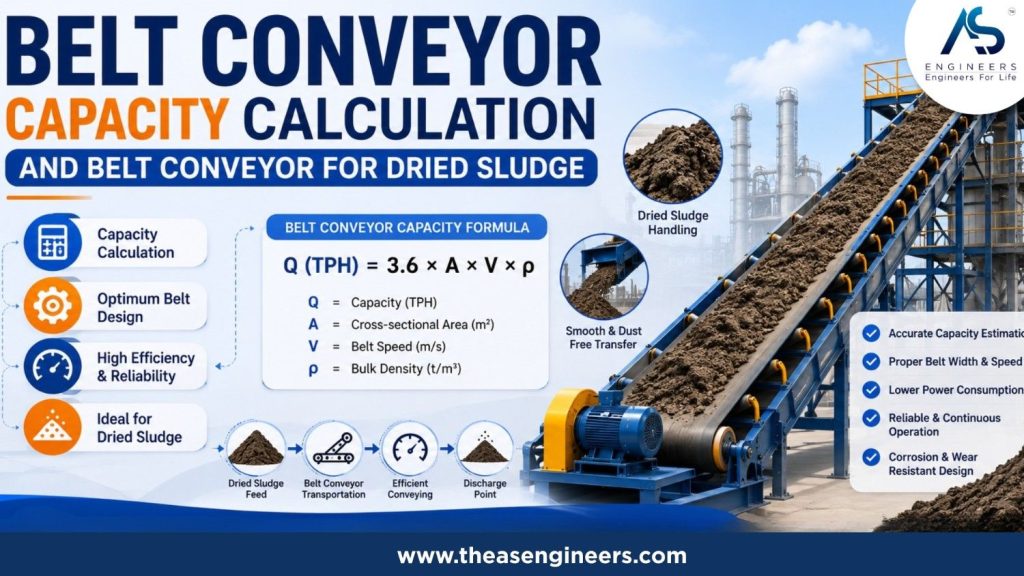
Belt Conveyor Capacity Calculation and Belt Conveyor for Dried Sludge

Belt conveyor capacity calculation helps plant teams estimate how much dried sludge a conveyor can safely move per hour. For dried sludge, the calculation should not stop at TPH. The conveyor must also match sludge moisture, bulk density, temperature, dust level, particle size, belt speed, enclosure need, discharge height, and downstream handling.
A belt conveyor for dried sludge works best when the sludge is granular, reasonably free-flowing, cooled enough for belt contact, and not too sticky or dusty for open handling. When the dried sludge is fine, hot, odorous, hazardous, or still tacky, an enclosed screw conveyor or another enclosed handling system may be safer than an open belt.
AS Engineers reviews the complete sludge drying and product handling line, including dryer discharge, conveyor layout, bagging, silo feeding, bucket elevation, and truck disposal requirements.
Belt Conveyor Capacity Calculation Formula
The basic belt conveyor capacity calculation is:
Volumetric capacity in m³/hr = 3600 × A × V
Where:
| Symbol | Meaning | Unit |
|---|---|---|
| A | Effective material cross-section on the belt | m² |
| V | Belt speed | m/s |
| 3600 | Seconds to hours conversion factor | Constant |
For mass capacity:
Capacity in TPH = 3.6 × A × V × ρ
Where:
| Symbol | Meaning | Unit |
|---|---|---|
| A | Effective load cross-section | m² |
| V | Belt speed | m/s |
| ρ | Bulk density of dried sludge | kg/m³ |
| 3.6 | Conversion from kg/s to tonnes/hour | Constant |
The important point is this: A is not only belt width. It is the actual material load area carried on the belt after considering belt width, troughing arrangement, surcharge angle, filling level, spillage allowance, and material behavior.
Simple Belt Conveyor Capacity Example for Dried Sludge
Assume a plant has dried sludge coming from a sludge drying system. The project engineer has measured or estimated the following values:
| Input | Example Value |
|---|---|
| Effective load area on belt | 0.035 m² |
| Belt speed | 0.35 m/s |
| Dried sludge bulk density | 550 kg/m³ |
Using the formula:
Capacity = 3.6 × 0.035 × 0.35 × 550
Capacity = 24.25 TPH approx.
This is only an example. The actual design may change after checking sludge density, moisture, belt width, troughing angle, incline, transfer point, skirt board design, dust control, drive power, and site layout.
First Convert Daily Sludge Output Into Hourly Conveyor Capacity
Many mistakes happen because teams discuss sludge in tonnes per day, but conveyors are selected in tonnes per hour.
Use this basic conversion:
Required conveyor capacity in TPH = Dry sludge output per day ÷ Conveyor operating hours per day
Example:
| Input | Value |
|---|---|
| Dried sludge output | 12 tonnes/day |
| Conveyor operating time | 10 hours/day |
| Base conveyor capacity | 1.2 TPH |
This 1.2 TPH is not the final design capacity. The engineer must still check dryer discharge variation, batch surges, upstream feeding pattern, downstream stoppage risk, and plant operating margin.
For sludge plants, conveyor sizing should be based on dry discharge load, not only wet sludge feed load. A sludge dryer manufacturer normally checks feed moisture, final moisture target, output form, and handling method before suggesting the conveyor system.
Why Dried Sludge Needs Special Conveyor Selection
Dried sludge is not always a simple free-flowing powder. Depending on the sludge source and drying result, it may behave like granules, flakes, crumbs, powder, semi-dry cake, or dusty fines.
Before selecting a belt conveyor for dried sludge, check these points:
| Selection Factor | Why It Matters |
|---|---|
| Final moisture | Semi-dry sludge can stick to belt, scraper, skirt, and chute surfaces. |
| Bulk density | Wrong density gives wrong TPH calculation and motor selection. |
| Particle size | Fine powder creates dust, while lumps may need wider belt and better transfer design. |
| Temperature | Hot discharge can damage belt material or create safety issues. |
| Dustiness | Dust may require cover, hooding, extraction, or enclosed conveying. |
| Odor | Odorous sludge may not be suitable for open belt conveying. |
| Abrasion | Abrasive dried sludge increases belt, liner, and scraper wear. |
| Corrosion | Chemical sludge may need suitable contact materials near chute, frame, or covers. |
| Incline angle | Steeper conveyors reduce practical carrying capacity and may need cleats or other handling choices. |
| Downstream equipment | Bagging, silo, bucket elevator, truck loading, or disposal route changes conveyor design. |
When I review a dried sludge conveyor requirement, I do not start with motor HP. I first check what comes out of the dryer, how stable the discharge is, whether the material remains free-flowing after cooling, and how the plant wants to store or dispatch the final dry product.
Belt Conveyor for Dried Sludge: When It Is a Good Fit
A belt conveyor can be suitable for dried sludge when:
- The dried sludge is granular, crumbly, or reasonably free-flowing.
- The material is not too sticky at the selected final moisture.
- The discharge temperature is suitable for the belt grade.
- The conveyor route is mostly horizontal or gently inclined.
- The plant needs visible inspection and easy access for cleaning.
- Dust and odor can be controlled with cover, hood, transfer design, or plant ventilation.
- The downstream route is bagging, truck loading, silo transfer, or another handling point.
In AS Engineers sludge drying layouts, dried product handling may connect with systems such as screw conveyor, bagging system, silo, bucket elevator, or truck disposal system. A belt conveyor can be considered where the site layout, material behavior, and EHS requirement make it practical.
When Belt Conveyor May Not Be the Right Choice
A belt conveyor may not be the best option when the dried sludge is:
| Condition | Better Design Direction |
|---|---|
| Sticky or tacky | Consider enclosed screw conveyor or modified discharge handling. |
| Very dusty | Use covered/enclosed conveying with dust extraction or an enclosed conveyor. |
| Strong-smelling | Avoid open conveying unless odor control is engineered. |
| Hot from dryer discharge | Add cooling stage, suitable belt grade, or alternative handling. |
| Hazardous or contaminated | Use enclosed and EHS-reviewed handling. |
| Fine powder with leakage risk | Check sealed transfer, screw conveyor, or enclosed system. |
| Steep vertical lift needed | Bucket elevator or other elevation system may be better. |
| Frequent washdown needed | Select design after checking cleaning, corrosion, and drainage. |
For many sludge plants, a belt conveyor is only one part of the handling decision. The complete line may include paddle dryer, discharge screw, cooling, dust control, bagging, silo, or truck loading.
Belt Conveyor vs Screw Conveyor for Dried Sludge
| Point | Belt Conveyor | Screw Conveyor |
|---|---|---|
| Best use | Longer horizontal transfer, visible handling, larger layout flexibility | Enclosed transfer, controlled discharge, shorter distance handling |
| Dust control | Needs cover, hooding, and transfer control | Naturally more enclosed |
| Odor control | More difficult if open | Better for enclosed handling |
| Sticky material | May cause belt carryback and scraper issues | Can still face buildup, but design can be controlled |
| Cleaning | Belt return side and transfer points need attention | Internal cleaning access must be planned |
| Incline | Limited unless cleated or specially designed | Can handle moderate incline depending on design |
| Maintenance focus | Belt tracking, scraper, rollers, pulley, take-up | Flights, shaft, bearings, seals, trough wear |
| Suitability for dried sludge | Good when dry, cool, granular, and low dust | Good when containment and controlled discharge are important |
A practical sludge handling system may use both. For example, a screw conveyor may collect dried sludge from a dryer discharge, while a belt conveyor may transfer it to a bagging or truck loading area.
How to Calculate Conveyor Capacity Without Wrong Assumptions
Use this step-by-step method before sending an RFQ.
Confirm the dried sludge output
Do not use wet sludge feed capacity directly. Confirm:
- Wet sludge feed rate
- Initial moisture
- Final moisture target
- Expected dry output in kg/hr or TPH
- Operating hours per day
- Batch or continuous discharge pattern
Measure or estimate bulk density
Bulk density has a major impact on belt conveyor capacity calculation. Dried sludge from ETP, STP, CETP, paper mill, chemical, pharma, pigment, food, or textile plants can behave differently.
Use actual measured bulk density wherever possible. If the density is assumed, clearly mention that the value is assumed and must be confirmed before final design.
Define the conveyor route
The route decides conveyor length, inclination, transfer points, supporting structure, chute design, and maintenance access.
Share:
- Horizontal length
- Lift height
- Incline angle
- Feed point location
- Discharge point location
- Available floor space
- Obstructions near the dryer
- Requirement for cover or enclosure
Check the belt loading area
The effective load area depends on belt width, troughing angle, surcharge angle, skirt design, and material flow behavior. Wider belt does not automatically mean correct capacity if the material spreads poorly, sticks, or creates spillage at transfer points.
Check belt speed
Higher belt speed increases theoretical capacity, but it can also increase dusting, spillage, wear, mistracking risk, and transfer point problems. For dried sludge, speed should be selected after checking material stability and dust behavior.
Check drive power separately
Capacity calculation does not complete the conveyor design. Motor power also depends on conveyor length, lift, belt weight, rolling resistance, pulley arrangement, loading condition, skirt friction, drive efficiency, and start-up condition.
For final design, conveyor safety and guarding should be reviewed with applicable plant standards such as the ASME B20.1 conveyor safety standard and local EHS requirements. Powered conveyor emergency stops, guarding, and lockout practices should also be checked during site safety review.
Dried Sludge Conveyor RFQ Checklist
Send these details when asking AS Engineers or any conveyor supplier for a belt conveyor for dried sludge:
| RFQ Input | What to Share |
|---|---|
| Sludge type | ETP, STP, CETP, paper, chemical, pharma, textile, food, pigment, municipal, or other |
| Upstream equipment | Paddle dryer, sludge dryer, filter press, belt press, centrifuge, screw press, or other |
| Feed condition | Dried granules, powder, flakes, crumbs, semi-dry cake, or mixed lumps |
| Feed rate | kg/hr, TPH, or tonnes/day with operating hours |
| Final moisture | Target moisture at dryer outlet |
| Bulk density | Measured value preferred |
| Temperature | Material temperature at conveyor feed point |
| Particle size | Approximate size range and lump percentage |
| Dust level | Low, medium, high, or requires dust extraction |
| Odor level | Open handling acceptable or enclosed handling required |
| Abrasion/corrosion | Chemical nature and material compatibility risk |
| Conveyor route | Length, width restriction, lift height, incline angle |
| Discharge point | Bagging, silo, truck, bucket elevator, skip, storage area |
| Enclosure need | Open, covered, hooded, enclosed, or dust extraction required |
| Cleaning access | Manual cleaning, inspection doors, washdown need |
| Safety requirement | Guards, pull cord, emergency stop, platforms, local EHS rules |
| Utilities | Motor supply, control panel, interlock with dryer |
| Site constraints | Indoor/outdoor, humidity, rain exposure, space limitation |
The better the RFQ data, the lower the chance of wrong belt width, wrong motor power, dust leakage, spillage, carryback, and downtime after installation.
Common Mistakes in Belt Conveyor Capacity Calculation
Using wet sludge capacity instead of dried sludge capacity
Wet sludge feed and dried sludge discharge are not the same. Conveyor selection after drying must use dried output, final moisture, and bulk density.
Ignoring bulk density
If bulk density is wrong, TPH calculation becomes wrong. This can lead to under-capacity, overloading, or oversizing.
Treating belt width as capacity
Belt width supports capacity, but actual capacity depends on load cross-section, speed, material behavior, and transfer design.
Selecting high belt speed to solve capacity
High speed may create dust, spillage, carryback, noise, and maintenance issues. For dried sludge, controlled handling is usually more important than aggressive speed.
Forgetting dust and odor control
Dried sludge can create fines. If the plant has odor, dust, or EHS concerns, an open belt conveyor may need cover, hooding, or a different enclosed handling method.
Ignoring dryer discharge surges
Even if the average capacity is low, the discharge can come in surges. The conveyor and downstream equipment must handle actual discharge behavior, not only average TPH.
Not planning cleaning and maintenance
Belt scrapers, return rollers, pulley guards, skirt boards, transfer chutes, take-up, and inspection access should be planned before fabrication.
How Belt Conveyor Fits Into a Sludge Drying Line
A typical sludge drying and dried product handling line may include:
- Dewatered sludge from filter press, centrifuge, belt press, or screw press
- Feeding system to the dryer
- Sludge drying system
- Dryer discharge handling
- Cooling or conditioning if required
- Belt conveyor, screw conveyor, bucket elevator, or enclosed transfer system
- Bagging, silo, truck disposal, or reuse route
For thermal drying, the conveyor should not be selected separately from the dryer. It should be selected as part of the complete sludge thermal drying and product handling system.
Practical Selection Guidance From AS Engineers
For dried sludge handling, I usually recommend checking the conveyor choice only after reviewing the sludge’s final physical form. If the dried product is clean, granular, and easy to handle, a belt conveyor can be simple and practical. If the dried product is dusty, hot, odorous, hazardous, or still sticky, the plant should consider enclosed conveying or a combination of screw conveyor, sealed chute, bucket elevator, silo, and bagging arrangement.
At AS Engineers, we review the duty condition before suggesting the layout. For dried sludge conveyor selection, share the sludge source, final moisture, dry output rate, bulk density, material temperature, conveyor length, lift height, dust level, odor control need, and downstream handling requirement.
FAQs
What is the formula for belt conveyor capacity calculation?
The basic metric formula is Capacity in TPH = 3.6 × effective load area in m² × belt speed in m/s × bulk density in kg/m³. The effective load area depends on belt width, troughing, material profile, filling level, and spillage allowance.
Can a belt conveyor be used for dried sludge?
Yes, a belt conveyor can be used for dried sludge when the material is dry enough, free-flowing, not too dusty, not too hot, and not strongly odorous. If the dried sludge is sticky, fine, hazardous, or needs containment, an enclosed screw conveyor or another enclosed system may be more suitable.
Should conveyor capacity be based on wet sludge or dried sludge?
For a conveyor placed after the sludge dryer, capacity should be based on dried sludge output, not wet sludge feed. The calculation should use dry output rate, final moisture, bulk density, and actual operating hours.
What details are required for a dried sludge conveyor RFQ?
Share sludge type, final moisture, dry output in kg/hr or TPH, bulk density, particle size, temperature, dust level, odor level, conveyor length, lift height, incline angle, discharge point, enclosure requirement, and downstream handling method.
Which is better for dried sludge, belt conveyor or screw conveyor?
A belt conveyor is better for visible, longer, mostly horizontal transfer of dry and free-flowing sludge. A screw conveyor is better when containment, controlled discharge, dust reduction, or enclosed transfer is important. The final choice depends on sludge behavior and plant layout.
Conclusion
Belt conveyor capacity calculation is simple in formula but sensitive in real sludge handling. The formula uses effective load area, belt speed, and bulk density, but dried sludge selection also depends on moisture, temperature, dust, odor, stickiness, abrasion, corrosion, conveyor route, enclosure, safety, and downstream handling.
For dried sludge from a paddle dryer or sludge dryer, do not select the belt conveyor only from TPH. Share the full duty condition with AS Engineers so the conveyor, dryer discharge, transfer point, bagging, silo, bucket elevator, or truck loading arrangement can be reviewed as one complete product handling system.
