
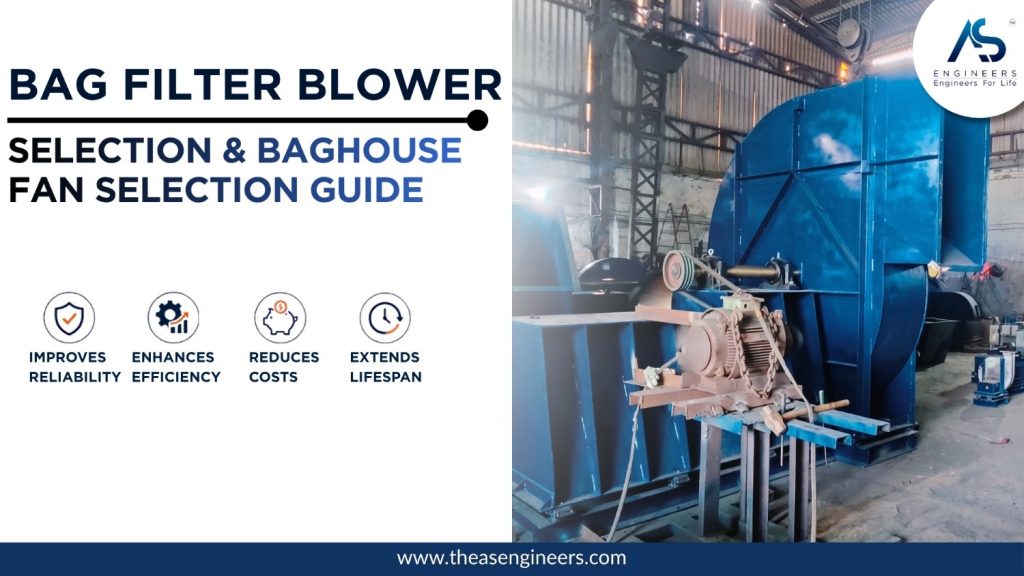
Bag Filter Blower Selection and Baghouse Fan Selection Guide

Bag filter blower selection should start with actual airflow and total static pressure, not motor HP alone. For baghouse fan selection, calculate the air volume required at the dust source, then add pressure losses from ducting, bends, hoods, bag filter housing, filter cake, dampers, stack, and accessories. The fan must maintain stable suction without exceeding the bag filter’s design air-to-cloth ratio.
A bag filter is not a standalone box. It works as part of a complete air circuit. The blower or ID fan decides whether dust is captured properly, whether the filter bags clean correctly, and whether the system runs with stable pressure drop.
At AS Engineers, we review bag filter and blower duty together because wrong fan selection can create poor dust capture, high bag pressure drop, short bag life, motor overloading, high vibration, and unstable plant operation. For complete dust collection projects, buyers can also review AS Engineers’ bag filter systems and wider pollution control equipment range.
What is a bag filter blower?
A bag filter blower is the fan or centrifugal blower that moves dust-laden air or process gas through a bag filter system. It creates the suction or draft required to capture dust from the source, pull it through the ducting and filter bags, and discharge cleaned air through the outlet duct or stack.
In many industrial plants, the blower is placed after the bag filter on the clean-air side. This is often called an ID fan or baghouse fan. In some applications, the fan may be installed before the collector on the dirty-air side, but that requires more careful impeller, casing, wear, sealing, and maintenance consideration.
Bag filter blower selection answer block
For correct bag filter blower selection, define these inputs before asking for a quotation:
| Selection input | Why it matters |
|---|---|
| Airflow, CFM or m³/hr | Decides whether the system can capture dust from all pickup points. |
| Total static pressure | Decides whether the fan can overcome duct, filter, stack, and equipment resistance. |
| Bag filter pressure drop | Dirty-bag or end-of-cycle pressure must be included, not only clean-bag pressure. |
| Dust type and dust load | Affects impeller choice, wear risk, filter media, hopper design, and cleaning load. |
| Gas temperature | Affects fan material, bearing arrangement, expansion, filter media, and density correction. |
| Moisture and stickiness | Wet or sticky dust can blind filter bags and increase system resistance. |
| Air-to-cloth ratio | Controls filtration velocity, pressure drop, cleaning frequency, and bag life. |
| Fan location | Clean-side and dirty-side fans have different wear, leakage, and maintenance risks. |
| Motor power and control | Motor must handle actual duty, startup load, damper position, and future operating margin. |
| Safety condition | Combustible, toxic, corrosive, or hot gas duties need engineering and EHS review. |
Baghouse fan selection is not the same as buying a standard blower
A standard blower can move air, but a baghouse fan must move air through a resistance-changing system. As dust builds on filter bags, pressure drop changes. When cleaning pulses operate, pressure drop changes again. If the fan curve, motor selection, damper setting, and filter design do not match, the plant may face unstable airflow.
The most common mistake I see in baghouse fan selection is starting with “How many HP blower do we need?” That is the wrong first question. Motor HP is the result of airflow, pressure, gas density, efficiency, drive losses, and service factor. It should not be the starting point.
For deeper fan and blower fundamentals, AS Engineers has a practical guide on centrifugal blower design and a separate guide on centrifugal blowers for dust collection systems.
How to select a blower for a bag filter system
Start with airflow at the dust source
The blower must create enough airflow at the pickup hood, duct entry, transfer point, mixer, crusher, dryer vent, silo vent, packing machine, grinding section, furnace exhaust, or bagging point.
Do not estimate airflow from blower size alone. First identify:
- Number of dust generation points
- Hood opening size
- Required capture velocity
- Process gas volume
- Duct branch layout
- Simultaneous operating points
- Leakage allowance
- Future expansion requirement
If airflow is lower than required, dust escapes at source. If airflow is too high, the bag filter may exceed its design air-to-cloth ratio, causing high filtration velocity, deeper dust penetration, more cleaning load, and shorter bag life.
Calculate total static pressure
For baghouse fan selection, total static pressure should include the complete system resistance.
Simple formula for selection thinking:
Total static pressure = pickup hood loss + duct friction + bend losses + entry losses + cyclone or pre-separator loss + bag filter pressure drop + dirty filter cake resistance + outlet duct + stack loss + damper or silencer loss + safety margin
This should be calculated at the operating airflow. Guessing pressure from a similar plant can be risky because duct length, number of elbows, dust loading, gas temperature, bag condition, and stack height can change the duty completely.
Use dirty-bag pressure drop, not only clean-bag pressure
A new bag filter has lower pressure drop. As dust cake forms, resistance increases. The fan must be selected so it can maintain the required airflow at the normal operating pressure drop, including end-of-cycle filter resistance.
If the fan is selected only for clean-filter pressure, the system may work for the first few days and then lose suction as the bags load with dust.
Check air-to-cloth ratio before finalizing the fan
Air-to-cloth ratio is the airflow passing through each square foot or square meter of filter media. If the fan pulls more air than the filter area is designed for, filtration velocity increases. That can cause high pressure drop, frequent pulsing, dust penetration, visible emissions, and short bag life.
If the fan pulls too little air, dust capture at the source becomes weak. The correct solution is not always a bigger fan. Sometimes the filter area, duct layout, cleaning system, or hood design must be corrected first.
EPA fabric-filter guidance also warns that overestimating gas-to-cloth ratio can increase pressure drop, particle penetration, cleaning frequency, and reduce fabric life, while too low a ratio can unnecessarily increase baghouse size and cost.
Clean-side fan vs dirty-side fan
| Fan position | Where it is installed | Typical advantage | Main caution |
|---|---|---|---|
| Clean-side fan / induced draft fan | After the bag filter | Fan handles filtered air, lower impeller wear, easier maintenance in many cases | Baghouse casing must handle negative pressure and leakage must be controlled |
| Dirty-side fan / forced draft fan | Before the bag filter | Can push dust-laden air into the collector where process layout demands it | Impeller wear, dust buildup, sealing, imbalance, and maintenance risk are higher |
| Booster fan | In longer duct networks or special layouts | Helps overcome long duct resistance | Must not disturb capture balance or exceed filter design flow |
| High-temperature fan | Hot gas or dryer exhaust duty | Handles elevated temperature duty | Requires temperature-specific material, bearing, expansion, and safety review |
| Abrasion-resistant fan | Heavy dust, abrasive fines, minerals, cement, metals | Better wear resistance | Needs correct impeller, liner, RPM, and dust loading review |
For most bag filter duties, a clean-side induced draft arrangement is often easier to maintain because the fan sees cleaner gas. But it is not a universal rule. Sticky dust, hot gases, corrosive vapours, explosive dust risk, long duct layouts, and process pressure requirements can change the selection.
Which centrifugal blower type is suitable for a bag filter?
The blower type depends on dust condition, pressure, flow, temperature, and whether the fan is on the clean side or dirty side.
AS Engineers’ centrifugal blower range includes backward curved blowers, backward inclined blowers, high-pressure radial blade blowers, exhauster radial blowers, high-temperature plug blowers, and abrasion-resistant exhauster air-handling blowers. The catalog selection factors include application, density, temperature, dust load, humidity, site location, altitude, material of construction, impeller blade design, and motor mounting arrangement.
| Blower type | Suitable starting point | Selection caution |
|---|---|---|
| Backward curved blower | Cleaner air, efficient air movement, many industrial ventilation and collection duties | Not ideal for heavy dust-laden dirty-side duty without review |
| Backward inclined blower | Clean-side baghouse fan duty where stable airflow and lower noise are priorities | Must be matched to pressure curve and system resistance |
| Radial blade blower | Dusty, abrasive, or heavy-duty air-handling applications | May have different efficiency and noise profile compared with backward designs |
| High-temperature plug blower | Hot exhaust, furnace, dryer, or high-temperature process gas duty | Needs temperature, expansion, bearing, and material review |
| Exhauster air-handling blower | Dusty or abrasive construction-style duty | Wear, balancing, and inspection access must be considered |
AS Engineers also supports industrial centrifugal blower selection and custom centrifugal blower for pollution control systems where standard blower selection is not enough.
Main design inputs for baghouse fan selection
Airflow and process duty
Airflow should be stated in CFM, m³/hr, Nm³/hr, or actual m³/hr, with the temperature and pressure basis clearly mentioned. A fan selected for normal volume and a fan selected for actual hot gas volume can give different results.
Important questions:
- Is the airflow from one pickup point or multiple branches?
- Will all branches run together?
- Is the source open, enclosed, or hooded?
- Is the system continuous or batch-operated?
- Is the fan expected to handle future expansion?
Static pressure and system resistance
Static pressure should include the full duct path. Long ducting, multiple bends, undersized duct, high dust deposits, narrow entry points, wet scrubber before or after the filter, cyclone pre-separator, stack height, and silencer can all increase pressure demand.
A fan that looks suitable on paper can fail if the pressure calculation misses duct resistance.
Dust load and dust behavior
Dust load affects both the bag filter and the blower. Cement dust, coal dust, fly ash, flour, metal powder, pigment, fertilizer dust, pharmaceutical powder, and chemical fines do not behave the same way.
Check:
- Particle size
- Bulk density
- Abrasiveness
- Stickiness
- Moisture content
- Hygroscopic behavior
- Electrostatic behavior
- Combustibility
- Corrosive components
- Product recovery requirement
Temperature and gas density
Hot gas has lower density than ambient air. Fan performance, motor power, actual volume, material selection, and bearing arrangement can change with temperature.
For high-temperature duties, the RFQ should clearly mention:
- Normal temperature
- Maximum upset temperature
- Gas composition
- Insulation requirement
- Expansion joints
- Cooling disc or cooling arrangement
- Bearing location
- Hot shutdown condition
MOC and corrosion risk
Material of construction depends on gas composition, dust abrasiveness, moisture, acidity, alkalinity, temperature, and process chemicals.
Common review points include:
- MS or carbon steel for general dry dust
- SS 304 or SS 316 where corrosion or hygiene requirement exists
- Hard-facing, liners, or wear-resistant design for abrasive dust
- Special sealing where leakage, odour, or fumes matter
Do not finalize MOC from industry name alone. A chemical plant can have mild dust in one line and corrosive vapour in another line.
Bag filter blower sizing formula, for concept only
A basic fan power concept is:
Fan power = Airflow × Pressure ÷ Fan efficiency
In SI form:
kW = Q × ΔP ÷ (1000 × efficiency)
Where:
Q= airflow in m³/sΔP= pressure in Paefficiency= fan efficiency as a decimal
This is only a concept formula. Final motor power must consider fan curve, gas density, mechanical losses, belt or coupling drive losses, temperature, service factor, duty variation, damper or VFD operation, starting condition, and engineering margin.
For RFQ and final design, do not select the blower from this formula alone.
Common mistakes in bag filter fan selection
| Mistake | What happens in the plant |
|---|---|
| Selecting blower by HP only | Wrong airflow or pressure, unstable dust capture, possible motor overloading |
| Ignoring dirty-filter pressure drop | System works initially, then suction falls after dust cake builds |
| Oversizing the fan | High air-to-cloth ratio, bag wear, excess pulsing, high power use, dust carryover risk |
| Undersizing the fan | Poor hood suction, dust leakage, low capture efficiency, housekeeping problems |
| Wrong impeller for dusty duty | Impeller erosion, buildup, imbalance, vibration, bearing failure |
| Ignoring duct layout | High pressure loss, uneven branch suction, poor system balance |
| No density correction | Fan underperforms in hot gas or high-altitude duty |
| No access for maintenance | Bag change, damper setting, bearing inspection, and cleaning become difficult |
| No combustible dust review | Fire or explosion risk may be missed in powder handling duties |
| Treating bag filter and fan as separate purchases | Air circuit mismatch between collector resistance and fan curve |
Maintenance and operating checks after installation
Even a correctly selected baghouse fan can create problems if installation and maintenance are weak.
Maintenance teams should monitor:
- Differential pressure across the bag filter
- Fan vibration
- Bearing temperature
- Belt tension or coupling alignment
- Damper position
- Duct dust accumulation
- Air leakage at flanges and access doors
- Bag cleaning pulse pressure
- Compressed air quality for pulse-jet systems
- Hopper discharge and rotary airlock operation
- Stack observation or outlet dust trend
- Motor current trend
Pressure drop should not be treated as a random number. It tells the operator whether the filter bags are cleaning correctly, whether dust cake is too heavy, whether bags are blinded, or whether airflow is outside the expected range. Air pollution control technology guidance also highlights regular temperature and pressure checks, filter inspection, accessibility for maintenance, and leak detection for properly maintained fabric filters.
EHS note for combustible dust and hazardous dust
For combustible dust, toxic dust, explosive dust, solvent vapour, high-temperature gas, or corrosive fumes, baghouse fan selection must go beyond airflow and static pressure. The system may need dust hazard analysis, explosion venting, isolation, grounding, spark control, safe duct routing, and plant-specific EHS review.
OSHA’s combustible dust guidance notes that deflagrations inside dust processing, conveying, storage, and collection equipment can lead to explosions, and equipment with explosion hazards should be designed with prevention or protection measures referenced to applicable NFPA standards. NFPA now also lists NFPA 660 as the standard for combustible dusts and particulate solids.
This article is for selection education only. Final design for hazardous or combustible dust duties should be reviewed by qualified engineering and safety professionals.
RFQ checklist for bag filter blower selection
Share these details with AS Engineers for faster and more accurate review:
- Application and industry
- Dust source and process equipment
- Airflow required, CFM or m³/hr
- Normal and maximum gas temperature
- Inlet dust concentration, if available
- Dust type, particle size, abrasiveness, moisture, and stickiness
- Combustible or hazardous dust condition, if known
- Duct layout with approximate length and bends
- Number of pickup points and branch lines
- Bag filter type, pulse-jet, reverse air, shaker, or existing system
- Existing pressure drop, if replacing a fan
- Required outlet condition or emission requirement
- Fan location, before or after bag filter
- Stack height and outlet duct details
- Available space and foundation condition
- Power supply, motor preference, VFD requirement
- Material of construction preference, if any
- Noise limitation, if applicable
- Existing operating problems, vibration, low suction, bag blinding, high current, or dust leakage
For plant teams planning a new bag filter system, start with AS Engineers’ baghouse systems guide and baghouse filters guide. For blower-focused selection, the AS Engineers ecosystem also includes a support guide on high pressure blowers in bag filter applications.
When to repair, retrofit, or replace the baghouse fan
Replacement is not always the first answer. In many existing bag filter systems, the problem may be caused by duct choking, bag blinding, wrong damper setting, leakage, worn impeller, belt slip, poor alignment, or changed process load.
Consider inspection or retrofit when:
- Suction has reduced after process expansion
- Motor current is higher than normal
- Fan vibration has increased
- Bags are failing frequently
- Dust is escaping from hoods
- Pressure drop is too high or unstable
- Production has increased beyond original design
- Ducting has been modified without fan review
- Existing fan is running away from its best efficiency zone
AS Engineers supports centrifugal blower services such as performance analysis, engineering surveys, retro-fitment, repair, on-site alignment, on-site balancing, customized engineering solutions, AMC, and site-based design.
FAQs
What is the difference between a bag filter blower and a baghouse fan?
A bag filter blower and baghouse fan usually refer to the same air-moving function in a dust collection system. The fan creates suction or draft to move dust-laden air through ducting and the bag filter. In many plants, the term baghouse fan is used when the fan is installed after the collector as an induced draft fan.
Should the fan be installed before or after the bag filter?
In many dust collection systems, the fan is installed after the bag filter on the clean-air side to reduce impeller wear. However, the final position depends on process layout, dust load, gas temperature, leakage risk, pressure requirement, and safety condition.
What causes low suction in a bag filter system?
Low suction can be caused by undersized fan selection, high filter pressure drop, blinded bags, duct choking, air leakage, worn impeller, wrong damper position, belt slip, poor fan speed, or increased system resistance after plant modification.
Can I increase bag filter performance by installing a bigger blower?
Not always. A bigger blower can exceed the design air-to-cloth ratio, increase bag wear, raise power consumption, and disturb filtration. First check airflow requirement, duct resistance, filter area, bag condition, cleaning system, and fan curve.
What information is needed for baghouse fan selection?
For baghouse fan selection, share airflow, static pressure, duct layout, bag filter pressure drop, dust type, dust load, gas temperature, moisture, fan position, material of construction, power supply, safety condition, and operating duty.
Conclusion
Bag filter blower selection is a system-level decision. The correct fan is not selected by motor HP alone. It must be matched with airflow, static pressure, dust load, gas temperature, duct resistance, bag filter pressure drop, air-to-cloth ratio, impeller design, motor power, and safety condition.
A properly selected baghouse fan helps the dust collection system maintain stable suction, better filter operation, predictable pressure drop, and easier maintenance. A wrong fan can create repeated dust leakage, bag failure, high current, vibration, and unstable plant performance.
If you are planning a new bag filter, replacing an existing baghouse fan, or troubleshooting low suction in a dust collection system, share your process data with AS Engineers. The team can review the full air circuit and suggest a suitable bag filter, centrifugal blower, ID fan, cyclone, scrubber, or complete pollution-control configuration based on actual site conditions.
Contact AS Engineers with your airflow, pressure, dust, temperature, and layout details for a duty-specific review.
