
Bag Filters for Different Industries: How to Choose the Right System

If you are selecting a bag filter for a cement plant, chemical unit, food process line, boiler exhaust, powder handling section, or general dust collection duty, the right choice depends on the process, not just the equipment name. A bag filter has to be matched to dust characteristics, gas temperature, moisture level, airflow, maintenance access, and cleaning method. That is where practical engineering matters. AS Engineers designs bag filter systems for industrial pollution control applications where stable performance, maintainability, and process-fit are more important than generic catalogue claims.
A well-selected bag filter helps control particulate emissions, protects downstream equipment, improves housekeeping, and supports cleaner plant operation. In many facilities, the real challenge is not deciding whether a bag filter is needed. The challenge is choosing the right configuration for the material, temperature, duty cycle, and layout available at site.
Where bag filters are commonly used
Bag filters are widely used in process and manufacturing environments where dry particulate has to be separated from an air or gas stream. Typical applications include cement and minerals handling, chemical and fertilizer plants, food and beverage processing, pharmaceutical powder handling, metal and foundry sections, pulp and paper operations, woodworking dust collection, and general material transfer points. These applications may all use a bag filter, but the design basis is never identical from one industry to another.
For example, a system handling dry free-flowing dust behaves very differently from one handling sticky fines, abrasive powder, or hot exhaust gas. In one plant, the priority may be emission control. In another, it may be product recovery, easy maintenance, or reduced dust escape near work zones. That is why bag filter selection should start with the application details rather than a standard model approach.
What changes from one industry to another
From an engineering point of view, the most important selection factors are usually:
1. Dust characteristics
Particle size, bulk density, abrasiveness, and whether the material is dry, fibrous, sticky, or hygroscopic all affect filter media selection, hopper design, and cleaning behaviour.
2. Gas temperature and moisture
Temperature range and moisture content influence bag material choice, condensation risk, and long-term reliability.
3. Air volume and process duty
The bag filter has to be sized around the actual gas load and operating pattern, not estimated casually. Continuous-duty sections and intermittent-duty sections may need different approaches.
4. Cleaning method
Depending on the application, pulse-jet, reverse-air, or other cleaning arrangements may be more suitable.
5. Layout and maintenance access
Installation height, access for bag replacement, hopper discharge arrangement, duct routing, and plant constraints often decide what is practical on site.
6. Integration with the rest of the system
In many cases, the bag filter is only one part of the overall pollution control arrangement, alongside ducting, hoppers, rotary airlocks, fans, chimneys, and discharge handling.
This is also why two bag filters with a similar external appearance may behave very differently in service. A system that works well for powder transfer may not be suitable for a hot process exhaust line. A design that handles free-flowing dust may not remain trouble-free when the dust becomes sticky or moisture-sensitive. Practical selection avoids these mismatches early.
Common bag filter arrangements in industry
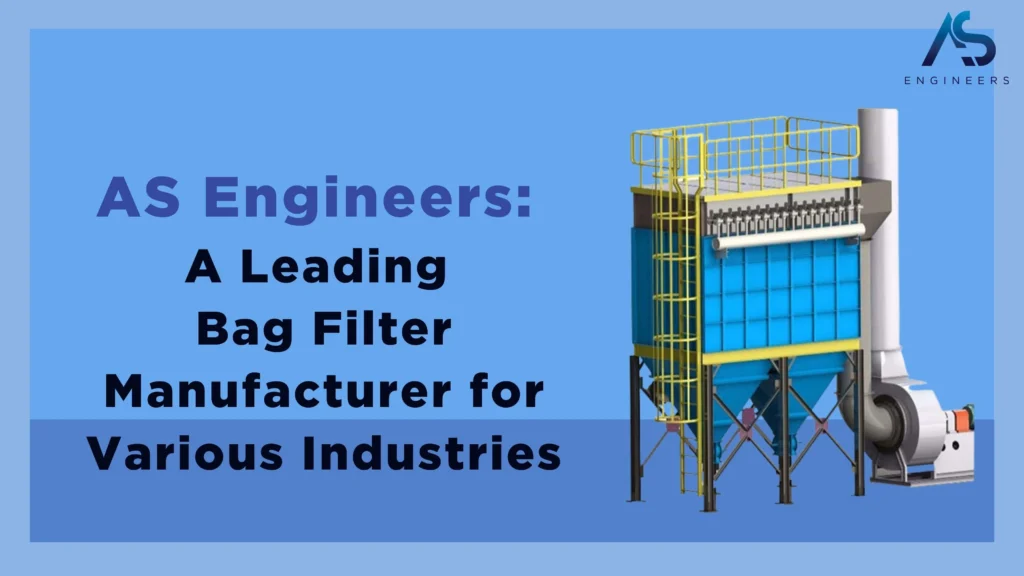
In industrial use, bag filters are commonly configured around the duty they have to perform. Some applications call for compact dust collection at transfer points. Others need larger pulse-jet bag filter systems for continuous process exhaust. In heavier-duty sections, the system may also include hoppers, discharge devices, ducting, an induced-draft or centrifugal fan, and stack discharge.
Where the dust load is high, it may also be practical to review whether a Cyclone Separator should be used ahead of the bag filter to reduce the burden on the filter section. Where the contaminant profile includes fumes, gases, or wet scrubbing requirements, a Scrubber may be more suitable for that part of the duty. For plants evaluating a broader solution, the Pollution Control Equipment range should be considered as a system, not as isolated equipment items.
How AS Engineers approaches bag filter selection
At AS Engineers, the starting point is the application. We look at what is being handled, where the dust is generated, how the air is being moved, what operating conditions the system will see, and what the plant needs from the final installation. That makes a difference in day-to-day performance because a bag filter should not only collect dust well on paper. It should also be workable for operators and maintenance teams after installation.
For buyers comparing suppliers, the practical questions are straightforward. Is the system being selected around the actual process? Is the design realistic for site conditions? Is maintenance access being considered early? Can the supplier support related equipment within the same pollution control line? These are the questions that usually matter more than broad sales language.
If you want to review the core commercial page, visit our Bag Filters Manufacturer page. If your requirement includes surrounding dust control equipment, it also makes sense to review Pollution Control Equipment, Cyclone Separator, and Scrubber options together. For sector-specific evaluation, our Industries page gives a broader view of the environments we serve.
What to share before asking for a bag filter quotation
A faster and more accurate technical discussion usually starts when the process team shares a few basic inputs:
- process or application description
- source of dust generation
- air volume or approximate gas quantity
- temperature and moisture condition
- nature of dust or particulate
- operating hours and duty cycle
- layout limitations or available installation space
- existing system issues, if this is a replacement or retrofit case
Providing this information early helps reduce guesswork and leads to a more suitable bag filter recommendation. In retrofit situations, it also helps identify whether the problem is really the filter housing, the filter bags, the cleaning arrangement, the duct layout, or the fan-system balance.
Bag filter selection by industry: practical examples
In cement, minerals, and bulk solids handling, the priority is often continuous dust collection and manageable maintenance under dusty operating conditions. In chemical and fertilizer plants, media compatibility and process behaviour become more important. In food and pharmaceutical applications, cleanliness, controlled dust handling, and stable operation matter more. In metals, boilers, and thermal process sections, temperature and particulate loading may become the deciding design factors. The equipment category is the same, but the engineering basis changes with the process.
That is the reason a serious bag filter manufacturer should be discussing application data, not only price. A lower initial quote can easily become an expensive choice if the system is difficult to maintain, overloaded in service, or selected without considering the actual dust and gas conditions. Good selection work reduces those risks at the start.
Frequently asked questions
What does a bag filter do in an industrial plant?
A bag filter separates particulate matter from an air or gas stream by passing the stream through filter media that retains dust while allowing cleaner air to pass.
Which industries use bag filters?
Bag filters are commonly used in cement, chemicals, food processing, pharmaceuticals, metals, pulp and paper, mining, woodworking, and other process industries where dust collection or particulate control is required.
How do I know whether I need a bag filter, cyclone separator, or scrubber?
That depends on the nature of the pollutant, dust loading, gas condition, and process duty. Dry particulate collection may suit a bag filter, high dust loading may benefit from pre-separation with a cyclone, and gas or fume treatment may call for a scrubber-based approach.
What information is needed to size a bag filter correctly?
At minimum, the supplier should understand the application, airflow, temperature, moisture condition, particulate nature, operating hours, and layout constraints.
When should an existing bag filter system be reviewed?
A review is worth doing when you see rising pressure drop, poor dust capture, repeated bag failures, difficult maintenance access, excessive dust escape, or unstable system performance after process changes.
If you are evaluating a bag filter for a new project, replacement duty, or retrofit requirement, contact AS Engineers with your process details. Our team can review the duty, understand the operating conditions, and guide you toward a more suitable solution for your plant. You can also visit the Contact page for a direct discussion or check the FAQ page for broader equipment questions.
