
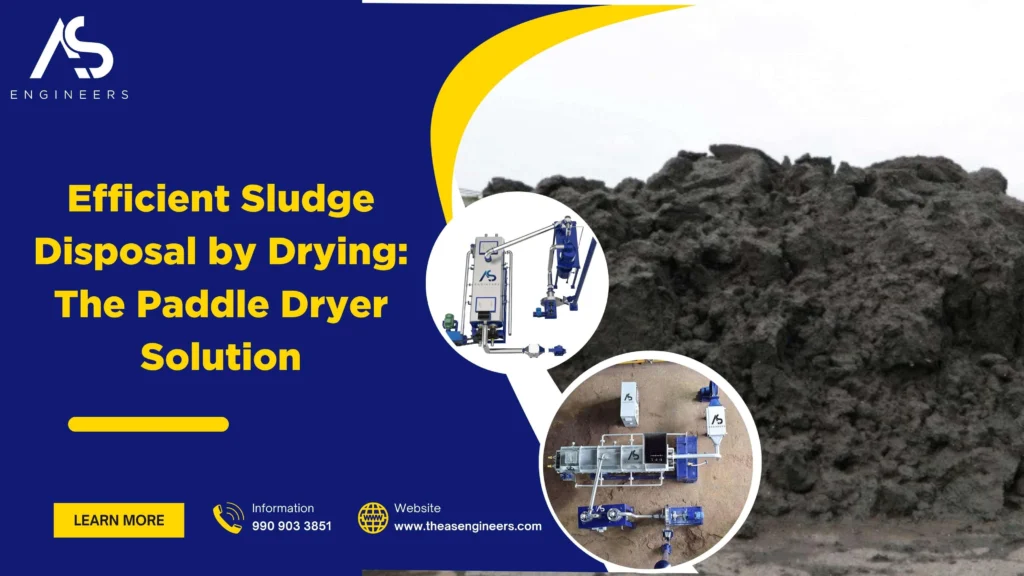
Sludge Drying for Disposal Cost Reduction: Why Paddle Dryers Are a Practical Solution

Sludge disposal becomes expensive when the material still carries high moisture. In most plants, the real problem is not just sludge generation. It is the cost and difficulty of handling, storing, transporting, and disposing of wet sludge day after day. When sludge stays heavy, sticky, and difficult to manage, disposal costs rise and plant operations become harder to control.
That is where thermal sludge drying becomes useful.
A paddle dryer helps reduce sludge moisture in a controlled and continuous way, so the material becomes lighter, easier to handle, and more suitable for disposal or further reuse. For ETP, CETP, STP, process plants, and waste-to-value projects, this can make a major difference in day-to-day sludge management.
If you are evaluating a paddle dryer or a dedicated sludge dryer, the main question is simple: can drying reduce your disposal burden enough to justify the system? In many cases, the answer depends on current moisture, disposal cost per ton, available heating media, and how the dried solids will be handled after discharge.
Why wet sludge is costly to manage
Wet sludge creates operational problems at multiple points in the process.
First, it increases transport and disposal cost because you are paying to move water along with solids. Second, it occupies more storage volume and creates handling issues at the plant. Third, higher moisture often means odour, mess, and poor housekeeping around the sludge area. In many facilities, sludge disposal is not just a utility problem. It becomes a recurring production and compliance problem.
Typical pain points include:
- High disposal cost per ton of wet sludge
- Difficult handling during loading and unloading
- Larger storage requirement before dispatch
- Odour and hygiene concerns
- Inconsistent sludge condition from one batch to another
- Limited options for further utilization or co-processing
For this reason, many plants first dewater sludge mechanically and then use thermal drying to reduce the remaining moisture further. A well-designed drying step can convert difficult wet sludge into a more stable, manageable solid.
Where a paddle dryer fits in sludge management
A paddle dryer is an indirect contact dryer. Instead of depending on large volumes of hot air, it transfers heat through heated surfaces while the material is continuously mixed and moved forward inside the machine.
For sludge applications, this matters because the feed is often pasty, sticky, or variable in consistency. The dryer must not only supply heat. It must also keep the material moving, expose fresh wet surface, and avoid dead zones that reduce drying efficiency.
This is why paddle dryers are commonly considered for sludge streams that need:
- Controlled moisture reduction
- Continuous operation
- Lower off-gas volume than direct hot-air systems
- Compact plant integration
- Enclosed handling for better housekeeping
Plants comparing technologies often also look at Paddle Dryer Services when they already operate a dryer and want performance improvement, repairs, upgrades, or retrofitting support.
How sludge drying works in a paddle dryer
In practical terms, sludge drying usually starts after upstream thickening or dewatering. The wet cake or sludge feed is introduced into the dryer through a suitable feeding arrangement. Inside the dryer, heated surfaces transfer energy into the material while rotating elements keep the sludge agitated and moving.
As moisture evaporates, the sludge gradually becomes drier and easier to discharge. Depending on the process requirement, the final product may be targeted for lower transport weight, safer disposal, co-processing, or downstream reuse.
The exact system arrangement depends on the application, but a sludge drying setup may include:
- Feed system for wet sludge
- Paddle dryer body and drive
- Heating system based on steam or thermic fluid
- Vapour handling and condensation or exhaust treatment
- Product discharge and conveying arrangement
- Optional pollution control equipment, depending on the process
For plants planning a complete evaluation, it is useful to review not only the dryer but also feeding, vapour management, product discharge, and maintenance access from the beginning.
Why paddle dryers are a practical option for sludge disposal
1. Lower disposal and transport burden
The most direct benefit of drying is that it reduces the weight and volume burden associated with wet sludge. That can lower transport frequency, reduce disposal tonnage, and make logistics easier to manage.
2. Better material handling
Wet sludge is often difficult to store, load, and transfer. Once moisture is reduced, handling generally becomes cleaner and more controlled. This helps operators, housekeeping teams, and maintenance teams.
3. Compact process integration
Many plants do not have unlimited floor space for sludge management. A paddle dryer-based system can often be integrated into an existing process line more practically than larger drying arrangements that require high air movement and larger auxiliary systems.
4. Controlled and enclosed operation
For facilities dealing with odour, hygiene, or environmental handling concerns, enclosed drying is often preferred over more open handling methods. This supports cleaner operation and better plant-level control.
5. Suitability for variable sludge conditions
Sludge rarely behaves like a uniform product. Feed consistency can change based on upstream treatment, solids concentration, and seasonal or process variation. Paddle dryers are often selected for these kinds of demanding materials because the system is built to both heat and agitate the feed.
When sludge drying makes the most sense
Sludge drying is usually worth serious consideration when one or more of these conditions apply:
- Disposal cost of wet sludge is already high
- The plant generates sludge continuously
- Storage and handling are becoming difficult
- The sludge must be prepared for reuse, co-processing, or easier transport
- Mechanical dewatering alone is not enough
- The plant wants a more controlled and cleaner sludge handling process
This is especially relevant in ETP, CETP, STP, chemical, pharmaceutical, dye-intermediate, food process, and other industrial facilities where sludge disposal is a recurring operating expense rather than a one-time issue.
What to evaluate before selecting a sludge dryer
Before finalizing a system, the correct approach is to evaluate the sludge and the plant conditions properly. A good sludge drying decision should not be based on dryer size alone.
The key points to assess are:
Feed characteristics
Initial moisture, particle nature, stickiness, flowability, and variability of sludge feed all influence dryer design.
Required final moisture
Some plants only want lower disposal weight. Others need a drier product for handling, storage, or reuse. This changes the heat load and residence time requirement.
Throughput
The hourly and daily sludge load must be defined clearly. Oversimplified estimates often result in under-sized or over-sized systems.
Heating media availability
Available steam, thermic fluid, or another heating arrangement will affect system selection and operating economics. For plants assessing utility compatibility, ASE also has a useful page on paddle dryer heating medium and fuel options.
Vapour and emission handling
Drying is not only about moisture removal inside the machine. The vapours generated during drying also need a proper handling strategy.
Maintenance and serviceability
Bearing access, drive arrangement, wear points, shaft condition, and cleaning approach all matter over the long run. Plants already running a unit can also consider Paddle Dryer Rental Service or service support where trials, temporary needs, or evaluation flexibility are important.
Disposal reduction is only one part of the value
Many buyers start with the goal of reducing disposal cost, and that is valid. But the practical value of sludge drying often goes beyond disposal alone.
A better sludge drying system can also improve:
- Cleanliness around the sludge handling area
- Ease of storage and transfer
- Process continuity
- Operator convenience
- Overall control of the sludge management line
In some applications, drying may also support downstream utilization, depending on the nature of the solids and local disposal or reuse pathways. That decision must always be evaluated case by case.
Choosing the right partner for sludge drying
A sludge dryer should be selected as a process solution, not just as a machine. Feed system, heat source, sludge behaviour, required dryness, vapour management, and discharge arrangement all need to work together.
If your plant is dealing with high sludge disposal cost, difficult wet cake handling, or recurring sludge management issues, it is worth reviewing the complete drying requirement with an application-focused team.
You can explore ASE’s sludge dryer solutions, review the main paddle dryer product page, or contact the AS Engineers team to discuss your sludge type, moisture level, and daily load.
Final thoughts
Sludge drying is not only about removing moisture. It is about making sludge easier and more economical to manage in real plant conditions.
Where wet sludge is creating disposal, storage, transport, or housekeeping problems, a paddle dryer can be a practical and commercially sensible solution. With the right process design, sludge drying can reduce disposal burden, improve handling, and support a more controlled waste management system.
