
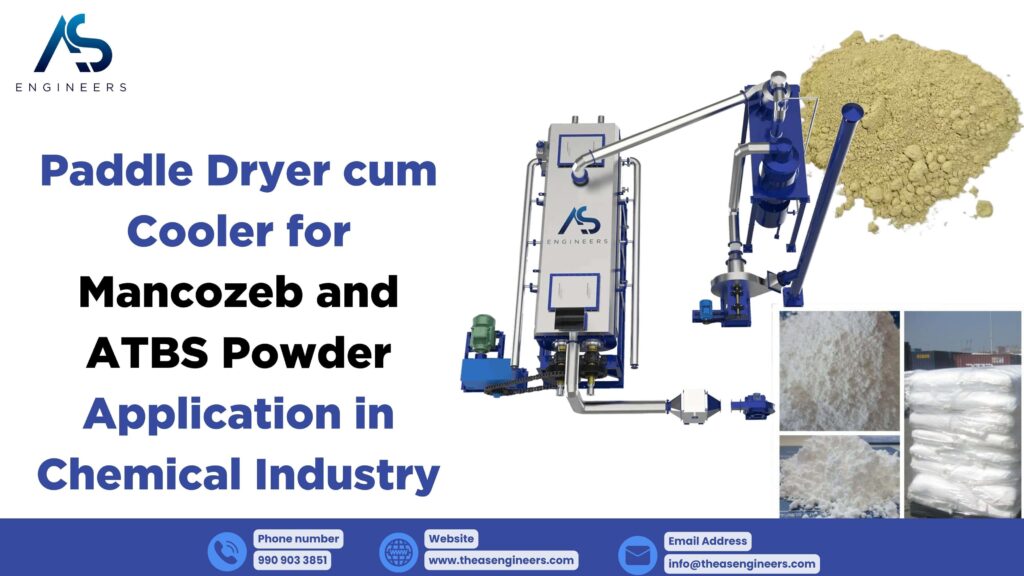
Paddle Dryer cum Cooler for Mancozeb and ATBS Powder Application in Chemical Industry

In chemical powder processing, drying alone is not always enough. For materials like mancozeb and ATBS powder, the process often has to do two jobs properly: remove moisture to the required level and bring the product down to a more suitable discharge temperature for handling, storage, packing, or downstream transfer. That is where a paddle dryer cum cooler becomes a practical process solution instead of using separate equipment for each stage. ASE’s current page already positions this as a combined drying-and-cooling application page, and ASE’s product pages present paddle dryers as indirect-contact systems used for drying, heating, and cooling across chemical duties.
A Paddle Dryer cum cooler is suitable for this type of chemical-duty application because it combines controlled indirect heat transfer with continuous agitation and product movement. The drying section helps reduce moisture through heated surfaces, while the cooling section helps condition the product before discharge. This is especially useful where powder quality, flow behaviour, and discharge condition matter as much as the drying step itself. General paddle dryer references also consistently describe the technology as an indirect system for powders, granules, and pasty materials, with the ability to handle drying and cooling duties in a compact process arrangement.
Why a dryer cum cooler matters in mancozeb and ATBS powder handling
For powder applications in the chemical industry, the challenge is usually not just moisture reduction. Plants also need stable product handling after drying. If a powder leaves the system too warm, it can affect storage, conveying, bagging, or downstream process control. If the drying is uneven, it can lead to inconsistent discharge behaviour and quality variation across the batch or continuous line.
That is why a paddle dryer cum cooler can be a better fit than a simple dryer-only arrangement in selected applications. It helps process teams manage two important objectives in one integrated system:
- controlled drying
- product conditioning before discharge
For mancozeb and ATBS powder applications, this combined approach is especially relevant where the plant wants a cleaner process layout, more controlled product movement, and a better-conditioned discharge for the next step.
How the system works in this application
In a paddle dryer cum cooler, the wet or damp powder is fed into the machine in a controlled manner. Inside the unit, rotating paddles continuously move and mix the material while the heated surfaces transfer energy indirectly for moisture removal. After the required drying zone, the material can be brought through a cooling zone so the final discharge condition is more suitable for handling and transfer.
This type of configuration is useful because it supports:
- more uniform heat exposure across the product
- continuous movement of the powder through the machine
- reduced dependence on large direct hot-air volumes
- a more compact process arrangement for drying and cooling
- better discharge condition for conveying, storage, or packing
ASE’s core paddle dryer positioning and broader paddle-dryer references both align with this indirect-contact, continuous-process logic for powder-duty chemical applications.
Why this approach can suit mancozeb and ATBS powder
Controlled product treatment
In chemical powder applications, the process should be selected around product behaviour, not only evaporation rate. A paddle dryer cum cooler gives more process control by combining moisture reduction and product cooling in one machine path.
Better discharge readiness
Where the downstream section depends on stable feeding, packing, or transfer, cooling after drying can improve the practical discharge condition of the powder.
Indirect heat transfer
Indirect heating is often preferred where plants want more controlled thermal input and lower off-gas volume than a fully direct-contact arrangement.
Compact line integration
Using one integrated drying-and-cooling concept can simplify the process layout when compared with handling the two duties separately.
Continuous process suitability
For plants running continuous chemical production, a paddle dryer cum cooler can fit well into a line where feed consistency, discharge condition, and predictable residence time matter.
What plant and procurement teams should evaluate
A good application page should help buyers ask the right technical questions early.
Feed condition
Is the material coming as filter cake, damp powder, or another intermediate form? Selection should reflect the actual feed state and moisture range.
Final moisture requirement
The required dryness should be defined clearly. Some applications need very low residual moisture, while others need only the level required for stable downstream use.
Final discharge temperature
This is one of the most important reasons to consider a dryer cum cooler instead of a standard dryer. The cooling requirement should be defined around the next process step.
Material behaviour
Powder flow, tendency to cake, thermal sensitivity, and discharge behaviour should all be considered during selection.
Utility availability
The heating and cooling arrangement should be matched with available plant utilities and operating philosophy.
Maintenance and support
For continuous-duty powder handling, serviceability matters. Bearings, seals, shafts, inspection access, and spare-part support should all be reviewed along with the equipment design. Relevant after-sales support is already offered through ASE’s Paddle Dryer Services section.
How AS Engineers can support this application
At AS Engineers, paddle dryer selection is approached around the actual process requirement rather than a standard machine-only offering. For mancozeb and ATBS powder applications, the important inputs are feed condition, required moisture reduction, discharge temperature target, utility availability, and the surrounding handling arrangement needed before and after the equipment.
Our paddle dryer systems are designed for continuous industrial duty and can be configured with the supporting process sections needed around the core machine, including feeding, heating, vent handling, and discharge systems. ASE’s published product material also highlights pilot-trial support and application evaluation, which is useful where powder behaviour, drying response, or final discharge condition need to be validated before project execution.
If your team is evaluating whether a paddle dryer cum cooler is the right solution for mancozeb or ATBS powder, the most useful next step is to review the feed condition and expected discharge requirement in detail. You can also explore ASE’s Paddle Dryer in Chemical Industry page for broader chemical-duty context, or use the Contact page to discuss your application with our team.
