
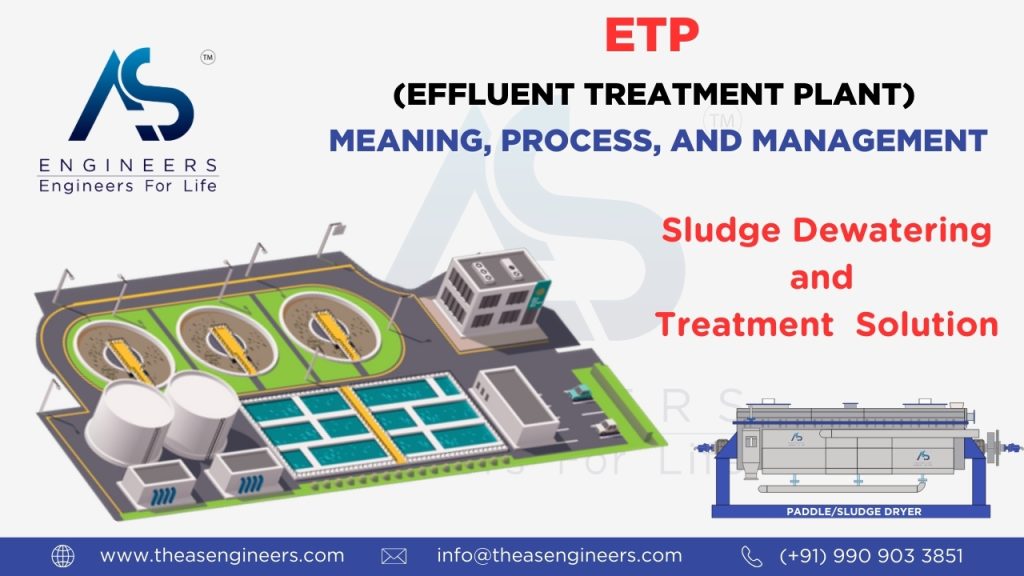
ETP(Effluent Treatment Plant): Meaning, Process, and Management

Every industrial facility in India that generates liquid effluent is legally required to treat that effluent before discharge. The Central Pollution Control Board (CPCB) and the Environment Protection Act 1986 are unambiguous on this point. But the question most plant engineers and purchase managers bring to us is not about the treatment process itself. It is about what happens after treatment.
The treated sludge that accumulates at the bottom of an ETP is one of the most underestimated operational problems in Indian process industry. It is expensive to handle, difficult to dispose of legally, and subject to increasingly strict enforcement under CPCB and National Green Tribunal (NGT) directions. Managing it correctly means understanding the full ETP process, which mechanical equipment each stage depends on, and what drying technology reduces the final sludge handling burden.
I am Karan Dargode, Operations Manager at AS Engineers. We work with ETP operators, plant heads, and production managers across chemical, pharmaceutical, food, textile, and water treatment industries. This article explains the ETP process from inlet to sludge, covers the equipment that keeps each treatment stage running reliably, and walks through the drying economics that make sludge disposal manageable.
What Is an Effluent Treatment Plant and What Does It Do
An Effluent Treatment Plant (ETP) is a facility that treats industrial wastewater to remove contaminants before the water is discharged into a water body, municipal drain, or returned to the process as recycled water. The objective is to bring the treated water to standards set by the relevant State Pollution Control Board (SPCB) and CPCB under the Water (Prevention and Control of Pollution) Act 1974.
Industries required to operate ETPs include pharmaceutical manufacturers, chemical plants, textile dyeing and processing units, food and beverage producers, electroplating facilities, paper mills, and fertilizer plants. In critically polluted areas designated by CPCB, Zero Liquid Discharge (ZLD) compliance is also mandated, meaning no treated water is discharged outside the facility boundary.
The contaminants an ETP must handle vary by industry. Pharmaceutical ETPs manage solvents and active pharmaceutical ingredient residues. Textile ETPs handle reactive dyes and surfactants. Chemical ETPs deal with heavy metals, dissolved organics, and process chemicals. The treatment sequence is broadly similar across industries, even though the specific chemistry differs.
The ETP Treatment Process: Stage by Stage
Stage 1: Collection and Equalisation
Industrial wastewater from multiple process streams enters a collection tank. Flow rates and pollutant concentrations vary across shifts and between processes. The equalisation tank homogenises these fluctuations, providing a consistent feed quality to the downstream treatment units. Without equalisation, peak loads can overwhelm secondary treatment capacity and produce inconsistent treated water quality.
Stage 2: Primary Treatment
Primary treatment removes suspended solids, oils, and coarse particulate matter using physical methods. Bar screens remove large solids. Oil and grease traps separate floating oils. Primary sedimentation tanks allow heavy settleable solids to settle to the bottom as primary sludge. This stage reduces the organic and solid load entering biological treatment by 30 to 50%.
Stage 3: Secondary Treatment
Secondary treatment is where dissolved organic matter is broken down by microorganisms. The three most common methods in Indian industrial ETPs are:
- Activated Sludge Process (ASP): Wastewater is aerated in a tank where a culture of microorganisms oxidises dissolved organics. The aeration tank requires a reliable, continuous air supply delivered by a centrifugal blower sized to the tank volume and oxygen demand. The treated effluent and biomass are separated in a clarifier. The settled biomass is either returned to the aeration tank as return activated sludge (RAS) or removed as waste activated sludge (WAS).
- Sequential Batch Reactor (SBR): A single tank handles aeration, settling, and decanting in timed sequential cycles. SBR systems offer flexibility for variable flow conditions and are increasingly used in pharmaceutical and food industry ETPs.
- Moving Bed Biofilm Reactor (MBBR): Plastic carrier media with high surface area are suspended in the aeration tank. Biofilm grows on the media surface and provides high biological treatment capacity in a compact footprint. MBBR is well-suited to plants with space constraints or high-strength effluent.
The biological stage generates secondary sludge, which is the excess biomass that cannot be returned to the process. This secondary sludge, combined with primary sludge, is the material that must be handled and disposed of at the end of the process.
Stage 4: Tertiary Treatment
Tertiary treatment removes residual contaminants that secondary treatment does not fully address. Common tertiary processes include chemical coagulation and flocculation (using alum or ferric chloride to agglomerate fine particles), multimedia filtration, activated carbon adsorption for residual organics, and disinfection using sodium hypochlorite, UV, or ozonation to inactivate pathogenic microorganisms before discharge.
For facilities under ZLD mandate, the tertiary stage also includes evaporation and crystallisation to recover water from the concentrate stream and produce a dry solid residue for disposal.
Aeration Blowers in ETP: Equipment Selection and Sizing
The activated sludge process depends on uninterrupted aeration. The dissolved oxygen (DO) level in the aeration tank must stay within the 1.5 to 3.0 mg/L range for healthy microbial activity. Below this range, biological treatment slows or fails. Above it, energy cost climbs without a proportional treatment benefit.
Centrifugal blowers sized for aeration service must deliver stable airflow against the submergence pressure of the diffuser system, typically 0.3 to 0.6 bar depending on tank depth and diffuser type. Continuous operation is the baseline expectation, which makes bearing life, impeller balance, and vibration levels as important as the initial airflow specification.
For ETP operators in chemical and pharmaceutical industries where the aeration air must be oil-free, backward curved impeller designs in stainless steel construction prevent contamination of the biological mass. For large installations with multiple aeration zones, individual zone control allows air delivery to match biological demand across different load conditions rather than running at full flow continuously.
AS Engineers designs centrifugal blowers for ETP aeration from the specific airflow and static pressure calculated for each tank volume, diffuser arrangement, and oxygen demand. The approach is application-specific engineering, not catalog selection, which matters when your ETP runs variable loads across shifts and seasons.
The Sludge Problem: Why This Is the Hardest Part of ETP Operation
Every stage of ETP treatment generates sludge. Primary treatment produces primary sludge, heavy in suspended solids. Secondary treatment produces secondary sludge, a biological mass with high water content. Combined sludge from an industrial ETP typically contains 80 to 85% water by weight when it exits the thickener or belt press.
Disposing of this wet sludge is expensive, logistically complicated, and environmentally regulated. Under the Solid Waste Management Rules 2016 and the Hazardous Waste Management Rules 2016, industrial sludge classified as hazardous must be treated and disposed of at an authorised treatment, storage, and disposal facility (TSDF). Disposal costs at authorised TSDFs in Gujarat and Maharashtra currently run at Rs 20 to 30 per kilogram of wet sludge, depending on the hazard category and TSDF location.
A 500 kg per day wet sludge plant, which is not a large ETP by industrial standards, is paying Rs 10,000 to 15,000 per day in disposal costs. That is Rs 30 to 45 lakh per year, before transport and handling.
The alternative is to dry the sludge before disposal. Reducing moisture content from 80 to 85% at the thickener outlet to 10 to 15% at the dryer outlet reduces sludge volume by 75 to 80%. The same 500 kg/day wet sludge plant produces 100 to 125 kg/day of dried product. Disposal costs drop by the same proportion. For a detailed cost reduction walkthrough matched to your specific plant volume, sludgedryer.in covers the full cost analysis.
Paddle Dryers for ETP Sludge: How They Work and Why They Are the Right Technology
A paddle dryer uses indirect contact heat transfer to dry wet sludge. Two counter-rotating shafts fitted with wedge-shaped hollow paddles rotate inside a jacketed trough. Heat transfer media, typically steam, thermic fluid, or hot water, flows through the jacket and through the hollow shaft and paddle interiors. The heat travels from the media, through the paddle wall, and directly into the sludge.
The critical word is indirect. The sludge is never contacted by hot gas, hot air, or open flame. This matters for two reasons.
First, it means the vapour generated during drying is low volume and concentrated, not diluted into a large airstream. This makes vapour handling and odour control systems smaller, simpler, and cheaper. For ETP sludge from chemical or pharmaceutical plants that may contain volatile organic compounds (VOCs), a vapour-tight paddle dryer design keeps the vapour contained and directable to a scrubber or condenser. The sludge dryers manufactured by AS Engineers are available in vapour-tight configurations specifically for this reason.
Second, indirect heating means the heat input is controllable precisely. The material temperature during drying tracks the heat media temperature, not a combustion system. For temperature-sensitive sludge types, such as pharmaceutical waste or food processing sludge, this precision avoids overheating and the associated risk of generating hazardous pyrolysis products.
The counter-rotating paddles continuously turn and expose fresh material surface for heat transfer. They also perform a self-cleaning action on each other and on the trough walls, preventing sludge from baking onto the heat transfer surfaces, which would reduce efficiency and require cleaning downtime.
ETP Sludge Drying: What the Numbers Look Like in Practice
For plant engineers and purchase managers evaluating a paddle dryer installation for ETP sludge, the key parameters are:
- Inlet moisture: AS Engineers’ paddle dryers handle inlet moisture content of 40 to 85% by weight. Thickened ETP sludge typically presents at 70 to 85% moisture, which is within the standard operating range.
- Outlet moisture: Standard outlet range is 5 to 15% moisture. For dried sludge targeted at TSDF disposal or co-processing in cement kilns, 10 to 15% outlet moisture is typically sufficient. For sludge targeted at incineration or waste-to-energy use, the outlet moisture can be brought lower.
- Volume reduction: Drying from 80% inlet to 10% outlet moisture delivers approximately 80 to 85% reduction in sludge volume and mass.
- Operating cost: Based on field data from installed units, operating cost for paddle drying of ETP sludge runs at Rs 5.45 to 7.50 per kilogram of dried output, depending on heat media type, installed capacity, and inlet moisture.
- Disposal cost avoided: At Rs 25 per kilogram of wet sludge disposal cost, every kilogram of moisture removed by drying avoids a direct disposal expense. For a 500 kg/day wet sludge plant, payback on the dryer installation has been achieved in 12 to 13 months in cases we have tracked.
For a detailed cost analysis against your plant’s specific sludge volume and disposal cost, our application team at paddledryer.in can prepare a payback calculation based on your parameters.
What Happens to Dried ETP Sludge: Disposal and Beneficial Reuse Options
Dried ETP sludge at 10 to 15% moisture has several legally available disposal and reuse pathways under Indian regulations:
- TSDF disposal: Authorised TSDF facilities accept dried sludge classified as hazardous waste. Because the mass is 75 to 80% lower after drying, transportation logistics and TSDF gate fees are proportionally reduced.
- Co-processing in cement kilns: Dried industrial sludge with adequate calorific value (ETP sludge from organic-rich processes can reach 3,000 to 3,500 kcal/kg after drying) is accepted by cement plants as an alternative fuel and raw material (AFR) under the MoEFCC co-processing notification. This pathway eliminates disposal cost and recovers energy value from the dried material.
- Land application (municipal sludge only): For non-hazardous municipal sewage sludge that meets the quality criteria under the Fertiliser (Inorganic, Organic or Mixed) (Control) Order, dried sludge may be used as a soil conditioner. This pathway is not applicable for hazardous industrial ETP sludge.
- Incineration: Some facilities incinerate dried sludge on-site or at common incineration facilities. Drying is a prerequisite for efficient incineration because wet sludge requires more fuel energy to combust than it yields.
Frequently Asked Questions: ETP Process, Blowers, and Sludge Management
What is the difference between ETP and STP?
An ETP (Effluent Treatment Plant) treats industrial wastewater from process operations, which may contain chemicals, heavy metals, solvents, or biological contaminants specific to the industry. An STP (Sewage Treatment Plant) treats domestic sewage, primarily containing biological waste and suspended solids. The treatment processes overlap in secondary biological treatment, but the primary and tertiary stages differ significantly because industrial effluent has a more variable and potentially more hazardous composition. Many large industrial campuses operate both an ETP for process water and an STP for domestic wastewater from the workforce.
Is ETP sludge classified as hazardous waste under Indian rules?
It depends on the industrial source. Under the Hazardous and Other Wastes (Management and Transboundary Movement) Rules 2016, sludge from ETPs treating effluent from industries listed in the Schedules of the Rules is classified as hazardous waste. This includes sludge from chemical, pharmaceutical, electroplating, textile processing, and several other industries. Non-hazardous ETP sludge may be managed under the Solid Waste Management Rules 2016. The correct classification for your facility must be confirmed with your State Pollution Control Board, as enforcement standards vary by state and category.
What is Zero Liquid Discharge (ZLD) and which industries must comply?
ZLD requires that no treated effluent is discharged outside the plant boundary. All water must be recovered and recycled within the facility. CPCB and MoEFCC have mandated ZLD compliance for textile dyeing and processing, pulp and paper, distilleries, sugar, and tannery industries in critically polluted clusters. Some State Pollution Control Boards have extended ZLD requirements to additional sectors. The ZLD mandate significantly increases sludge generation because the concentrate stream that would previously have been discharged must now be evaporated and crystallised on-site, producing a dry solid residue that must be managed as sludge or hazardous waste.
How do I know if a paddle dryer is the right size for my ETP’s sludge output?
Dryer sizing starts with four parameters: the daily wet sludge volume from your ETP in kilograms per day, the inlet moisture content as a percentage (your thickener or belt press outlet moisture), your target outlet moisture, and the number of operating hours per day. From these inputs, we calculate the required evaporation rate in kilograms of water per hour, which determines the heat transfer area and shaft configuration. If you provide these four numbers, our technical team can produce a preliminary sizing and heat media requirement estimate. Share your parameters at sludgedryer.in/contact.
What blower capacity does an ETP aeration tank require?
Aeration blower sizing depends on the organic load in the influent (BOD in mg/L), the target dissolved oxygen level (typically 1.5 to 3.0 mg/L for activated sludge), the tank volume, the diffuser submergence depth, and the oxygen transfer efficiency (OTE) of the diffuser system. For a mid-scale industrial ETP treating 500 m³ per day with a BOD loading of 500 mg/L, a backward curved centrifugal blower in the 15 to 30 kW range is a common starting reference. Exact sizing requires an air demand calculation specific to your tank geometry and diffuser layout. AS Engineers’ technical team can carry out a blower sizing review if you share your tank volume, BOD loading, and diffuser specifications.
Managing ETP sludge is an ongoing operational cost that compounds over the plant’s operating life. The capital investment in a paddle dryer is typically recovered within 12 to 15 months based on avoided disposal costs alone, before accounting for reduced transport and handling. For facilities under ZLD compliance or facing tightening CPCB enforcement on hazardous sludge disposal, the case is stronger.
To discuss your ETP sludge volume, inlet moisture, and disposal cost with AS Engineers’ technical team, share your plant parameters at sludgedryer.in/contact. We will review your data and provide a preliminary recommendation and payback estimate within one working day.
ETP Sludge Dryer Trial
Boost your industry's performance and save costs with our paddle dryer for ETP Sludge Drying. Our dryers are the most efficient and effective on the market, and we can help you reduce your ETP Sludge Drying costs by up to 50%.
